

If you are reading this, you may be navigating the strange and painful experience of grieving while the world around you seems to burst into life. Summer arrives with its long, sun‑filled days, its backyard barbecues, its family vacations, and its unspoken expectation that you should be enjoying yourself. But grief does not take a vacation. And for many people, the contrast between the external world of celebration and their internal world of loss can feel overwhelming.
Maybe you have lost someone recently, and the summer feels like a cruel joke. Maybe you are approaching the anniversary of a loss, and the season is filled with painful reminders. Maybe you are struggling to find joy in activities you once loved, or you feel guilty for even wanting to feel better. Maybe you are exhausted by the pressure to appear happy at social gatherings, or you are avoiding them altogether.
Here is the truth that grief tries to hide from you: grief does not follow a calendar. It does not care about the season. And you are not failing because summer feels harder than you expected.
Research shows that summer can intensify feelings of grief or loneliness, particularly for those who have experienced loss. Holidays, family gatherings, and anniversaries during this season may serve as painful reminders of a loved one's absence. Summer can also surface unresolved grief. Grief is not bound by calendar years. It attaches itself to sensory memory—sunlight, heat, music.
Greene Psychology Group in Raleigh, NC, offers evidence‑based grief therapy to help you navigate loss and find a way forward. This guide is a complete, research‑backed resource: why summer can be especially hard for grieving people, practical strategies for coping, when to seek professional help, and how to find support.
Part 1: Why Summer Can Be Especially Hard for Grieving People
Grief is a complex and deeply personal experience, one that knows no boundaries of time or season. Yet, there can be an unexpected shift in its intensity when summer arrives.
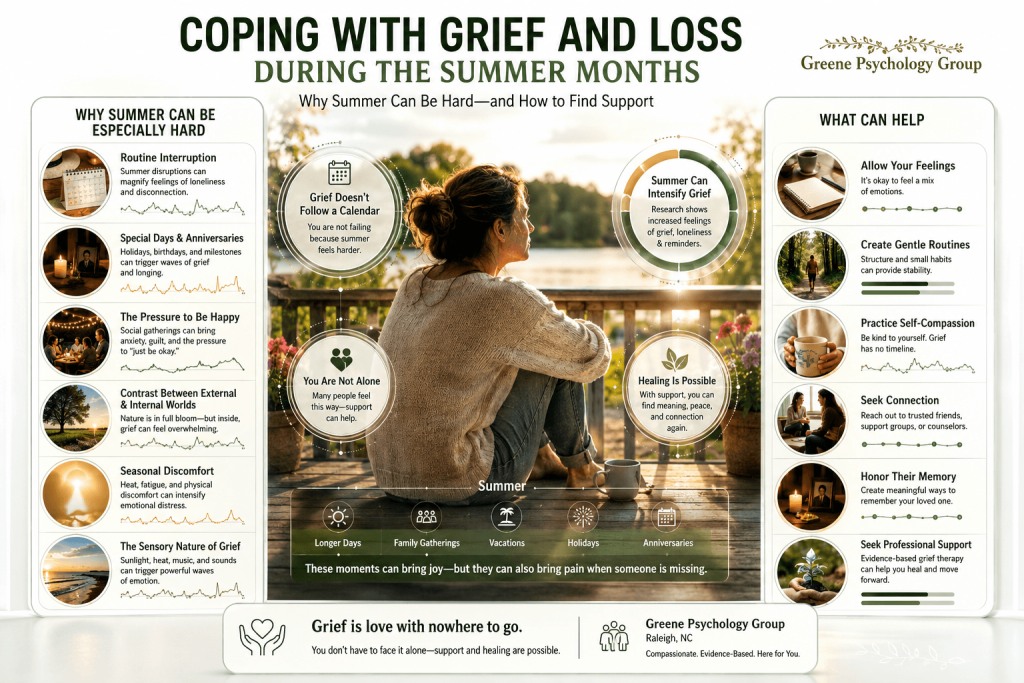
Routine Interruption
Summer often disrupts established routines. Children are out of school, vacations are planned, and work schedules may shift. For those grieving, these disruptions can magnify feelings of loneliness and isolation. The absence of familiar routines can accentuate the void left by a loved one, causing a sense of disconnection from the world around you.
Research from McMaster University confirms that summer brings disruptions to routines that support well‑being: community programs pause, family routines shift, and caregivers or loved ones may travel more. These changes can lead to feelings of disconnection or loneliness.
Special Days and Anniversaries
Anniversaries, birthdays, and special occasions can trigger waves of grief, regardless of the season. However, the summertime hosts its share of significant dates, from family reunions to milestone celebrations. For those mourning the loss of a loved one, these occasions serve as stark reminders of their absence, heightening feelings of sorrow and longing.
Graduations, weddings, engagement parties, and the Fourth of July are all summer events that can feel particularly painful when someone is missing.
The Pressure to Be Happy
Summer is synonymous with socialization—backyard barbecues, beach outings, and outdoor festivals abound. For the grieving, social gatherings can be fraught with discomfort and anxiety. The pressure to appear happy and engaged in the midst of festivities can feel overwhelming, leading to a heightened sense of alienation from others.
Summer often comes with an unspoken expectation: you should be happy right now. Longer days, family gatherings, beach trips, and backyard barbecues can amplify joy—or they can magnify grief, loneliness, exhaustion, and depression. For many people, summer is not easier—it is harder.
The Contrast Between External and Internal Worlds
Summer is the season of vibrant landscapes and blooming flowers, which can feel like a stark contrast to the internal feeling of grief. The juxtaposition of natural growth with your own sense of loss might be jarring, intensifying feelings of despair and hopelessness. Changing seasons also brings the ever‑present passing of time to the forefront of your mind, serving as a poignant reminder of the permanence of loss.
Seasonal Discomfort
For some, the heat of summer can exacerbate feelings of irritability, fatigue, and emotional vulnerability. Physical discomfort, such as excessive sweating and dehydration, can further amplify the emotional distress experienced by the grieving.
The Sensory Nature of Grief
Grief is not bound by calendar years. It attaches itself to sensory memory. Sunlight, heat, music—all can trigger powerful waves of emotion. The sounds of summer—children playing, birds singing, lawnmowers humming—can feel jarring when your internal world is filled with sadness.
Part 2: The Dual Process Model – A Framework for Understanding Grief
One of the most helpful frameworks for understanding grief is the Dual Process Model developed by Stroebe and Schut. Rather than viewing grief as a series of stages to "get through," this model describes grief as a dynamic oscillation between two orientations.
Loss‑Oriented Coping
This involves focusing on the loss itself: crying, yearning, remembering, feeling the pain. It is the time you spend processing your emotions, thinking about the person you lost, and allowing yourself to feel the sadness.
Restoration‑Oriented Coping
This involves focusing on rebuilding your life: making new routines, taking on new roles, finding new meaning. It is the time you spend attending to practical matters, engaging in activities, and moving forward.
The Oscillation
Healthy grieving involves oscillating between both. You spend some time in the pain of loss, and some time in the work of rebuilding. You move back and forth—and that is exactly how healing happens.
When people get "stuck," it is usually because they are stuck in one orientation:
Stuck in Loss‑Orientation: Constant rumination, inability to function, chronic depression
Stuck in Restoration‑Orientation: Avoiding grief entirely, throwing yourself into work, never processing the loss
The goal is oscillation—allowing yourself to feel the pain and take steps forward, in your own time.
Applying the Dual Process Model to Summer Grief
Summer can make oscillation more challenging. The pressure to be "happy" and "social" can push you toward restoration‑oriented coping when you are not ready. At the same time, the sensory reminders of loss—the sunshine, the sounds, the traditions—can pull you into loss‑oriented coping when you are trying to move forward.
The key is to give yourself permission to oscillate. Some days you may need to stay home and grieve. Other days you may need to go out and engage with the world. Both are valid. Both are part of healing.
Part 3: Practical Strategies for Coping with Grief in Summer
Navigating grief during the summer months can feel overwhelming. By acknowledging the unique challenges posed by the season and seeking support from loved ones or professional resources, it is possible to find solace.
1. Set Boundaries
Give yourself permission to excuse yourself from events that feel overwhelming. You do not have to attend every event, or any event if you do not feel up to it. Choose what you feel is manageable and respectfully turn down the rest.
What this looks like:
"I appreciate the invitation, but I need to take some time for myself this weekend."
"I'd love to come for an hour, but I may need to leave early."
"I'm not up for socializing right now. Can we catch up another time?"
2. Plan Ahead for Emotional Moments
If you know a certain event will be tough, try to plan around it. This could look like taking some quiet time for a morning walk, a therapy session, or a self‑care routine to help you stay grounded. This can help give you a sense of control during a time that may feel unpredictable.
What this looks like:
Schedule a therapy session before a difficult event
Plan a quiet activity for after the event to decompress
Identify a trusted person you can call if you need support
3. Create New Traditions
Recreating old traditions can feel painful because they may not be the same anymore. Consider creating new traditions that honor your loss in a gentle way. This could look like meeting in a special, meaningful location or donating to a cause that your loved one cared about.
Example: Instead of trying to recreate a loved one's famous barbecue, try making a new recipe together with family. Before the meal, take a moment to share favorite memories. The tradition will not be the same—but it can be a step forward in the healing journey.
4. Take Small Steps
You don't need to plan a long walk or a grand gesture. If all you manage is standing in your garden, walking to the end of the street, or sitting on a nearby bench, that's enough. The goal isn't exercise. It is simply giving yourself permission to pause, breathe, and spend a few quiet moments outside.
Small steps for summer:
Open a window. Fresh air won't take your grief away, but it can help you feel more connected to the world.
Step outside for five minutes.
Let yourself enjoy the sunshine—moments of peace don't erase the love you have.
Find one small comfort: an ice cream, a cup of tea outside, listening to birdsong.
5. Say No Without Feeling Guilty
Summer often brings invitations, celebrations, and social events. It is okay to say yes. It is okay to say no. You don't have to explain yourself. Protecting your energy is part of caring for yourself.
6. Take Them with You
Many people worry they will forget the person they love if life begins to feel lighter. You won't. Perhaps take a photograph where they would have smiled. Cook their favorite summer meal. Visit a place they loved. Tell someone a story about them. Love doesn't disappear because life carries on.
7. Stick to a Routine
Regular wake‑up times, meals, and movement can help anchor your day and support mental health. While summer often disrupts routines, maintaining some structure can provide a sense of stability.
8. Find Connection
Schedule a weekly call with a friend, join a community center activity, or explore online discussion groups that match your interests. Connection—even small moments—can help combat the isolation of grief.
9. Plan Something Meaningful
Whether it is tending a garden, visiting a museum, or volunteering, having something to look forward to can be a powerful mood booster.
Part 4: Grief in Specific Populations
Grief in Children and Adolescents
Children grieve differently than adults. They may:
Grieve in "bursts"—play for a while, then cry, then play again
Regress (bedwetting, thumb‑sucking, clinginess)
Have trouble concentrating in school
Act out behaviorally
Express grief through physical symptoms (stomachaches, headaches)
Summer challenges: Summer break means less structure and more time with feelings. Children may miss the routine of school and the support of teachers and counselors.
What helps: Honest, age‑appropriate explanations. Maintaining some routine. Allowing them to express grief in their own way. Therapy (play therapy for younger children, CBT for older children/adolescents).
Grief in Older Adults
Older adults face unique challenges:
Cumulative losses (spouse, friends, siblings, health, independence)
Social isolation (friends have died, family lives far away)
Medical conditions that complicate grief
Summer challenges: Extreme heat can limit outdoor activity and social connection.
What helps: Grief groups specifically for older adults. Individual therapy focused on meaning‑making and legacy. Home‑based therapy if mobility is limited.
Grief in Caregivers
Caregivers who have lost someone they cared for may experience:
Relief—and guilt for feeling relief
Loss of identity
Exhaustion
Summer challenges: The absence of caregiving routines can leave a void. Summer may bring memories of past summers spent caregiving.
What helps: Grief therapy that validates the complex emotions. Support groups for former caregivers.
At Greene Psychology Group, we offer grief therapy for individuals of all ages, as well as family therapy when grief affects the whole family.
Part 5: When to Seek Professional Help – The Warning Signs
Grief is a natural process, but it can become complicated. Complicated grief (also called prolonged grief disorder) is diagnosed when grief persists intensely for 12 months or more (or 6 months for children/adolescents) and interferes with daily functioning.
Signs of Complicated Grief
Intense yearning or longing for the deceased
Preoccupation with thoughts or memories of the deceased
Difficulty accepting the death
Avoidance of reminders of the loss
Emotional numbness
Feeling that life is meaningless
Severe impairment in daily functioning
Red Flags That Require Immediate Attention
Suicidal thoughts—"I want to die," "Everyone would be better off without me"
Self‑harm—cutting, burning, hitting oneself
Inability to care for basic needs—not eating, drinking, or sleeping for days
Substance use—using alcohol or drugs to cope with grief
What to Do
Talk to someone you trust. You are not alone.
Seek professional help. Contact Greene Psychology Group at (919) 205-5339 or schedule an appointment.
In a crisis: Call 988 or Alliance Health Mobile Crisis at (800) 510-9132.
Part 6: Raleigh‑Specific Resources for Grief Support
Crisis and Urgent Support
988 Suicide & Crisis Lifeline: Call or text 988 – 24/7, confidential
Alliance Health Mobile Crisis: (800) 510-9132 – 24/7, free
Grief Support Groups in Raleigh
UNC Hospitals Grief Support Groups: Small, in‑person grief support groups that meet weekly for an eight‑week series. Groups typically meet in the spring, summer, and fall at their Hospice Home in Pittsboro and at Artspace in Raleigh.
GriefShare at St. Matthew Baptist Church: In‑person grief recovery support in Raleigh.
GriefShare at Crossroads Fellowship: In‑person and online grief recovery support with childcare available.
Transitions LifeCare – Support Over Solitude (S.O.S.): Free teen grief support group for youth ages 14‑18 who have lost a parent, sibling, or other significant person.
Learning to Carry It: A Healing Space for Grief: Guided, supportive circle at Elevated Energy Healing in Raleigh.
Outpatient Therapy (Greene Psychology Group)
We offer in‑person and online therapy for grief, loss, and bereavement. We serve individuals, couples, and families. Contact us at (919) 205-5339.
Part 7: Putting It All Together – Three Grief Archetypes
Archetype A: The Sudden Summer Loss
Presentation: 38‑year‑old, lost a parent unexpectedly in early summer. Struggling with the contrast between the vibrant season and internal grief. Avoids family gatherings and feels guilty.
Bottleneck: Acute grief with avoidance and guilt.
Treatment map: 12 weeks of grief therapy → Normalize the experience: "It makes sense that summer feels hard" → Identify and challenge guilt: "I am not betraying my loved one by living my life" → Create new traditions to honor the loss → At 12 weeks, reports "I still miss them, but I can find moments of peace."
Archetype B: The Anniversary Grief
Presentation: 55‑year‑old, lost a spouse 18 months ago. The anniversary of the death falls in July. Has been dreading the date for months. Feeling anxious, sad, and isolated.
Bottleneck: Anniversary grief with anticipatory anxiety.
Treatment map: 8 weeks of grief therapy → Plan ahead for the anniversary: decide how to spend the day, who to be with, what to do → Create a ritual to honor the memory → Practice self‑compassion → At 8 weeks, reports "I still feel the loss, but I made it through the anniversary."
Archetype C: The Caregiver's Grief
Presentation: 62‑year‑old, cared for a parent with dementia for 5 years. Parent died in the spring. Now feels relief—and intense guilt for feeling relief. Also exhausted and unsure who she is without the caregiver role.
Bottleneck: Caregiver grief with identity loss and guilt.
Treatment map: 12 weeks of individual therapy → Validate the complex emotions: relief and guilt can coexist → Explore identity post‑caregiving → Mindfulness therapy for self‑compassion → At 12 weeks, reports "I still feel sad, but I am learning to be kind to myself."
The information provided in this blog is for educational and informational purposes only and is not intended as medical advice, diagnosis, or treatment. It does not create a therapist‑patient relationship between you and Greene Psychology Group. Always seek the advice of a qualified mental health professional or physician with any questions you may have regarding a mental health condition. If you are in crisis or experiencing a medical emergency, please call 911 immediately or contact the 988 Suicide & Crisis Lifeline. For non‑emergency mental health support, call Greene Psychology Group at (919) 205-5339 or visit our website to schedule an appointment.
FAQs
Summer brings disruptions to routines, social pressure to be happy, painful anniversaries, and sensory reminders of loss. The contrast between the vibrant season and internal grief can feel overwhelming
Yes. While less common than winter seasonal affective disorder, summer‑onset depression is a real phenomenon. Summer can intensify feelings of grief or loneliness, particularly for those who have experienced loss.
The Dual Process Model describes grief as an oscillation between loss‑oriented coping (feeling the pain) and restoration‑oriented coping (rebuilding life). Healthy grieving involves moving back and forth between both
Set boundaries, plan ahead for emotional moments, create new traditions, and give yourself permission to say no without guilt
Yes, guilt is common. But moments of peace don't erase the love you have for the person who died. Joy and grief can exist together
That is normal, especially during summer when sensory reminders are everywhere. Give yourself time to remember and honor them. If it becomes overwhelming, seek professional support.
Yes. Grief therapy can help you process the pain, develop coping strategies, and find a way to carry your loss while still living your life.
Open a window, step outside for five minutes, let yourself enjoy the sunshine, find one small comfort, or take your loved one with you in a photograph or story
Listen without trying to fix, offer specific practical help, acknowledge their loss, and let them set the pace for social activities.
If grief persists intensely for 12+ months (6+ months for children), interferes with daily functioning, or is accompanied by suicidal thoughts or self‑harm, seek professional help.
Yes. UNC Hospitals, GriefShare, Transitions LifeCare, and other organizations offer grief support groups in the Raleigh area
Look for a licensed therapist with experience in grief and bereavement. Greene Psychology Group offers evidence‑based grief therapy – call (919) 205-5339.
Sources
Grief does not take a vacation—and neither should your support system. If you are struggling with grief and loss during the summer months, evidence‑based grief therapy in Raleigh, NC, can help you navigate the pain and find a way forward. Call Greene Psychology Group at (919) 205-5339 or schedule an appointment online. We offer individual therapy, family therapy, grief support, evening appointments, and free insurance verification. Same‑week availability for new clients.