

High-functioning anxiety can look like success from the outside and feel like relentless pressure from the inside. A person may meet deadlines, care for others, stay organized, and receive praise while privately worrying, overpreparing, replaying conversations, or feeling unable to rest. The visible achievement is real—but so is the hidden cost.
The phrase can help people describe an experience that others overlook. However, high-functioning anxiety is not a formal diagnosis. A qualified clinician may determine that someone’s symptoms fit an anxiety disorder or another concern, or that the pattern reflects a combination of stress, perfectionism, learned coping, health factors, and life circumstances. This guide explains common signs, the cycle that can maintain distress, and how therapy may help without asking someone to abandon healthy ambition.
What does high-functioning anxiety mean?
High-functioning anxiety describes a mismatch between external performance and internal distress. Someone may appear calm, dependable, productive, or highly prepared while using worry and pressure to maintain that appearance. The word “functioning” can be misleading because functioning is not all-or-nothing. A person may perform well at work while sleep, relationships, health routines, flexibility, or enjoyment steadily deteriorate.
The term does not appear as a standalone disorder in standard diagnostic systems. It should not be used to diagnose yourself or someone else. A clinician instead evaluates the person’s specific symptoms and may consider recognized conditions such as generalized anxiety disorder, social anxiety disorder, panic disorder, obsessive-compulsive disorder, depression, trauma-related conditions, or other explanations.
Still, the phrase can identify an important clinical problem: achievement does not reveal how much fear, avoidance, checking, or recovery time is required to achieve it. The more useful question is not simply “Are you getting things done?” It is “What does getting things done cost you, and is that pattern sustainable?”
Why can success hide anxiety and impairment?
Success can hide distress because many anxiety-driven behaviors are socially rewarded. Double-checking, arriving early, anticipating problems, responding quickly, and taking responsibility may look like dedication. These behaviors can be useful in moderation. They become costly when they are rigid, fear-driven, difficult to stop, or necessary for the person to feel temporarily safe.
Achievement can also become a safety behavior. A safety behavior is an action used to prevent, escape, or reduce a feared outcome. For example, someone who fears criticism may spend hours perfecting a routine email. The email is accepted, which brings relief. Because the feared outcome did not occur, the person may conclude that exhaustive checking prevented disaster. The next email then feels just as dangerous—or more so.
This pattern can continue for years because outward results appear positive. Other people may say, “You always handle everything,” while the person feels unable to admit how much effort it takes. Offers of help may even increase anxiety if delegating means losing control over the result.
What are nine possible signs of high-functioning anxiety?
Possible signs include patterns of thought, behavior, emotion, and physical tension. None of these signs proves that someone has an anxiety disorder. They become more clinically important when they are persistent, difficult to control, distressing, or disruptive.
1. Overpreparing for ordinary situations
You may rehearse conversations, research far beyond what a decision requires, or prepare multiple backup plans for a low-risk event. Preparation reduces uncertainty briefly, but it may consume time and reinforce the belief that you cannot cope without total readiness.
2. Perfectionism that prevents proportionate effort
You may treat routine tasks as tests of worth or competence. A reasonable draft feels irresponsible, so you revise repeatedly, delay submitting, or avoid starting. The standard is not merely high—it is inflexible and disconnected from the task’s actual importance.
3. Difficulty delegating or receiving help
You may believe it is faster or safer to handle everything yourself. Delegating can trigger fears about mistakes, disappointment, indebtedness, or being seen as incapable. The result may be an unsustainable workload and frustration with people who were never given a clear opportunity to contribute.
4. Reassurance seeking and repeated checking
You may ask whether someone is upset, reread messages, check locks or schedules repeatedly, or seek confirmation that a choice is correct. Reassurance can lower anxiety in the moment. When relied on repeatedly, it may make uncertainty feel less tolerable over time.
5. Procrastination hidden beneath productivity
High-functioning anxiety does not always look like early completion. Some people avoid the most emotionally charged task by completing many smaller ones. Others wait until urgency becomes stronger than fear. The final result may be good, but the path involves dread, lost sleep, or frantic effort.
6. Constant mental rehearsal and overthinking
You may replay past conversations, forecast every possible response, or continue analyzing after a decision has been made. Thinking feels productive because it creates the sensation of working on the problem. Yet rumination often repeats the same questions without producing new, actionable information.
7. Guilt or restlessness during downtime
Rest may feel undeserved, unsafe, or wasteful. You may fill quiet moments with chores, messages, or planning because stopping allows worry to become more noticeable. Even enjoyable activities can feel like another task to perform correctly.
8. Physical tension despite outward calm
Anxiety may involve muscle tension, headaches, gastrointestinal discomfort, sleep disturbance, fatigue, restlessness, or a racing heart. These symptoms can have many causes, and new, severe, or persistent physical symptoms deserve appropriate medical evaluation rather than being automatically attributed to anxiety.
9. Irritability or exhaustion after prolonged self-control
Maintaining composure and vigilance can consume substantial energy. A person who seems calm all day may become irritable, withdrawn, tearful, or depleted in private. This does not mean the public competence is fake. It means the method used to sustain it may be costly.
| Potential strength | Flexible use | Possible anxiety-driven use |
|---|---|---|
| Preparation | Effort matches the importance and risk of the task | Routine situations require exhaustive research or backup plans |
| High standards | Quality matters, but “good enough” is possible | Minor imperfections feel dangerous or shameful |
| Reliability | Commitments include realistic limits and recovery | Saying no feels unacceptable, even when overloaded |
| Independence | Help is accepted when useful | Delegation feels unsafe or like proof of inadequacy |
| Reflection | Thinking leads to a decision or next step | Analysis repeats without new information or resolution |
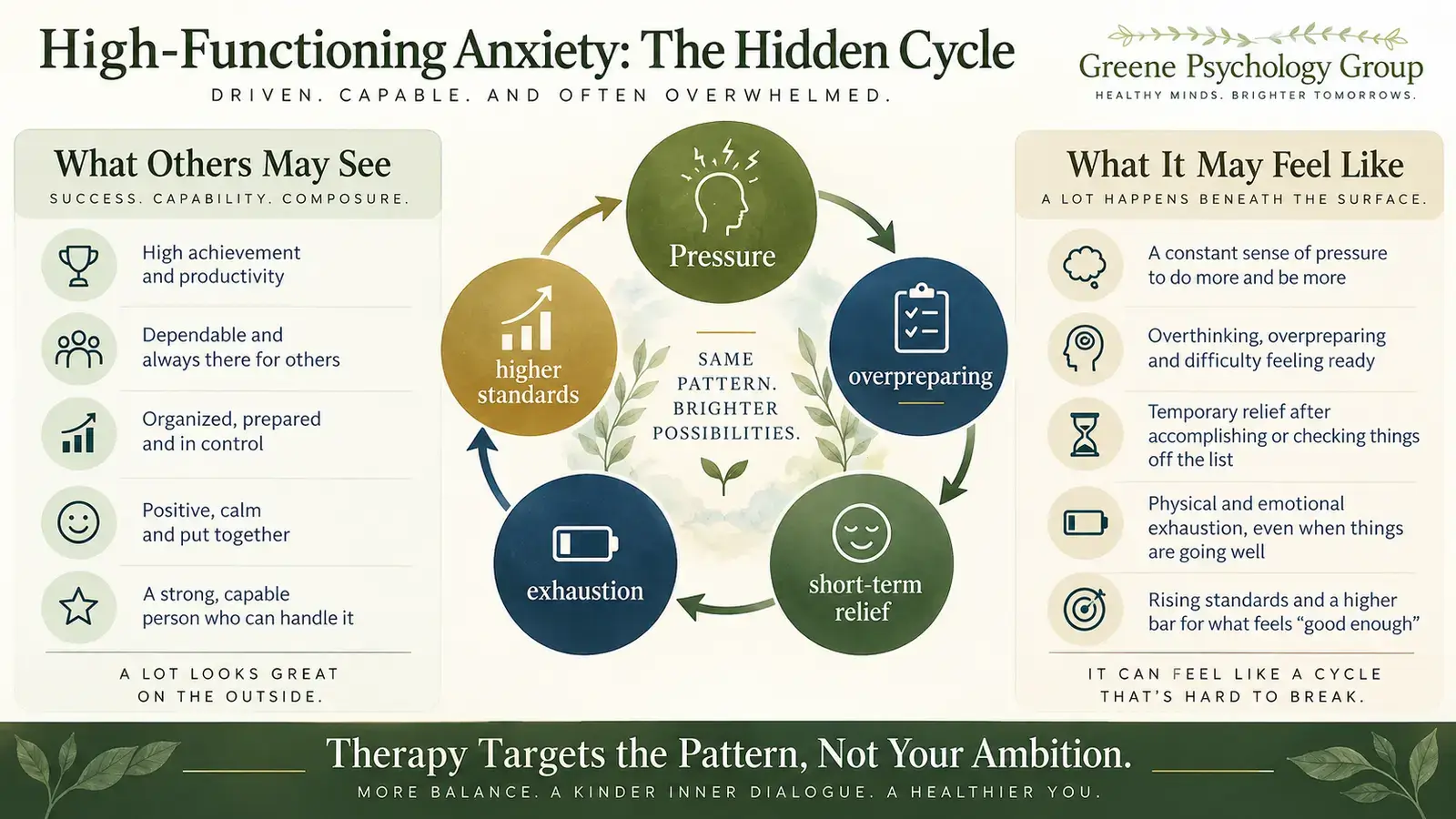
How does the hidden anxiety cycle maintain itself?
The high-functioning anxiety cycle often begins with a trigger: a deadline, evaluation, unfamiliar task, interpersonal ambiguity, or possibility of error. The person interprets the trigger as a threat to security, acceptance, reputation, or control. Anxiety rises, and the person responds with overpreparing, checking, reassurance, avoidance, or taking over.
That response creates short-term relief. The task is completed, the person receives praise, or the feared consequence does not occur. Short-term relief is powerful learning. It teaches the brain that the safety behavior was necessary, even when the feared outcome was unlikely or manageable. Standards then rise, and the person feels pressure to work just as hard next time.
Eventually, exhaustion makes concentration, patience, and decision-making harder. Ordinary tasks begin to feel more threatening. The person may respond by increasing control, which restarts the cycle. Therapy often targets this pattern—not ambition itself—by helping the person test more proportionate behavior and learn that uncertainty and imperfection can be tolerated.
How are perfectionism, control, and people-pleasing connected?
Perfectionism can function as an attempt to prevent criticism, rejection, guilt, or uncertainty. The rule may sound like, “If I do everything correctly, no one can be disappointed in me.” Control then becomes a way to manage anxiety, while people-pleasing reduces the immediate risk of conflict.
These patterns can overlap without being identical. A person may pursue excellence because the work matters, because achievement is meaningful, or because precision is genuinely required. Anxiety is more likely to be involved when standards remain rigid across low- and high-stakes situations, mistakes feel personally catastrophic, or the person cannot disengage after reasonable completion.
People-pleasing can also create hidden resentment. Agreeing automatically may prevent discomfort today while creating exhaustion and frustration later. Therapy may help someone tolerate the anxiety of setting a limit, communicate clearly, and discover that a respectful “no” does not automatically destroy a relationship.
How is high-functioning anxiety different from stress, burnout, ADHD, or depression?
Symptoms overlap, so the distinction depends on history, timing, context, and impairment. A label based on one behavior can miss important factors or lead to the wrong strategy.
| Concern | Possible pattern | Important limitation |
|---|---|---|
| High-functioning anxiety | Achievement continues while worry, checking, avoidance, or overcontrol creates distress | Informal phrase, not a formal diagnosis |
| Everyday stress | Tension is connected to identifiable demands and may ease when the situation resolves | Persistent or disproportionate symptoms may need broader evaluation |
| Burnout | Exhaustion, cynicism, detachment, or reduced effectiveness linked to prolonged demands | Depression, sleep disorders, medical concerns, and anxiety can look similar or coexist |
| ADHD | Developmental pattern involving attention and/or hyperactivity-impulsivity across settings | Anxiety can impair concentration; ADHD symptoms begin in childhood |
| Depression | Low mood or loss of interest may occur with changes in energy, sleep, thinking, or self-worth | Some people remain productive while depressed; functioning alone does not rule it out |
| OCD | Obsessions and compulsions may create repetitive checking, reassurance, or mental rituals | Ordinary worry and perfectionism are not automatically OCD |
| Trauma-related concerns | Hypervigilance, avoidance, sleep disturbance, and threat sensitivity may follow trauma | Trauma history does not determine one diagnosis or treatment |
Medical conditions, medication effects, caffeine or other substances, hormonal changes, chronic pain, and sleep problems can also contribute to anxiety-like symptoms. Assessment should remain open to more than one explanation. Do not start, stop, or change medication based on an article.
What should an evidence-informed anxiety assessment include?
An assessment should examine the form, frequency, intensity, duration, and consequences of symptoms. A clinician may ask what triggers worry, which physical sensations occur, what the person does to feel safer, how long relief lasts, and what the pattern costs. The goal is to understand the cycle rather than assume that visible success means low severity.
Relevant areas may include sleep, medical history, medications, caffeine and substance use, trauma exposure, mood symptoms, attention history, family patterns, cultural expectations, identity, workload, relationships, and current stressors. Safety is also assessed when clinically relevant. Screening questionnaires can organize information, but they do not replace a clinical interview or establish a diagnosis by themselves.
A good assessment also identifies strengths and goals. The person may want to sleep more consistently, send work without repeated checking, delegate one responsibility, attend a social event without rehearsing every sentence, or rest without guilt. Observable goals make treatment more accountable and help distinguish meaningful progress from vague reassurance.
How can therapy help with high-functioning anxiety?
Therapy can help a person understand what keeps the pattern going and practice new responses. The approach should fit the person’s symptoms, diagnosis when applicable, preferences, culture, safety needs, and goals. No method works for everyone, and no ethical therapist can guarantee a specific result or timeline.
Cognitive behavioral therapy
Cognitive behavioral therapy, or CBT, can examine links among interpretations, emotions, physical sensations, and behavior. Treatment may identify rules such as “If anyone is disappointed, I have failed” and test whether more balanced behavior leads to the feared outcome. Behavioral experiments should be collaborative and appropriately paced rather than used as tests of willpower.
Reducing safety behaviors
Therapy may help a client reduce repeated checking, reassurance seeking, overpreparing, or avoidance gradually. The purpose is not recklessness. It is to learn what level of effort the situation actually requires and build confidence in responding if something imperfect occurs.
Acceptance- and values-based work
Acceptance-based approaches may help someone make room for uncertainty and physical anxiety while choosing actions guided by values. The aim is not to approve of every thought or eliminate discomfort before acting. It is to stop treating anxiety as the sole decision-maker.
Mindfulness and attention skills
Mindfulness can help a person notice worry, urgency, and self-criticism without automatically turning them into commands. It is a skill, not a cure, and it may need modification for people who find inward attention activating. A therapist can help select a tolerable practice.
Self-compassion and flexible standards
Self-compassion does not mean lowering every standard or avoiding responsibility. It means responding to difficulty without adding humiliation. Therapy may help separate accountability from self-attack and develop standards that reflect the task’s real importance.
Communication and boundaries
When high-functioning anxiety includes people-pleasing or overresponsibility, therapy may include practicing requests, delegation, limits, and repair after conflict. Progress may look like asking for clarification sooner, allowing another person to contribute, or tolerating temporary disappointment without abandoning a reasonable boundary.
What practical steps can reduce the hidden cost of anxiety?
Self-help strategies are not substitutes for individualized care, but small experiments can provide useful information. Choose one pattern, define a modest change, and observe the result rather than trying to overhaul your personality.
- Match effort to stakes. Before beginning, decide whether the task needs a draft, a careful final product, or true precision. Not every email deserves the standards of a legal document.
- Set a stopping rule. Choose a reasonable time, number of reviews, or completion criterion before anxiety rises. A stopping rule prevents worry from moving the finish line indefinitely.
- Delay reassurance briefly. When safe and appropriate, wait a short, planned period before asking for confirmation. Notice whether anxiety changes without immediate reassurance.
- Define the feared outcome. Replace “Something will go wrong” with a specific prediction. Then estimate likelihood, impact, and what you could do if it happened.
- Practice proportionate imperfection. Allow a low-stakes task to be adequate rather than flawless. This should be intentional and safe—not applied to high-risk responsibilities.
- Protect recovery time. Rest supports functioning; it is not a prize awarded only after every possible task is complete.
- Track cost, not just output. Record sleep, time, tension, avoidance, and recovery alongside achievement. This gives a more complete picture of functioning.
- Use direct communication. Ask what is actually required instead of assuming the highest possible standard.
If a step produces overwhelming distress or conflicts with safety, trauma needs, medical guidance, or real job requirements, pause and seek individualized support. The aim is flexible learning, not forcing exposure without context.
When is it time to seek professional support?
Consider professional support when worry is persistent, difficult to control, or interfering with sleep, relationships, work, school, health, caregiving, decision-making, or enjoyment. Help may also be appropriate when success requires increasingly rigid routines, substances are used to cope, physical symptoms are frequent, or the person feels trapped by expectations.
You do not need to wait until performance collapses. Early conversations can clarify whether therapy, medical evaluation, medication consultation, workplace support, changes in workload, or another resource may be appropriate. A consultation also does not obligate someone to accept a particular diagnosis or continue indefinitely.
If you may act on suicidal or violent thoughts, cannot stay safe, or face immediate danger, call 911 or go to the nearest emergency department. In the United States, call or text 988 for the Suicide & Crisis Lifeline. A therapy practice’s routine phone, email, patient portal, and contact form are not emergency services.
Finding anxiety therapy in Raleigh or Asheville
Greene Psychology Group provides psychotherapy for adolescents and adults and lists offices in Raleigh and Asheville. Its broader anxiety therapy page explains the practice’s anxiety services, while its online therapy information describes telehealth options. Availability and suitability depend on the clinician, the client’s location during sessions, clinical needs, privacy, technology, and applicable licensure requirements.
When contacting a practice, ask whether a clinician’s current experience fits the concerns you want to address, what services are offered, how progress is reviewed, and whether another assessment or prescriber may be needed. Do not assume that every clinician offers every therapy approach or works with every age group.
Insurance participation and benefits can change. Review Greene Psychology Group’s current insurance information, then verify eligibility, deductibles, copays, authorizations, visit limits, and out-of-network benefits with the insurer and the practice. An inquiry does not establish a therapist-client relationship or guarantee an appointment.
Ask About Anxiety Therapy
If high-functioning anxiety, perfectionism, overthinking, or chronic pressure is affecting daily life, a conversation with a qualified professional may help clarify the next step. Contact Greene Psychology Group or call 919-205-5339 to ask about current services, clinician fit, Raleigh or Asheville appointments, telehealth, insurance, and scheduling.
Frequently Asked Questions
Is high-functioning anxiety a real diagnosis?
No. High-functioning anxiety is an informal phrase, not a standalone diagnosis. It describes anxiety that may remain hidden because a person continues to achieve or meet responsibilities. A qualified clinician evaluates specific symptoms, duration, severity, impairment, medical factors, and alternative explanations before determining whether a recognized anxiety disorder or another concern is present.
Can you have severe anxiety and still be successful?
Yes. Outward achievement does not reliably show internal distress or functional cost. Someone may meet deadlines and receive praise while losing sleep, checking repeatedly, avoiding delegation, or feeling unable to rest. Clinical significance depends on the full pattern, including suffering, sustainability, relationships, health, and how much rigid coping is required to maintain performance.
What are the most common signs of high-functioning anxiety?
Possible signs include overpreparing, perfectionism, repeated checking, reassurance seeking, procrastination, overthinking, difficulty delegating, restlessness during downtime, muscle tension, sleep problems, and exhaustion after prolonged self-control. These experiences are not specific to one condition. Their timing, persistence, triggers, and effects on functioning help determine what kind of support may fit.
Is high-functioning anxiety the same as generalized anxiety disorder?
No. High-functioning anxiety is an informal description, while generalized anxiety disorder is a recognized diagnosis with defined criteria. Some people using the informal phrase may meet criteria for generalized anxiety disorder; others may have social anxiety, OCD, depression, trauma-related concerns, ADHD, stress, or no mental disorder. Individual assessment is needed.
Why do people with high-functioning anxiety procrastinate?
Procrastination may occur when a task activates fear of mistakes, uncertainty, criticism, or an impossible standard. Completing smaller tasks can provide temporary relief while the threatening task remains. Some people then rely on deadline urgency to override avoidance. Procrastination can also relate to depression, ADHD, exhaustion, unclear expectations, or excessive workload, so the reason matters.
Can perfectionism make anxiety worse?
Perfectionism can maintain anxiety when rigid standards make ordinary mistakes feel dangerous or personally unacceptable. Repeated checking and overpreparing may reduce fear temporarily, reinforcing the belief that extreme effort was necessary. High standards are not automatically unhealthy. The concern is inflexibility, distress, avoidance, and effort that is disproportionate to the task.
Can therapy help without reducing ambition?
Yes. Therapy does not have to eliminate meaningful goals or conscientiousness. It may help distinguish values-based effort from fear-driven overcontrol, reduce unnecessary checking, improve boundaries, and make performance more sustainable. Outcomes vary, and treatment should be individualized. The aim is proportionate effort and greater flexibility—not carelessness or forced relaxation.
How long does therapy for anxiety take?
There is no universal timeline. Duration depends on symptom severity, diagnosis, goals, treatment approach, co-occurring concerns, consistency, outside stressors, and available support. A responsible therapist should explain the working plan, identify observable goals, review progress, and adjust the approach or recommend additional services when the current plan is not helping.
Can online therapy help with high-functioning anxiety?
Teletherapy can be useful for some non-emergency anxiety concerns when the clinician is authorized to practice where the client is physically located and the person has adequate privacy, technology, and clinical stability. It is not appropriate for every situation. Suitability depends on risk, needs, preferences, access, and whether in-person or higher-level care would be safer.
When should anxiety symptoms receive urgent attention?
Seek urgent help when there is immediate danger, inability to stay safe, suicidal or violent intent, severe confusion, or another acute crisis. Call 911 or go to the nearest emergency department. In the United States, call or text 988 for crisis support. New severe physical symptoms also warrant appropriate medical evaluation rather than being assumed to be anxiety.
Sources
- National Institute of Mental Health: Anxiety Disorders
- National Institute of Mental Health: Psychotherapies
- Substance Abuse and Mental Health Services Administration: 988 Suicide & Crisis Lifeline
Educational notice: This article provides general information and does not diagnose an anxiety disorder, replace individualized medical or mental-health care, or establish a therapist-client relationship. Services, clinician fit, telehealth eligibility, insurance benefits, and appointment availability must be confirmed directly with the practice.