

Burnout vs depression can be difficult to separate because both may involve exhaustion, irritability, low motivation, concentration problems, sleep changes, withdrawal, and feeling unlike yourself. The difference matters, but it is not always an either-or decision. Burnout and depression can overlap, and prolonged workplace stress can occur alongside anxiety, insomnia, substance use, medical problems, or a depressive disorder.
Context offers clues. The World Health Organization describes burnout as an occupational phenomenon resulting from chronic workplace stress that has not been successfully managed. Depression is a mental disorder that can affect mood, interest, thinking, sleep, appetite, self-worth, and functioning across many areas of life. Only an individualized assessment can determine what best explains one person’s experience.
What is the key difference in burnout vs depression?
The clearest difference is scope. Under the WHO’s ICD-11 description, burnout refers specifically to the occupational context. It develops in relation to chronic workplace stress that has not been successfully managed. Depression is not limited to work and may affect how a person feels, thinks, sleeps, eats, relates to others, and handles daily activities across settings.
That distinction is useful, but real life is not always clean. Someone may first notice distress at work because work consumes most waking hours. A person with depression may temporarily feel better during a distraction or vacation. Someone with burnout may carry irritability, sleep loss, or emotional depletion home. Location alone cannot settle the question.
A better comparison examines the full pattern: when symptoms began, what triggers them, whether interest returns away from the stressor, how long changes last, which areas of life are affected, and whether hopelessness, worthlessness, or thoughts of death are present.
Why does distinguishing burnout from depression matter?
Distinguishing burnout vs depression can improve the next step. If every symptom is attributed to work, a depressive episode or medical condition may be overlooked. If every symptom is treated only as an individual mental-health problem, unsafe workload, low control, inadequate staffing, bullying, unfairness, or value conflict may go unaddressed.
The distinction also affects expectations. A weekend off may provide useful information, but it is not a diagnostic test. Severe depletion may not resolve quickly even after leaving a stressor, and depression can fluctuate. Treatment planning should allow organizational conditions, individual health, relationships, finances, identity, caregiving responsibilities, and access to recovery to matter at the same time.
What signs are commonly associated with burnout?
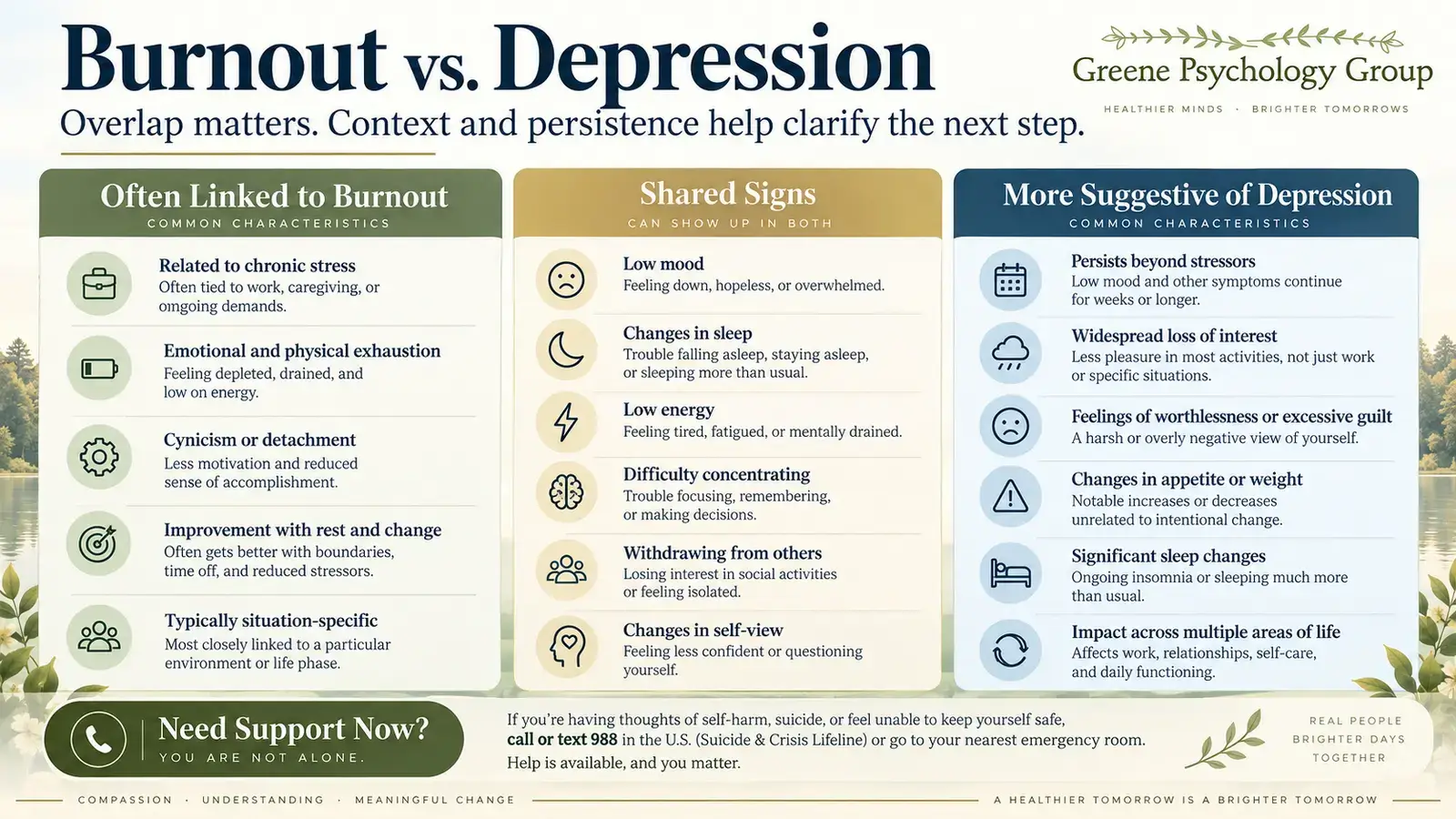
In a burnout vs depression comparison, the WHO describes three dimensions of burnout: energy depletion or exhaustion, increased mental distance from one’s job or negativism or cynicism related to the job, and reduced professional efficacy. These dimensions describe an occupational phenomenon, not a medical diagnosis.
Energy depletion or exhaustion
A person may feel emotionally and physically drained before work, struggle to recover between shifts, or need increasingly long periods to feel functional. Sleep may be shortened by workload or disrupted by anticipatory stress. Exhaustion can also have medical causes, so persistent fatigue should not automatically be labeled burnout.
Cynicism, detachment, or mental distance
Someone who once cared deeply may become emotionally numb, irritable, or detached from clients, patients, coworkers, or the mission of the job. This response can be protective when demands repeatedly exceed resources, but it may also create guilt or relationship strain.
Reduced professional efficacy
A person may feel less capable, productive, or effective. Concentration can decline, mistakes may increase, and even familiar tasks may require more effort. Importantly, the individual may still be performing well by external standards while using unsustainable effort to do so.
Symptoms closely tied to the work context
Burnout symptoms are often strongest around work demands and may ease when the person has genuine time, control, safety, and distance from the stressor. However, financial pressure, remote-work boundaries, caregiving, or fear of consequences can prevent a true break. Improvement with rest supports a work-related formulation but does not rule out depression.
What signs may suggest depression?
When considering burnout vs depression, depression can involve a persistent sad, anxious, or empty mood, but sadness is not required in the way many people expect. Some people primarily notice irritability, numbness, loss of interest, slowed thinking, agitation, physical complaints, or withdrawal. Symptoms vary by person.
According to the National Institute of Mental Health, possible signs include hopelessness, guilt, worthlessness, loss of interest or pleasure, fatigue, concentration problems, sleep changes, appetite or unplanned weight changes, unexplained physical symptoms, and thoughts of death or suicide. Not everyone experiences every symptom.
Loss of interest across multiple parts of life
One important clue is breadth. A person may lose interest not only in work but also in relationships, hobbies, food, movement, intimacy, or activities that previously mattered. The experience can feel less like “I cannot face my job” and more like “Nothing reaches me anywhere.”
Persistent low mood, hopelessness, or worthlessness
Depression may involve a harsh, global view of the self, future, or world. Someone may believe they are a burden, that improvement is impossible, or that failures define their entire identity. These beliefs deserve careful assessment, especially when accompanied by withdrawal or thoughts of death.
Changes that continue beyond the stressor
When symptoms remain present across weekends, vacations, relationships, and previously restorative activities, depression becomes more important to evaluate. Persistence alone does not establish a diagnosis, but it suggests that changing one work condition may not be enough.
Burnout vs depression: seven critical differences
No single difference acts as a home diagnostic test. The comparison below highlights useful questions for assessment rather than rigid rules.
| Area | Pattern often linked to burnout | Pattern that may suggest depression |
|---|---|---|
| Primary context | Most closely connected to chronic workplace stress | Can affect work, home, relationships, self-care, and enjoyment broadly |
| Interest and pleasure | Detachment may center on the job or professional role | Loss of interest or pleasure may extend across many activities |
| Response to distance | May improve with meaningful rest, reduced demands, control, or workplace change | May continue despite time away or a change of setting |
| Self-evaluation | Often includes feeling ineffective or cynical about work | May involve global worthlessness, excessive guilt, or hopelessness |
| Energy | Depletion may be strongly linked to work cycles and inadequate recovery | Fatigue or slowing may be pervasive and present even without demands |
| Time course | May build gradually as demands continue to exceed resources | A depressive episode is assessed through a defined symptom pattern, duration, and impairment |
| Safety concerns | Burnout can be serious and can coexist with mental-health risks | Thoughts of death, suicide, or inability to stay safe require immediate attention |
These are tendencies, not boundaries. A person with burnout may feel hopeless. A person with depression may identify work as the main trigger. A person can meet criteria for depression while also working in conditions that promote burnout. Assessment should not force a complex situation into one box.
Can burnout and depression happen at the same time?
Yes. Burnout and depression can occur together, so burnout vs depression is not always an either-or choice. Chronic workplace stress can erode sleep, relationships, health routines, hope, and access to recovery. Depression can make work demands harder to manage and may increase withdrawal, concentration problems, and feelings of ineffectiveness. The overlap can create a self-reinforcing cycle.
Other concerns may also coexist, including anxiety disorders, insomnia, trauma-related symptoms, substance misuse, grief, chronic pain, and medical conditions. Someone may use alcohol, cannabis, sedatives, stimulants, or excessive caffeine to push through or shut down. These patterns should be discussed without shame because they affect safety and treatment planning.
Overlap is one reason online checklists have limits. A score can help organize symptoms, but it cannot determine whether the main driver is depression, burnout, another condition, workplace harm, medication effects, or several factors together.
What questions can help clarify the pattern?
A short written timeline can make a burnout vs depression conversation more useful. The goal is not to diagnose yourself; it is to replace a vague sense of collapse with specific information.
- When did the symptoms begin, and what changed around that time?
- Are symptoms strongest before, during, or after work?
- Do interest and energy return during genuine time away?
- Which activities still feel meaningful or enjoyable?
- How have sleep, appetite, concentration, movement, and substance use changed?
- Do feelings of failure center on work, or do they affect your whole identity?
- Are there periods of unusually elevated mood, reduced need for sleep, or risky activity that a provider should know about?
- Have physical symptoms or medication changes occurred?
- Has anyone close to you noticed a change?
- Have thoughts of death, self-harm, or being a burden appeared?
Include exceptions. Notice when the problem is less intense and what is different then. Improved functioning with structure, support, reduced workload, restorative sleep, or social connection can reveal useful treatment targets without proving one diagnosis.
What should an evidence-informed assessment include?
A burnout vs depression assessment should examine onset, duration, severity, frequency, functional impact, and context. A clinician may ask about prior episodes, family history, medical conditions, medications, sleep, substance use, trauma, grief, relationships, work conditions, protective factors, and safety.
Medical evaluation may be appropriate when fatigue, concentration problems, appetite or weight changes, sleep disruption, pain, or other physical symptoms could have a medical cause. Certain medications and conditions can resemble or contribute to depression symptoms. Good mental-health care does not assume every symptom is purely psychological.
Screening measures may help track depression or occupational stress, but they are not diagnoses by themselves. The clinician should explain the working formulation in understandable language and remain willing to revise it when new information appears.
How may support differ for burnout and depression?
Support for burnout vs depression should match the full formulation. Burnout-focused work may emphasize workload, control, fairness, boundaries, recovery, communication, role clarity, values, and organizational change. Depression care may include psychotherapy, medication evaluation, behavioral activation, interpersonal strategies, cognitive work, sleep support, or combined treatment depending on severity and preference.
Psychotherapy for burnout-related distress
Therapy can help someone identify which demands are changeable, communicate needs, set boundaries, examine perfectionism or overresponsibility, and make decisions under pressure. It should not imply that better coping can repair every harmful workplace. Sometimes the appropriate goal is advocacy, leave, reassignment, or planning a transition.
Psychotherapy for depression
Evidence-based approaches for depression include cognitive behavioral therapy and interpersonal therapy. Treatment may address withdrawal, reduced activity, harsh beliefs, relationship patterns, grief, role transitions, or barriers to support. No therapy works for everyone, and improvement cannot be guaranteed on a fixed timeline.
Medication and coordinated care
Medication management and psychotherapy are different services. Some people with depression use psychotherapy, medication, or both. Prescribing decisions belong with a qualified healthcare professional who can review benefits, risks, health history, side effects, and alternatives. Do not start, stop, or change medication based on a blog.
Rest and lifestyle support
Sleep, regular meals, movement, social support, and time away from demands may support recovery, but they are not moral tests or complete treatments for everyone. Advice such as “just take a vacation” can be unrealistic and may minimize depression, financial constraints, caregiving, or workplace harm.
Why individual coping is not the whole solution to burnout
In burnout vs depression planning, burnout is not always solved by asking an individual to become more resilient. When demands consistently exceed resources, meaningful prevention may require changes in workload, staffing, control, scheduling, psychological safety, leadership, bullying policies, role clarity, or access to support.
Workers can document patterns, clarify priorities, request realistic deadlines, use available leave or accommodations, consult an employee assistance program, or seek guidance about workplace rights when appropriate. The safest option depends on the job, resources, health, finances, and possible retaliation. Therapy can support planning but should not provide legal advice or promise a workplace outcome.
Greene Psychology Group’s article on coping with workplace stress may be useful for readers whose symptoms are primarily connected to work. Its broader depression therapy information may be more relevant when low mood or loss of interest extends across life.
When should symptoms receive urgent attention?
Seek immediate help when there is suicidal or violent intent, a plan, inability to stay safe, severe confusion, psychosis, or immediate danger. In the United States, call or text 988 for the Suicide & Crisis Lifeline. Call 911 or go to the nearest emergency department for life-threatening danger.
Urgent medical evaluation may also be needed for severe physical symptoms, inability to eat or drink, sudden neurological changes, or other acute health concerns. Do not assume a medical emergency is “just stress.”
Finding support in Raleigh or Asheville
People seeking help with burnout vs depression can ask about an individualized assessment. Greene Psychology Group provides psychotherapy for adolescents and adults and lists offices in Raleigh and Asheville. Its online therapy information describes telehealth options. Telehealth suitability and availability depend on clinical needs, risk, privacy, technology, the clinician, and where the client is physically located during sessions.
When contacting a practice, ask whether the clinician’s current experience fits your concerns, how assessment and progress review work, and whether medical or prescribing coordination may be appropriate. Do not assume every clinician offers every modality or works with every age group.
Insurance participation and benefits can change. Review the practice’s current insurance information, then confirm eligibility, deductibles, copays, authorizations, visit limits, and out-of-network benefits with both the insurer and the practice. An inquiry does not establish a therapist-client relationship or guarantee availability.
Ask About Therapy and Next Steps
If exhaustion, low mood, detachment, or loss of interest is affecting daily life, a professional conversation may help clarify the pattern. Contact Greene Psychology Group or call 919-205-5339 to ask about current services, clinician fit, Raleigh or Asheville appointments, telehealth, insurance, and scheduling.
Frequently Asked Questions
Is burnout a medical diagnosis?
No. In the burnout vs depression distinction, the World Health Organization includes burnout in ICD-11 as an occupational phenomenon, not a medical condition. It is described as resulting from chronic workplace stress that has not been successfully managed. A person using the word burnout may still have depression, anxiety, insomnia, substance-use concerns, a medical condition, or another issue requiring assessment.
Can burnout turn into depression?
Burnout and depression are distinct concepts, but they can overlap and occur together. Prolonged workplace stress may erode sleep, relationships, recovery, and hope, while depression can make work harder to manage. A timeline and assessment are more useful than assuming one automatically becomes the other. Persistent or widespread symptoms deserve professional evaluation.
How can I tell burnout vs depression at home?
You cannot reliably diagnose the difference at home, but context offers clues. Burnout is formally tied to chronic workplace stress, while depression may affect mood, interest, self-worth, sleep, appetite, thinking, and functioning across life. Improvement away from work is useful information, not a definitive test. Bring a symptom timeline to a qualified professional.
Does feeling better on weekends rule out depression?
No. Depression can fluctuate, and a supportive environment or temporary distraction may reduce symptoms. Likewise, severe burnout may not resolve during a short weekend. A clinician considers the broader pattern, including duration, interest, mood, sleep, appetite, guilt, hopelessness, functioning, prior episodes, medical factors, and safety—not one good or bad day.
Can I have burnout if I still perform well?
Yes. External performance does not show how much effort, recovery time, anxiety, or detachment is involved. Some people maintain strong results by working longer, sacrificing sleep, or becoming increasingly rigid. Burnout assessment considers exhaustion, cynicism or mental distance from work, and reduced professional efficacy—not only whether deadlines are still being met.
Is loss of motivation always depression?
No. Reduced motivation can occur with burnout, sleep deprivation, anxiety, ADHD, grief, medical conditions, medication effects, substance use, unclear expectations, or an unsustainable workload. Depression becomes more important to assess when low mood or loss of interest is persistent, affects multiple areas of life, and occurs with other depressive symptoms.
Will a vacation fix burnout?
A meaningful break may provide relief and useful information, but a vacation does not necessarily change excessive workload, low control, unfairness, bullying, or inadequate staffing. Recovery may also take longer than a few days. Sustainable improvement may require workplace changes, boundaries, health care, therapy, or a broader transition plan depending on the situation.
Can therapy help with both burnout and depression?
Therapy may help clarify a burnout vs depression pattern, address withdrawal or unhelpful beliefs, improve boundaries and communication, support behavioral change, and plan around workplace conditions. Depression may also require medication evaluation or coordinated medical care. Outcomes vary, and therapy cannot guarantee that an employer or workplace system will change.
Can online therapy help with burnout or depression?
Teletherapy can help some people with non-emergency concerns when the clinician is authorized to practice where the client is physically located and the client has adequate privacy, technology, and clinical stability. It is not suitable for every situation. Risk, symptom severity, access, preferences, and need for in-person or higher-level care should guide the decision.
When should I seek emergency help for depression symptoms?
Seek immediate help if you may act on suicidal or violent thoughts, have a plan, cannot stay safe, experience severe confusion or psychosis, or face immediate danger. Call 911 or go to the nearest emergency department. In the United States, call or text 988 for crisis support. Routine therapy-office messages are not emergency services.
Sources
- World Health Organization: Burn-out an Occupational Phenomenon
- National Institute of Mental Health: Depression
- Centers for Disease Control and Prevention: Providing Support for Worker Mental Health
- Substance Abuse and Mental Health Services Administration: 988 Suicide & Crisis Lifeline
Educational notice: This article provides general information and does not diagnose burnout, depression, or another condition; replace individualized medical or mental-health care; or establish a therapist-client relationship. Services, clinician fit, telehealth eligibility, insurance benefits, and appointment availability must be confirmed directly with the practice.