

Rumination and overthinking can make the mind feel busy without helping it move forward. You may replay a conversation, review a mistake, search for the “right” explanation, or imagine every possible outcome. The thinking can feel urgent and responsible, yet leave you more anxious, ashamed, exhausted, or uncertain than when you started.
Occasional reflection is normal and can be useful. The concern is not simply having many thoughts. It is becoming caught in a repetitive loop that produces little new information, interferes with sleep or concentration, and pulls attention away from the life in front of you. Understanding that process can make it easier to respond with skill instead of treating every thought as a problem that must be solved immediately.
What Are Rumination and Overthinking?
Rumination commonly involves repeatedly examining distressing events, emotions, perceived failures, or questions about what an experience means. It often sounds like “Why did I do that?” “What does this say about me?” or “How could I have prevented it?” The mind keeps returning to the material as though one more round of analysis will finally create certainty or relief.
Overthinking is not a formal diagnosis. It is a common description for thought patterns that feel excessive, hard to disengage from, or disproportionate to the decision at hand. A person may overanalyze choices, rehearse future conversations, review past interactions, compare possibilities, or repeatedly seek reassurance.
Rumination can appear alongside anxiety, depression, obsessive-compulsive symptoms, trauma responses, grief, insomnia, perfectionism, or stressful life transitions. It may also happen without meeting criteria for a mental health disorder. A licensed clinician considers the full pattern—including duration, severity, triggers, impairment, health factors, and other symptoms—rather than diagnosing someone from a single habit.
Reflection vs. Rumination vs. Worry
These experiences overlap, but their direction and results can differ. Reflection generally helps a person understand an experience, make a decision, or choose a next step. Rumination tends to circle around past or present distress. Worry usually focuses on possible future threats. The content alone does not determine whether thinking is helpful; the process and outcome matter.
| Pattern | Typical focus | Common result |
|---|---|---|
| Reflection | What happened, what can be learned, and what matters now | Greater understanding, a decision, acceptance, or action |
| Rumination | Past events, causes, mistakes, identity, regret, or emotional pain | Repeated review with little new information and increased distress |
| Worry | Future danger, uncertainty, and “what if” scenarios | More prediction, preparation, checking, or avoidance without lasting certainty |
Why Rumination and Overthinking Keep the Mind Stuck
The brain is designed to notice threats, errors, and unfinished problems. When an experience feels painful, uncertain, socially risky, or inconsistent with how we want to see ourselves, the mind may keep returning to it. Repetition can create a temporary sense of effort and control: “At least I am doing something about this.”
The loop may also help a person avoid another difficult experience. Replaying a conversation can postpone sending a message. Analyzing every possible outcome can delay a choice. Trying to understand an emotion perfectly can prevent a person from feeling it directly. This does not mean rumination is intentional. It means the pattern may continue because it provides short-term protection or relief, even when it has a longer-term cost.
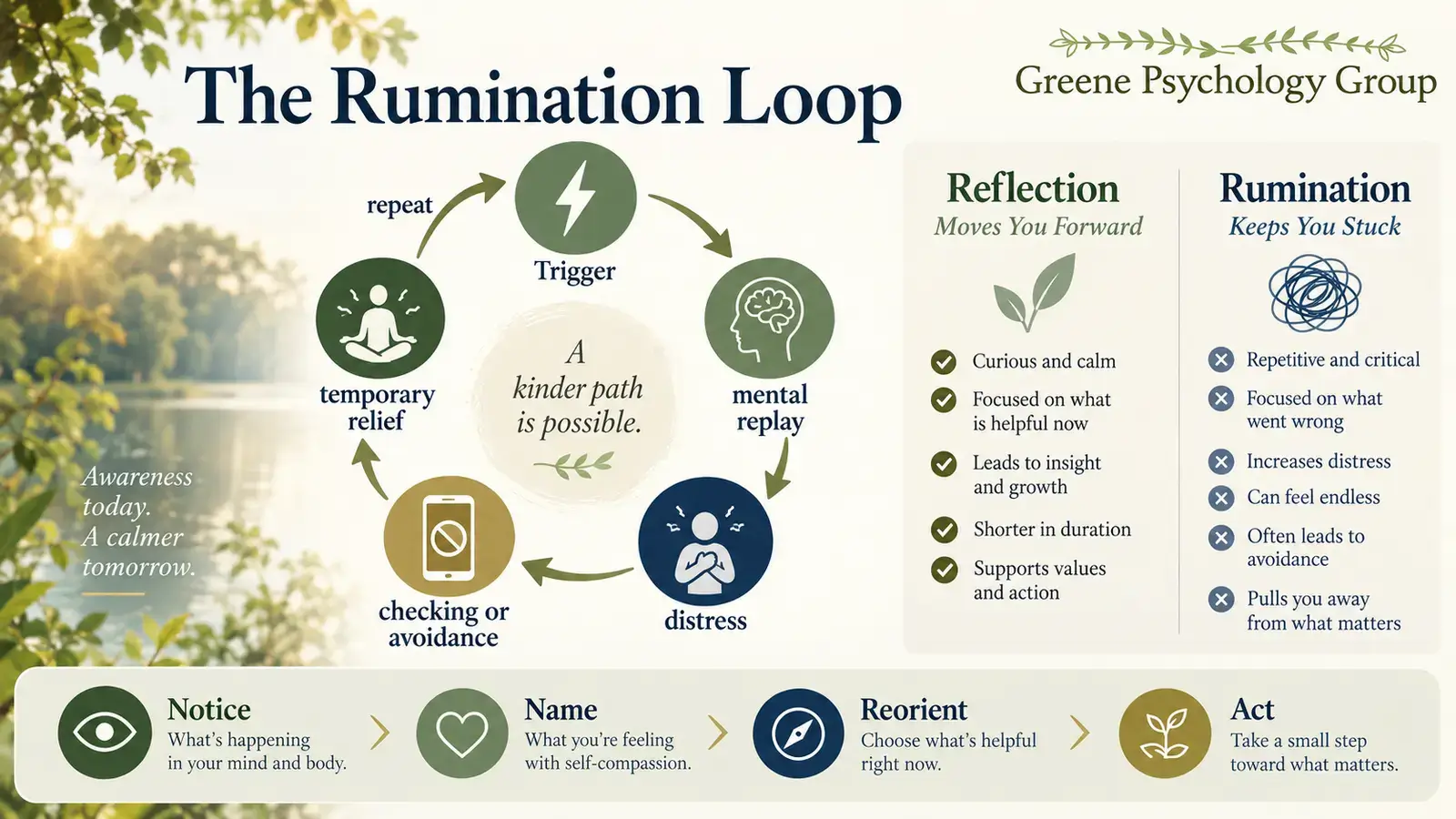
The rumination cycle
- Trigger: A mistake, memory, ambiguous message, uncomfortable emotion, quiet moment, or uncertain decision captures attention.
- Mental replay: The mind reviews the event, searches for certainty, judges what happened, or predicts consequences.
- Distress: Anxiety, shame, sadness, frustration, or physical tension increases.
- Checking or avoidance: The person seeks reassurance, rereads messages, researches, withdraws, delays a decision, or tries to suppress the thought.
- Temporary relief: The response briefly lowers discomfort or creates a sense of control.
- Repeat: Because the relief is short-lived, the brain learns to restart the same process the next time discomfort appears.
Common Signs That Thinking Has Become a Loop
Rumination and overthinking do not always look dramatic. They may happen internally while a person continues working, parenting, studying, or socializing. Signs can include:
- Replaying conversations and searching for the moment something went wrong
- Repeatedly reviewing a decision after it has already been made
- Trying to determine exactly why you feel a certain way before taking action
- Mentally rehearsing explanations, apologies, or future conversations
- Asking several people for reassurance but feeling uncertain again soon afterward
- Rereading messages, checking tone, or researching the same question repeatedly
- Having difficulty falling asleep because the mind becomes more active at night
- Withdrawing from people or activities while trying to “figure everything out”
- Feeling mentally exhausted without reaching a decision
- Criticizing yourself for overthinking, which creates another layer of rumination
The key issue is impact. A thought pattern deserves attention when it persistently disrupts sleep, work, relationships, decision-making, self-care, or the ability to be present.
Common Triggers for Rumination and Overthinking
Uncertainty and incomplete information
An unanswered message, unclear feedback, medical uncertainty, or an unresolved relationship issue can invite the mind to fill gaps with explanations. When certainty feels necessary before moving forward, thinking can expand far beyond what the available facts can answer.
Perfectionism and fear of mistakes
Perfectionistic standards can turn ordinary decisions into tests of worth or competence. A person may believe there is one correct choice and that careful enough analysis should eliminate all risk. Because most real decisions contain uncertainty, the review never feels complete.
Social evaluation
Interactions can be especially sticky when belonging, approval, conflict, or embarrassment is involved. The mind may repeatedly examine facial expressions, wording, pauses, or tone while trying to determine what another person thought.
Fatigue, stress, and unstructured time
Rumination may become louder when attention is depleted. It often intensifies late at night, during commutes, after stressful workdays, or in periods with little structure. Sleep problems and rumination can reinforce one another: repetitive thinking delays rest, and poor sleep makes attention and emotion regulation harder the next day.
How to Interrupt Rumination and Overthinking
The goal is not to force the mind to become blank. Thought suppression can make a thought feel even more important. A more realistic goal is to recognize the loop sooner and change what you do next.
1. Notice the process
Use a neutral label such as “My mind is replaying,” “I am searching for certainty,” or “This is rumination, not new problem-solving.” Labeling the process creates a small amount of distance without arguing with the thought.
2. Name what is present
Identify the emotion, body sensation, and urge beneath the analysis. You might notice shame, fear, tightness in the chest, or an urge to check. Naming the experience can shift attention from the story about the emotion to the experience occurring now.
3. Reorient to what is useful
Ask whether a decision or action is available at this moment. If a real problem can be addressed, define it in one sentence and choose a short planning period. If no action is available, gently return attention to the present through the senses, movement, breathing, or an absorbing task.
4. Act in the direction that matters
Choose one small behavior guided by your values rather than by the demand for certainty. That might mean returning to work for ten minutes, going to bed, sending a concise message, taking a walk, or being present with another person. Action does not prove the thought wrong; it prevents the thought from controlling the entire moment.
Practical Strategies for Rumination and Overthinking
Separate solvable problems from hypothetical questions
A solvable problem has a current action: schedule the appointment, clarify the deadline, make a list, or ask a direct question. A hypothetical question—such as “What if everyone secretly thinks I failed?”—cannot usually be resolved through more analysis. Naming the difference helps direct energy toward what can actually be influenced.
Use a bounded problem-solving period
Set a brief window to write down facts, options, costs, and the next action. When the time ends, stop gathering more arguments unless genuinely new information becomes available. A boundary turns thinking into a task instead of allowing it to occupy the whole day.
Reduce reassurance rituals gradually
Reassurance is not inherently harmful. It becomes part of the cycle when it must be repeated and relief disappears quickly. Consider delaying one check, asking one person instead of several, or noticing the urge without immediately responding. If reassurance-seeking feels compulsive or overwhelming, a therapist can help pace this work safely.
Practice attention flexibility
Grounding is not a trick for erasing thoughts. It is practice in placing attention intentionally. Notice several things you can see, hear, and feel. Engage in an activity that requires enough focus to compete with replay. Each return to the present strengthens the ability to choose where attention goes.
Respond with self-compassion
Self-criticism often intensifies rumination. Try speaking to yourself as you would to someone you respect: “This is painful, and my mind is trying to protect me. I do not have to solve everything tonight.” Compassion does not excuse harmful behavior. It creates a steadier state from which accountability and repair are more possible.
How Therapy Helps With Rumination and Overthinking
Therapy begins by clarifying the function of the loop. Two people may replay conversations for different reasons: one may fear rejection, another may be responding to trauma cues, and another may use analysis to avoid uncertainty. Treatment is more useful when it targets the pattern maintaining distress rather than treating “overthinking” as a personality flaw.
Cognitive behavioral therapy
Cognitive behavioral therapy (CBT) can help identify beliefs that keep the loop active, such as “If I analyze long enough, I can prevent every mistake” or “I must feel certain before I act.” A therapist may help test these assumptions through behavioral experiments, compare rumination with structured problem-solving, and build responses that support daily functioning.
Mindfulness and acceptance-based approaches
Mindfulness-based work can strengthen the ability to observe thoughts as mental events instead of commands or facts that require an immediate response. Acceptance-based approaches may help a person make room for uncertainty and uncomfortable emotion while choosing behavior consistent with personal values.
Behavioral activation and exposure
When rumination contributes to withdrawal or depression, behavioral activation can help rebuild routines and contact with meaningful activities. When avoidance and intolerance of uncertainty maintain the cycle, carefully planned exposure may help a person practice facing discomfort without relying on repeated checking or reassurance.
Work on underlying patterns
Therapy may also address grief, trauma, relationship dynamics, shame, perfectionism, or longstanding beliefs about responsibility and self-worth. The aim is not a perfectly quiet mind. Progress may look like recognizing the loop earlier, spending less time in it, recovering more quickly, making decisions with greater flexibility, and participating more fully in life.
When to Seek Support for Rumination and Overthinking
Consider speaking with a mental health professional when rumination and overthinking are persistent, difficult to interrupt, or affecting sleep, concentration, relationships, work, school, caregiving, or self-care. An assessment is also important when the pattern occurs with ongoing sadness, loss of interest, panic, compulsive behavior, trauma symptoms, substance use, or major changes in functioning.
Some medical conditions, medications, sleep disorders, and substance-related factors can affect mood and concentration. A therapist may recommend coordination with a primary care clinician or another qualified professional when medical evaluation is appropriate. Psychotherapy does not replace medical care, and medication decisions should be made with a qualified prescriber.
Preparing for a Therapy Appointment
You do not need to explain rumination and overthinking perfectly. A few concrete examples can help a therapist understand the pattern. Before an appointment, consider noting:
- What usually triggers the mental replay
- The questions or predictions your mind repeats
- How long the loop lasts and how often it occurs
- What you do for relief, including checking, reassurance, research, or avoidance
- How the pattern affects sleep, attention, decisions, relationships, and daily responsibilities
- Any recent changes in health, medication, substance use, stress, or sleep
- One functional change that would make therapy feel worthwhile
A responsible assessment looks at onset, duration, severity, impairment, history, stressors, safety, protective factors, and your goals. Questionnaires can organize information, but they do not establish a diagnosis by themselves.
Talk With a Greene Psychology Group Therapist
If rumination and overthinking are narrowing your choices or interfering with daily life, therapy can help you understand the cycle and develop a more flexible response. Treatment for rumination and overthinking can focus on practical changes in attention, behavior, and your response to uncertainty. Greene Psychology Group provides psychotherapy for adolescents and adults, with Raleigh and Asheville locations and online therapy options described on the practice website.
Contact Greene Psychology Group or call 919-205-5339 to ask about scheduling and therapist availability.
Frequently Asked Questions
Is rumination the same as overthinking?
Not exactly. Rumination and overthinking overlap, but overthinking is a broad everyday term for excessive or difficult-to-stop thinking. Rumination more specifically describes repetitive thinking about distress, past events, perceived mistakes, causes, or meanings. Worry tends to focus more on possible future threats.
Is rumination a mental health diagnosis?
Rumination is a thinking pattern, not a diagnosis by itself. It can occur with depression, anxiety, obsessive-compulsive symptoms, trauma-related concerns, grief, insomnia, and other difficulties. A clinician evaluates the broader symptom pattern and its impact.
Why do I replay conversations in my head?
You may be trying to understand ambiguity, prevent rejection, correct a perceived mistake, or gain certainty about what another person thought. Replaying becomes less helpful when it stops producing new information and increases distress or avoidance.
Can I stop overthinking by distracting myself?
Purposeful redirection can be useful, especially after deciding that no action is available. However, frantic distraction used only to escape thoughts may provide short relief without changing the cycle. The goal is flexible attention and meaningful action, not permanent thought suppression.
How does CBT help with rumination?
CBT may help identify beliefs and behaviors that maintain repetitive thinking, distinguish problem-solving from mental replay, test predictions, reduce checking or avoidance, and practice more useful responses. The exact plan depends on the person’s symptoms, goals, and clinical needs.
Can mindfulness make overthinking worse?
Some people initially notice thoughts more clearly when they slow down, which can feel uncomfortable. Mindfulness should focus on observing and redirecting attention rather than monitoring whether thoughts have disappeared. A therapist can adapt the practice when trauma, panic, or other concerns make certain exercises difficult.
When should I seek therapy for rumination and overthinking?
Consider therapy when the loop is persistent, distressing, difficult to interrupt, or interfering with sleep, work, school, relationships, decisions, or self-care. You do not need to wait for a crisis to request an assessment.
Can online therapy help with overthinking?
Online therapy may be appropriate for many non-emergency concerns when the client is physically located where the clinician is authorized to practice and has adequate privacy and technology. Suitability depends on clinical needs, risk, preferences, and logistics.
How long does therapy take?
There is no universal timeline. Duration depends on the severity and history of the pattern, co-occurring concerns, goals, treatment approach, consistency, and outside stressors. A therapist should discuss a working plan and review progress rather than promise a fixed result.
Sources
- American Psychological Association: Targeting Perseveration to Reduce Distress
- National Institute of Mental Health: Depression
- National Institute of Mental Health: Anxiety Disorders
This article is educational and does not provide a diagnosis or replace individualized mental health or medical care.