
Health anxiety reassurance cycle is the pattern in which a sensation or health concern triggers fear, checking or reassurance briefly reduces that fear, and doubt soon returns. The next sensation then feels even more important. Someone may repeatedly examine their body, search symptoms online, ask loved ones for certainty, or request additional medical opinions—not because the fear is imaginary, but because the mind is trying to eliminate uncertainty.
Concern about health is normal and can be protective. The problem begins when attention, interpretation, and safety behaviors become so persistent that they increase distress or interfere with sleep, relationships, work, healthcare decisions, and daily activities. Understanding the cycle can help a person respond proportionately without dismissing genuine medical needs.
What Is Health Anxiety?
Health anxiety involves persistent fear or preoccupation about having or developing a serious illness. A person may interpret ordinary sensations, normal physical changes, or minor symptoms as signs of danger. Even after appropriate evaluation, relief may not last because the underlying need for certainty remains unresolved.
Health anxiety can exist on a spectrum. Some people frequently seek appointments, tests, online information, or reassurance. Others avoid doctors, medical information, exercise, or places associated with illness because they fear what they might discover. Both checking and avoidance can be attempts to reduce anxiety.
Health anxiety is not the same as pretending to be ill. Physical sensations and fear are real experiences. Anxiety can also produce or intensify sensations such as muscle tension, dizziness, stomach discomfort, sweating, tingling, a racing heartbeat, or shortness of breath. At the same time, psychological and medical conditions can coexist. Responsible care does not force a false choice between “physical” and “psychological.”
Health Concern vs. the Health Anxiety Reassurance Cycle
Reasonable health concern responds to evidence and follows a proportionate care plan. Anxiety-driven concern tends to return after appropriate information, shift to another symptom, or demand a level of certainty that medicine cannot provide. The difference is not whether someone cares about health; it is how the concern behaves over time.
| Proportionate health response | Anxiety-maintaining response |
|---|---|
| Notices a symptom and follows an established medical plan | Checks the symptom repeatedly throughout the day |
| Uses credible information for a specific purpose | Searches many sources until finding a frightening possibility |
| Accepts that a qualified evaluation reduces risk without eliminating all uncertainty | Needs repeated confirmation before feeling safe |
| Returns to ordinary activities after taking an appropriate step | Continues monitoring, researching, or avoiding activities |
| Seeks follow-up when symptoms change according to medical guidance | Seeks repeated appointments or tests primarily for short-term relief |
The goal is not to ignore the body or avoid healthcare. It is to make decisions using a consistent medical plan rather than allowing fear to create a new rule every time discomfort appears.
How the Health Anxiety Reassurance Cycle Works
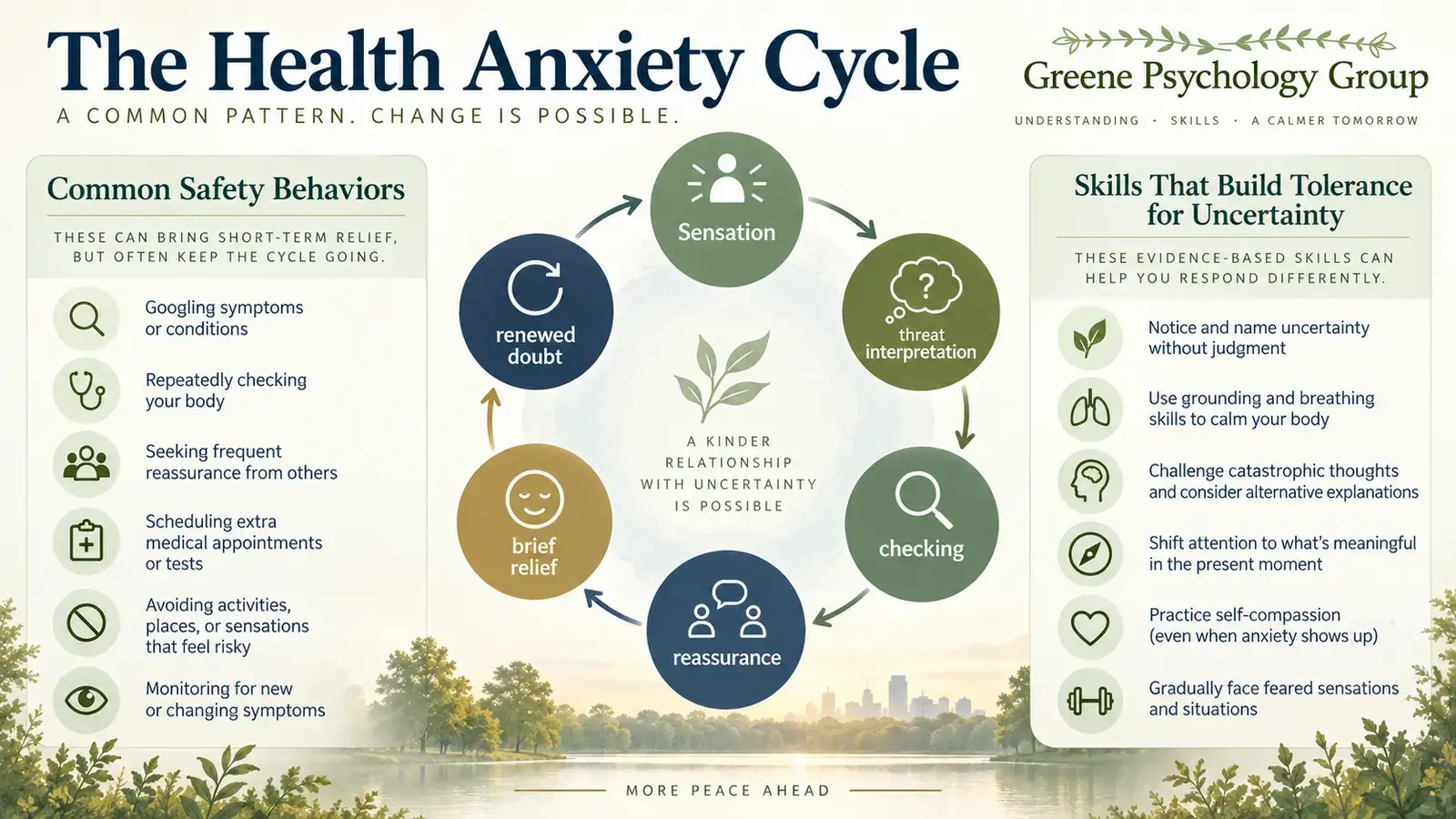
- Sensation or trigger: You notice pain, dizziness, a heartbeat change, a mark on the skin, a health story, or another person’s diagnosis.
- Threat interpretation: The mind rapidly connects the trigger to a serious disease or dangerous outcome.
- Anxiety and increased attention: Fear heightens body awareness. Normal fluctuations become easier to detect, and anxiety may create additional physical sensations.
- Checking or reassurance: You examine the area, search online, ask someone what they think, compare symptoms, schedule another appointment, or avoid a feared activity.
- Brief relief: A reassuring answer, normal reading, or negative test lowers anxiety temporarily.
- Renewed doubt: The relief fades. A new sensation, exception, online story, or “What if they missed something?” thought restarts the cycle.
The health anxiety reassurance cycle is strengthened by short-term relief. When checking is followed by relief, the brain can learn that checking prevented danger. The next urge therefore feels more urgent, even though the behavior did not create lasting confidence.
Safety Behaviors That Keep the Health Anxiety Reassurance Cycle Going
A safety behavior is something a person does to prevent a feared outcome or reduce anxiety. These actions may be understandable and sometimes appropriate. They become part of the health anxiety reassurance cycle when they are excessive, repeated, or used primarily to create immediate certainty.
Repeated body checking
This may include checking pulse, blood pressure, temperature, breathing, skin, lymph nodes, vision, strength, or symmetry. Repetition increases attention to small variations and may irritate tissue, create soreness, or make normal sensations more noticeable.
Online symptom searching
Search results remove clinical context and can make rare conditions feel common. A person may begin with one symptom, open multiple pages, compare personal experiences, and continue until an alarming possibility appears. The search then becomes evidence for danger rather than a neutral source of information.
Reassurance seeking
Questions such as “Do I look okay?” or “Are you sure this is nothing?” may briefly help. When asked repeatedly, however, reassurance can place family members in an impossible role: they cannot provide medical certainty, and their answer may be doubted minutes later.
Repeated appointments or tests
Medical evaluation is essential when clinically indicated. The pattern becomes problematic when new consultations or tests are pursued mainly to reduce fear after an appropriate plan has already been established. Repeated testing may carry financial, emotional, or physical costs and still fail to create lasting certainty.
Avoidance
Some people avoid appointments, health news, exercise, travel, certain foods, medication, or contact with illness. Avoidance prevents the person from learning that anxiety can rise and fall without the feared outcome occurring. It can also interfere with appropriate preventive or follow-up care.
Why Reassurance Never Ends the Health Anxiety Reassurance Cycle
Reassurance answers a specific question, but health anxiety often asks for a guarantee. A clinician may explain that a serious condition is unlikely, while the anxious mind asks whether “unlikely” still means possible. A loved one may say that a symptom appears normal, but the mind produces a new exception.
The problem is not a lack of intelligence or medical information. It is the attempt to use information to achieve complete certainty. Because no person, test, or clinician can remove every possible risk, the standard for feeling safe keeps moving.
Lasting improvement therefore involves more than finding the perfect reassuring statement. It requires building confidence in a reasonable decision process and learning that uncertainty can be present without controlling behavior.
The Role of Body Scanning and Anxiety Sensations
Attention changes perception. When you monitor one area closely, you notice sensations that would normally pass without comment. Anxiety also activates the body’s threat system, which may increase heart rate, breathing changes, muscle tension, sweating, lightheadedness, nausea, or tingling. Those sensations can then be interpreted as further evidence of illness.
This does not mean symptoms are “all in your head.” It means that attention, interpretation, emotion, and physiology influence one another. Therapy can help examine this interaction while maintaining appropriate medical boundaries.
Building a Safe Medical Plan During the Health Anxiety Reassurance Cycle
A mental health approach to health anxiety should never instruct someone to ignore new or urgent symptoms. A safer approach is to create clear decision rules with qualified healthcare professionals.
Use a consistent medical point of contact
When possible, work with a primary care clinician who understands your medical history. Continuity can reduce fragmented care and make changes easier to evaluate over time.
Ask for specific follow-up guidance
Ask which changes should prompt a routine appointment, urgent consultation, or emergency care. Write the instructions down so anxiety does not have to create a new rule in the moment.
Distinguish recommended monitoring from repeated checking
Some conditions require tracking. Follow the frequency and method recommended by the treating clinician rather than adding extra checks whenever anxiety rises.
Coordinate care when appropriate
With permission, mental health and medical professionals may coordinate so that treatment respects both psychological patterns and genuine medical needs.
Practical Ways to Interrupt the Health Anxiety Reassurance Cycle
These strategies are educational and should be adapted to individual medical and clinical needs. The goal is gradual change, not suddenly eliminating every source of support.
1. Name the cycle
Try a neutral statement: “I noticed a sensation, my mind predicted danger, and now I feel an urge to check.” Naming the sequence can create distance between the trigger and the response.
2. Follow the established medical rule
Ask whether the situation matches guidance already provided by a healthcare professional. If it does, follow that plan. If it does not require immediate action, notice the urge to create a new rule and allow time before deciding what to do.
3. Delay one nonessential check
Begin with a manageable delay rather than demanding complete abstinence. During the delay, observe how anxiety changes without another search, examination, or reassurance request. This can teach the brain that an urge is uncomfortable but temporary.
4. Reduce repeated reassurance
Consider asking once, using one trusted source, or writing down an answer instead of requesting it again. Loved ones can respond with empathy—“I can see that you are scared”—without repeatedly debating whether a feared illness is present.
5. Shift attention deliberately
Use grounding, paced breathing, movement, or an absorbing activity to reconnect with the present. This is not proof that the symptom is harmless. It is practice in choosing where attention goes after you have followed an appropriate care plan.
6. Return to meaningful activity
Health anxiety narrows life around monitoring and prevention. Choose one small action that represents what matters outside the fear: finish a task, talk with a friend, prepare a meal, take a medically appropriate walk, or resume a valued routine.
How CBT Can Help the Health Anxiety Reassurance Cycle
Cognitive behavioral therapy (CBT) can help identify the interpretations and safety behaviors that maintain the health anxiety reassurance cycle. Treatment does not require a therapist to promise that nothing bad will ever happen. Instead, it supports a more balanced way of evaluating risk and responding to uncertainty.
Depending on the individual, CBT may include:
- Mapping triggers, interpretations, emotions, sensations, and responses
- Examining beliefs about illness, responsibility, uncertainty, and reassurance
- Comparing anxiety-based predictions with available evidence
- Reducing repeated checking, searching, and reassurance gradually
- Practicing behavioral experiments that test feared predictions
- Re-engaging with activities avoided because of health fears
- Developing a consistent plan for appropriate medical care
- Tracking functional progress rather than waiting for zero anxiety
Exposure and response prevention
Exposure-based work may involve approaching safe, feared situations while reducing the usual safety response. Examples might include allowing a benign sensation to be present without repeatedly checking it, reading ordinary health information without starting an extended search, or returning to an activity cleared by a medical provider.
Exposure should be collaborative, gradual, and clinically appropriate. It is not a direction to ignore medical guidance. A therapist considers actual health conditions, trauma history, panic symptoms, risk, readiness, and the purpose of each exercise.
Mindfulness, acceptance, and self-compassion
Mindfulness can help a person notice sensations and thoughts without immediately turning them into conclusions. Acceptance-based work focuses on making room for uncertainty while choosing actions aligned with personal values. Self-compassion can reduce the shame and self-criticism that often add a second layer of distress.
What an Assessment Should Consider
A thorough assessment looks beyond the label “overthinking.” A clinician may ask about the onset and duration of health fears, specific triggers, checking and avoidance, medical history, previous evaluations, medication, sleep, substance use, panic symptoms, obsessive-compulsive features, depression, trauma, recent illness or loss, family experiences, and the effect on daily functioning.
Health anxiety may overlap with illness anxiety disorder, somatic symptom disorder, generalized anxiety, panic disorder, obsessive-compulsive disorder, depression, or trauma-related concerns. These conditions are not interchangeable. Screening tools can organize information, but diagnosis requires professional evaluation and appropriate consideration of medical factors.
The assessment should also define meaningful outcomes. Progress might include fewer hours spent researching, less frequent body checking, more consistent sleep, improved attendance, greater participation in exercise approved by a medical provider, fewer reassurance conflicts, or faster recovery after a trigger.
How Loved Ones Can Respond Without Feeding the Cycle
Family members and partners often feel torn between offering comfort and becoming trapped in repeated reassurance. A supportive response can validate emotion without providing endless certainty.
- Acknowledge the fear: “I can see this feels frightening.”
- Refer back to the agreed plan: “What did your clinician recommend for this situation?”
- Avoid lengthy debates about every possible diagnosis.
- Support the person in delaying a nonessential check or returning to an activity.
- Encourage appropriate medical care when symptoms meet the established rule.
- Discuss reassurance boundaries during a calm moment, not only during a spike in fear.
Reducing reassurance should not become coldness or punishment. The aim is to shift support from proving safety toward helping the person tolerate uncertainty and follow a responsible plan.
When to Seek Professional Support
Consider therapy when the health anxiety reassurance cycle consumes substantial time, repeatedly disrupts sleep, leads to frequent checking or appointments, causes avoidance of appropriate care, strains relationships, interferes with work or school, or prevents participation in valued activities.
You do not need to wait until symptoms become severe. Early support can help clarify the pattern, coordinate with medical care when needed, and prevent safety behaviors from taking up more of daily life.
Preparing for a Therapy Appointment
You do not need a perfectly organized explanation. A few recent examples can help a therapist understand the health anxiety reassurance cycle in your life. Consider noting:
- The sensation or event that triggered fear
- The illness or outcome you feared
- What you checked, searched, asked, or avoided
- How long relief lasted
- How the cycle affected sleep, relationships, work, or daily activities
- Relevant diagnoses, medications, tests, and medical guidance
- One practical change that would make treatment worthwhile
You can also ask the therapist how they approach health anxiety, how they coordinate with medical providers, what methods they use, and how progress will be evaluated.
Talk With a Greene Psychology Group Therapist
If health fears, repeated checking, or reassurance seeking are limiting your daily life, therapy can help you understand the pattern and develop a safer, more flexible response. Greene Psychology Group provides psychotherapy for adolescents and adults, with Raleigh and Asheville locations and online therapy options described on the practice website.
Contact Greene Psychology Group or call 919-205-5339 to ask about scheduling and therapist availability.
Frequently Asked Questions
Is health anxiety the same as illness anxiety disorder?
Health anxiety is a broad term describing excessive fear or preoccupation about health. Illness anxiety disorder is a specific diagnosis with defined clinical criteria. Not everyone who experiences health anxiety meets those criteria, and only a qualified professional can diagnose an individual.
Are symptoms caused by health anxiety real?
Yes. Physical sensations are real experiences, and anxiety can create or intensify bodily changes. However, symptoms can also have medical causes, and psychological and medical conditions may coexist. New, severe, worsening, or emergency symptoms require appropriate medical evaluation.
Why does reassurance only help for a short time?
Reassurance lowers anxiety temporarily but cannot provide complete certainty. Within the health anxiety reassurance cycle, that relief can teach the brain that checking or asking prevented danger, increasing the urge to repeat the behavior when doubt returns.
Should I stop checking symptoms completely?
Not necessarily. Some monitoring is medically appropriate. The goal is to follow guidance from qualified healthcare professionals and reduce checking that is excessive, repeated, or primarily used to relieve anxiety. Changes should account for your medical history and current care plan.
Is searching symptoms online harmful?
Online information can be useful when it comes from credible sources and serves a clear purpose. It becomes unhelpful when repeated searching increases alarm, replaces professional evaluation, or continues until temporary reassurance is achieved.
How does CBT help with the health anxiety reassurance cycle?
CBT can help identify threat interpretations and safety behaviors, evaluate predictions, reduce nonessential checking and reassurance gradually, practice tolerance of uncertainty, and restore activities limited by fear. Treatment is individualized and should respect legitimate medical needs.
Can online therapy help with health anxiety?
Online therapy may be appropriate for many non-emergency concerns when the client is physically located where the clinician is authorized to practice and has adequate privacy and technology. Suitability depends on clinical needs, risk, preference, and logistics.
When should I seek therapy for health anxiety?
Consider therapy when fear, checking, searching, reassurance seeking, or avoidance persist and interfere with sleep, relationships, healthcare decisions, work, school, or valued activities. You do not need to wait for a crisis to request an assessment.
Does therapy replace medical care?
No. Psychotherapy and medical evaluation have different roles. Therapy can address the health anxiety reassurance cycle while medical professionals evaluate and manage physical health concerns. Coordination may be useful when the client gives permission.
How long does therapy take?
There is no universal timeline. Duration depends on symptom severity, history, co-occurring concerns, goals, treatment approach, consistency, outside stressors, and medical factors. A therapist should discuss a working plan and review progress rather than guarantee a fixed result.
Sources
- National Institute of Mental Health: Anxiety Disorders
- MedlinePlus: Illness Anxiety Disorder
- American Psychological Association: How to Handle Health Anxiety
This article is educational and does not provide a diagnosis or replace individualized mental health or medical care.