

Teen Therapy Confidentiality: 12 Parent Questions to Ask
Teen therapy confidentiality is one of the most important topics for parents, guardians, and adolescents to discuss before sensitive details are shared in counseling. Parents usually want enough information to support their teen, while teens often need a private space to speak honestly. The goal is not secrecy from parents or a full report to parents after every session; it is a clear, age-appropriate, safety-aware communication plan. This article offers general education for families considering adolescent therapy, not a legal opinion about consent or parental access.
Quick answer: Confidentiality in adolescent therapy is not an all-or-nothing promise. The American Psychological Association’s public education page on psychotherapy confidentiality explains that, often at the first psychotherapy visit, the child, parent, and psychologist discuss ground rules for privacy, including what might be shared with parents and what may remain private. Families can ask how consent is handled, what parent updates may include, how records are documented, and what safety-related circumstances may require information sharing.
IMAGE PLACEHOLDER: featured image
Why privacy questions belong at the beginning
Privacy expectations are easier to discuss before therapy begins than after a teen has already shared something sensitive. A parent may assume they will receive detailed updates because they scheduled the appointment or pay for care. A teen may assume that anything they say will immediately be repeated at home. Both assumptions can create anxiety, hesitation, or conflict.
A clear conversation at the beginning helps everyone understand the purpose of therapy. The teen can hear that therapy is meant to be a place for honest conversation, not surveillance. Parents can hear how they may stay involved without requiring session-by-session details. The clinician can explain how safety concerns, consent questions, record requests, and family communication are handled.
This is different from a general first-session guide. A first-session guide usually covers forms, goals, assessment, scheduling, and payment. This article focuses on the privacy agreement and communication plan among the teen, parent or guardian, and clinician.
What confidentiality means in adolescent therapy
In therapy, confidentiality generally means that personal health information is protected and not casually shared. In practical terms, it covers many kinds of information: what the teen says in session, the reason for therapy, attendance, treatment goals, records, billing information, and communication with family members or other professionals.
At the same time, “confidential” does not mean “nothing can ever be shared.” Therapy is health care, and health care involves documentation, coordination, safety responsibilities, and legal or ethical duties. The family’s task is to understand where the boundaries are, who decides what is shared, and how those decisions are communicated.
It can help to separate several categories that families sometimes blend together:
- Session conversations: what the teen discusses privately with the clinician.
- General updates: broad themes such as goals, coping skills, or ways parents can support progress.
- Administrative information: scheduling, attendance, insurance, billing, or forms.
- Clinical records: documentation that may include assessments, diagnoses if applicable, treatment plans, progress notes, and other health information.
- Private psychotherapy notes: notes a clinician may keep separately from the medical record, when applicable.
- Safety-related information: information that may need to be shared when there is concern about serious harm or other safety issues.
Families do not need to know every legal detail before scheduling a first appointment. They do need a chance to ask plain-language questions and hear how the practice explains its confidentiality policy.
Teen therapy confidentiality is a shared conversation
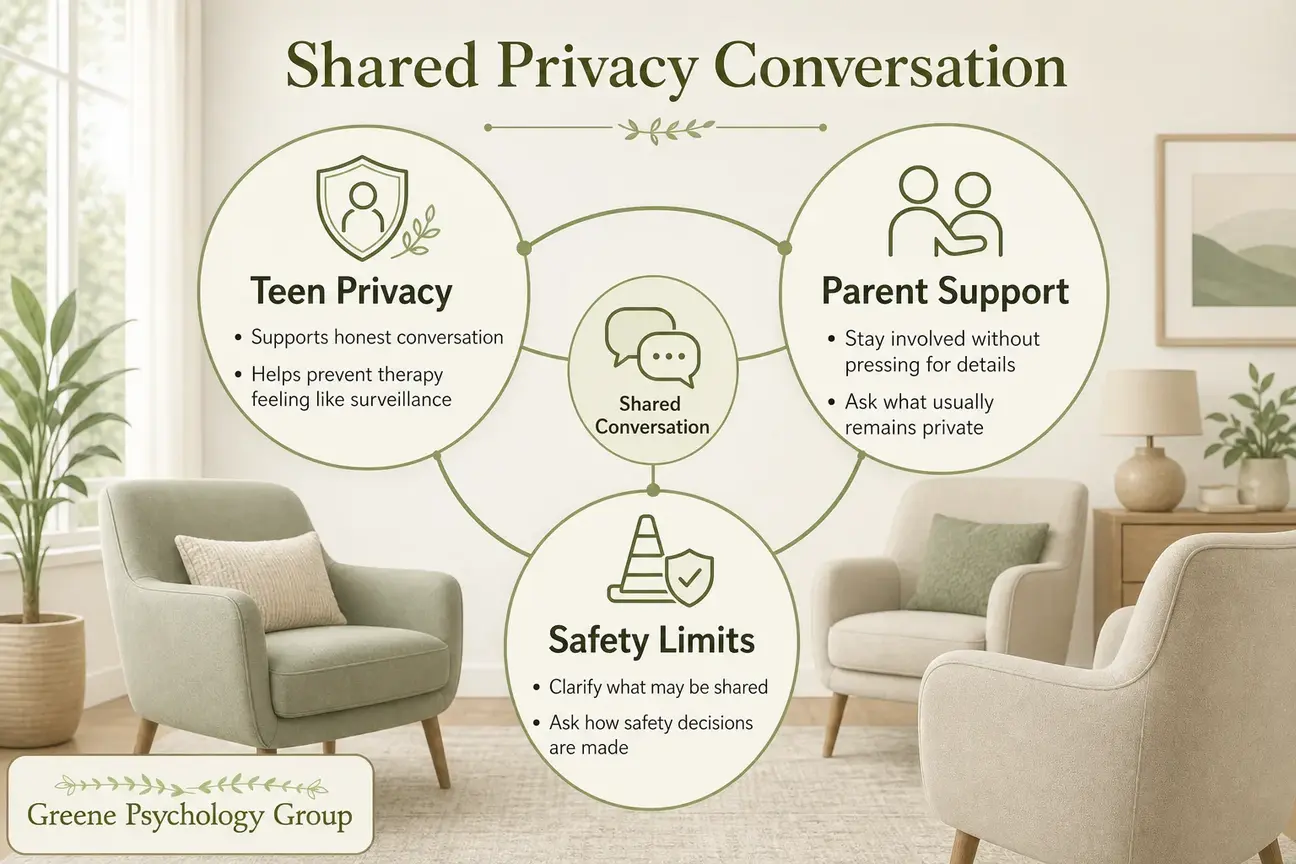
Teen therapy confidentiality works best when the teen, parent or guardian, and clinician do not rely on guesswork. A shared conversation can reduce misunderstandings and help the teen understand the difference between privacy and isolation. It can also help parents know how to be supportive without pressing for details that the teen is not ready to share.
Parents can ask the clinician to explain what will usually remain private, what kinds of information may be shared, and how decisions are made when the teen’s safety is a concern. Teens can ask what happens if they talk about conflict at home, school stress, anxiety, sadness, relationships, identity questions, or other personal topics.
For many families, the most reassuring part of this discussion is hearing that parent involvement and teen privacy can coexist. A parent does not have to be shut out completely for a teen to have privacy. A teen does not have to give up all confidentiality for a parent to stay appropriately involved.
Parent involvement therapy: support without turning sessions into reports
Parent involvement therapy is not one single format. In adolescent care, parent participation may look different depending on the teen’s age, concerns, family circumstances, safety needs, consent requirements, and the clinician’s approach. The important point is to clarify expectations rather than assume a standard model.
Some families may begin with the parent and teen together for part of the intake conversation. The teen may then have private time with the clinician. In other situations, the clinician may schedule periodic parent check-ins, invite a parent into part of a session, or recommend family therapy when family communication or relationship patterns are part of the concern.
Parent updates do not have to include every detail a teen shares. They may focus on broad themes: whether the teen is engaging, what skills are being practiced, what kinds of support may help at home, or whether there are concerns that need more direct attention. Families should ask whether updates are typically verbal, written, scheduled in advance, or handled case by case.
When parent involvement therapy is working well, it also respects the parent’s legitimate concerns. Parents often notice changes in sleep, mood, school functioning, friendships, irritability, withdrawal, or family conflict before a teen is ready to explain what is happening. A clinician can help decide how those concerns should be addressed in therapy without promising that every parental concern will lead to a detailed disclosure.
Parents can ask, “How can I share concerns without making my teen feel monitored?” They can also ask, “How will you help us talk about privacy if my teen and I disagree?” Those questions make parent participation more collaborative and less reactive.
Teen therapy privacy and trust with parents
Teen therapy privacy is often what allows an adolescent to speak honestly. A teen who fears that every word will be repeated may avoid the most important topics. A parent who feels completely excluded may feel anxious, helpless, or suspicious. The goal is to create enough privacy for therapy to be useful while keeping appropriate communication with parents.
Parents can support teen therapy privacy by avoiding promises that are not realistic. For example, it is not helpful to tell a teen, “Nothing you say will ever be shared.” It is also not helpful to say, “Your therapist will tell me everything.” Both statements set up unrealistic expectations and may undermine trust later.
A steadier message might be: “The therapist will explain what is private, what may need to be shared, and how we can all communicate. I want you to have space to talk, and I also want us to understand how safety and parent involvement work.”
Some teens worry that therapy will become a place where adults talk about them rather than with them. Inviting the clinician to explain teen therapy privacy directly to the teen can help. The teen can ask questions in their own words and hear the answer from the person providing care.
Parents may also need reassurance that privacy does not mean they are being blamed or excluded. It means the teen is being given developmentally appropriate space to build trust, practice emotional honesty, and work on concerns that may be hard to say out loud at home.
Confidentiality limits families should clarify
Confidentiality limits are the circumstances in which information may be shared even when therapy is generally private. Families should ask the practice to explain those limits in plain language before the teen shares highly personal information. This is especially important because federal privacy rules, professional ethics, state law, safety concerns, and practice policies may all matter.
Federal HIPAA guidance explains that privacy protections apply to identifiable health information, including mental-health information, but those rules do not answer every question about adolescent therapy on their own. The U.S. Department of Health and Human Services describes HIPAA rights and protections for individuals, while also recognizing that specific situations can depend on the type of information and applicable law.
Parent access and minor consent questions can be state-specific. Because answers may depend on state law, the family’s paperwork, and the practice’s policies, ask the clinician directly who can consent to adolescent therapy, what parent or guardian access may look like, and how privacy is explained to the teen.
Helpful questions include: What are the confidentiality limits? How are they explained to the teen? When might a parent be contacted? How are safety concerns handled? How are record requests handled? What should a family do if custody, consent, or communication is complicated?
Safety is one important category. Families should ask how the clinician evaluates and communicates safety concerns, without assuming that every situation will be handled identically. If there is immediate danger, crisis resources should be used rather than waiting for a routine therapy appointment.
Other confidentiality limits may involve treatment coordination, payment, required reporting, court or legal matters, or other regulatory obligations. Rather than trying to memorize a list, families can ask the practice to walk through the specific privacy policy, consent paperwork, and intake materials that apply to their situation.
Adolescent therapy questions about consent
Adolescent therapy questions often begin with consent: Who signs the paperwork? What role does the teen have in agreeing to therapy? What happens if parents disagree? How does insurance affect communication? These are important questions, but they should be answered by the practice using its current policies and applicable requirements, not by assumptions from a blog article.
Parents can ask who completes intake and consent forms, how the teen’s agreement or participation is discussed, and what happens if family circumstances change. If parents share decision-making or if there are custody orders, the family should ask what documentation the practice needs and whether legal guidance is appropriate.
Consent questions can also arise with telehealth. If a teen participates in online therapy in North Carolina, the client must be physically in the state during the session, and families should ask how privacy is protected when sessions happen from home. A teen may need a private room, headphones, or a plan for interruptions. Parents may need to know how to communicate with the clinician without sending detailed health information through unsecured channels.
Insurance can add another layer. Parents can review insurance and payment information and ask both the insurer and the practice what information may appear in billing, claims, statements, or other administrative communications. Greene Psychology Group is in-network with most BCBS and Aetna plans, and families should verify benefits with their insurer and the practice. Coverage, copays, and plan details should not be assumed.
Adolescent therapy questions about consent are not signs that a family is being difficult. They are responsible questions. The sooner they are addressed, the less likely it is that parents, teens, and clinicians will have different expectations later.
What parents might hear from a teen’s therapist
Parents often ask, “Will the therapist tell me what is going on?” The most accurate answer is: ask the practice before care begins. The answer may depend on the teen’s circumstances, the concern being treated, consent, safety, and the clinician’s communication plan.
Parents may receive general information such as whether the teen is attending, participating, or working on agreed goals. They may receive suggestions for supporting the teen at home, such as how to respond during conflict, how to reduce pressure during a stressful week, or how to encourage coping skills. They may also receive administrative information about scheduling, forms, insurance, or payment.
Parents should not assume they will receive a complete report of everything the teen says. They also should not assume they will receive no information at all. This is where clear teen therapy privacy expectations matter. A teen may be more willing to participate if they know session details are not routinely repeated. A parent may feel more comfortable if they know how broad updates and safety concerns will be handled.
It is also useful to ask how the clinician handles parent concerns. If a parent emails or calls about a change in mood, school refusal, conflict at home, or a safety worry, will the clinician confirm receipt? Will the concern be discussed with the teen? Will the parent receive follow-up? Families should ask these questions without sending extensive health details by unencrypted email or a contact form.
Records, notes, and information-sharing expectations
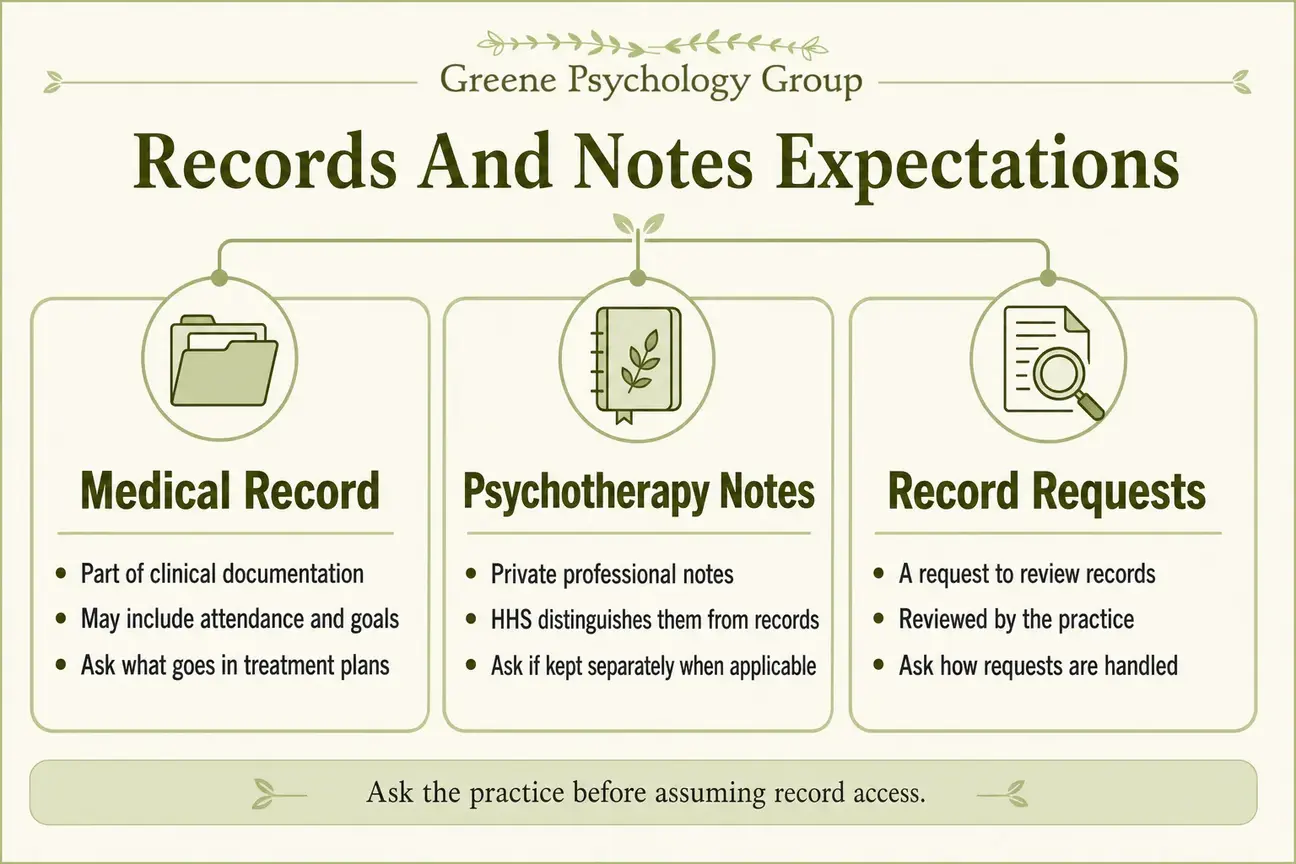
Clinical records and private therapy notes are not always the same thing. HHS explains that the Privacy Rule distinguishes between a mental-health professional’s private psychotherapy notes and information contained in the medical record. Because this area can be legally and factually sensitive, families should ask the practice how it handles documentation rather than assuming what a parent can or cannot obtain.
Questions about records may include:
- What information is included in progress notes or treatment plans?
- How are attendance, diagnosis when applicable, and goals documented?
- Are private psychotherapy notes kept separately from the medical record?
- How are record requests reviewed?
- How are billing and insurance records handled?
- What information may be shared with parents, insurers, or other providers?
Information sharing should also be limited to its purpose. For example, an insurance claim does not require the same information as a family check-in. A safety concern may require a different kind of communication than a routine progress update. Families can ask how the practice limits disclosures to what is relevant for care, payment, coordination, or safety.
These questions are especially important when multiple caregivers are involved. Families can ask who may receive information, how communication preferences are documented, and what the practice needs if there are complicated family circumstances.
12 adolescent therapy questions parents can ask before care begins
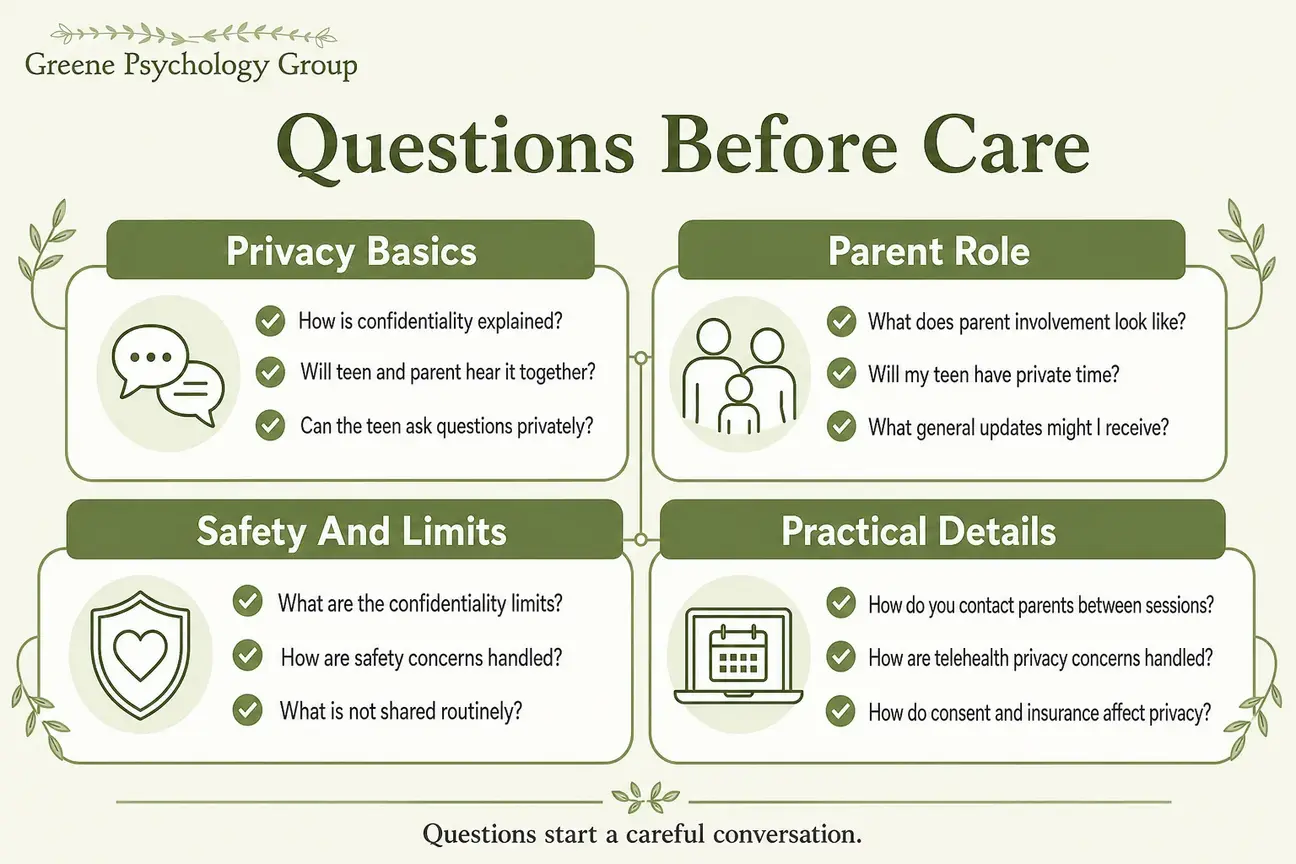
When you contact a practice or attend an initial appointment, it can help to bring written adolescent therapy questions. A checklist keeps the conversation grounded and reduces the chance that a parent or teen leaves with unspoken worries. These 12 questions are not demands for a particular answer; they are a way to start a careful conversation.
1. How do you explain confidentiality to teens and parents?
This question clarifies expectations before sensitive topics come up. Ask whether the teen and parent hear the same explanation together, whether the teen has time to ask questions privately, and how the clinician checks that everyone understands the agreement.
2. What does parent involvement usually look like?
Parent involvement may include intake participation, brief check-ins, joint sessions, separate parent conversations, or guidance about support at home. Asking directly helps the family understand whether the approach is mostly individual work, family communication support, or some combination.
3. Will my teen have private time with the clinician?
Private time can help a teen speak openly, but the structure should be discussed in advance. Parents can ask how private time is introduced, whether it happens at every session, and how the clinician balances privacy with appropriate parent communication.
4. What kinds of general updates might parents receive?
General updates may focus on goals, participation, coping skills, family support, or concerns that need attention. This question helps separate broad support from detailed session reporting.
5. What information is not shared routinely?
A teen may feel safer when they know that every private thought, disagreement, or emotional disclosure will not automatically be repeated. Parents can ask what information usually stays within the therapy relationship unless safety, consent, or another requirement changes the plan.
6. What are the confidentiality limits?
This is one of the most important adolescent therapy questions. Ask how confidentiality limits are explained, what types of situations may require sharing information, and how the clinician communicates those limits to the teen.
7. How are safety concerns handled?
Families should ask how risk is assessed and what happens if the clinician becomes concerned about a teen’s safety. The answer may include parent communication, additional support, referral to crisis resources, or other steps depending on the situation.
8. How do you communicate with parents between sessions?
Ask whether parent communication happens by phone, email, scheduled check-in, form, or another process. If email or a contact form is used, ask what information should and should not be shared through that channel.
9. How are telehealth privacy concerns handled?
For online sessions, families can ask how the teen can participate from a private space, what happens if someone enters the room, and how the clinician confirms that the client is physically located where therapy can be provided.
10. How do you distinguish clinical records from psychotherapy notes?
Documentation questions can feel technical, but they matter. Parents can ask what is included in the medical record, whether private psychotherapy notes are kept separately when applicable, and how record requests are reviewed.
11. How do consent and insurance affect privacy?
Consent, billing, claims, and insurance communications can affect what information exists outside the session itself. Parents can ask what paperwork is required, what information may appear in insurance-related communications, and what should be verified with the insurer.
12. What should we do if custody or consent is complicated?
If multiple caregivers are involved or there are complicated legal documents, ask what the practice needs before care begins. The practice may ask for documentation or recommend that the family seek legal guidance for questions outside the clinician’s role.
How parents can talk with a teen about privacy
Many teens enter therapy with mixed feelings. They may want help but fear losing control over their privacy. They may worry that a parent will be angry, embarrassed, disappointed, or overly involved. Parents can reduce that fear by approaching the conversation with curiosity rather than pressure.
Try asking, “What would make therapy feel safer to try?” or “What are you worried I might find out?” You do not have to agree with every fear to take it seriously. Sometimes a teen simply needs to hear that the first appointment can include questions about confidentiality before they share personal details.
Parents can also say, “I’m not asking the therapist to report everything to me. I do want to understand how safety and parent communication work.” This statement supports teen therapy privacy while acknowledging that parents still have a role.
Avoid framing therapy as punishment, surveillance, or proof that something is wrong with the teen. It may be more helpful to describe therapy as a place to talk with a licensed clinician, learn coping skills, and get support with emotions, relationships, stress, or family communication.
If the teen refuses therapy, avoid bargaining with unrealistic promises about confidentiality. Instead, ask whether they would be willing to attend an initial conversation focused only on questions, privacy, and fit. Some teens may be more open when they know they do not have to disclose everything immediately.
When parent involvement therapy may need more structure
Some situations require a more structured communication plan. For example, a teen may be experiencing intense family conflict, school avoidance, anxiety, depression symptoms, grief, major life changes, or safety concerns. This article cannot diagnose a teen or tell a family what level of care is needed, but it can encourage parents to ask direct questions early.
More structured parent involvement therapy may include scheduled parent check-ins, agreed-upon goals for home support, family sessions when clinically appropriate, or a plan for how parents can share concerns. The clinician may also explain when a higher level of care, crisis support, or other resources should be considered.
Parents can ask what information helps the clinician without putting the teen on the defensive. For example, a parent might provide observations about sleep, attendance, mood changes, conflict, or safety concerns, while leaving room for the teen to describe their own experience. The clinician can then decide how to use that information therapeutically.
More structure does not have to mean less respect. A teen can still be spoken to directly, included in planning, and told clearly what information will be shared. Parents can still receive guidance without requiring every private detail.
How Greene Psychology Group can help families start the conversation
Greene Psychology Group provides individual therapy for adolescents and adults. Families can also learn more about the practice’s psychologists and therapy approaches before reaching out. For adolescent care, parents and teens should ask the practice directly about consent, privacy, communication, records, and confidentiality limits at the beginning of care.
If you are considering therapy for your teen, you may contact Greene Psychology Group, call 919-205-5339, or email [email protected]. Because the contact form and email are unencrypted, share only contact details, a brief reason for reaching out, whether you prefer Raleigh, Asheville, or online sessions, and insurance information. Do not send detailed health information through email or the contact form.
Before a first appointment, you might write down your most important adolescent therapy questions: What will my teen hear about confidentiality? What will I hear as a parent? What are the confidentiality limits? How should I share concerns? What happens if my teen asks that something not be shared? These questions can help the first conversation feel calmer and more transparent.
A calm way to hold both privacy and safety
Teen therapy confidentiality is not about choosing between a teen’s privacy and a parent’s care. It is about creating a clear structure so the teen can speak honestly, the parent can stay appropriately involved, and the clinician can respond responsibly when safety or legal concerns arise.
The most helpful step is often the simplest: ask the practice to explain the privacy agreement before therapy begins. Ask how parent involvement therapy is handled, what teen therapy privacy means in practice, what confidentiality limits apply, and which adolescent therapy questions should be answered before sensitive information is shared.
This article is for general education and isn't a substitute for diagnosis or treatment from a licensed professional. If you are in crisis, call or text 988 or call 911. For immediate danger, call 911 or go to the nearest emergency room. For a mental-health or suicidal crisis, call or text 988. Greene Psychology Group does not provide emergency or crisis services.
Frequently Asked Questions
Is teen therapy confidential from parents?
Teen therapy is generally private, but confidentiality should not be treated as an all-or-nothing promise. The teen, parent or guardian, and clinician should discuss privacy expectations at the beginning of care, including what may be shared, what usually remains private, and what safety or legal concerns may change the plan.
What should parents expect to hear from a teen’s therapist?
Parents should ask the practice directly. Depending on the situation, parents may receive general updates about goals, participation, support at home, scheduling, billing, or safety concerns. Families should not assume that parents will receive either a complete session-by-session report or no information at all.
Can a therapist share information if a teen may be in danger?
Safety concerns are one of the main reasons privacy may have limits. Families should ask the clinician how risk is assessed, when parents or others may be contacted, and how the teen will be included in the conversation when appropriate.
Does HIPAA decide whether a parent can access a teen’s therapy information?
HIPAA is only part of the picture. Minor consent, parental access, safety concerns, records, and family circumstances can involve state law and practice policies. Families should ask the practice to explain its current process rather than relying on assumptions.
What is the difference between psychotherapy notes and a teen’s medical record?
A medical record may include information such as assessments, treatment plans, progress documentation, attendance, and billing details. Private psychotherapy notes, when used, may be treated differently. Parents can ask the practice how it documents care and handles record requests.
Should a teen have private time with the therapist?
That is a good question to discuss before care begins. Some clinicians may include private time for the teen, parent check-ins, or joint conversations, depending on the teen’s needs, consent, safety, and the clinician’s approach. Families should ask how that structure is decided.
What should families ask before starting adolescent therapy?
Ask about consent, confidentiality, parent involvement, limits to privacy, safety communication, record requests, insurance communications, telehealth privacy, and how the practice handles complicated custody or family communication concerns.
Sources
- American Psychological Association: Protecting your privacy: Understanding confidentiality in psychotherapy
- U.S. Department of Health and Human Services: HIPAA for Individuals
- U.S. Department of Health and Human Services: Information Related to Mental and Behavioral Health
- 988 Suicide & Crisis Lifeline