
Mental health crisis NC: Safe Options for Urgent Help
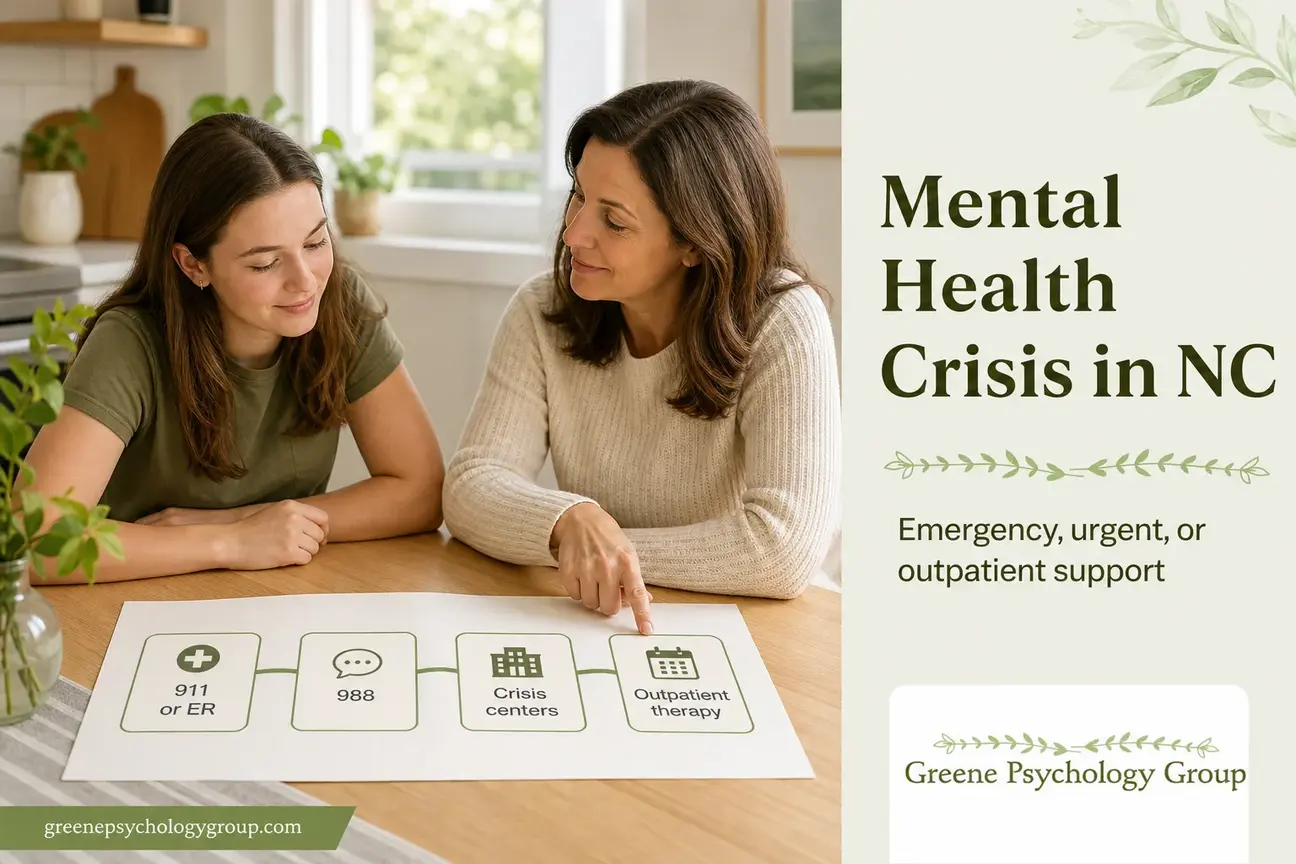
If you are trying to decide whether a situation is a mental health crisis NC residents should handle through 988, an urgent non-emergency need, or an immediate emergency, start with safety. If there may be immediate danger, a life-threatening emergency, serious injury, or a need for emergency responders now, call 911 or go to the nearest emergency room. If the concern is a mental-health or suicidal crisis, call or text 988 or use online chat through the 988 Lifeline. If the situation is urgent but not life-threatening, mobile crisis teams, community crisis centers, open access clinics, or the NC Peer Warmline may be appropriate depending on what is happening.
Quick answer: Use 911 or the nearest emergency room for immediate danger or a life-threatening emergency. Use 988 for a mental-health or suicidal crisis, emotional distress, or urgent support when emergency responders may not be needed. Use mobile crisis, community crisis centers, or open access clinics for urgent behavioral-health needs that are not clearly life-threatening. Outpatient therapy may fit ongoing concerns when the person is safe enough to wait for a scheduled appointment.
How to think about a mental health crisis NC families may face
It is common to feel unsure in the moment. A parent may wonder whether a teen’s statements are an emergency. A partner may be trying to decide whether to call 988 or drive to a crisis center. An adult may feel overwhelmed but not know whether outpatient therapy is enough. You do not need to make a perfect clinical decision before seeking help.
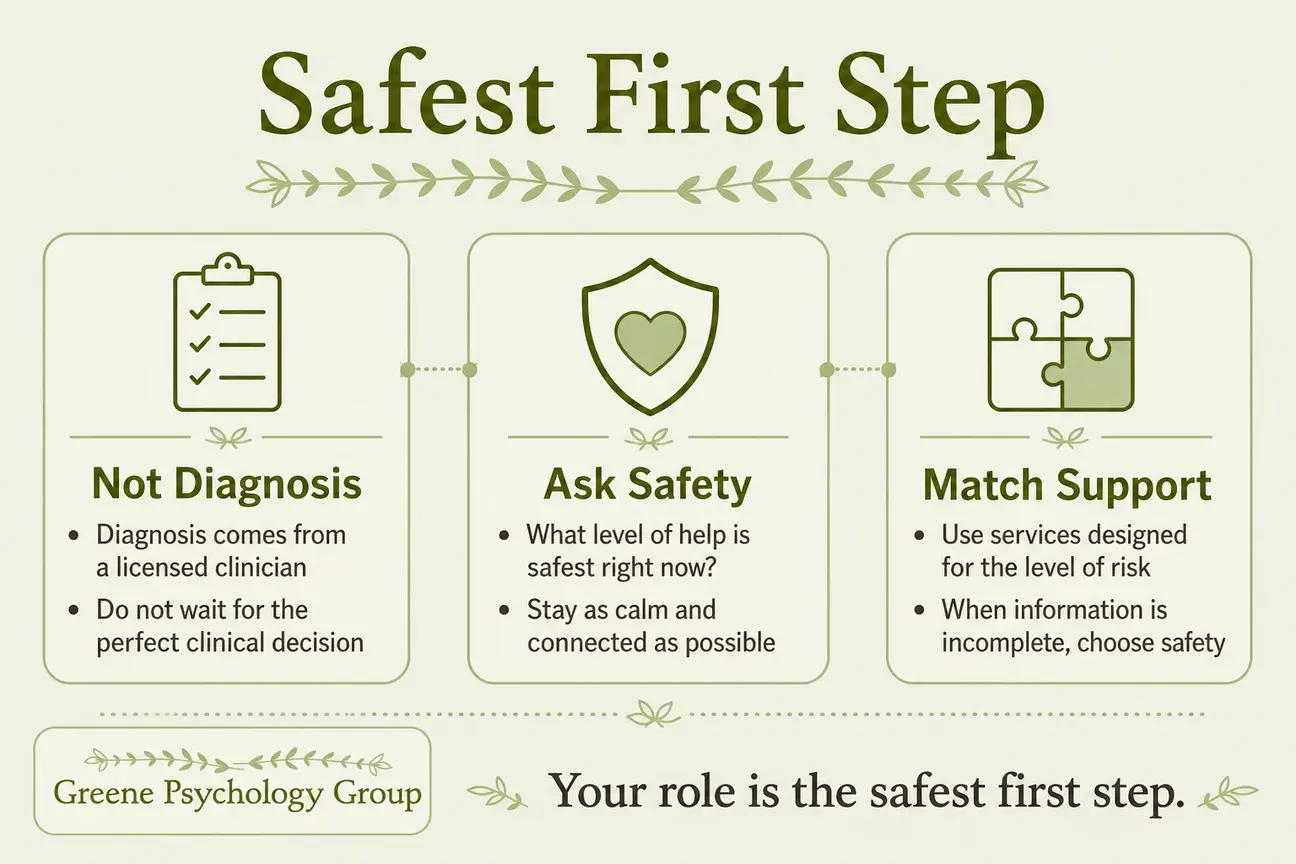
The most important question is not “What is the exact diagnosis?” It is “What level of help is safest right now?” Diagnosis comes from a licensed clinician. In a tense moment, your role is to choose the safest first step, stay as calm and connected as possible, and use services designed for the level of risk.
When information is incomplete, choose the option that protects life and safety first. It is better to use a crisis or emergency resource and be redirected than to wait because you are afraid of choosing the wrong door. Crisis systems are designed to help people sort out next steps under pressure.
| Situation | First option | Why |
|---|---|---|
| Immediate danger or life-threatening emergency | 911 or nearest emergency room | Emergency responders or medical evaluation may be needed now. |
| Mental-health or suicidal crisis | 988 by call or text, or online chat | Crisis counseling and connection to resources may be needed right away. |
| Urgent but not life-threatening behavioral-health need | Mobile crisis, community crisis center, or open-access clinic | Same-day or in-person crisis support may be available. |
| Ongoing concern without immediate danger | Outpatient therapy or another scheduled behavioral-health appointment | Assessment and continuing care can address persistent concerns over time. |
These categories can overlap. Someone may start with 988 and be connected to another service. A family may begin at an urgent option and be told that emergency care is safer. When in doubt about immediate danger, use emergency services rather than waiting for a routine appointment.
When 911 or the nearest emergency room is the safest first step
Call 911 or go to the nearest emergency room when there may be immediate danger to someone’s life, a serious medical concern, a serious injury, or a situation that requires emergency responders right away. For life-threatening emergencies, NCDHHS crisis services guidance directs people to call 911 and notes that callers can ask for a Crisis Intervention Team officer where available.
Use emergency help if the situation is rapidly escalating and you cannot reasonably keep yourself or another person safe. Examples may include a person who is at immediate risk of serious harm, a severe medical concern occurring alongside emotional distress, or an unsafe situation in which police, fire, or emergency medical responders may be needed.
If you are a family member or friend, do not delay emergency help because you are worried about overreacting. You can describe what you are seeing and ask for help. If leaving the person alone would increase danger, try to stay connected while you contact emergency services, but do not put yourself in danger.
When calling 911, use plain language. Say where the person is, what immediate danger you are seeing, whether there are injuries or medical concerns, and whether the person is willing to accept help. If you do not know an answer, say that. The goal is to communicate what responders need to make the situation safer.
Do not use an outpatient therapy contact form, email, voicemail, or appointment request for an emergency. Outpatient practices are not set up to provide immediate emergency response, and a delayed message may not be seen in time.
988 North Carolina support for crisis counseling
988 North Carolina support is for mental-health crises, suicidal crises, emotional distress, and urgent support when 911 may not be the right first step. You can call or text 988. You can also use online chat through the 988 Suicide & Crisis Lifeline. If the situation becomes life-threatening or someone needs emergency responders immediately, call 911 instead.
The state’s crisis-services information describes 988 as a way to connect with a crisis counselor and, when appropriate, connect with additional resources. This may include guidance about mobile crisis or other local supports. 988 North Carolina support is often a helpful first call when you are scared, unsure what to do, or trying to support someone who is distressed but does not appear to need emergency medical response at that moment.
A person can reach out for themselves. A parent, partner, friend, or caregiver may also seek guidance about how to respond to someone they are worried about, while understanding that the responding service will guide what it can do based on the situation and its policies.
If you contact 988 for someone else, it can help to know the person’s location, whether they are alone, whether there is immediate danger, and whether they are willing to speak directly with the crisis counselor. You do not need a polished explanation. Start with what made you worried and what kind of help you are trying to find.
988 North Carolina support is not only for moments when someone has already reached a breaking point. It can also be used when distress is rising, a person feels unable to cope safely, or a caregiver needs help deciding whether to use a more urgent service. If safety becomes uncertain while you are talking, follow the crisis counselor’s direction or call 911.
For readers in Wake County and nearby areas, Greene Psychology Group also has a related article on what to do in a mental health crisis. That article can be useful for education, but it is not a substitute for 911, 988, or a crisis service when help is needed now.
Mobile crisis teams for urgent mental health care
Mobile crisis may be part of urgent mental health care when a person needs timely behavioral-health support but the situation does not appear to require an ambulance or emergency department. NCDHHS describes mobile crisis teams as able to meet people in a safe location and provide in-person help. In many situations, 988 can help a caller think through whether mobile crisis or another resource may fit.
Mobile crisis is not the same as 911. It is not a guarantee that a specific team will arrive at a specific time or that every county circumstance will be handled the same way. Availability, dispatch procedures, and next steps can vary. If there is immediate danger, a medical emergency, or a need for emergency responders, call 911 or go to the nearest emergency room.
Mobile crisis can be especially relevant when a person is too distressed to wait for a routine appointment, a caregiver needs help assessing next steps, or the person may benefit from being seen outside of a hospital setting. The safest way to use this option is to contact 988 or the appropriate state or local crisis directory and let the crisis system guide the next step.
Urgent mental health care can include several different doors, and mobile crisis is only one of them. Depending on the situation, a crisis counselor may suggest 911, a community crisis center, an open-access clinic, or another local resource. Try to treat that guidance as a way to match the level of help to the level of risk.
Community crisis centers and when they may help
Community crisis centers are places where people can receive urgent help for mental-health or substance-use concerns without going to an emergency room. NCDHHS describes community crisis centers as safe places where people can get help from licensed clinicians. The state notes that most are open 24 hours a day, 7 days a week, and most do not require an appointment.
A community crisis center may be a reasonable option when the person needs in-person support soon, the situation is more urgent than a routine therapy appointment, and emergency medical care does not appear to be needed. These centers can help clarify what level of care may be appropriate, but services, age ranges, and capacity can vary by location.
Before traveling, check the current NCDHHS listing or call ahead when possible. Do not assume every center offers the same services or can address every medical or safety situation. If immediate danger emerges while you are deciding, shift to 911 or the nearest emergency room.
For parents and caregivers, community crisis centers may be easier to understand as “not routine therapy, but not necessarily the emergency room.” They are part of a crisis continuum. They can be useful when someone needs a licensed clinician’s help soon and waiting days or weeks for an outpatient intake does not feel safe enough.
It may help to bring basic information if you go to a crisis center: the person’s name, age, current location, emergency contact information, and a brief description of what changed. Avoid trying to prepare a long history while the situation is urgent. The priority is helping the receiving team understand what is happening now.
Open access clinics for same-day assessment
Open access clinics, sometimes called walk-in clinics, can be another path for urgent behavioral-health needs. NCDHHS says open access clinics offer same-day support for mental-health or substance-use needs. The state describes a process in which people can walk in during clinic hours, receive an assessment, and be connected with an appropriate level of care.
This option may fit when someone needs help sooner than a scheduled outpatient appointment but is not in immediate danger. For example, a person may be overwhelmed, struggling to function, or unsure what services they need. A walk-in assessment can help determine whether outpatient therapy, a crisis service, a higher level of care, or another referral may be appropriate.
Open access clinics are not a substitute for 911. They also are not the same as starting ongoing therapy with a chosen outpatient therapist. Hours, locations, eligibility, and services may vary, so check current details before going. If the person’s safety changes or the situation escalates, choose emergency or crisis help rather than continuing to wait.
Open access clinics can be especially useful when the main question is, “What level of care do we need?” A same-day assessment may help sort out whether the next step is scheduled therapy, a crisis resource, or another type of behavioral-health support. That assessment is not the same as diagnosing yourself; it is a way to involve a qualified professional in the decision.
NC Peer Warmline for support before or after a crisis
The NC Peer Warmline may be a helpful option when someone wants connection, emotional support, or a conversation with a trained peer, but the situation is not a life-threatening emergency. The number is 1-855-PEERS-NC, or 1-855-733-7762. NCDHHS describes the NC Peer Warmline as a free, private phone number staffed by people with personal experience with mental-health or substance-use concerns, and the state page describes current English-language availability as 24 hours a day, 7 days a week.
A warmline is different from emergency response. It can be useful when someone feels isolated, emotionally worn down, or unsure whether they need more formal help. It may also be helpful after a difficult event, when a person is no longer in immediate crisis but still wants to talk with someone who understands.
The NC Peer Warmline is not the right first choice for immediate danger. It also is not a replacement for 988 when someone needs immediate crisis counseling. If you are unsure whether the situation has crossed into crisis, 988 is usually the more appropriate crisis-support option.
Some people use a warmline as part of a broader support plan after urgent mental health care has passed. For example, a person might have outpatient appointments scheduled and still want peer support during a difficult evening. If distress intensifies or safety becomes uncertain, move from warmline support to 988, 911, or another crisis resource.
How parents, partners, and family members can help
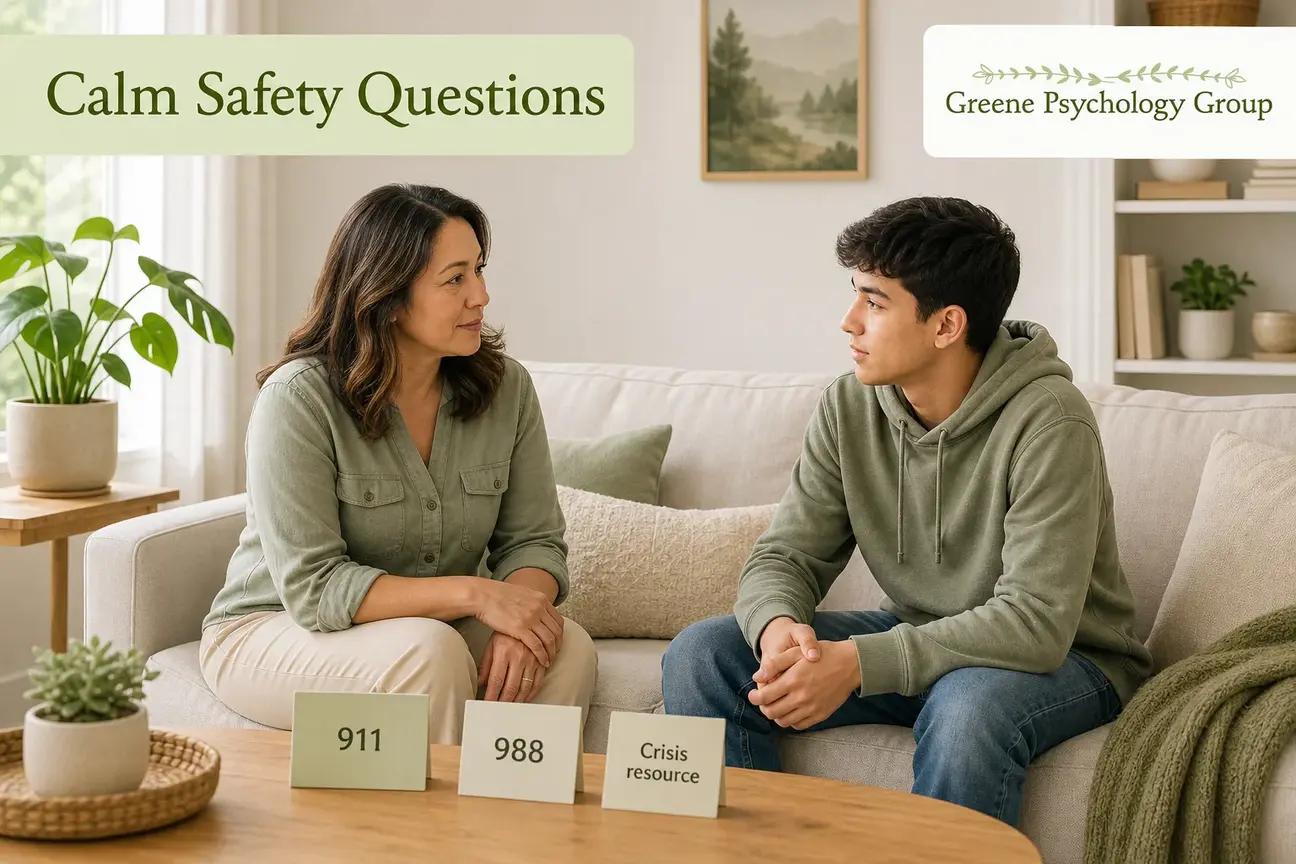
When someone you care about is struggling, it is natural to want the perfect words. You do not have to become their therapist. Your job is to stay as calm as you can, ask direct safety-oriented questions, and help connect them to the right level of support.
You might say, “I’m worried about you, and I want to understand what kind of help you need right now.” If you are concerned about immediate safety, ask directly and calmly whether they feel able to stay safe. Asking about safety does not diagnose them, and it does not replace professional support. It simply helps you decide whether to call 911, contact 988, or use another crisis resource.
If the person is willing, sit with them while they call or text 988, look up a community crisis center, or contact an open-access clinic. If you call on their behalf, be ready to describe what is happening, where the person is, whether there is immediate danger, and what support is already available nearby.
Parents of teens may face an added layer of worry. If a teen is in immediate danger, use 911 or the nearest emergency room. If the teen is in emotional crisis but emergency responders may not be needed, 988 can be a first step. For ongoing therapy, parents and teens should ask the practice about consent and confidentiality rather than relying on general assumptions.
Try not to argue about whether the person is “really” in crisis. Focus on what would make the next hour safer. If the person refuses help and you believe immediate danger is present, use emergency services. If you are unsure, 988 can help you think through options in the moment.
It can also help to reduce the number of people giving advice at once. Choose one calm person to speak, one person to handle practical details, and one person to contact help if needed. Too many voices can increase distress, even when everyone is trying to be supportive.
Safety planning without trying to manage everything alone
Safety planning can be helpful when it is done collaboratively with a qualified professional or crisis service. In this article, safety planning means identifying what support the person should use, reducing delay in reaching help, and clarifying who to contact if risk increases. It does not mean creating a detailed self-harm plan on your own or trying to manage a dangerous situation privately.
After a crisis contact, write down the service used, any follow-up instructions, and any appointments or referrals suggested. If a crisis counselor, clinician, or medical professional recommends a higher level of care, take that recommendation seriously. If the person’s safety worsens, return to 911 or 988 rather than waiting for an outpatient appointment.
Families can also plan practical supports after the immediate situation has passed. That might include arranging transportation to a follow-up visit, helping the person remember an appointment, or asking what kind of check-in feels supportive. Keep the focus on connection and next steps, not blame.
If the person is an adult, respect their privacy while still taking safety seriously. If the person is a teen, parents and caregivers may need to stay more involved while also asking professionals about confidentiality and consent. The exact balance can depend on the situation and the setting providing care.
What to do after urgent mental health care has passed
After urgent mental health care, people often feel relief, exhaustion, confusion, or all three. The next step is usually follow-up. That may include a recommendation from a crisis clinician, a primary-care appointment, outpatient therapy, family support, or another level of behavioral-health care. Try to keep written notes from the crisis contact so you do not have to rely on memory later.
If the person used 988, a mobile crisis team, a community crisis center, open access clinics, or the NC Peer Warmline, ask what follow-up was suggested. If the person received emergency care, follow the discharge or referral instructions provided by that setting. If the next step is outpatient therapy, schedule when the person is safe enough to wait for a routine appointment.
It can also help to reduce pressure in the days after a crisis. Families may want a complete explanation right away, but the person may need rest and steady support before they can talk in detail. Focus first on safety, connection, and follow-through with professional recommendations.
After urgent care, watch for practical barriers that could interrupt follow-up. Transportation, insurance questions, work schedules, school schedules, and fear about starting therapy can all make the next step harder. Solving one practical barrier at a time is often more useful than trying to force a long conversation before the person is ready.
When outpatient therapy may be appropriate
Outpatient therapy may be appropriate when concerns are ongoing, the person can remain reasonably safe, and there is no need for emergency response or same-day crisis intervention. Examples may include anxiety, depressed mood, stress, grief, relationship concerns, family conflict, life transitions, or patterns that are affecting daily functioning but are not creating immediate danger.
A licensed clinician can assess concerns, discuss therapy options, and help determine whether outpatient care is an appropriate level of support. Therapy may include building coping skills, understanding patterns, improving communication, processing grief or stressors, and identifying when more support is needed.
Greene Psychology Group offers mental health therapy and individual therapy for adolescents and adults. The practice also offers online therapy in North Carolina for people who are physically in the state during the session. These are scheduled outpatient services.
What outpatient therapy can help with after safety is stable
Outpatient therapy is usually a slower, more collaborative process than crisis care. The first sessions often focus on understanding what has been happening, what the client wants help with, and what supports are already in place. A therapist may ask about symptoms, stressors, relationships, routines, safety history, strengths, and goals.
For adults, therapy may focus on anxiety, depression, work stress, grief, relationship concerns, ADHD-related patterns, trauma history, or life transitions. For adolescents, therapy may involve both the teen and parent or caregiver in ways that fit the teen’s needs and the practice’s confidentiality policies. Parents should ask directly how communication, consent, and privacy are handled.
Therapy may also help families talk about what happened after an urgent situation without turning every conversation into an interrogation. A therapist can help the client identify coping skills, notice warning signs, and decide when additional support is needed. The goal is not to replace crisis resources, but to build ongoing care when scheduled treatment is the right level of help.
If insurance or payment is part of the decision, it is reasonable to ask questions before starting. Greene Psychology Group is in-network with most BCBS and Aetna plans, out-of-network for most other plans, and accepts self-pay clients. Coverage, deductibles, and reimbursement vary, so confirm benefits with your insurer and the practice before relying on a plan detail. Self-pay and uninsured clients receive a Good Faith Estimate under the No Surprises Act.
Considering outpatient therapy in North Carolina?
If the immediate situation has passed and you are looking for scheduled outpatient therapy, you can contact Greene Psychology Group, call 919-205-5339, or email [email protected]. Because the website notes phone issues, use the phone and email together if needed. The practice has offices in Raleigh and Asheville, and online therapy is for people physically in North Carolina during the session.
When reaching out, share your contact information, a brief reason for seeking therapy, whether you prefer in-person or online sessions, and insurance information. Do not send detailed health information through the contact form or email, because the contact form and email are not encrypted.
If cost or coverage is part of your planning, review the practice’s insurance and payment information and verify benefits with your insurer and the practice. Do not include detailed clinical history in an email or web form; a brief reason for reaching out is enough for an initial contact.
A calmer way to make the next decision
When emotions are high, decisions can feel all-or-nothing. It may help to slow the question down: “What does safety require right now, and what can wait for a scheduled conversation?” That question can reduce pressure on family members, partners, and friends who are trying to help but do not have clinical training.
It is also okay if the first resource redirects you. A crisis counselor may suggest emergency care. A community crisis center may recommend another level of treatment. An outpatient therapist may explain that a different service is needed first. Redirection is not failure; it is part of matching the person’s current needs to the right setting.
For a mental health crisis NC resources can feel confusing, but you do not have to sort every option alone. Start with immediate safety, use urgent supports when risk is urgent, and consider outpatient therapy when the person is safe enough to wait for scheduled care.
Key takeaways
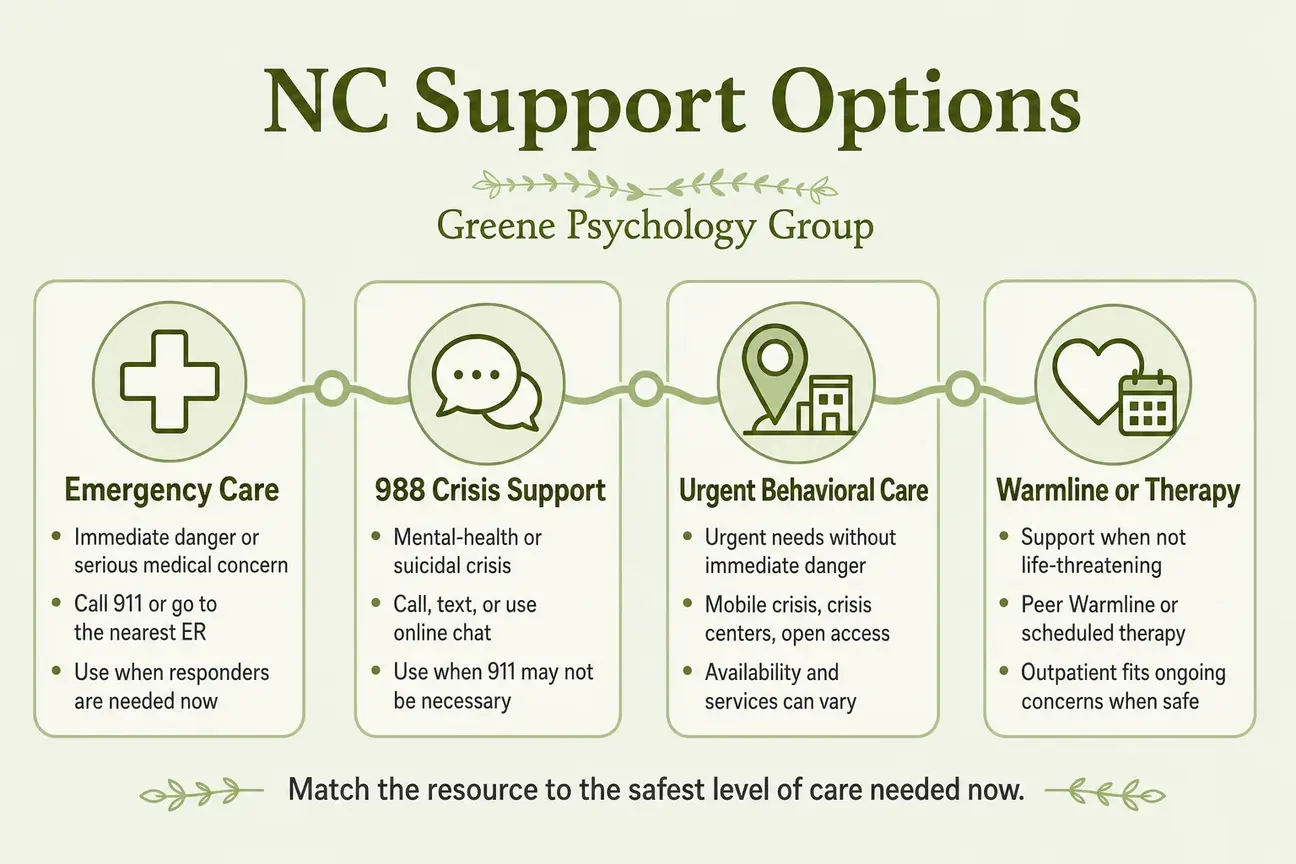
- Use 911 or the nearest emergency room for immediate danger, life-threatening emergencies, serious medical concerns, or situations requiring emergency responders now.
- Use 988 by call, text, or online chat for a mental-health or suicidal crisis, emotional distress, or urgent support when 911 may not be necessary.
- Mobile crisis teams, community crisis centers, and open access clinics can help with urgent behavioral-health needs, but availability and services can vary.
- The NC Peer Warmline can offer free, private peer support when the situation is not a life-threatening emergency and immediate crisis counseling is not the main need.
- Outpatient therapy may fit ongoing concerns when the person is safe enough to wait for a scheduled appointment.
- Greene Psychology Group provides outpatient psychotherapy, not emergency or crisis services.
This article is for general education and isn't a substitute for diagnosis or treatment from a licensed professional. If you are in crisis, call or text 988 or call 911.
For immediate danger, call 911 or go to the nearest emergency room. For a mental-health or suicidal crisis, call or text 988 or use online chat at 988lifeline.org.
Frequently Asked Questions
What is the difference between a mental-health crisis and a mental-health emergency?
An emergency involves immediate danger, a life-threatening situation, a serious medical concern, or a need for emergency responders now. A mental-health crisis may still require immediate support, but 988, mobile crisis, a community crisis center, or another crisis service may be appropriate when emergency responders are not needed.
Should I call 911 or 988?
Call 911 for immediate danger or a life-threatening emergency. Call or text 988, or use 988 online chat, for a mental-health or suicidal crisis, emotional distress, or urgent support when 911 may not be necessary.
Can a mobile crisis team come to someone’s home?
Mobile crisis teams may meet people in a safe location, and crisis services can help determine whether mobile response is appropriate. Availability, response procedures, and next steps can vary, so 911 remains the right choice when there is immediate danger.
What is a community crisis center?
A community crisis center is a place where someone can receive urgent mental-health or substance-use help from a licensed clinician without going to an emergency room. Most are open 24/7 and most do not require an appointment, but local details can change.
What is an open-access or walk-in clinic?
Open-access or walk-in clinics offer same-day support, assessment, and connection to an appropriate level of care for mental-health or substance-use needs. Hours, locations, eligibility, and services vary by clinic.
What is the NC Peer Warmline number?
The NC Peer Warmline number is 1-855-PEERS-NC, or 1-855-733-7762. It may be useful for peer support and connection when the situation is not a life-threatening emergency or an immediate crisis requiring 988.
Can outpatient therapy replace crisis care?
No. Outpatient therapy can help with ongoing concerns when the person is safe enough to wait for a scheduled appointment, but it is not emergency or crisis care. Use 911, 988, or an appropriate crisis resource when help is needed immediately.