
Adult ADHD Emotions: Why Overwhelm Feels So Hard
If adult ADHD emotions can feel bigger, faster, or harder to recover from than other people seem to expect, that does not mean you are “too sensitive” or intentionally difficult. Emotional overwhelm can happen when ADHD-related attention, inhibition, working memory, transitions, and competing demands are strained at the same time. It can also overlap with anxiety, depression, sleep problems, trauma responses, relationship stress, or a season of too many demands.
Quick answer: Adults with ADHD may feel emotionally overwhelmed when the brain is trying to manage feelings, tasks, time pressure, interruptions, and relationships all at once. Frustration, perceived criticism, unfinished tasks, and sudden transitions can intensify the response. These experiences are not specific to ADHD, so a licensed clinician considers developmental history, patterns across settings, functional impact, and other possible explanations before making a diagnosis or treatment recommendation.
How adult ADHD emotions can become overwhelming
ADHD is often described in terms of attention, hyperactivity, and impulsivity, but many adults are most distressed by the emotional side: irritability after small interruptions, feeling crushed by criticism, shutting down when tasks pile up, or having a hard time returning to calm after conflict. Those reactions may be connected to ADHD, but they are not a stand-alone proof of ADHD.
The National Institute of Mental Health describes ADHD as a neurodevelopmental disorder involving persistent patterns of inattention, hyperactivity, and/or impulsivity that interfere with functioning across situations. NIMH also notes that symptoms usually begin in childhood and may continue through adolescence and adulthood. That developmental pattern matters because feeling emotionally overwhelmed in adulthood can have many causes.
It can help to separate three ideas. Emotional overwhelm is the lived experience of feeling that your feelings, stimulation, or demands exceed your current coping capacity. Emotional dysregulation means difficulty noticing, modulating, expressing, or recovering from emotional activation. An ADHD diagnosis is a clinical determination that considers a broader pattern of symptoms, history, impairment, and alternative explanations.
If you are reading as a partner or family member, this distinction matters. A strong emotional reaction is not automatically manipulation, carelessness, or a lack of love. At the same time, ADHD does not excuse hurtful behavior. It can explain some of the strain while still leaving room for boundaries, repair, and support.
ADHD emotional dysregulation is an experience, not a diagnosis
ADHD emotional dysregulation is a phrase people often use to describe rapid frustration, intense hurt, irritability, tearfulness, panic-like urgency, or shutdown that feels difficult to control. It can be a useful description, especially when it helps a person notice patterns without shame. But it is not the same thing as a diagnosis.
Emotional dysregulation can appear in many situations. Someone may feel emotionally flooded after a conflict, during grief, when sleep has been poor, when anxiety is high, after trauma reminders, or during depression. Some people with ADHD experience intense emotions, and some do not describe this as a major concern. The presence or absence of ADHD emotional dysregulation does not confirm or rule out ADHD.
There is also a difference between feeling something intensely and acting on it in a way that damages trust. Therapy often pays attention to both: what is happening internally and what happens next. A person can validate the emotion while also learning to pause, repair, communicate more clearly, or ask for support earlier.
For readers who want a broader explanation of emotion regulation, Greene Psychology Group has an article on emotional dysregulation. This article stays focused on why emotional overwhelm may show up when adult ADHD patterns, stress, relationships, and daily demands intersect.
What drives ADHD overwhelm when demands pile up
ADHD overwhelm often begins before the visible emotional reaction. A person may look fine on the outside while managing a crowded mental workspace: several unfinished tasks, a text that needs a reply, a work deadline, a partner’s request, a misplaced item, and a vague sense of being behind. Then one more demand lands, and the emotional response seems disproportionate to that one moment.
The CDC explains that ADHD in adults may look different than ADHD in childhood and may become more noticeable or impairing as adult demands increase. The CDC describes adult difficulties with attention, lengthy tasks, organization, behavioral control, and internal restlessness. That helps explain why adult responsibilities can make previously compensated patterns feel much harder to manage.
Think of ADHD overwhelm as a load problem rather than a character flaw. The person may be trying to track too many moving parts with limited mental bandwidth. When working memory, inhibition, time awareness, and emotional salience are all taxed, the feeling can shift quickly from “I need to handle this” to “I cannot handle anything.”
Inhibition and rapid reactions
Inhibition is the ability to pause before speaking, acting, or sending the message. When inhibition is strained, a person may respond before the calming part of the brain has time to catch up. This can look like interrupting, snapping, over-explaining, leaving the room abruptly, or sending a text that later feels too intense.
This does not mean the person wanted to hurt someone. It also does not mean other people should ignore the impact. It means the repair conversation may need to include both the trigger and the response: “What made that moment so hard?” and “What do we want to do differently next time?”
Working-memory overload
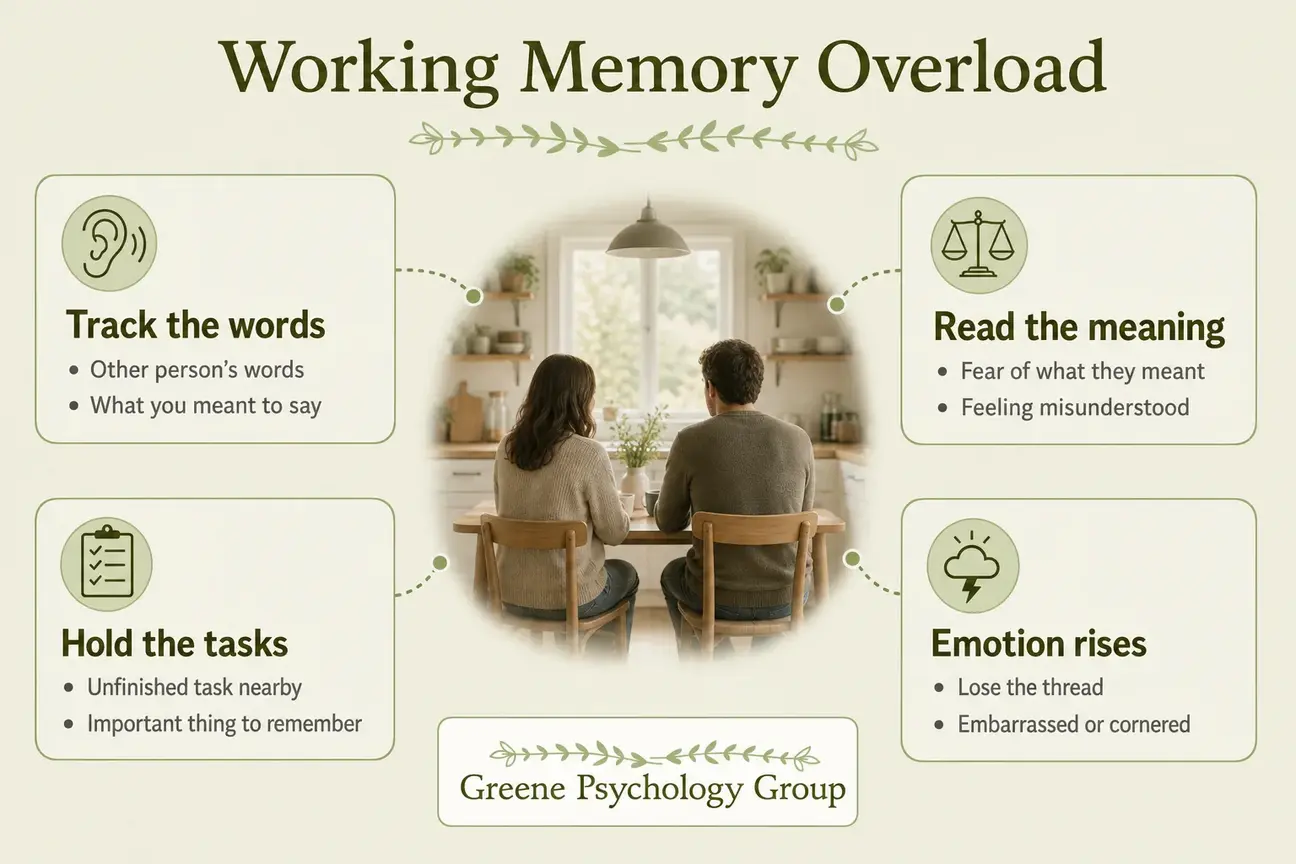
Working memory helps you hold information in mind long enough to use it. In a tense conversation, working memory might be trying to track what the other person said, what you meant to say, what you are afraid they meant, what task is still unfinished, and whether you are about to forget something important.
When working memory is overloaded, the person may lose the thread and then feel embarrassed, cornered, or misunderstood. That can feed ADHD emotional dysregulation because the emotion is not only about the topic. It is also about the mental effort of trying to keep up.
Task initiation, unfinished demands, and shame
Starting a task can be emotionally loaded when a person has a long history of feeling behind, criticized, or inconsistent. A bill, email, laundry pile, or work assignment may seem simple to someone else, but it can carry a heavy emotional message: “I am failing again.”
That shame response can intensify ADHD overwhelm. The task is no longer just a task. It becomes a symbol of competence, reliability, or worth. When partners or family members respond only to the unfinished chore, they may miss the emotional weight attached to it. When the person with ADHD responds only to shame, they may miss the practical need for follow-through.
Transitions and loss of momentum
Transitions can be hard because they require the brain to stop one stream of attention, hold the next goal in mind, and tolerate the discomfort of shifting gears. Ending an absorbing activity, leaving for an appointment, changing plans, or moving from work mode to family mode may take more effort than others realize.
For some adults, transition stress is where ADHD frustration tolerance gets tested. The feeling may be “I was finally focused, and now I have to stop,” or “I cannot find the entry point into this next thing.” The visible emotion may be irritation, but the underlying strain may include pressure, disorientation, or fear of losing control of the day.
Attention captured by emotional information
A critical comment, a delayed reply, an unexpected tone, or a small mistake can capture attention intensely. Once the brain locks onto the emotional meaning, it may be hard to shift away. This is one reason perceived rejection, conflict, or uncertainty can feel so consuming.
The goal is not to tell yourself the feeling is wrong. A more useful first step is often to slow the interpretation. What exactly happened? What else could it mean? What information is missing? What response would still make sense tomorrow?
ADHD frustration tolerance and everyday blocked goals
ADHD frustration tolerance refers to how much delay, confusion, interruption, or obstacle a person can handle before emotion escalates. Everyone has limits. ADHD-related patterns can lower the threshold when the person is already managing fatigue, time pressure, sensory input, or a long list of demands.
Common blocked-goal moments include unclear instructions, repeated corrections, unexpected waiting, a technology problem, a missing item, a partner changing the plan, or a task that has more steps than expected. The emotion may rise quickly because the person is not responding only to the immediate obstacle. They may also be responding to the fear that the whole day is about to unravel.
For partners and family members, it can be tempting to argue that the reaction is “too much.” That usually does not help during escalation. A calmer approach is to name the obstacle and offer one concrete next step: “The form is confusing. Do you want ten minutes alone, or should we identify the first line together?”
For the person experiencing the frustration, it may help to name both the feeling and the blocked goal: “I am frustrated because I cannot find the next step.” This does not solve every situation, but it can reduce the sense that the emotion is the entire problem.
ADHD rejection sensitivity and perceived criticism
ADHD rejection sensitivity is a commonly used phrase for strong emotional reactions to perceived criticism, exclusion, disappointment, or disapproval. It is not an official diagnosis, and it does not prove that a person has ADHD. Still, many adults find the phrase helpful because it describes the speed and intensity of the hurt they feel.
Perceived rejection can be especially powerful when attention narrows around one possible meaning: “They are disappointed in me,” “I ruined it,” “They are going to leave,” or “Everyone thinks I am unreliable.” Those interpretations may be influenced by ADHD-related mistakes and corrections, but they can also be shaped by anxiety, depression, trauma history, relationship experiences, or current stress.
ADHD rejection sensitivity can affect relationships because the reaction may arrive before clarification. A partner says, “Did you remember to call?” and the person hears, “You never do anything right.” A supervisor asks for a revision, and the person feels exposed or ashamed. A friend replies briefly, and the person assumes distance.
A gentle pause can help when it is possible: “I am noticing that I heard that as criticism. Is that what you meant?” This is not a complete solution or a rule that works in every situation. It is a way to create space between the first emotional meaning and the next action.
Why anxiety, depression, sleep, and trauma can look similar
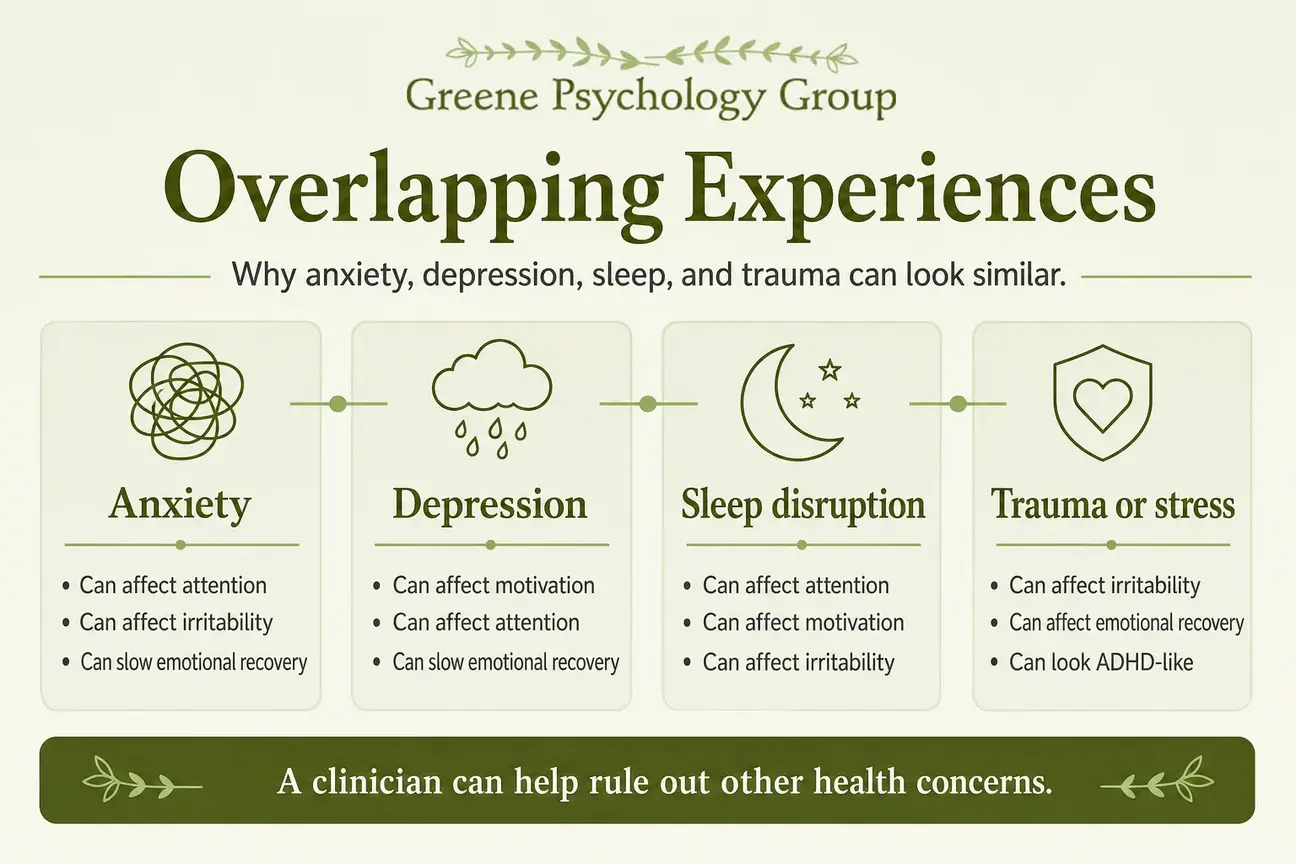
Emotional overwhelm is not specific to ADHD. This is one reason self-diagnosis can be misleading, even when an online description feels familiar. Anxiety, depression, sleep disruption, trauma responses, substance use, learning differences, medical concerns, relationship stress, and major life transitions can all affect attention, motivation, irritability, and emotional recovery.
NIMH notes that ADHD often co-occurs with sleep problems, anxiety, and depression, which can make diagnosis and treatment more difficult. The CDC also states that a medical and psychological exam may be needed to rule out other health problems that can cause ADHD-like symptoms or commonly occur with ADHD.
| Experience or context | Why it can resemble ADHD overwhelm | Why assessment matters |
|---|---|---|
| Anxiety | Worry, vigilance, irritability, and difficulty concentrating can make emotions feel urgent. | Anxiety may coexist with ADHD or account for some of the distress. |
| Depression | Low motivation, slowed thinking, irritability, and withdrawal can affect follow-through and relationships. | Mood symptoms can influence attention, energy, and emotional responsiveness. |
| Sleep problems | Fatigue can reduce concentration, patience, and stress tolerance. | Sleep disruption can worsen ADHD-like difficulties or intensify existing ADHD concerns. |
| Trauma responses | Hyperarousal, shutdown, avoidance, or heightened sensitivity can make conflict and transitions feel unsafe. | Trauma-related patterns need careful, trauma-informed assessment and support. |
| Relationship stress | Repeated misunderstandings can create defensiveness, resentment, or emotional withdrawal. | The relationship context may be central even when ADHD is also present. |
| ADHD | Developmental, cross-situational patterns involving attention, impulsivity, organization, and impairment can strain daily life. | A licensed clinician considers history, settings, impairment, and alternatives. |
This is also why ADHD overwhelm may worsen during life transitions. A new job, parenthood, caregiving, grief, a move, a breakup, a health change, or increased independence can expose patterns that were previously managed by structure, support, or habit. The emotional intensity may be real, even if the explanation is more complex than one label.
How relationships can become part of the emotional cycle
Relationship stress can magnify adult ADHD emotions because daily life depends on shared expectations. A missed detail, lateness, forgotten commitment, impulsive comment, or emotional withdrawal can affect trust. The person with ADHD may feel criticized or ashamed. The partner or family member may feel alone with the practical burden. Both people may start reacting to the pattern rather than the single event.
The cycle can sound like this: one person asks a question, the other hears criticism, the first person feels dismissed, the second person feels attacked, and the practical issue remains unresolved. Over time, even small reminders can carry emotional history.
Supportive communication does not mean avoiding accountability. It means separating the person from the behavior. A partner might say, “I know you are overwhelmed, and I still need us to make a plan for the missed appointment.” The person with ADHD might say, “I felt ashamed and reacted defensively. I want to talk about a system that will help.”
When patterns are persistent, relationship counseling or family therapy may help people discuss expectations, repair attempts, communication habits, and boundaries. Counseling cannot guarantee a specific outcome, but it can provide a structured place to slow down patterns that have become difficult to manage alone.
For partners and family members
During escalation, try to focus less on proving whether the reaction is reasonable and more on reducing the intensity enough to return to the issue later. You might ask, “What happened just now?” or “Do you want a pause before we keep talking?” Clear, concrete requests are often easier to respond to than broad criticisms.
It is also appropriate to maintain boundaries. Validating an emotion is not the same as accepting yelling, threats, intimidation, or repeated hurtful behavior. A supportive response can sound like, “I can hear that you feel overwhelmed. I am going to pause this conversation if we cannot speak respectfully.”
For parents of teens, emotional intensity may raise questions about ADHD, anxiety, depression, stress, or family dynamics. Parents and teens should ask the practice about consent and confidentiality before starting therapy. This article does not provide legal advice about minors’ consent.
What to try when ADHD overwhelm is rising
The following ideas are educational coping options, not a treatment plan. They may help some people create a little more space in the moment, but they are not substitutes for diagnosis, therapy, medical care, or crisis support when those are needed.
- Name the emotion and the immediate demand. For example: “I am frustrated because I cannot find the first step,” or “I feel hurt because I heard that as criticism.”
- Reduce competing input when possible. Lowering noise, stepping away from a crowded room, or closing extra tabs may reduce the load enough to think.
- Pause before sending the message. If a text or email is emotionally charged, waiting before sending can prevent a temporary surge from becoming a longer conflict.
- Write down the next concrete step. Instead of solving the whole problem, identify the next visible action: call, open the document, put the appointment in the calendar, or ask for clarification.
- Return to the conversation after arousal decreases. Repair often works better when both people are calmer and can remember the goal.
- Protect basic routines where possible. Sleep, meals, movement, and predictable transitions are not treatment by themselves, but disrupted basics can make emotion regulation harder.
For ADHD frustration tolerance, the most useful step is often not a perfect strategy. It is a smaller step that prevents the moment from becoming all-or-nothing. “I need a pause” may be better than continuing a conversation that is becoming hurtful. “I can do the first five minutes” may be better than waiting to feel fully ready.
For ADHD rejection sensitivity, it may help to delay interpretation when possible. You do not have to dismiss your feeling. You can say, “This feels like rejection, and I need more information before I decide what it means.” That small pause can protect relationships from assumptions made at the peak of emotion.
How a licensed clinician assesses possible adult ADHD
A licensed clinician does not diagnose ADHD based only on emotional intensity. Assessment typically considers whether relevant patterns began in childhood, appear across more than one setting, and interfere with functioning at work, school, home, relationships, or daily responsibilities. Screening tools can be part of the conversation, but screening is not the same as diagnosis.
A careful assessment also looks at sleep, anxiety, depression, trauma, substance use, learning differences, medical factors, current stress, and relationship context. This does not mean the clinician is trying to dismiss ADHD. It means the goal is to understand the whole picture so support fits the person’s actual needs.
Greene Psychology Group should not be assumed to provide ADHD testing or formal ADHD evaluations based on this article. The practice does offer psychotherapy for adolescents and adults, and a licensed clinician can talk with clients about concerns, patterns, goals, and whether therapy or referral may be appropriate. You can learn more about Greene Psychology Group clinicians and their backgrounds on the practice website.
If you are looking for support, it is reasonable to ask a potential therapist how they think about ADHD, emotion regulation, anxiety, depression, sleep, trauma, and relationship stress. You can also ask what kind of assessment or referral they recommend if diagnostic clarity is important.
ADHD therapy adults may seek: what support can include
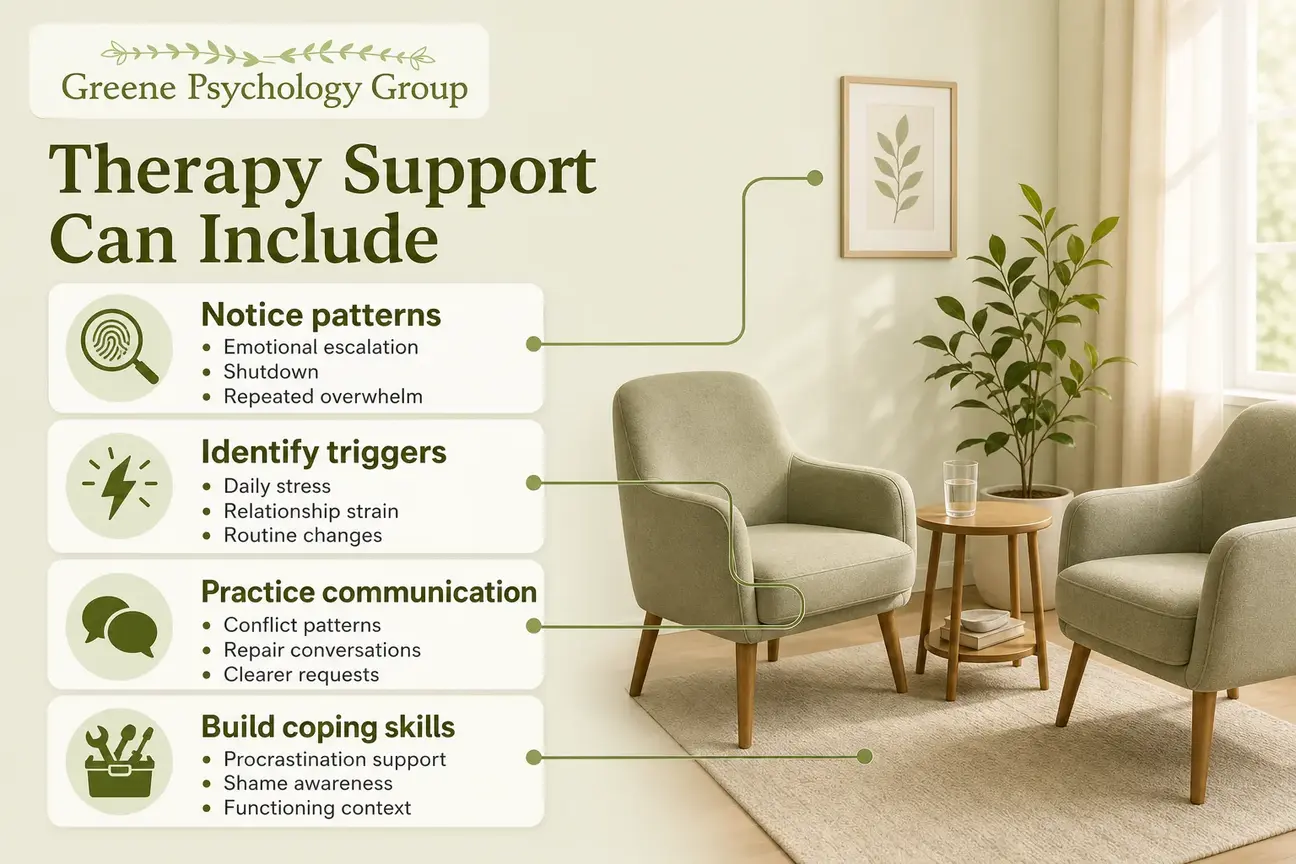
People often search for ADHD therapy adults when they are not only looking for a label, but for help with daily patterns: emotional escalation, shutdown, communication, procrastination, conflict, shame, and repeated overwhelm. Therapy may help a client notice patterns, identify triggers, practice communication, develop coping skills, and consider how stress, relationships, and routines affect functioning.
NIMH states that standard ADHD treatments include medication and psychosocial interventions, including cognitive behavioral therapy, parent training, and school interventions. More broadly, the NIMH psychotherapies page describes psychotherapy as a range of treatments in which a person works with a trained mental health professional to identify and change troubling emotions, thoughts, and behaviors. Therapy is not one-size-fits-all, and no article can tell you which approach is right for you.
For ADHD therapy adults may include work on recognizing escalation earlier, building practical supports, reducing shame, communicating needs, or repairing after conflict. Some clients also work on anxiety, depression, stress, grief, trauma-related responses, or relationship concerns alongside ADHD-related patterns. Greene Psychology Group offers individual therapy for adolescents and adults, but this article is not a promise of a specific treatment plan or outcome.
Therapy may also include discussion of whether other services are needed. Medication decisions belong with a prescriber; Greene Psychology Group does not prescribe medication or provide medication management. If a person needs formal testing, medication consultation, sleep evaluation, substance-use treatment, or a higher level of care, a therapist may discuss referral options.
When anxiety, depression, or stress also need attention
ADHD emotional dysregulation can become more difficult when anxiety, depression, or chronic stress are also present. Anxiety can make uncertainty feel urgent. Depression can reduce energy, motivation, and hope. Stress can make the nervous system more reactive and reduce the room available for patience.
Some people begin therapy thinking only about ADHD overwhelm and then realize that worry, mood, grief, burnout, or relationship strain are also part of the picture. Others begin with anxiety or depression and later explore whether ADHD-related patterns have been contributing to repeated stress. Either path is valid; the point is not to force one explanation.
If anxiety, mood symptoms, or chronic pressure are major concerns, a therapist can help sort through what may be contributing and what kind of support fits. Some people benefit from focusing on anxiety skills first, while others need to address stress load, relationship strain, grief, trauma-related responses, or depressive symptoms alongside attention and executive-function concerns.
Practical next steps for getting support
If emotional overwhelm repeatedly disrupts work, caregiving, school, relationships, or daily functioning, it may be time to talk with a licensed clinician. You do not have to wait until everything is falling apart. Support can be useful when conflict is becoming hard to repair, when sleep and mood concerns are persistent, when self-help is not enough, or when shame is keeping you isolated.
Greene Psychology Group offers individual psychotherapy for adolescents and adults, with offices in Raleigh and Asheville and online therapy in North Carolina for people physically in the state during sessions. To ask about starting therapy, you can contact Greene Psychology Group, call 919-205-5339, or email [email protected].
Because the contact form and email are not encrypted, share only contact details, a brief reason for reaching out, whether you prefer in-person or online sessions, and insurance information. Please do not send detailed health information through email or the contact form.
The practice is in-network with most BCBS and Aetna plans, and readers should confirm benefits with both their insurer and the practice. Other plans may be out-of-network, and self-pay is accepted. You can review the practice’s insurance and payment information. Uninsured and self-pay clients receive a Good Faith Estimate; no fees are quoted here.
What to remember about emotional overwhelm and ADHD
Adult ADHD emotions can feel confusing because the visible reaction may be only the final layer of a much larger load. Attention, inhibition, working memory, transitions, unfinished tasks, sleep, stress, and relationship context can all affect how quickly emotions rise and how long they take to settle.
At the same time, emotional intensity alone is not an ADHD diagnosis. ADHD overwhelm, ADHD rejection sensitivity, and ADHD frustration tolerance are useful phrases only when they lead to clearer understanding, not when they replace careful assessment. A licensed clinician can help sort through ADHD, anxiety, depression, sleep concerns, trauma responses, relationship patterns, and life stressors with more nuance than a checklist can provide.
This article is for general education and isn't a substitute for diagnosis or treatment from a licensed professional. If you are in crisis, call or text 988 or call 911.
Greene Psychology Group is not a crisis service. For immediate danger, call 911 or go to the nearest emergency room. For a mental-health or suicidal crisis, call or text 988 or use the 988 Lifeline.
Frequently Asked Questions
Is emotional dysregulation an official ADHD diagnosis?
No. Emotional dysregulation describes difficulty modulating, expressing, or recovering from emotional activation. It may occur with ADHD, but it is not a stand-alone ADHD diagnosis and does not prove that someone has ADHD.
Can anxiety or depression cause the same kind of emotional overwhelm?
Yes. Anxiety can increase worry, vigilance, irritability, and urgency. Depression can affect motivation, concentration, energy, and emotional responsiveness. Anxiety or depression may coexist with ADHD, or they may explain some experiences that look similar.
What is ADHD rejection sensitivity?
ADHD rejection sensitivity is a commonly used phrase for strong reactions to perceived criticism, exclusion, disappointment, or disapproval. It is not an official diagnosis. Perceived rejection can also be shaped by anxiety, depression, trauma history, relationship patterns, or current stress.
Why do interruptions and transitions feel so intense?
Interruptions and transitions can disrupt attention, working memory, and momentum. If someone is already managing several demands, being stopped or redirected may feel like losing control of the whole sequence, not just changing one task.
Can sleep problems make adult ADHD emotions worse?
Sleep problems can make attention, patience, and emotional recovery harder. Poor sleep can also mimic or intensify ADHD-like difficulties, which is one reason clinicians ask about sleep when assessing attention and emotional concerns.
How can a partner respond without dismissing or excusing the reaction?
A partner can validate the feeling while still keeping boundaries around behavior. Clear requests, processing time, calmer follow-up conversations, and repair after conflict often work better than debating whether the reaction was reasonable during escalation.
When should an adult consider therapy for emotional overwhelm?
Consider therapy when emotional reactions repeatedly disrupt work, caregiving, relationships, school, sleep, or daily functioning; when conflict is hard to repair; or when anxiety, depression, trauma-related responses, or stress are also persistent.