

Teen depression moodiness vs. typical mood changes: What parents should watch for
When a teenager seems irritable, withdrawn, exhausted, or unusually quiet, it can be hard to know whether you are seeing ordinary adolescence or something more serious. Quick answer: teen depression moodiness is not about one bad day, one slammed door, or one difficult week after a disappointment. Parents are usually looking for a pattern: changes that persist, cause distress, interfere with school, sleep, relationships, or daily life, or look clearly different from the teen’s usual self. You do not need to diagnose your teen before asking for help; a licensed clinician can assess the full picture.
Adolescence brings real emotional intensity. Teens are building independence, navigating school and peer pressure, adjusting to changing bodies, and learning how to manage bigger feelings with still-developing coping skills. At the same time, depression can appear during adolescence, and it may show up as irritability, loss of interest, low energy, sleep changes, isolation, or school struggles. The goal is not to watch your teen like a detective. The goal is to notice changes with care, respond calmly, and know when support may be needed.
The National Institute of Mental Health explains that child and adolescent mental health concerns deserve attention because early support can help young people and families understand what is happening and what kind of care may fit. This article offers parent-focused guidance about depression concerns, not a diagnostic checklist. It can help you organize what you are seeing so you can have a more grounded conversation with your teen and, when appropriate, with a licensed clinician.
Teen depression moodiness: the pattern matters more than one moment
Most parents have seen their teen move from cheerful to irritated quickly, want more privacy, or seem upset about something that looks small from the outside. Those teen mood changes can be uncomfortable, but they are not automatically a sign of depression. Context matters: Was there a conflict with a friend? A test? A breakup? A sleep-deprived week? A disappointing tryout or performance?
More concerning patterns tend to be persistent, pervasive, distressing, or interfering. Persistent means the change keeps going or keeps returning. Pervasive means it shows up in more than one setting, not only during one disagreement. Distressing means your teen appears emotionally or physically overwhelmed. Interfering means the change affects daily life, such as school attendance, sleep, activities, friendships, self-care, or family responsibilities.
A helpful question is: “Is this a clear change from my teen’s baseline?” A teen who has always needed quiet time after school may not be withdrawing simply because they close their door for an hour. A teen who used to enjoy friends, music, art, sports, gaming, or family meals and now avoids nearly everything may be showing a different pattern. Teen depression signs are most meaningful when they are considered together, over time, and in relation to who your teenager usually is.
Parents may also notice that teen mood changes feel different when several areas shift at once. A difficult week after a disappointment is one thing; a longer pattern of withdrawal, exhaustion, low motivation, and disconnection deserves more attention. In that situation, teen depression signs become a reason to slow down and gather support rather than assume the teen is simply being difficult.
Typical teen mood changes can still feel intense
Typical teen mood changes can include frustration, embarrassment, strong reactions to limits, and a growing desire for independence. Your teenager may want more privacy, challenge your rules, or seem less eager to talk after school. Some teens become more opinionated or emotionally reactive as they practice separating from parents and forming their own identity.
Those changes can still be hard on families. Parents may miss the younger child who shared everything, and teens may feel misunderstood when adults ask questions. A difficult mood does not always mean danger. It may mean your teen needs rest, space, clearer expectations, more support, or help naming feelings they do not yet know how to explain.
It can help to separate the behavior from the interpretation. “My teen is quiet at dinner” is an observation. “My teen is depressed” is a conclusion. “My teen hates our family” is another conclusion. Observations keep the door open; conclusions often lead to arguments. When parents stay with what they can see, they are more likely to invite a real conversation.
Teen mood changes also do not always look like sadness. Some teens become snappish, numb, sarcastic, restless, or hard to reach. Others keep up with school and activities while showing more strain at home. This is why parents need a broad lens and a calm pace. The question is not whether your teen has ever been moody. The question is whether a concerning pattern is developing.
Typical teen mood changes can still deserve care, even when they are not depression. A teen who is overwhelmed by school, embarrassed by a friendship conflict, or exhausted after a busy season may need support, structure, and patience. The difference is that ordinary teen mood changes often ease when the stressor changes, rest improves, connection returns, or the teen has time to recover.
Teen depression signs parents can observe without diagnosing
The NIMH depression page describes depression as a mood disorder that can affect how a person feels, thinks, and manages daily activities. For parents, the practical task is not to label a teenager from a list. It is to notice whether several areas of life are changing in ways that cause distress or interference.
The following table can help you organize what you are seeing. It is not a test, and it cannot determine whether your teen has depression. A licensed clinician makes that kind of assessment after considering the teen’s full context.
| Area to watch | Changes parents may notice | What to consider |
|---|---|---|
| Mood | Ongoing sadness, irritability, anger, tearfulness, emptiness, or emotional flatness | Is this different from your teen’s usual emotional range? |
| Interest | Less interest in friends, hobbies, sports, music, gaming, clubs, or family time | Has withdrawal spread beyond one activity or one conflict? |
| Energy and motivation | Unusual fatigue, slower movement, low drive, or difficulty starting ordinary tasks | Is daily functioning becoming noticeably harder? |
| Sleep | Substantial changes in sleep timing, sleeping much more, sleeping much less, or persistent difficulty sleeping | Is sleep affecting school, mood, or daytime responsibilities? |
| School functioning | Declining work, attendance, concentration, participation, or motivation | Is the change interfering with learning or school routines? |
| Friendships and isolation | Pulling away, losing contact, avoiding plans, or spending far more time alone | Is your teen disconnecting from usual supports? |
| Physical and emotional complaints | Changes in appetite, frequent complaints of not feeling well, increased sensitivity, or appearing overwhelmed | Could distress, health, sleep, stress, or another issue be contributing? |
Teen depression signs may be easy to miss when they appear gradually. A parent might first notice a messy room, missed assignments, or more time in bed. Underneath those visible changes, a teen may be feeling discouraged, ashamed, numb, anxious, or exhausted. At the same time, those same behaviors can have other explanations. That is why careful observation and compassionate curiosity are more useful than quick conclusions.
One sign by itself does not tell the whole story. A teen who sleeps late after a demanding week may be recovering from stress. A teen who quits one activity may be making a healthy choice. A teen who spends more time alone may need privacy. But when several changes cluster together, continue, and interfere with life, it is reasonable to look more closely.
Parents often find that teen depression signs become clearer when they compare current behavior with the teen’s own baseline rather than with another teenager. Some teens are naturally quiet, while others are usually social. Some are intense and expressive, while others hold feelings inside. A meaningful change from the teen’s usual pattern matters more than whether the behavior matches a stereotype.
A depressed teenager may not look the way parents expect
A depressed teenager may still laugh with friends, get decent grades, attend practice, or post online. Depression does not always look like staying in bed all day. Some teens work hard to appear fine outside the home and then fall apart privately. Others show irritability more than sadness. Some seem disconnected, flat, or unusually hard on themselves.
This is one reason parents sometimes doubt their own concern. A parent may think, “They were smiling yesterday, so maybe I’m overreacting,” or “They went to school, so it can’t be serious.” Functioning can vary. A teen may be struggling and still doing some expected tasks, especially if they are worried about disappointing people or drawing attention.
On the other hand, not every struggling teen is experiencing depression. A depressed teenager can look similar to a teen dealing with grief, anxiety, trauma-related distress, sleep problems, academic stress, family conflict, medical concerns, substance use, or another mental-health issue. Parents do not have to sort all of that out alone. A clinician can ask broader questions and help clarify what kind of support may fit.
The phrase depressed teenager can also make parents feel frightened, as if the situation is already decided. Try to use the phrase gently and provisionally in your own mind: “I’m concerned my teenager may be depressed or may need support.” That leaves room for assessment, collaboration, and other explanations without minimizing what you are seeing.
A depressed teenager may also become more self-critical. Parents might hear comments about being a burden, not being good enough, or feeling like nothing matters. Those comments should be taken seriously, especially when they appear with other teen depression signs. Respond with calm concern rather than debate. A teen who feels ashamed may need reassurance that support is available and that adults can help carry the next steps.
Why teen depression signs need context
Teen depression signs are most useful when they are viewed in context. Think about what changed, when it changed, what was happening around that time, and where the change shows up. A teen who becomes quiet only after a specific family argument may need repair and conversation. A teen who becomes quiet everywhere, stops reaching out to friends, loses interest in valued activities, and struggles to get through the school day may need a deeper assessment.
Context also includes identity, culture, family expectations, school demands, online life, physical health, and recent losses. A teen’s distress may be shaped by pressures they have not fully explained. Parent-focused guidance should leave room for the teen’s perspective because parents often see the outside of a struggle before they understand the inside of it.
It can help to keep brief notes for yourself, not as surveillance, but as memory support. You might note sleep changes, missed school days, withdrawal from activities, or comments that worried you. Bring observations rather than accusations: “I noticed you stopped going to art club and you seem exhausted after school most days.” This gives a clinician more useful information than a global statement like “My teen is impossible lately.”
Teen depression signs should also be considered alongside strengths. Does your teen still connect with one friend? Do they open up to a coach, teacher, relative, or school counselor? Are there moments when they seem more like themselves? These details matter. They can help adults support the teen without defining them only by symptoms.
Parents also need to acknowledge overlap. Teen mood changes, anxiety, burnout, grief, family stress, and depression can share visible features. A teen might withdraw because they are sad, worried, overwhelmed, ashamed, exhausted, or unsure how to ask for help. Context helps adults avoid turning one behavior into a label too quickly.
What a licensed clinician considers during an assessment
A licensed clinician does more than ask whether a teen seems sad. An assessment may consider the teenager’s developmental stage, baseline functioning, current stressors, family and peer relationships, school functioning, sleep, appetite, concentration, mood, motivation, and safety. The clinician may also ask about physical health, substance use, trauma exposure, grief, anxiety, and other concerns that can overlap with depression.
Diagnosis comes from a licensed clinician after an individualized assessment. A checklist alone is not enough. Parents can help by sharing what they have noticed while also giving the teen room to speak for themselves. The clinician may gather information from both the teenager and caregivers in a way that fits the teen’s needs and the practice’s policies.
For minors, parents should ask the practice about consent and confidentiality for teens. It is appropriate to ask what information parents may receive, how safety concerns are handled, and how caregivers can support therapy without needing to know every detail the teen shares. This article does not provide legal advice about minor consent or confidentiality.
Psychotherapy can take different forms. NIMH describes psychotherapies as treatments that involve talking with a trained mental-health professional to help with emotional, behavioral, or relationship concerns. For a teenager, therapy may help them understand emotions, practice coping skills, communicate more clearly, and address patterns that are affecting daily life. It does not promise a specific outcome or a specific number of sessions.
If medication questions come up, those decisions belong with a qualified prescriber. Greene Psychology Group provides outpatient psychotherapy and does not provide medication prescribing or medication management.
An assessment can also help parents understand whether they are seeing teen depression signs, a different concern, or several overlapping stressors. That distinction matters because support should fit the teen’s actual needs. A depressed teenager may benefit from a plan that includes therapy, caregiver involvement, school coordination when appropriate, and safety planning when risk is present.
Parent depression guide: how to start a calmer conversation
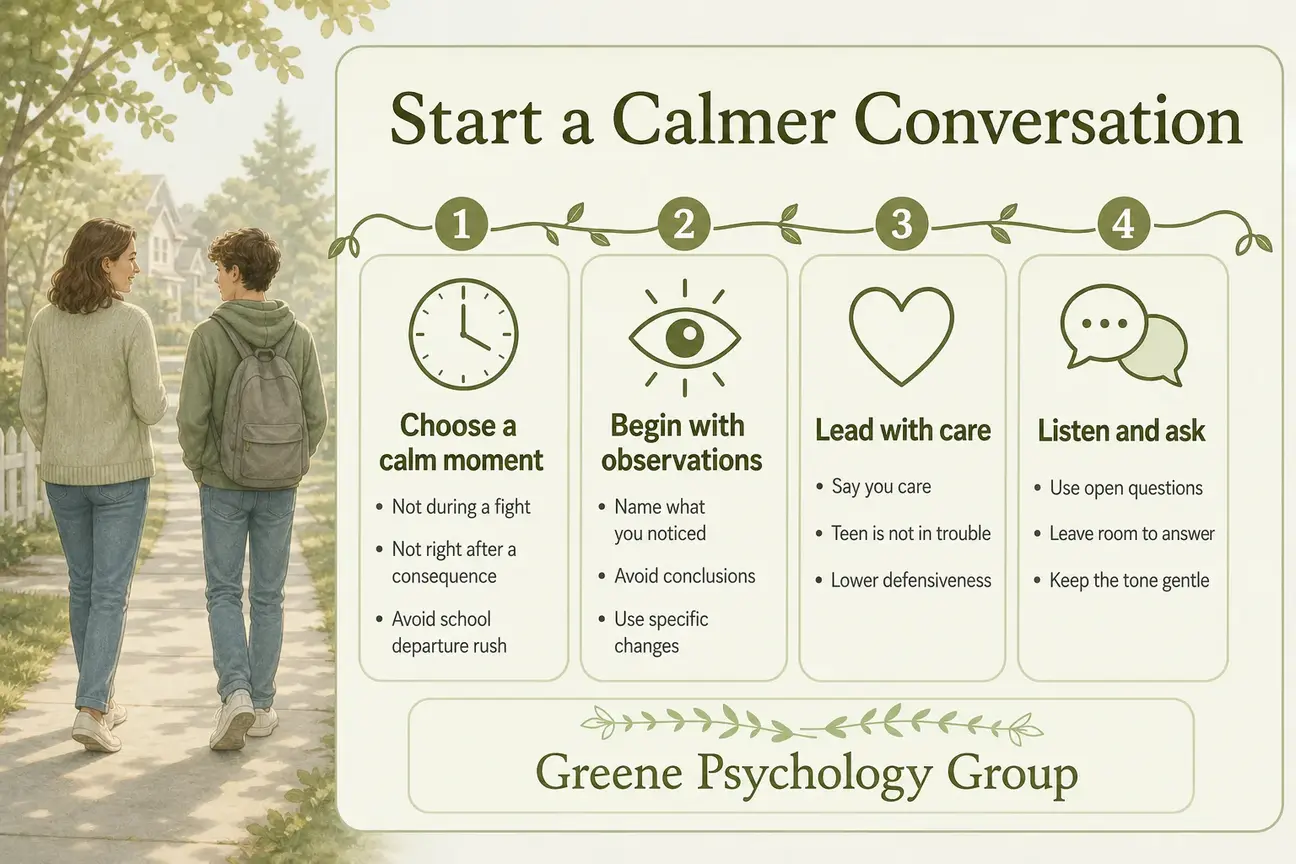
A parent depression guide is most helpful when it gives practical words for a hard conversation. Start by choosing a calm moment. Avoid beginning the conversation in the middle of a fight, right after a consequence, or when your teen is trying to leave for school. A perfect moment is not required, but a less-charged moment gives both of you a better chance.
Begin with observations, not conclusions. For example: “I’ve noticed you haven’t wanted to see your friends lately, and you seem really tired after school.” Then lead with care: “I’m asking because I care about you, not because you’re in trouble.” This lowers defensiveness and makes it less likely that your teen will experience the conversation as an accusation.
Ask open questions and then pause. You might ask, “How have things been feeling lately?” “What has been hardest?” or “Is there something you wish adults understood better right now?” If your teen gives a short answer, resist the urge to immediately lecture, correct, or solve. A calm “I’m glad you told me that” can do more than a long speech.
Reflect what you hear. If your teen says, “I’m just tired of everything,” you might say, “That sounds exhausting.” If they say, “You wouldn’t get it,” you might say, “You may be right that I don’t fully get it yet, but I want to understand.” Reflection is not the same as agreement. It tells your teen you are listening.
When safety concerns are present, ask directly and calmly about whether they feel safe or have thoughts of harming themselves. You do not need to diagnose a depressed teenager to ask about safety. Avoid method details. If there is immediate danger or a mental-health crisis, use the urgent-help guidance later in this article rather than trying to manage it alone.
Offer next steps without turning support into punishment. You might say, “We don’t have to figure this out tonight, but I do think we should talk with someone who helps teens with this.” Options may include a school support person, primary-care clinician, or licensed mental-health clinician. Keep the message steady: help is not a consequence for being difficult; it is support for something that feels hard.
This kind of parent depression guide also encourages parents to return to the conversation. One talk may not be enough, especially if a teen feels embarrassed, guarded, or unsure what they are feeling. A calm follow-up such as “I’m still thinking about what you said, and I’m here when you want to talk more” can show steadiness without pressure.
When teen mood changes are a reason to contact a clinician
Parents often wait because they do not want to overreact. That hesitation is understandable. But certainty is not required before asking for guidance. Consider contacting a licensed clinician when teen mood changes persist or keep returning, cause meaningful distress, interfere with school or sleep, affect relationships or activities, or leave your family unsure how to help.
It is also reasonable to reach out when your teen’s withdrawal feels significant, when motivation drops sharply, when your teen seems hopeless, or when ordinary routines have become difficult to maintain. If parents are repeatedly trying to support a teen and the pattern is not easing, professional input can help clarify what may be happening.
Greene Psychology Group offers depression treatment and individual therapy for adolescents and adults. Therapy may help a teen explore emotions, build coping skills, and address patterns that are interfering with daily life. It may also help parents understand how to support the teen without taking over the teen’s voice.
If you decide to reach out, you can contact Greene Psychology Group, call 919-205-5339, or email [email protected]. Because the practice notes that phone service may not always be working properly, use phone and email together as needed. Share contact information, a brief reason for reaching out, whether you prefer Raleigh, Asheville, or online sessions, and insurance information. Do not send detailed health information through email or the contact form.
Teen mood changes do not need to be severe before a parent asks questions. Sometimes an early consultation helps families understand whether watchful waiting, school support, therapy, medical follow-up, or another step makes sense. If the concern is a depressed teenager, earlier support may help the family respond with more clarity and less fear.
What support can look like at home while you seek help
Home support is not a substitute for assessment when a teen is struggling, but it can reduce pressure and keep connection open. Start with predictable routines. Sleep, meals, school expectations, and family responsibilities still matter, but try not to frame every difficulty as defiance. A teen who is overwhelmed may need help breaking tasks into smaller pieces.
Stay connected without forcing disclosure. Some teens talk best in the car, while walking, during a shared activity, or late at night. Others need to know a parent is available before they are ready to talk. A simple sentence such as “I’m here, and I won’t be shocked by your feelings” can be reassuring, even if your teen rolls their eyes.
Reduce shame where you can. If a teen is falling behind at school, criticism may increase avoidance. Practical support might include helping them make a short list of missing assignments, contacting a school counselor, or setting up a quiet work period. The goal is not to remove all responsibility. It is to make the next step possible.
Watch your own emotional intensity. Parents understandably feel scared when they see teen depression signs. But if every conversation becomes urgent, the teen may shut down. It may help to talk with another trusted adult, your own therapist, or a clinician so you can respond with steadiness rather than panic.
Be careful with reassurance that dismisses the problem. “Look at everything going well” or “Everyone feels this way” may be meant kindly, but it can leave a teenager feeling unseen. Try, “I’m sorry it has felt so heavy,” or “I may not fully understand yet, but I’m taking you seriously.”
Parents can also support a depressed teenager by keeping expectations clear and humane. Limits, school responsibilities, and family routines still matter, but they can be paired with flexibility and problem-solving. This balance communicates, “Your life still matters, and we will help you take one manageable step at a time.”
Professional support, online therapy, and practical questions
Some families prefer in-person therapy; others consider teletherapy because of schedule, transportation, or comfort. Greene Psychology Group offers online therapy in North Carolina for people who are physically in the state at the time of the session. Parents can ask whether online or in-person care is appropriate for their teen’s situation.
If cost or benefits are part of your decision, the practice is in network with most Blue Cross Blue Shield and Aetna plans, and families should verify benefits with both their insurer and the practice. Out-of-network and self-pay options may be available, and self-pay clients receive information related to a Good Faith Estimate. You can review insurance and payment information before contacting the office. Do not assume a specific plan is covered until it is confirmed.
Parents sometimes worry that starting therapy means something is “wrong” with their child. A more compassionate frame is that therapy is one form of support when a teen’s distress is bigger than the family can comfortably hold alone. It can be a place to slow down, understand patterns, and decide what next step makes sense.
A parent depression guide can make the first call feel less overwhelming by clarifying what information is useful. Parents can share the main teen mood changes they are seeing, how long the pattern has been present, whether school or sleep is affected, and whether safety concerns exist. Detailed health information should be saved for a secure clinical conversation rather than email or an unencrypted form.
Infographic: persistence, distress, and interference
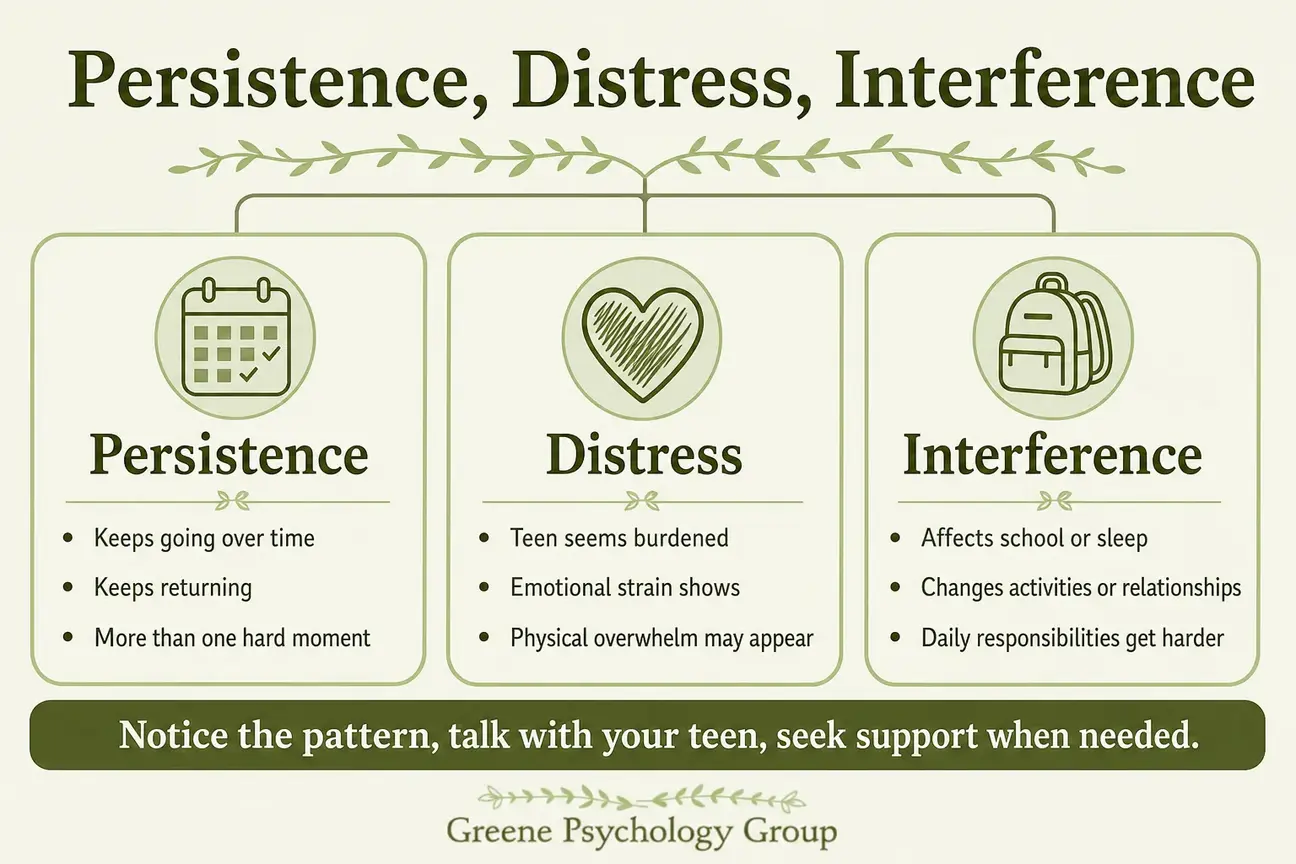
If you remember only one framework, remember these three words: persistence, distress, and interference. Persistence asks whether the change keeps going or keeps returning. Distress asks whether your teen seems emotionally or physically burdened. Interference asks whether the pattern is affecting school, sleep, activities, relationships, self-care, or daily responsibilities.
This framework helps parents avoid two common extremes. One extreme is dismissing every concern as “just teenage behavior.” The other is treating every difficult feeling as a diagnosis. The middle path is attentive, respectful, and responsive: notice the pattern, talk with your teen, and seek professional guidance when the pattern is concerning.
Irritability and withdrawal can be confusing because they may look like attitude or avoidance. Try to stay curious. The behavior may still need limits, but limits work best when paired with care. A teen can be accountable for behavior and still deserve support for distress.
When parents use this framework, teen depression signs become easier to discuss without blame. Instead of saying, “You are acting depressed,” a parent can say, “I’m noticing changes that are lasting, seem painful, and are getting in the way of school and friends.” That kind of language is more likely to keep the conversation open.
When it is urgent and waiting is not the right plan
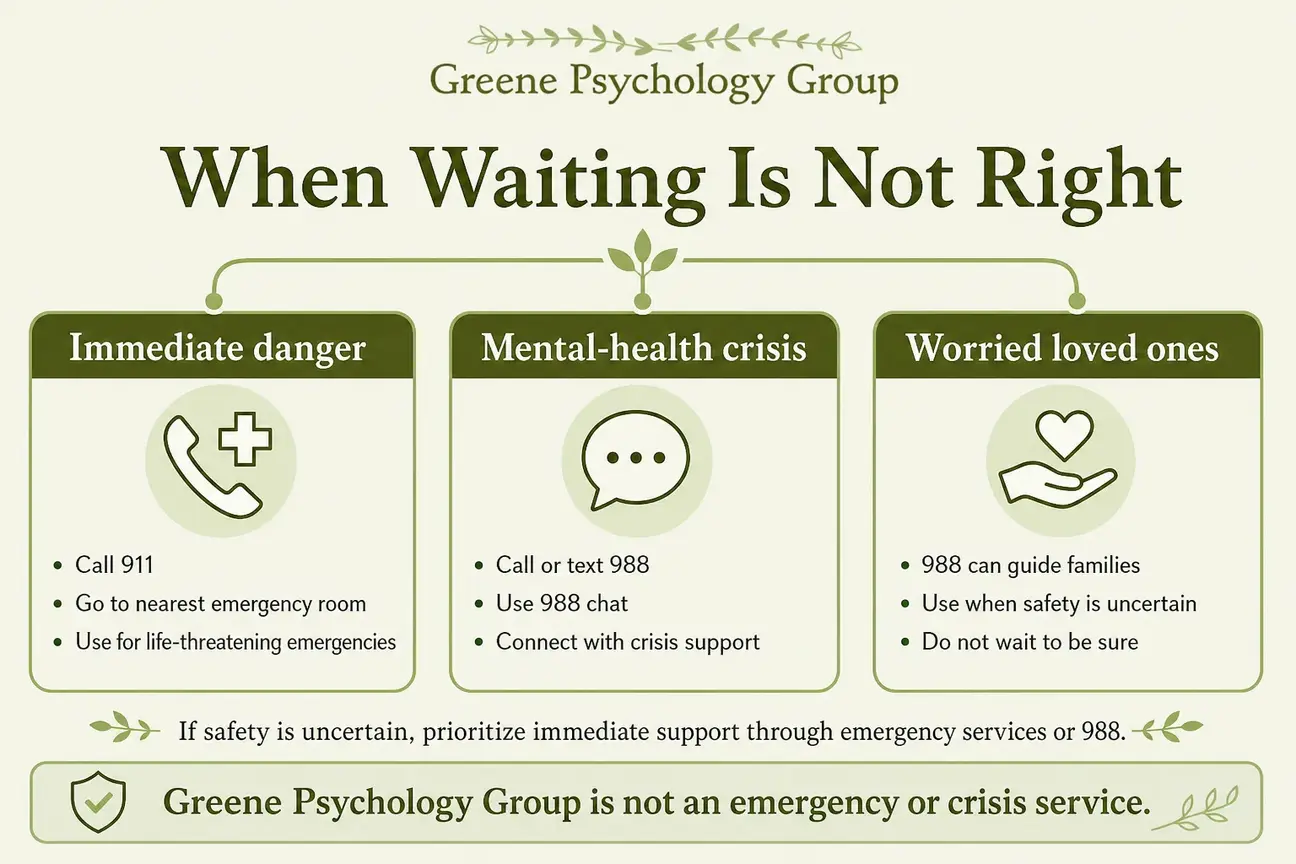
Some concerns call for immediate action rather than continued observation. If there is immediate danger or a life-threatening emergency, call 911 or go to the nearest emergency room. If your teen is in a mental-health or suicidal crisis, call or text 988 or use chat through the 988 Lifeline.
SAMHSA describes 988 as a way to connect with crisis support by call, text, or chat. Loved ones can also use 988 for guidance when they are worried about someone else. You do not need to decide whether a situation is “serious enough” before seeking crisis support.
Greene Psychology Group is not an emergency or crisis service. If safety is uncertain, prioritize immediate support through emergency services, the nearest emergency room, or 988. Avoid leaving a message for an outpatient practice as the only response to an urgent safety concern.
Closing thoughts for parents watching a worried pattern
If you are reading this because your teen seems different, the perfect answer is not expected today. Start with what you can observe. Look for patterns across mood, interest, energy, sleep, school, friendships, and isolation. Ask whether the changes are persistent, distressing, interfering, or clearly different from your teen’s baseline.
Use a calm conversation, not a confrontation. Listen for what your teen is able to share. Ask directly about safety when there is reason to be concerned. Reach out to a licensed clinician when the pattern is bigger than you can understand or support on your own. Educational guidance cannot replace individualized care, but it can help you take the next step with steadiness.
Teen depression moodiness is confusing because ordinary adolescence and depression can overlap on the surface. Teen mood changes deserve context, teen depression signs deserve attention, and a depressed teenager deserves support that is calm, respectful, and appropriate to the level of concern.
This article is for general education and isn't a substitute for diagnosis or treatment from a licensed professional. If you are in crisis, call or text 988 or call 911.
For immediate danger, call 911 or go to the nearest emergency room. For a mental-health or suicidal crisis, call or text 988.
Frequently Asked Questions
How can I tell whether my teen is moody or depressed?
Look for a pattern rather than one mood or one argument. Moodiness may be temporary and tied to stress, conflict, fatigue, or disappointment. A more concerning pattern is persistent, distressing, interfering with daily life, or clearly different from your teen’s usual behavior. A licensed clinician can assess whether depression or another concern may be present.
What are common teen depression signs parents may notice?
Parents may notice changes in mood, interest, energy, sleep, school functioning, friendships, appetite, or isolation. These signs should not be used as a self-test. They are reasons to pay attention, talk with your teen, and consider contacting a licensed clinician if the pattern persists or interferes with life.
Can a depressed teenager still go to school or spend time with friends?
Yes. A depressed teenager may still attend school, laugh with friends, or complete responsibilities at times. Outward functioning does not always show the full level of distress. Assessment looks at the whole pattern, including what has changed, how long it has continued, and how much effort it takes for the teen to keep going.
What should I say if my teenager refuses to talk?
Stay calm, describe what parents are noticing, and leave the door open. You might say, “I can see you do not want to talk right now, but I care about you and I’m available.” Offer another support option, such as a school counselor, primary-care clinician, or therapist, especially if the pattern continues.
When should I contact a licensed clinician about teen mood changes?
Consider contacting a licensed clinician when teen mood changes persist, keep returning, cause meaningful distress, interfere with school or sleep, affect relationships or activities, or leave your family unsure how to help. Certainty that your teen has depression is not required before asking for guidance.
Should I ask my teen directly about suicide?
If you are worried about safety, ask directly and calmly whether your teen feels safe or is thinking about harming themselves. You do not need to provide details or handle the concern alone. If there is immediate danger, call 911 or go to the nearest emergency room. For a mental-health or suicidal crisis, call or text 988.
Can parents be involved in a teenager’s therapy?
Parents can ask the practice how caregiver involvement, consent, and confidentiality work for teen therapy. The specific arrangement may depend on the teen’s needs, safety considerations, and practice policies. Parents should ask these questions directly rather than assuming they will receive every detail from sessions.