
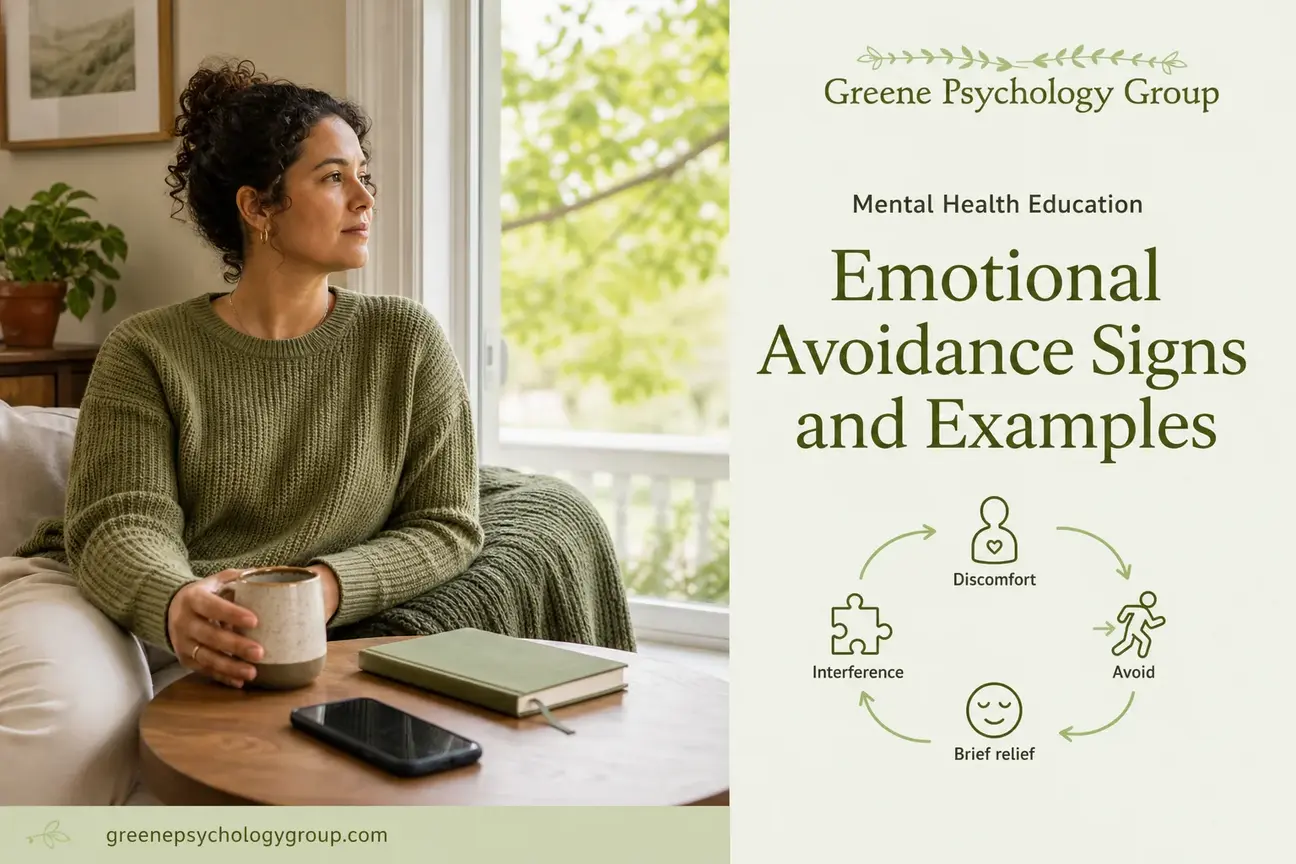
What Is Emotional Avoidance? 7 Signs and Examples
Quick answer: Emotional avoidance means trying to move away from uncomfortable feelings, thoughts, memories, uncertainty, or conversations. It can look like staying constantly busy, withdrawing, postponing hard discussions, seeking reassurance, or avoiding reminders of painful experiences. Taking a break from difficult emotions is not automatically harmful; concern grows when the pattern brings short-term relief but repeatedly interferes with relationships, responsibilities, sleep, work, parenting, or the parts of life that matter.
What does this coping pattern mean?
This is a coping pattern, not a character flaw. In plain language, it means trying not to feel, think about, remember, talk about, or come close to something emotionally painful. The feeling might be fear, sadness, anger, grief, shame, guilt, disappointment, loneliness, or uncertainty. The strategy might be obvious, such as canceling plans, or subtle, such as changing the subject every time a topic becomes personal.
This pattern can happen through behavior, attention, thinking, and communication. Someone might work late every night so grief has less room to surface. Someone else might ask for reassurance again and again because uncertainty feels hard to tolerate. Another person might avoid a needed conversation because conflict feels overwhelming.
Not every pause, distraction, or boundary is avoidance in a problematic sense. Sometimes stepping away is wise. A person may need rest before discussing something difficult, privacy before sharing feelings, or distance from an unsafe situation. The important questions are whether the response is flexible, whether the person can return to the issue when they are ready, and whether the pattern supports or limits the life they want to live.
It can help to think of this as a “move away” strategy. It moves away from emotional discomfort, but it may also move away from connection, clarity, grief, decision-making, or repair. That does not mean the person is doing something wrong on purpose. Avoidance often begins as an understandable attempt to get through a painful moment.
Why avoidance coping can feel helpful at first
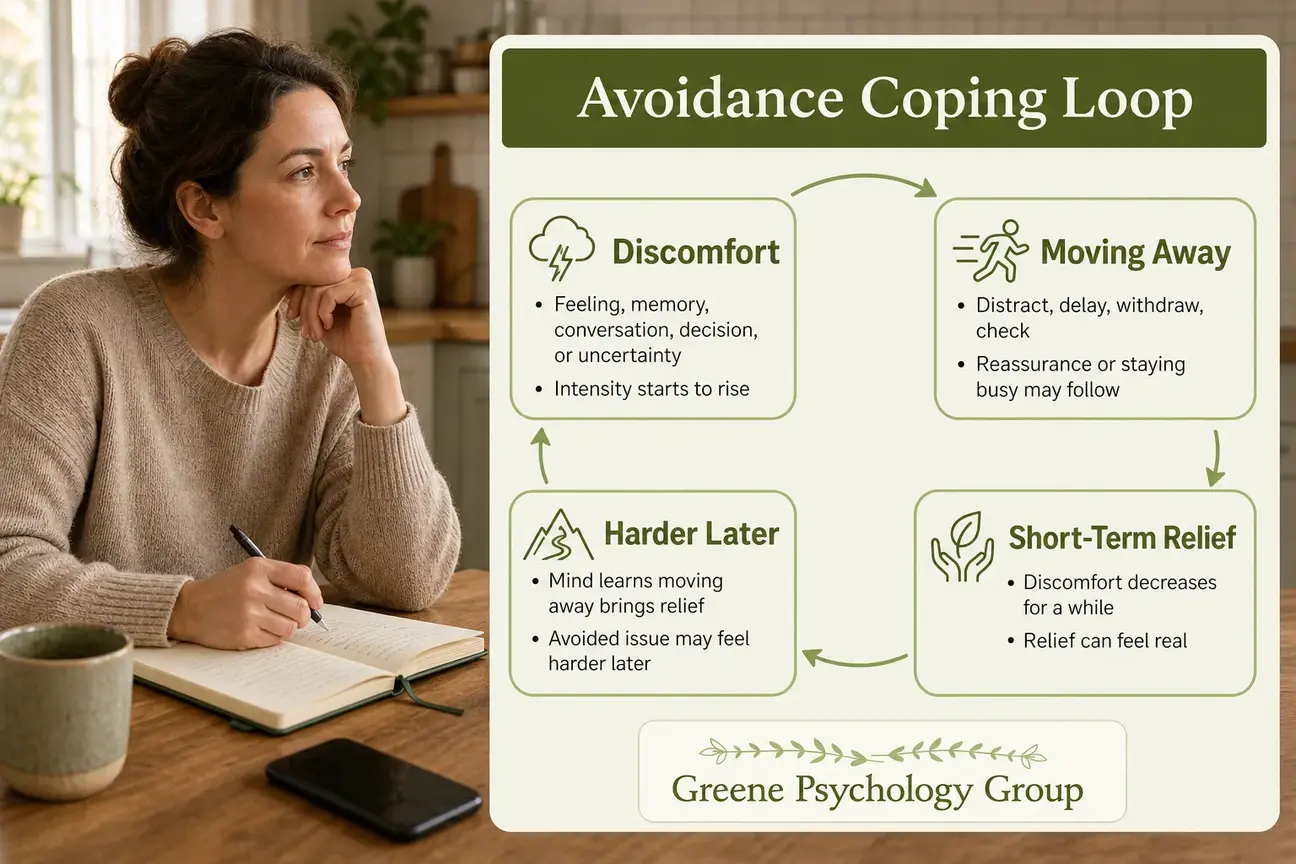
Avoidance coping can feel effective because it often works in the short term. A difficult feeling appears, the person distracts, withdraws, postpones, checks, reassures, scrolls, works, or stays busy, and the intensity drops. That relief can be real. It is also why the pattern can become hard to notice.
A general pattern may look like this:
- A feeling, memory, conversation, decision, or uncertainty becomes uncomfortable.
- The person moves away from it by distracting, delaying, withdrawing, checking, or seeking reassurance.
- The discomfort decreases for a while.
- The mind may learn that moving away is the fastest path to relief.
- The avoided issue may feel harder to approach later.
This does not happen the same way for every person. Avoidance coping may be protective when someone is exhausted, overwhelmed, grieving, unsafe, or lacking support. It may also become restrictive when the person wants to act differently but feels stuck in the same loop.
For example, postponing a conversation for one night because sleep is needed may be a healthy pause. Postponing the same conversation for months, while resentment builds and the relationship becomes more distant, may be a sign that the strategy is no longer serving its purpose. The difference is not whether discomfort exists. It is whether avoidance has become the only available response.
7 emotional avoidance signs that may show up day to day
The following signs are not a self-test and do not prove that a person has a mental-health condition. They are reflection points. Any one behavior may have reasonable explanations, including fatigue, privacy, boundaries, medical concerns, neurodivergence, grief, safety needs, or ordinary stress.
| Possible sign | How it may look | Why context matters |
|---|---|---|
| Staying constantly busy | Filling quiet time with work, errands, screens, exercise, caregiving, projects, or chores so feelings have little room to surface. | Busyness may be necessary in some seasons. It becomes more concerning when rest feels threatening or distress appears whenever activity stops. |
| Withdrawing | Pulling away from friends, family, social events, intimacy, or support because contact may bring up difficult emotions or questions. | Time alone can be healthy. A pattern of isolation may deserve attention when it narrows support or increases distress. |
| Postponing hard conversations | Repeatedly delaying discussions about conflict, grief, boundaries, finances, parenting, relationship concerns, or needs. | A pause can prevent escalation. Ongoing delay can leave problems unresolved and increase tension. |
| Seeking reassurance repeatedly | Asking others again and again to confirm that a decision is right, everything is fine, or a feared outcome will not happen. | Reassurance is not automatically unhealthy. It can become part of avoidance coping when it replaces tolerating uncertainty or making decisions. |
| Avoiding reminders | Staying away from places, objects, people, media, topics, dates, or conversations connected with something painful. | This can be understandable after loss or trauma. It may need support when reminders increasingly restrict daily life. |
| Shutting down or minimizing | Changing the subject, saying “I’m fine,” going blank, joking, feeling detached, or minimizing the impact of an event. | People sometimes need time to find words. It becomes more concerning when the person cannot access or communicate important feelings at all. |
| Overthinking instead of feeling | Analyzing every detail, planning every possible outcome, researching for certainty, or replaying conversations without touching the underlying emotion. | Thinking and planning can be useful. They may become avoidant when they keep grief, fear, anger, or vulnerability out of awareness. |
When people search for emotional avoidance signs, they often hope for a clear yes-or-no answer. Real life is usually more nuanced. A licensed clinician looks at the full pattern: what triggers the response, how often it happens, how much distress is involved, and whether the behavior interferes with daily functioning or relationships.
Taken together, these emotional avoidance signs are best understood as context clues, not proof of a diagnosis. A behavior that is protective in one situation may become limiting in another.
Examples of avoiding feelings in everyday life
Avoiding feelings can be hard to recognize because it often blends into normal routines. The examples below are hypothetical and non-identifying. They are meant to show patterns, not diagnose anyone.
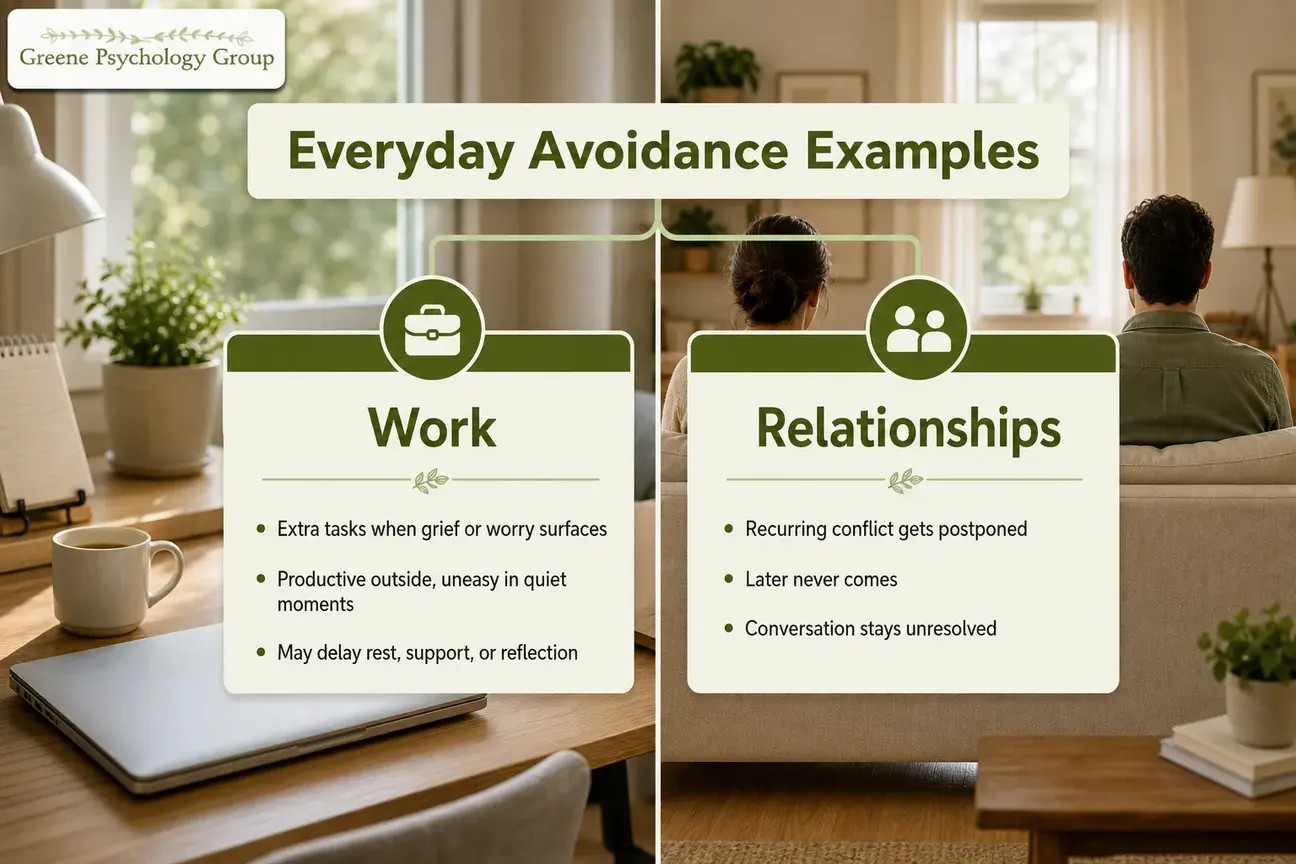
At work: A person takes on extra tasks every time grief or worry starts to surface. Colleagues may see them as dependable and productive, while internally the person feels uneasy whenever there is a quiet moment. Avoiding feelings through work can bring structure, but it may also delay needed rest, support, or reflection.
In relationships: A couple knows they need to talk about a recurring conflict, but one partner keeps saying, “Let’s discuss it later.” Later never comes. The postponed conversation may protect the person from immediate discomfort, yet the unresolved issue continues to shape tone, closeness, and trust. In this situation, relationship counseling may be one way to explore communication patterns when both people are willing.
After a loss: Someone avoids photographs, favorite places, or conversations connected with a person who died. This may be part of grief and may not be a problem by itself. Concern may increase if the person’s world becomes smaller and smaller, or if they want support but feel unable to reach for it.
With uncertainty: A person repeatedly asks, “Are you sure everything is okay?” or “Did I make the right decision?” The first reassurance may calm them. Then doubt returns, and they need more reassurance. Avoidance coping can sometimes hide inside the search for certainty.
As a parent: A parent notices their teenager is upset but avoids asking questions because they fear saying the wrong thing. The parent may care deeply, yet the teen may experience the silence as distance. Parents of adolescents can ask a therapist about consent and confidentiality before beginning therapy with a teen.
During stress: Someone tells everyone they are fine, stops responding to messages, and spends evenings scrolling or watching shows until they fall asleep. Rest and distraction can be normal. The question is whether avoiding feelings is the only way the person can get through the day.
Avoidance and anxiety often overlap, but they are not the same
Avoidance and anxiety can become closely linked because anxiety often involves threat anticipation: the body and mind prepare for something to go wrong. Avoidance is one possible response to that distress. A person may avoid a place, decision, sensation, conversation, email, social interaction, or memory because it feels unsafe, overwhelming, or uncertain.
The National Institute of Mental Health explains that anxiety disorders can involve intense fear in common situations, avoidance of social encounters, or refusing to leave home in severe cases. That does not mean every avoidant behavior is an anxiety disorder. It means that avoidance can be part of the picture for some people living with anxiety.
It may help to separate the pieces. Anxiety is the emotional and physical experience of fear, worry, unease, or threat anticipation. Avoidance is a behavior or mental strategy that moves away from that experience. For some people, avoidance and anxiety reinforce each other: the person avoids, feels temporary relief, and then the avoided situation feels even harder to face later.
Avoidance can also appear with grief, stress, depression, trauma-related symptoms, shame, burnout, relationship strain, or major life transitions. If anxiety is a significant part of the pattern, reading about anxiety therapy may help with understanding what professional support can include. The broader point is not to apply a label, but to notice whether life is becoming more restricted.
Is this coping pattern a diagnosis?
No. Avoidant emotional coping is a descriptive term for a pattern, not a standalone diagnosis. A person can show avoidant patterns without having a mental-health diagnosis. A person can also have a diagnosable condition in which avoidance is one feature among many. Only a licensed clinician can assess that broader context.
Trauma-related avoidance is a good example of why context matters. The National Institute of Mental Health lists staying away from reminders of a traumatic experience and avoiding related thoughts or feelings among PTSD avoidance symptoms. However, avoidance alone does not establish PTSD. PTSD involves a broader symptom pattern, duration, distress, and functional impact that should be assessed by a qualified professional.
It is also important not to force confrontation with trauma reminders alone because of something read in an article about avoidance. Trauma work and exposure-based approaches belong in a carefully planned professional context when appropriate. For some people, stabilization, safety, coping, and relationship support come first.
A licensed clinician may consider anxiety, depression, grief, trauma-related symptoms, stress, ADHD-related challenges, medical concerns, substance use, sleep, relationship dynamics, culture, identity, safety, and practical circumstances. Assessment is not about labeling every coping behavior as disordered. It is about understanding what is happening and what support may fit.
When avoidance coping starts to interfere with life
Avoidance coping becomes more concerning when it repeatedly moves a person away from important parts of life. The clearest sign is often interference: the strategy may reduce discomfort briefly, but it also creates distance, delay, or restriction.
Examples of interference may include:
- Important conversations repeatedly do not happen.
- Relationships become more distant, guarded, or tense.
- Work, school, parenting, caregiving, or health responsibilities are affected.
- Sleep or daily routines become disrupted because distress returns when distraction stops.
- Reassurance seeking, checking, or overthinking consumes more time than the person wants.
- Reminders, places, topics, or ordinary situations increasingly narrow the person’s life.
- The person feels emotionally numb, disconnected, or unable to identify what they feel.
- The person wants to respond differently but feels unable to change the pattern alone.
Interference does not have to be dramatic to matter. Sometimes the cost is quiet: fewer honest conversations, less closeness, more resentment, more exhaustion, or a sense that life is being organized around not feeling something. Those are valid reasons to seek support.
If stress is a major part of the pattern, therapy for stress may offer a place to understand how coping strategies are helping, where they are costing something, and what alternatives may fit. Therapy should not pressure anyone into moving faster than they are ready to move.
How a licensed clinician can assess avoiding feelings
A licensed clinician can help slow the pattern down and look at it with care. Instead of asking, “What is wrong with me?” therapy may ask, “What happens right before withdrawal, distraction, reassurance, postponing, or shutting down?” That shift can reduce shame and make the pattern easier to understand.
Assessment may include exploring:
- What feeling, memory, thought, uncertainty, or conversation tends to come before avoidance.
- What the person does to move away from the discomfort.
- Whether distress decreases briefly and then returns.
- What the longer-term consequences are for relationships, work, school, parenting, sleep, or health care.
- Whether the behavior is a reasonable boundary, privacy choice, or safety response.
- Whether anxiety, depression, grief, trauma-related symptoms, stress, relationship conflict, or life transitions are part of the broader picture.
A clinician may also ask about strengths and values. What does the person want more of: connection, rest, honesty, confidence, grief support, calmer communication, or more room to make decisions? Avoidance patterns are easier to understand when they are connected to what a person cares about, not only to what they want to escape.
If another level of care or a different professional is needed, a clinician can talk through options based on the person’s goals, safety, readiness, symptoms, and preferences. In outpatient therapy, next steps should be individualized rather than based on a checklist from an article.
What therapy may involve when avoidance and anxiety are part of the pattern
Therapy for avoidant patterns is not about forcing someone to feel everything all at once. It is usually more gradual and collaborative than that. The aim is to understand the role avoidance is playing, build capacity for difficult emotions, and consider choices that fit the person’s values and circumstances.
The National Institute of Mental Health describes psychotherapy, or talk therapy, as treatments that aim to help a person identify and change troubling emotions, thoughts, and behaviors. NIMH also describes psychotherapy as a place where people may identify ways to cope with stress and develop problem-solving strategies. That broad description fits many situations where avoiding feelings has become limiting.
For some people, CBT may be considered when automatic thoughts, threat predictions, reassurance loops, or behavior patterns contribute to distress. CBT may help a person notice unhelpful thought and behavior patterns, understand how those patterns affect emotions, and practice different responses. This does not mean CBT is the right fit for everyone, and it does not promise a specific result.
Some therapy approaches may include attention to emotions, communication, boundaries, grief, stress, trauma-related symptoms, or relationship patterns. Greene Psychology Group offers mental health therapy for concerns that may include anxiety, stress, trauma-related concerns, relationships, and life transitions. The specific approach should be based on assessment rather than on a label from an article.
It is especially important to be careful with trauma reminders. NIMH describes exposure therapy as a type of CBT used for anxiety disorders in which a person spends brief periods in a supportive environment learning to tolerate distress. That supportive treatment context matters. This article is not recommending self-directed exposure or trauma-processing exercises.
What to notice before seeking therapy
No one needs a perfect explanation before asking for help. If the goal is to understand personal avoidance coping, gentle observation may be enough. The purpose is not to score a checklist, prove a disorder, or force a feeling. It is simply to notice patterns.
Reflection questions might include:
- What situations tend to trigger the urge to withdraw, distract, postpone, check, or seek reassurance?
- What feeling might be underneath the urge: fear, sadness, anger, grief, shame, loneliness, guilt, uncertainty, or exhaustion?
- Does the strategy help only briefly, or does it support longer-term functioning?
- What conversations, choices, relationships, or responsibilities are being affected?
- Can a pause happen with a return later, or does returning feel nearly impossible?
- Would support from a licensed clinician make the pattern easier to understand?
These are reflection prompts, not treatment instructions. If trauma, abuse, self-harm, suicidal thoughts, eating-disorder concerns, substance use, psychosis, or immediate safety issues are part of the situation, it is important to seek appropriate professional or crisis support rather than trying to manage it alone.
For general mental-health self-care, routines may also matter. The National Institute of Mental Health’s caring for your mental health page lists examples such as exercise, regular meals, sleep, relaxing activities, goal-setting, gratitude, social connection, and paying attention to when professional help may be needed. These steps are not a substitute for therapy, but steady routines and supportive connection may make it easier to notice what is happening.
How avoidant patterns can show up in parents, partners, and teens
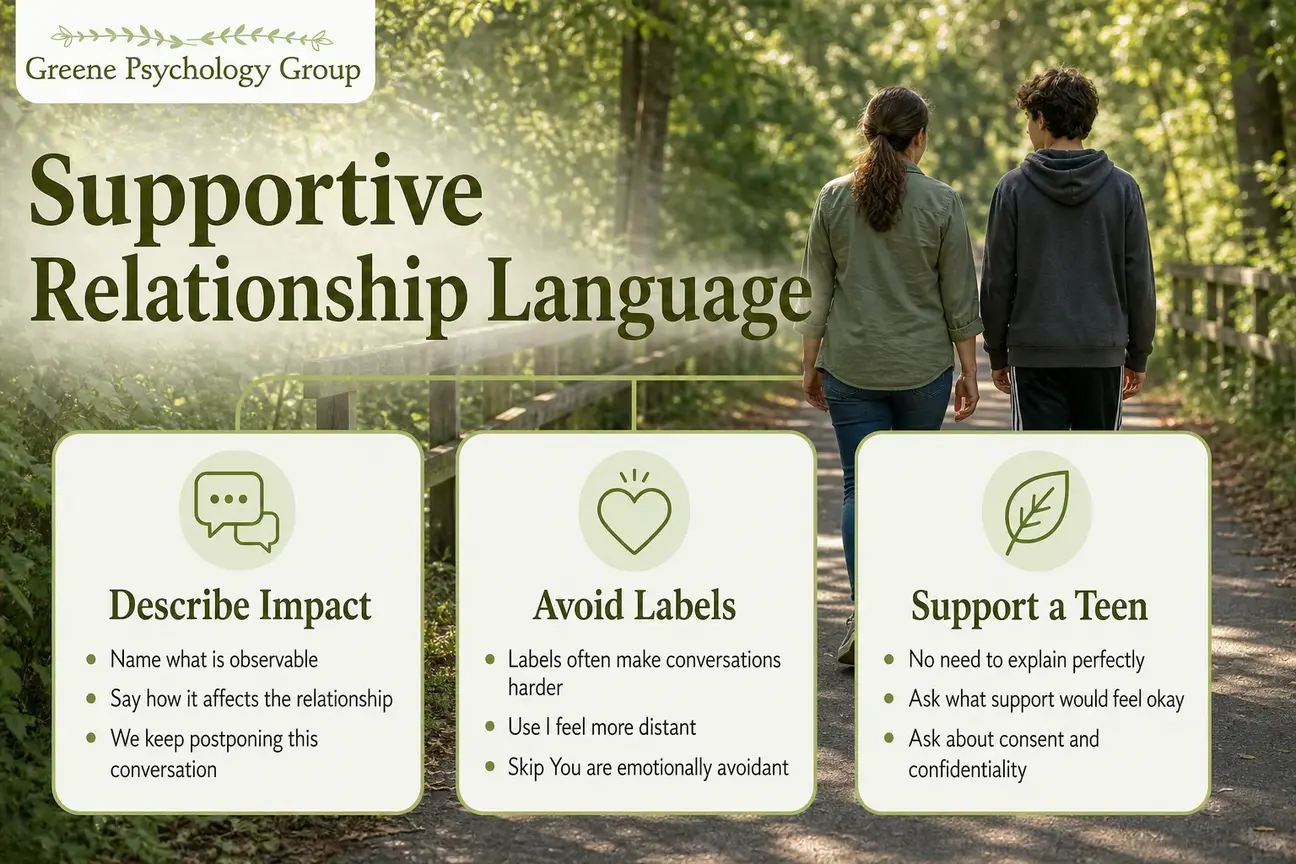
It can be tempting to label someone else as avoidant when their behavior affects a relationship. Labels often make conversations harder. If there is concern about a partner, teenager, parent, or friend, it may be more useful to describe what is observable and how it affects the relationship.
For example, “I notice we keep postponing this conversation, and I’m feeling more distant from you,” is different from, “You are emotionally avoidant.” A parent might say to a teen, “I can tell something has been heavy lately. I don’t need you to explain it perfectly, but I’m here and I’d like to understand what support would feel okay.”
Parents of adolescents should ask the practice about consent and confidentiality when considering therapy for a teen. A therapist can explain how they handle parent involvement, privacy, safety, and communication within the limits of their role and applicable requirements.
Partners and family members can also seek their own support. A loved one is not responsible for diagnosing or treating someone else’s avoidance. Supportive people can set boundaries, communicate needs, and encourage professional support when avoidance is affecting functioning, safety, or the relationship.
When therapy may be worth considering
Therapy may be worth considering when avoiding feelings becomes persistent, rigid, or costly. Waiting until things feel severe is not required. A person might reach out because distress keeps returning after distraction, important conversations keep getting delayed, reassurance is taking up more time, or relationships feel increasingly distant.
Therapy may also be appropriate when avoidance is connected with grief, chronic stress, anxiety, depression, trauma-related symptoms, relationship strain, parenting stress, or major life changes. A licensed clinician can help assess whether the pattern is a short-term coping response, a sign of another concern, or part of a broader therapy focus.
If you are in North Carolina and would like to talk with someone about avoidance patterns, anxiety, stress, or relationship concerns, you can contact Greene Psychology Group, call 919-205-5339, or email [email protected]. Share contact details, a brief reason for reaching out, whether Raleigh, Asheville, or online sessions are preferred, and insurance information. Please do not send detailed health information through the contact form or email.
Local options for support
Greene Psychology Group offers individual psychotherapy for adolescents and adults, with offices in Raleigh and Asheville and online therapy in North Carolina for people physically located in the state at the time of the session. The practice is in network with most BCBS and Aetna plans, and clients should verify benefits with both their insurer and the practice. Out-of-network and self-pay options may also be discussed through the practice’s process.
If it is unclear whether a concern “counts,” it is okay to ask. Many people seek therapy not because they have a neat label, but because a pattern is affecting life and they want help understanding it. A first conversation can focus on what has stood out, what feels stuck, and what kind of support may fit.
A careful next step
Emotional avoidance can be understandable and protective in the short term. It may help a person get through a hard day, pause before speaking, or create distance from something overwhelming. The concern is not that avoidance ever happens. The concern is when it becomes the main way of coping and starts to shrink connection, honesty, rest, responsibility, or choice.
If parts of this pattern feel familiar, try to meet that recognition with curiosity rather than criticism. Avoidance often develops around something that feels difficult for a reason. Support can help make sense of the pattern without forcing a diagnosis or rushing into steps that do not feel safe or appropriate.
This article is for general education and isn't a substitute for diagnosis or treatment from a licensed professional. If you are in crisis, call or text 988 or call 911.
For immediate danger, call 911 or go to the nearest emergency room. For a mental-health or suicidal crisis, call or text 988.
Frequently Asked Questions
Is emotional avoidance always unhealthy?
No. Taking a break, choosing privacy, setting a boundary, or waiting until you are calmer can be healthy. Avoidance becomes more concerning when it is rigid, repeated, hard to change, or interferes with relationships, responsibilities, sleep, work, parenting, or daily life.
Can emotional avoidance happen without anxiety?
Yes. Avoidance can overlap with anxiety, but it can also occur with grief, stress, depression, trauma-related symptoms, shame, relationship conflict, burnout, or major life transitions. A licensed clinician can help sort out what else may be contributing.
Is staying busy a form of avoidance?
It can be, but not always. Staying busy may be necessary or meaningful. It may become avoidant when activity leaves no room for rest, grief, reflection, or needed conversations, especially if distress returns whenever things get quiet.
Does emotional avoidance mean someone has PTSD?
No. Avoidance can be part of PTSD for some people, but avoidance alone does not establish PTSD. PTSD diagnosis involves a broader pattern and should be assessed by a licensed clinician rather than by an article or checklist.
How can I talk to a partner or teen who seems emotionally avoidant?
Try describing specific behavior and its impact instead of using a label. For example, a person might say, “I notice we keep postponing this conversation, and I’m feeling more distant.” For teens, parents should ask the practice about consent and confidentiality before starting therapy.
What kind of therapy can help with avoidance patterns?
The right approach depends on the person, context, goals, and safety needs. Therapy may include understanding triggers, building coping skills, improving communication, addressing stress or anxiety, or exploring grief and relationship patterns. CBT may be considered for some people, but it is not the only option.