

ACT therapy Raleigh guidance can help you understand a practical approach to difficult thoughts, emotions, and life choices. Acceptance and Commitment Therapy does not require eliminating every uncomfortable feeling before moving forward. It helps people develop a more flexible relationship with inner experiences while taking action guided by what genuinely matters.
ACT, pronounced as the word “act,” combines acceptance, mindfulness, values clarification, and behavior change. Its central goal is psychological flexibility: the ability to stay aware of the present, make room for difficult experiences, and choose behavior that serves meaningful values. Treatment is individualized, and an assessment can help determine whether ACT fits your needs, goals, and circumstances.
Quick answer
Acceptance and Commitment Therapy is a behavioral therapy that builds psychological flexibility through six interconnected processes: acceptance, cognitive defusion, present-moment awareness, self-as-context, values, and committed action. ACT does not teach people to approve of harmful situations or suppress difficult thoughts. It helps them respond more flexibly and take workable steps toward a meaningful life.
What Is Acceptance and Commitment Therapy?
Acceptance and Commitment Therapy is a form of behavioral psychotherapy. It uses acceptance and mindfulness processes alongside commitment and behavior-change strategies to increase psychological flexibility. The approach asks whether a response is workable in the context of a person’s goals and values, rather than judging every thought as simply true, false, good, or bad.
The word acceptance can be misunderstood. In ACT, acceptance means making room for thoughts, feelings, memories, and physical sensations that are already present when fighting them would create more difficulty. It does not mean approving of abuse, ignoring danger, abandoning boundaries, or refusing to solve changeable problems.
The word commitment refers to repeatedly choosing actions that reflect personal values. Those actions can be small. Sending an honest email, attending an appointment, taking a restorative break, applying for a position, or having a difficult conversation may all represent committed action depending on the person and situation.
What Is Psychological Flexibility?
Psychological flexibility means contacting the present moment and adjusting or continuing behavior when doing so serves chosen values. It is not constant calm, positive thinking, or emotional control. A psychologically flexible person can still feel anxious, sad, angry, uncertain, or uncomfortable.
Flexibility becomes useful when attempts to avoid inner discomfort begin narrowing life. Someone may avoid social events to escape anxiety, delay medical care to avoid fear, overwork to avoid guilt, or repeatedly seek reassurance to reduce uncertainty. These responses may bring short-term relief while strengthening the longer-term problem.
ACT examines the function of a behavior. The question is not merely “Did this make me feel better?” but “What did this response help me move toward or away from over time?” That distinction can open alternatives when familiar coping strategies no longer work.
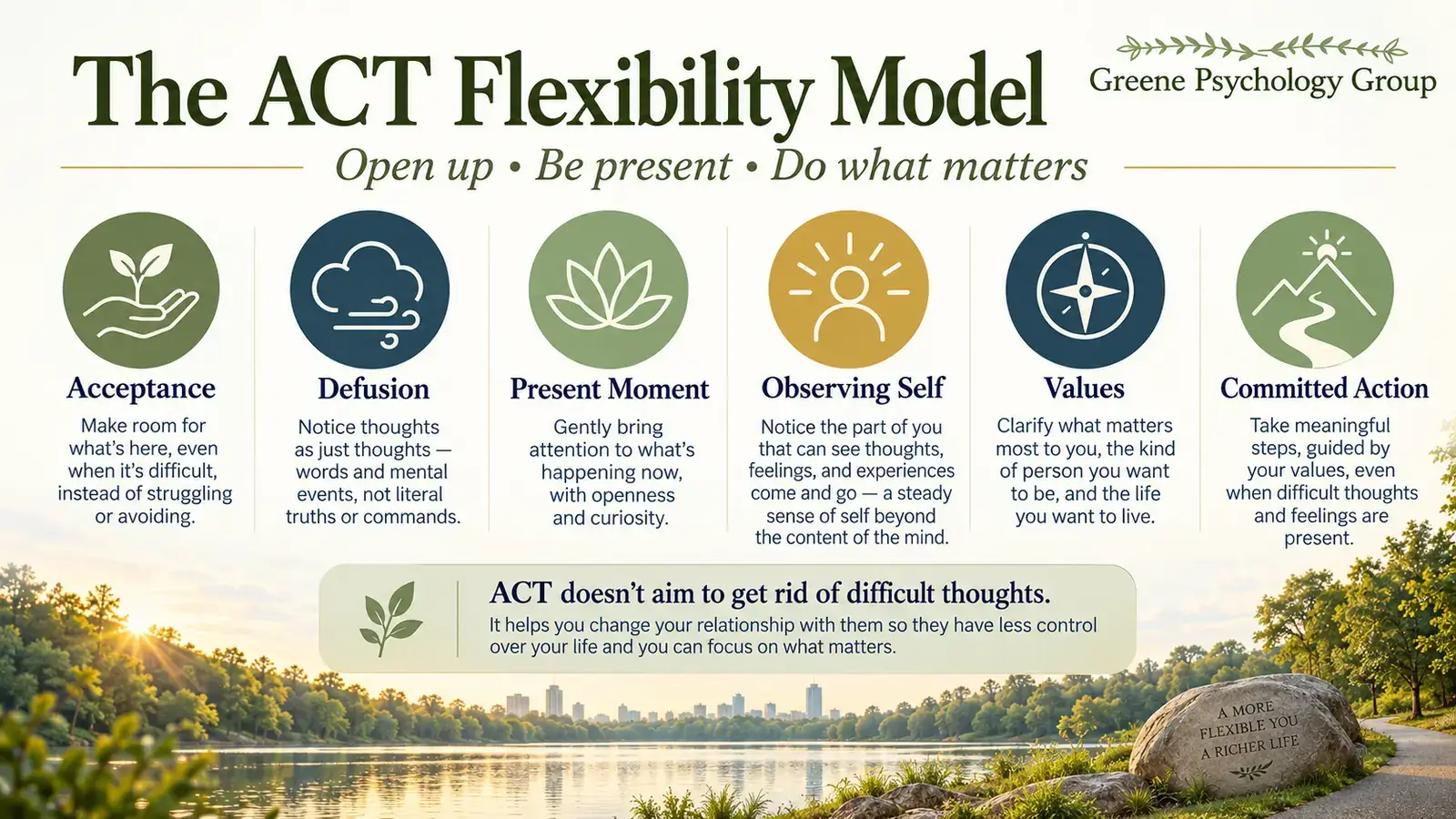
The Six Core Processes of ACT
The ACT model describes six connected processes. They are not rigid stages, and therapy does not always address them in the same order.
1. Acceptance
Acceptance involves opening up to difficult internal experiences when avoidance or control efforts are making life smaller. A person may practice noticing anxiety in the body while remaining in a meaningful conversation instead of escaping immediately.
2. Cognitive defusion
Defusion means noticing thoughts as mental events rather than automatically treating them as commands or literal facts. “I will fail” can become “I am noticing the thought that I will fail.” The thought may remain, but its ability to dictate behavior can change.
3. Present-moment awareness
Present-moment awareness involves intentionally contacting what is happening now with openness and curiosity. It can include attention to breathing, physical sensations, surroundings, emotions, and the task in front of you. It is not an instruction to ignore the past or stop planning.
4. Self-as-context
Sometimes called the observing self, self-as-context is the perspective from which thoughts, feelings, roles, and stories can be noticed. A person is more than the content passing through awareness. This perspective may reduce overidentification with labels such as “I am broken” or “I am an anxious person.”
5. Values
Values describe chosen qualities of ongoing action: being caring, honest, curious, dependable, courageous, or engaged. They differ from goals. A goal can be completed, such as earning a credential. A value such as learning can guide many actions before and after that achievement.
6. Committed action
Committed action means taking flexible, values-guided steps and adjusting from experience. It includes persistence when discomfort appears, but it is not stubbornly following a plan that has become unsafe or ineffective.
How ACT Works in Daily Life
Imagine that anxiety appears before an important presentation. The mind predicts embarrassment and urges you to cancel. A control-focused response might involve arguing with every anxious thought, waiting to feel confident, or avoiding the presentation. If those strategies fail, the anxiety may become proof that you cannot proceed.
An ACT response might involve noticing the prediction as a thought, allowing physical anxiety to be present, reconnecting with the current room, remembering that contribution or professional growth matters, and taking the next prepared step. The goal is not to enjoy anxiety. It is to prevent anxiety from making the entire decision.
This does not mean exposure to every feared situation is automatically appropriate. Context, readiness, safety, trauma history, health, and available support matter. Therapy helps tailor the step rather than applying a motivational slogan to a complex problem.
ACT vs. CBT: What Is the Difference?
ACT and Cognitive Behavioral Therapy share behavioral roots and can overlap in practice. Both may examine patterns connecting thoughts, feelings, behavior, and consequences. Both can use structured exercises, between-session practice, and collaborative goals.
| Area | ACT emphasis | Traditional CBT emphasis |
|---|---|---|
| Difficult thoughts | Change the relationship to thoughts through defusion and awareness | Often evaluate and revise inaccurate or unhelpful thinking |
| Emotions | Build willingness to experience emotions while acting effectively | Use cognitive and behavioral skills to change maintaining patterns |
| Direction | Values clarify the qualities that guide ongoing action | Goals and symptom-linked formulations guide intervention |
| Relationship | ACT is part of the broader behavioral and cognitive-behavioral tradition | Contemporary CBT can include acceptance and mindfulness methods |
The comparison should not be treated as a contest. Therapists may integrate compatible methods based on the concern, evidence, training, and client preference. Ask a prospective therapist how they understand your problem and why they recommend a particular approach.
Who May Benefit From ACT?
Research has examined ACT across a range of psychological and health-related concerns. Depending on the individual and the clinician’s scope, ACT may be considered when difficulties involve:
- anxiety, worry, panic, or avoidance;
- depression, withdrawal, or reduced engagement;
- stress, burnout, or perfectionism;
- obsessive or repetitive thinking patterns;
- chronic pain or adjustment to health conditions;
- grief, identity questions, or major life transitions;
- difficulty making values-consistent decisions; or
- repeated attempts to control feelings that create additional limitations.
A treatment approach should not be selected from a diagnosis list alone. Severity, developmental needs, culture, medical factors, safety, prior treatment, learning preferences, and co-occurring concerns can change what is appropriate. Some situations require medication management, specialized protocols, family involvement, substance-use treatment, medical care, or a higher level of support.
What Happens in an ACT Therapy Session?
For people researching ACT therapy Raleigh appointments, an initial session generally includes discussion of current concerns, history, functioning, goals, strengths, prior treatment, preferences, and safety. The therapist may ask where efforts to control thoughts or feelings have been useful and where they have created costs.
ACT sessions can include conversation, metaphors, mindfulness exercises, experiential activities, behavioral planning, and review of what happened between appointments. For example, a therapist might help you notice a self-critical story, identify the value hidden beneath the struggle, and design one specific action that expresses that value.
Good ACT therapy is collaborative. You should be able to ask what an exercise is intended to accomplish, whether alternatives are available, and how progress will be evaluated. You can also tell the therapist when language, pacing, or an exercise does not fit.
Examples of ACT Exercises and Skills
Name the mental event
Silently add “I am noticing the thought that…” before a recurring prediction or judgment. This is not an argument with the thought. It creates enough distance to choose a response.
Notice the control strategy
Identify what you do to avoid discomfort, the immediate relief it provides, and its longer-term cost. This can reveal why a behavior persists even when it conflicts with important goals.
Use a values compass
Choose one life area, such as relationships, work, learning, health, or community. Ask what quality you want to express there and what small action would point in that direction today.
Practice willing contact
With appropriate support, notice where an emotion appears in the body and allow it to exist briefly without immediate escape or suppression. Willingness should be paced, purposeful, and connected to a meaningful action.
Choose the next workable step
Define an action small enough to be observable: draft one paragraph, walk for five minutes, ask one question, or make one appointment. Review what happened and adjust without turning the outcome into a judgment about your worth.
What Does the Research Say About ACT?
ACT has been studied across multiple concerns and delivery formats. Reviews and meta-analyses generally support ACT as a useful intervention for a range of psychological and health-related problems, although evidence strength, study quality, comparison conditions, and outcomes vary by population and concern.
Research also examines psychological flexibility as a potential process of change. A 2024 systematic and meta-analytic review of treatment mechanisms reported that ACT interventions were associated with changes in several dimensions of flexibility and inflexibility. This supports the model’s relevance, but it does not mean every technique works equally for every person.
Evidence-based practice combines research with clinical expertise and the client’s characteristics, culture, circumstances, and preferences. Claims that ACT is universally superior, produces guaranteed results, or works within a fixed number of sessions should be treated cautiously.
Fit, Limitations, and Safety Considerations
ACT can feel unfamiliar because it does not make symptom elimination the immediate requirement for action. Some people appreciate its experiential, values-focused style. Others prefer more direct cognitive restructuring, skills training, insight-oriented work, or another approach. Preference is clinically relevant because treatment requires participation and trust.
Acceptance language must never be used to pressure someone to tolerate abuse, discrimination, unsafe working conditions, untreated medical problems, or preventable harm. Therapy should support protective action, boundaries, advocacy, referral, and practical problem-solving when circumstances need to change.
Mindfulness and exposure-like exercises may require modification for trauma, dissociation, panic, psychosis, medical conditions, or other needs. A qualified clinician should assess fit and pacing. A blog or self-help exercise cannot provide that individualized judgment.
Urgent support: If you may harm yourself or another person, cannot stay safe, or face an immediate emergency, call 911 or go to the nearest emergency department. In the United States, call or text 988 for the Suicide & Crisis Lifeline.
How Progress in ACT May Be Measured
Progress is not limited to whether uncomfortable thoughts disappear. Useful outcomes might include spending less time struggling with thoughts, recovering more quickly after distress, approaching situations that matter, setting healthier boundaries, following through on meaningful tasks, or participating more fully in relationships.
Therapists may use symptom measures, psychological-flexibility measures, behavior tracking, goal review, and the client’s lived experience. Measures should connect to the original treatment goals. If progress is limited, the therapist and client can reconsider the formulation, methods, frequency, barriers, diagnosis, or need for another service.
There is no universal timeline. Duration depends on the concern, severity, goals, format, attendance, practice, outside stressors, and co-occurring needs. A therapist can discuss an initial plan without promising a fixed result.
ACT Therapy Raleigh Options: What to Look For
People exploring ACT therapy Raleigh options may be looking for help with anxiety, depression, stress, perfectionism, avoidance, health concerns, or a difficult transition. Greene Psychology Group provides therapy for adolescents and adults, with treatment tailored to the client’s needs and the clinician’s training.
When contacting a practice, ask whether the clinician uses ACT as a primary approach or integrates ACT processes with other therapies. You can also ask about experience with your concern, session format, progress monitoring, teletherapy eligibility, fees, insurance procedures, and current availability.
You can learn about Cognitive Behavioral Therapy, explore mindfulness therapy, or compare different types of therapy.
Ask whether ACT fits your goals
Contact Greene Psychology Group to ask about current availability and therapy options.
Contact Us Call 919-205-5339Frequently Asked Questions
1. What is ACT therapy?
Acceptance and Commitment Therapy is a behavioral psychotherapy that uses acceptance, mindfulness, values, and behavior-change processes to increase psychological flexibility.
2. What are the six core processes of ACT?
The six processes are acceptance, cognitive defusion, present-moment awareness, self-as-context or the observing self, values, and committed action. They work together rather than as rigid sequential steps.
3. Is ACT the same as CBT?
No, but they are related. Both come from behavioral traditions. ACT often emphasizes changing your relationship with thoughts and acting from values, while traditional CBT may place more emphasis on evaluating and modifying inaccurate or unhelpful thoughts.
4. Does acceptance mean approving of harmful situations?
No. Acceptance concerns making room for internal experiences that are already present. It should not be used to justify abuse, danger, discrimination, or preventable harm. Values-guided action may include boundaries, advocacy, leaving, or seeking protection.
5. Can ACT help with anxiety?
ACT may help some people respond differently to anxious thoughts, physical sensations, uncertainty, and avoidance. Suitability depends on the person, diagnosis, severity, goals, safety, and other clinical factors.
6. What happens during an ACT session?
Sessions may include discussion, mindfulness, metaphors, experiential exercises, values clarification, behavioral planning, and review of actions between appointments. The exact format depends on the therapist and treatment goals.
7. Does ACT try to eliminate negative thoughts?
Not necessarily. ACT helps people notice thoughts as mental events and reduce their unhelpful control over behavior. Thoughts may change, remain, or become less central as a person acts more flexibly.
8. How long does ACT therapy take?
There is no universal timeline. Duration depends on the concern, severity, goals, treatment setting, consistency, outside stressors, response, and whether other conditions or services are involved.
9. How do I know whether an ACT therapist is qualified?
Verify active professional licensure, relevant education, supervised experience, ACT-specific training, experience with your concern, and a clear approach to assessment, safety, progress, confidentiality, and referral.
10. Is ACT therapy available online in North Carolina?
ACT may be delivered through teletherapy when the clinician is authorized to practice where the client is located and remote care is clinically appropriate. Privacy, technology, risk, preference, and treatment needs affect suitability.
Sources and Further Reading
- Association for Contextual Behavioral Science: Acceptance and Commitment Therapy
- Association for Contextual Behavioral Science: Six Core Processes of ACT
- PubMed: An Overview of Research on Acceptance and Commitment Therapy
- PubMed: Psychological Flexibility as an ACT Treatment Mechanism
- SAMHSA: 988 Suicide & Crisis Lifeline
This article is for educational purposes only and is not a substitute for diagnosis, treatment, or individualized advice from a qualified healthcare professional.