

Adult ADHD Executive Function: 4 Practical Therapy Supports
Adults often look up adult ADHD executive function concerns because everyday life has started to feel harder than it “should”: unfinished tasks, late bills, missed deadlines, emotional overwhelm, or difficulty shifting from one responsibility to the next. Quick answer: therapy may help adults build routines, improve task initiation, understand patterns, and develop coping skills for stress, frustration, and emotional responses. Difficulty with executive functions does not by itself mean a person has ADHD; anxiety, depression, stress, sleep problems, learning differences, and other concerns can look similar. A licensed clinician assesses diagnosis, while medication decisions belong with a prescriber. Therapy can support functioning whether or not a person ultimately receives an ADHD diagnosis.
If therapy feels like a big step before receiving a diagnosis, it may help to separate two questions. One question is diagnostic: “Do I meet criteria for ADHD or something else?” Another is functional: “What is getting in the way of daily life, and what support could help me respond differently?” Therapy often begins with the second question. It can provide a place to look at routines, avoidance, stress, shame, emotional intensity, relationships, and follow-through without requiring anyone to reduce a whole experience to a label.
This article is not an ADHD test. The reflection points below are meant to help you think clearly about what you are noticing and when professional support may be useful. A licensed clinician can assess whether ADHD, anxiety, depression, stress, sleep issues, learning differences, or another concern may be involved.
What executive function means in adult life
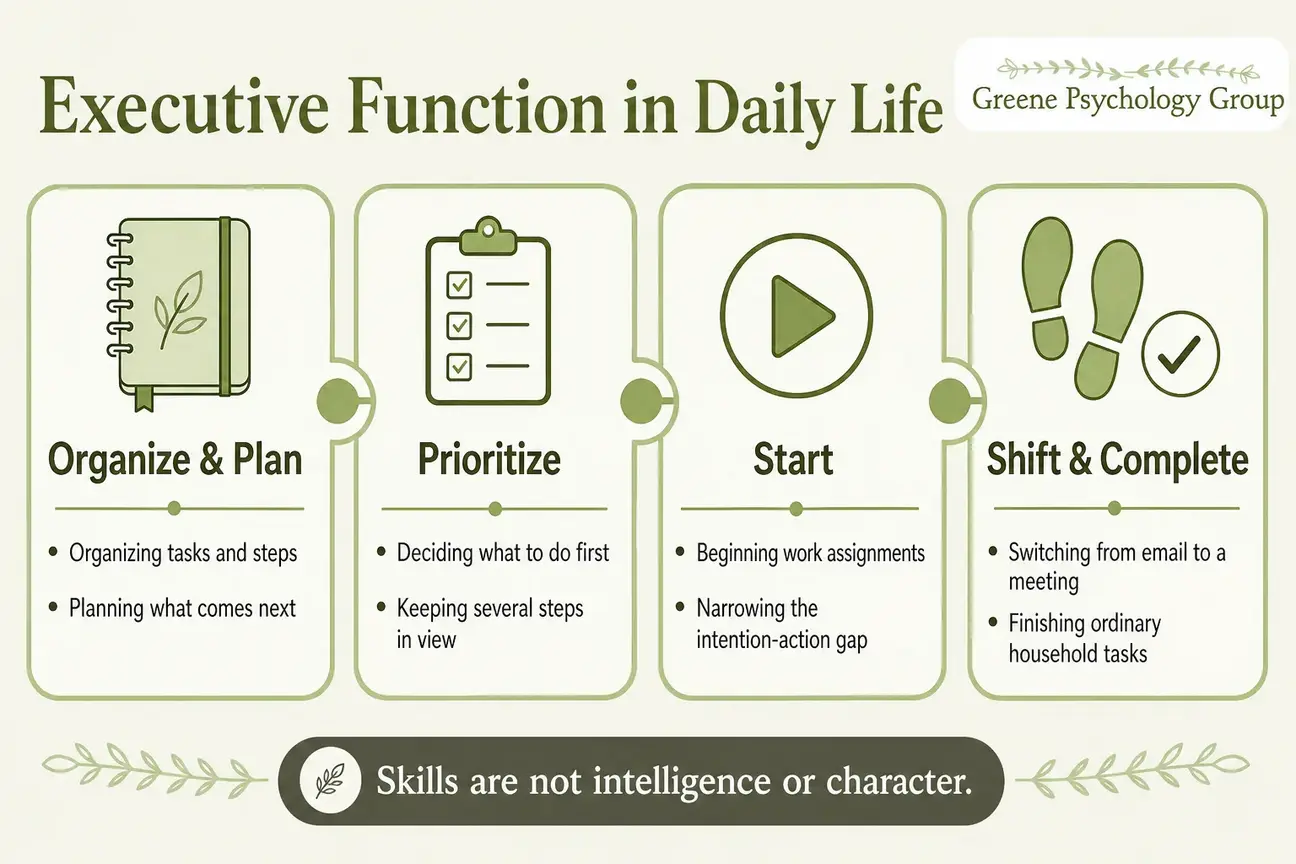
Executive function is a practical way to describe mental processes involved in organizing, planning, prioritizing, starting, shifting between, and completing tasks. In daily life, it can show up in very ordinary moments: deciding what to do first, remembering why you walked into a room, getting started on a work assignment, leaving on time, switching from email to a meeting, or keeping track of several steps in a household task.
Executive-function skills are not about intelligence or character. Many adults who struggle in these areas are thoughtful, capable, and deeply motivated. The frustrating part is that the gap between intention and action can become wide. A person may care about a task and still avoid it. A deadline may matter and still drift out of awareness. A plan may be clear in theory but hard to organize when emotions rise.
Common executive-function areas adults talk about in therapy include:
- Planning and sequencing: turning a goal into steps that can actually be done.
- Prioritizing: choosing what matters now instead of reacting to everything at once.
- Working memory: holding information in mind while using it.
- Task initiation: beginning a task, especially when it feels boring, ambiguous, emotionally loaded, or too large.
- Time awareness: estimating how long something will take and noticing time passing.
- Transitions: moving from one activity, role, or environment to another.
- Self-monitoring: checking progress and adjusting before a problem grows.
- Emotion and impulse regulation: pausing long enough to choose a response when frustration, urgency, or shame is high.
These challenges can occur with ADHD, and they can also appear for other reasons. When adults describe trouble starting tasks, losing track of time, or becoming emotionally overwhelmed, the most useful next step is not self-blame. It is noticing the pattern, its context, and whether support could help daily life feel more workable.
Adult ADHD executive function concerns are reflection points, not a diagnosis
Difficulties with planning, prioritizing, task initiation, working memory, transitions, or emotional responses can be useful reflection points when deciding whether support may help. They are not, by themselves, an ADHD test or diagnosis. A person can struggle with follow-through during a stressful season, after a loss, during a major transition, because of sleep disruption, or because anxiety or depression is affecting concentration and motivation.
The CDC explains that adults concerned about ADHD should speak with a healthcare provider, because other mental-health or physical-health concerns can cause similar symptoms or occur alongside ADHD. That distinction matters. If every organization problem is assumed to be ADHD, anxiety, depression, burnout, grief, sleep problems, substance misuse, medical issues, or learning differences may be missed.
Reflection questions can still be helpful when used carefully. They are not a score, checklist, or diagnosis. They are a way to describe what is happening so a conversation with a therapist, healthcare provider, or evaluation professional can be more specific.
- Do important tasks remain difficult to start even when they matter?
- Does a long list become so overwhelming that choosing the first step feels almost impossible?
- Do transitions create more delay, irritation, or shutdown than expected?
- Are reminders, calendars, written instructions, or visual cues needed to hold onto plans?
- Does emotional intensity interfere with problem-solving, communication, or follow-through?
- Are these patterns recent, longstanding, situation-specific, or connected to stress?
- Do shame or self-criticism make it harder to recover after something slips?
Some adults bring these questions to therapy after searching for ADHD task initiation strategies, while others begin with ADHD time management or ADHD emotional regulation concerns. The wording matters less than the pattern: something repeatedly gets in the way between intention and action.
It can be tempting to answer these questions with a harsh story: “I’m lazy,” “I’m unreliable,” or “I should be able to do this.” Therapy often helps people slow down that story. The goal is not to excuse every consequence or avoid responsibility. It is to understand what is actually happening so the next step can be more effective and less shame-driven.
What can look like executive-function difficulty
Many experiences can interfere with attention, memory, motivation, and follow-through. Anxiety can make the mind scan for risk and second-guess decisions. Depression can reduce energy, slow thinking, and make tasks feel pointless or unusually heavy. Chronic stress can narrow attention and make everything feel urgent, even when priorities are unclear. Grief and life transitions can disrupt routines that used to be automatic.
Sleep problems can also affect focus, emotional steadiness, and working memory. Substance use, medical concerns, learning disabilities, trauma history, and relationship stress may complicate the picture. None of this means ADHD is not possible. It means that executive-function challenges deserve context.
One reason therapy may be useful is that daily functioning rarely happens in isolation. A missed deadline may connect to avoidance, fear of criticism, unclear expectations, sleep loss, perfectionism, or resentment. A pattern of late arrivals may involve time estimation, transitions, emotional resistance, or a schedule that has too little buffer. A pile of unfinished tasks may reflect task size, low mood, competing responsibilities, or a system that depends too heavily on memory.
ADHD task initiation can look similar to anxiety-based avoidance. ADHD time management can resemble the effects of chronic stress or sleep disruption. ADHD emotional regulation can overlap with depression, trauma responses, relationship strain, or burnout. Therapy can help sort through these possibilities without turning a reflection point into a self-diagnosis.
A licensed clinician can help explore these patterns without jumping too quickly to a single explanation. If a formal diagnostic question becomes important, the clinician may recommend an appropriate evaluation path or encourage coordination with a healthcare provider.
How adult ADHD is assessed by a licensed clinician
Adult ADHD diagnosis is broader than “I cannot stay organized” or “I procrastinate.” The National Institute of Mental Health describes ADHD as involving ongoing patterns of inattention, hyperactivity, or impulsivity that interfere with functioning or development. For adults, a clinician also considers history over time, current functioning, and whether symptoms were present before age 12.
An assessment may include clinical interviews, rating scales, symptom checklists, developmental history, information from people who know the person well, review of medical and mood history, and psychological testing when clinically indicated. The exact process depends on the evaluator’s role, setting, and scope of practice.
A careful assessment also considers whether symptoms occur in more than one setting and whether they create meaningful impairment. For example, a person who is overwhelmed only during a temporary work crisis may need a different kind of support than someone who has struggled with organization, time, and follow-through across school, work, home, and relationships for many years.
This is why diagnosis belongs with a qualified professional. Online articles can help people find language for an experience, but they cannot determine whether ADHD, anxiety, depression, sleep disruption, trauma, learning differences, or another concern is the best explanation. If testing or diagnostic clarification is the goal, ask a licensed clinician or qualified evaluation provider what assessment options are available. Greene Psychology Group’s verified service for this topic is psychotherapy, not a confirmed ADHD testing service.
ADHD task initiation: starting when the task matters
ADHD task initiation is a phrase many adults use when the hardest part is not knowing what to do, but beginning. A task may sit untouched even when it is important, even when consequences are clear, and even when the person feels guilty about delaying it. This can be especially painful because it looks simple from the outside: open the document, make the call, start the laundry, reply to the message.
In therapy, initiation concerns may be explored in a more specific way. What counts as “starting”? Is the first step too large? Is the task emotionally loaded? Is there fear of doing it wrong? Is the person trying to begin at the hardest part instead of creating an easier entry point? Does the task require a decision that has not been made yet?
Therapy may help by breaking a vague task into a visible first action. “Clean the house” might become “put dishes in the dishwasher for ten minutes.” “Deal with finances” might become “open the bill folder and list what is inside.” “Write the report” might become “create the document and add three rough bullet points.” These are not magic solutions, and they do not work the same way for every person. They are examples of how therapy can help turn an overwhelming demand into an observable next step.
ADHD task initiation work can also involve noticing what happens emotionally before starting. Some adults feel dread, irritation, shame, boredom, fear of criticism, or pressure to do the whole task perfectly. Therapy can help identify those internal barriers and develop coping skills for beginning without waiting for the feeling of readiness.
Another part of this work is learning what makes a start more likely. Some people need a smaller first step. Some need a body-doubling structure, a clearer deadline, or a written cue. Others need to address the shame that appears before the task begins. Therapy can help test strategies while also asking why a strategy does or does not fit real life.
ADHD time management: making time more visible
ADHD time management concerns often involve more than being late. Adults may underestimate how long tasks take, forget transition time, overcommit because each task seems small in isolation, or lose track of time when focused on something engaging. Others feel constantly rushed but still cannot identify where the time went.
Therapy may support time awareness by helping a person create systems that make time external and visible. That might include planning backward from a deadline, adding transition buffers, using alarms as cues rather than judgments, or reviewing how long tasks actually take compared with estimates. The emphasis is usually on experimentation, not perfection.
For some adults, ADHD time management is complicated by avoidance. If a task feels unpleasant, time can become fuzzy. The person may keep doing less important tasks because they provide a sense of motion without requiring the difficult start. Therapy can help separate urgency from importance and identify whether anxiety, perfectionism, low mood, or conflict is shaping the schedule.
Time planning can also involve expectations about capacity. A calendar may technically have space for a task, but the person may be depleted, overstimulated, or emotionally worn down. Therapy can help clients plan in a way that accounts for real capacity rather than an idealized version of the day.
Because ADHD time management often affects other people, therapy may include communication skills. It can be useful to practice saying what is realistic, building in buffer time, and repairing after a missed deadline or late arrival without collapsing into shame.
ADHD emotional regulation: when feelings interrupt follow-through
ADHD emotional regulation refers to the way strong emotions can affect attention, decisions, communication, and action. Some adults notice that frustration rises quickly when plans change. Others feel intense shame after a mistake and then avoid the task even more. A small criticism may derail the rest of the day, or a conflict may make it hard to return to work.
Emotion regulation is not about suppressing feelings. It is about noticing escalation early enough to choose a response. In therapy, a person might learn to identify the first signs of overwhelm, pause before sending a message, step away from a conflict, or name what is happening without turning it into a global judgment.
For adults with executive-function concerns, emotional intensity can become part of the task problem. The task is no longer just “answer the email.” It is “answer the email while managing dread, embarrassment, resentment, and fear of being misunderstood.” Therapy may help make those layers more visible so the person can respond to the actual barrier instead of repeatedly blaming themselves for not “just doing it.”
ADHD emotional regulation work may also include communication skills. Missed tasks, forgotten plans, or delayed responses can affect partners, family members, coworkers, or friends. Therapy may help a person practice repair, clarify expectations, and ask for support without using shame as the main motivator.
For some adults, emotional intensity is the concern that finally leads them to therapy. The visible problem may be procrastination or disorganization, but the painful part is the crash afterward. Therapy can help separate a mistake from identity, which may make it easier to return to the task and repair what needs attention.
Where adult ADHD therapy fits—and where it does not
Adult ADHD therapy can support coping, routines, self-understanding, and daily functioning. It is not the same as a formal ADHD evaluation, and it is not medication management. That distinction can reduce confusion and help people ask for the right kind of care.
The American Psychological Association describes psychotherapy as a collaborative treatment based on the relationship between a person and a psychologist. In the context of executive-function concerns, therapy may focus on current patterns: how tasks are approached, what gets avoided, what emotions show up, what systems are missing, and how relationships are affected.
The NIMH ADHD information also lists medication and psychotherapy among treatment categories, but that does not mean every person needs the same combination of care. Medication decisions belong with a prescriber. Greene Psychology Group does not provide medication prescribing or medication management. Therapy and medication can be separate or coordinated parts of care depending on the person’s needs and the professionals involved.
Adult ADHD therapy may include CBT-informed strategies, behavioral planning, psychoeducation, values-based work, mindfulness-informed coping, or skills for emotion regulation. It may also address anxiety, depression, stress, shame, grief, relationships, or life transitions that affect concentration and follow-through. The focus should be individualized rather than a one-size-fits-all program.
This kind of therapy can be especially helpful when goals are practical and emotionally aware at the same time. For example, task initiation may require smaller steps, but it may also require working with dread or perfectionism. Time management may involve calendars, but it may also involve grief about repeated disappointments. Emotion regulation may involve coping skills, but it may also involve relationship repair.
Therapy, ADHD testing, and medication management compared
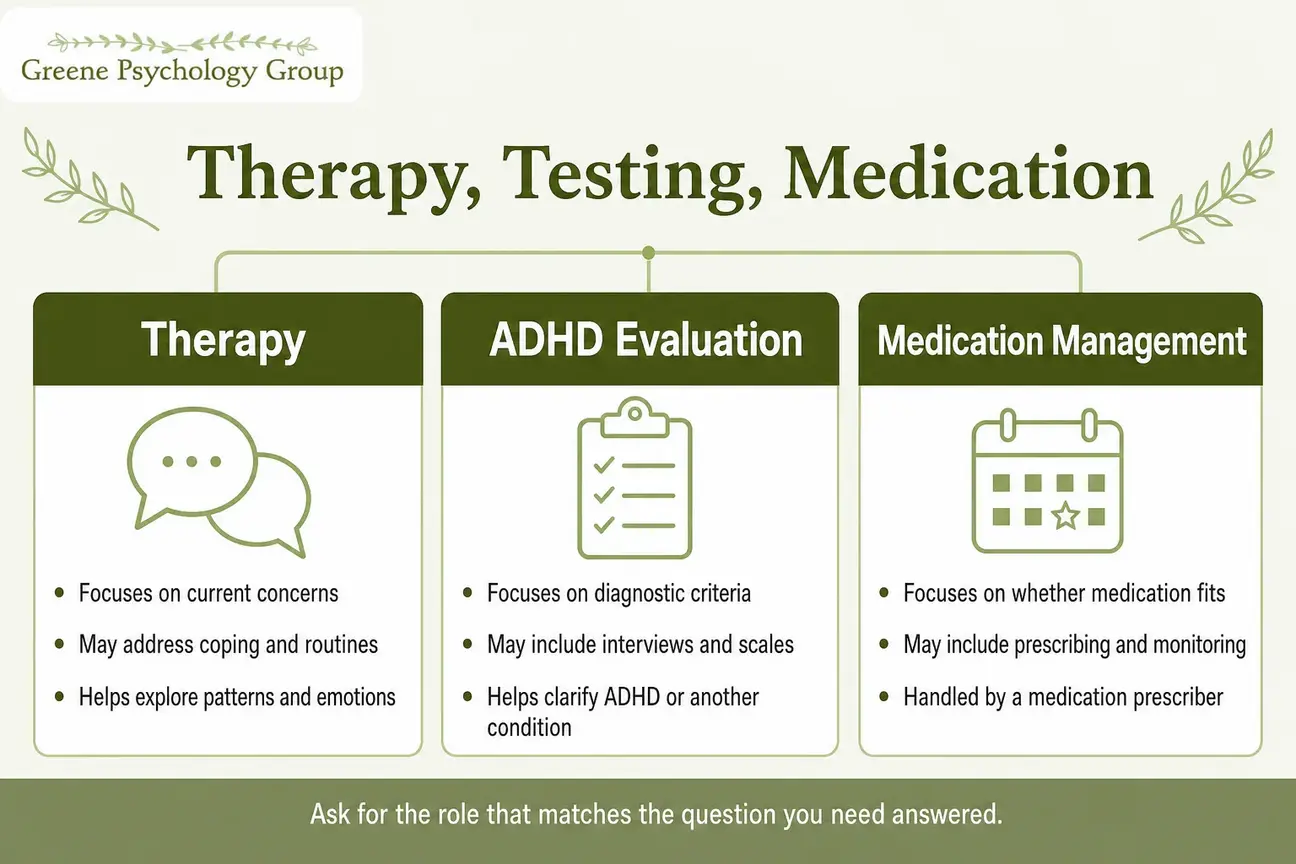
Many adults use the words “therapy,” “testing,” and “treatment” interchangeably when they first start looking for help. They are related, but they answer different questions. The table below is a general educational comparison, not a promise of what any specific provider offers.
| Therapy | ADHD evaluation or testing | Medication management |
|---|---|---|
| Focuses on current concerns, coping skills, patterns, relationships, emotions, and daily functioning. | Focuses on determining whether diagnostic criteria for ADHD or another condition are met. | Focuses on whether medication is appropriate, how it is prescribed, and how it is monitored by a prescriber. |
| May address ADHD task initiation, routines, ADHD time management, emotional responses, anxiety, depression, stress, or shame. | May include interviews, rating scales, developmental history, collateral information, and psychological testing. | Requires a qualified prescribing professional; therapy practices may or may not provide this service. |
| Can be useful whether or not a person ultimately receives an ADHD diagnosis. | Provides diagnostic conclusions within the evaluator’s scope and process. | Does not replace therapy when emotional, relational, behavioral, or coping concerns need attention. |
| Does not automatically establish an ADHD diagnosis. | May help clarify whether ADHD, another concern, or more than one concern is involved. | Medication decisions belong with a prescriber; do not start, stop, or change medication based on an article. |
This distinction can make the first step less intimidating. No one needs to know in advance whether concerns “count” as ADHD to talk with a therapist about what is affecting life. At the same time, if the main goal is diagnostic testing, it is appropriate to ask directly whether a provider offers that service or can suggest where to seek an evaluation.
4 practical therapy supports for daily functioning
Therapy for executive-function concerns often returns to four overlapping areas: starting, planning time, regulating emotions, and building compassionate routines. These are not four promised outcomes. They are four areas where therapy may help people understand patterns and practice different responses.
Support 1: ADHD task initiation and one visible action
Support for starting may focus on creating a first action that is small enough to do. Rather than waiting for motivation, a therapist may help identify the first visible behavior, reduce ambiguity, and notice the emotions that block beginning.
For example, the therapy conversation may move from “I need to get my life together” to “I will open the document and write three rough bullet points.” That shift matters because the second statement describes an action the person can observe. ADHD task initiation support often works best when it reduces vagueness and lowers the emotional cost of beginning.
Support 2: ADHD time management and visible planning
Support for time planning may focus on making time more concrete. This can include buffers, backward planning, reminders, transition cues, and reviewing what actually happens during the day instead of relying only on intention.
In therapy, a person might look at why a calendar repeatedly fails. Is travel time missing? Is the plan too tightly packed? Are tasks scheduled during predictable low-energy times? ADHD time management support often involves adjusting the system to fit real life rather than treating every delay as a character flaw.
Support 3: ADHD emotional regulation and a pause before reaction
Support for strong emotions may focus on pausing before emotions choose the next move. Therapy may help people notice escalation, name shame or frustration, and return to a task or conversation with more choice.
This work may be especially useful when a mistake leads to avoidance, defensiveness, or shutdown. ADHD emotional regulation support can include noticing early cues, practicing repair language, and separating a single problem from a global judgment about the self.
Support 4: adult ADHD therapy for routines that fit real capacity
Adult ADHD therapy may support routines that fit real capacity. A routine is more likely to last when it accounts for energy, stress, relationships, work demands, and the person’s values. Therapy can help adjust the system rather than treating every breakdown as a personal failure.
Capacity-based routines are not about doing less out of avoidance. They are about planning from what is true. A person may need a simpler morning system, a written shutdown routine at work, a clearer household plan, or a recovery strategy after emotionally intense days. Therapy can help test what fits and revise what does not.
How therapy may support routines, relationships, and self-understanding
Therapy for executive-function concerns is often most useful when it is concrete and compassionate at the same time. Concrete means the work connects to real life: calendars, bills, household routines, school or work demands, communication, sleep patterns, and transitions. Compassionate means the work does not rely on shame as the engine for change.
A therapist may help examine a routine that repeatedly breaks down. Instead of asking, “Why can’t I do this?” the therapy conversation might ask, “Where does the system fail?” Maybe the reminder comes too late. Maybe the plan depends on remembering five steps. Maybe the task is scheduled after an exhausting day. Maybe the first step is unclear. Maybe the task carries emotional meaning that has not been named.
Adult ADHD therapy can also support self-understanding. Some adults have spent years interpreting missed tasks as moral failures. Others overcompensate by working late, over-preparing, or hiding their struggles. Therapy may help identify patterns of overfunctioning, avoidance, people-pleasing, perfectionism, or all-or-nothing thinking that make daily life more stressful.
Relationships can be part of the work, too. Executive-function challenges may create conflict when responsibilities are missed, conversations are forgotten, or one partner feels like they are carrying the mental load. Therapy can help a person practice clearer communication, repair after mistakes, and realistic planning. When relationship concerns are central, individual therapy may focus on the client’s patterns and choices; couples or family work is a separate type of service to ask about.
In relationship work, emotion regulation may be just as important as calendars or reminders. A missed chore may lead to defensiveness, shutdown, or a long argument. Therapy can help identify the moment when frustration takes over and support a more direct repair conversation.
What to try before or between therapy sessions
The following ideas are organizational experiments, not treatment instructions or diagnostic tools. They may help some adults notice patterns and reduce friction. If any strategy increases distress, self-criticism, or pressure, it is okay to stop and bring that reaction to a licensed clinician.
- Choose one visible next action. Replace “finish the project” with “open the file and write the three headings.” This can support task initiation by lowering the barrier to entry.
- Move tasks out of memory. Use a calendar, written list, reminder, or visual cue so working memory does not have to carry everything.
- Plan the transition, not just the task. If an appointment starts at 2:00, include the time needed to stop what is happening, gather items, travel, log in, or settle. This can make time management more concrete.
- Use a short start. Try a small, time-limited beginning that lowers the barrier to entry. The goal is to start, not to prove everything can be finished at once.
- Notice mood, worry, sleep, and stress. Track whether concentration changes when rested, anxious, sad, rushed, or emotionally overloaded.
- Name the feeling before the reaction. For ADHD emotional regulation, it may help to notice “I feel embarrassed” or “I feel pressured” before sending a message, quitting the task, or arguing.
- Write down questions for a clinician. Include what is recent, what is longstanding, what happens across settings, and which strategies are already tried.
Task initiation, time planning, and emotional regulation often improve most sustainably when strategies fit the person’s real life. A tool that works for a friend may not fit another person’s schedule, nervous system, responsibilities, or values. The point is to gather information, reduce shame, and build systems that are easier to repeat.
When therapy may be worth considering
Therapy may be worth considering when executive-function concerns repeatedly affect work, school, household responsibilities, relationships, self-care, or emotional well-being. Certainty that ADHD is the explanation is not required before asking for help. Impact matters: how often the pattern happens, what it costs, how much distress it creates, and whether current coping strategies are enough.
It may be time to reach out if self-criticism is increasing, if cycles of overpromising and avoiding feel hard to interrupt, or if a major transition has made longstanding patterns harder to manage. Therapy may also help if it is unclear whether anxiety, depression, stress, sleep, grief, or ADHD is most relevant. A licensed clinician can help clarify the next step and, when appropriate, discuss whether evaluation by a qualified provider would be useful.
Adult ADHD therapy does not require a promise that therapy will change everything. A more realistic goal is to understand patterns, practice coping skills, and build supports that make daily life more workable. Some people use therapy to focus on routines and follow-through. Others use it to work on shame, emotional reactivity, or relationship strain. Many need a combination.
When ADHD task initiation keeps important responsibilities stuck, ADHD time management repeatedly affects commitments, or strong emotional reactions strain relationships, therapy may offer a structured place to slow down the pattern and consider what kind of support fits.
Starting therapy with Greene Psychology Group
Greene Psychology Group offers individual psychotherapy for adults and adolescents. If support for executive-function concerns is under consideration, learn more about our therapists, the practice’s mental health therapy services, and self-improvement therapy for goals, motivation, and personal growth.
Some clients begin therapy because they want help with routines, procrastination, emotional responses, or stress rather than a formal label. Others are already wondering about ADHD and want support while deciding whether to pursue evaluation elsewhere. If testing is the main goal, ask directly about assessment options with a licensed clinician or qualified evaluation provider, because psychotherapy and testing are different services.
Greene Psychology Group has offices in Raleigh and Asheville, and online therapy in North Carolina is for people physically located in the state during the session. You can also read more about individual therapy if counseling is new or expectations feel unclear.
To ask about scheduling, contact Greene Psychology Group, call 919-205-5339, or email [email protected]. Because the contact form and email are not encrypted, share only contact details, a brief reason for reaching out, whether an office or online sessions are preferred, and insurance information if relevant. Please do not send detailed health information by email or the contact form.
For insurance questions, Greene Psychology Group is in network with most BCBS and Aetna plans, while many other plans may be out of network; clients should verify benefits with both their insurer and the practice. You can review the practice’s insurance and payment information. Self-pay and uninsured clients receive a Good Faith Estimate, and CMS provides general information about the No Surprises Act.
A grounded closing thought about adult ADHD executive function
If you are searching for help with adult ADHD executive function, it may be because trying harder has not explained why the same patterns keep returning. Therapy may help slow the cycle of shame, look at the real barriers, and build coping skills that fit responsibilities and values. It can also help clarify whether diagnostic evaluation, medical consultation, or another kind of support should be part of the next step.
The most important point is that executive-function challenges are information, not a verdict on character. Whether or not ADHD is ultimately part of the explanation, a careful, nonjudgmental look at what is making daily life harder can help identify what support may be appropriate.
Educational and crisis note
This article is for general education and isn't a substitute for diagnosis or treatment from a licensed professional. If you are in crisis, call or text 988 or call 911.
Greene Psychology Group is not an emergency or crisis service. For immediate danger, call 911 or go to the nearest emergency room. For a mental-health or suicidal crisis, call or text 988; SAMHSA describes 988 as a resource for suicide, mental-health, and substance-use crises.
Frequently Asked Questions
Is difficulty with executive function the same as adult ADHD?
No. Planning, task initiation, working memory, time management, transitions, and emotional responses can be affected by ADHD, but they can also be affected by anxiety, depression, stress, sleep problems, learning differences, substance use, medical concerns, and other factors. A licensed clinician assesses diagnosis.
Can therapy help if I am not sure whether ADHD fits?
Yes, therapy may help address current concerns such as routines, task initiation, emotional responses, anxiety, stress, relationships, or self-understanding without requiring a diagnosis first. Therapy does not itself establish an ADHD diagnosis.
Does therapy provide ADHD testing?
Therapy and ADHD testing are different services. An ADHD evaluation may involve developmental history, clinical interviews, rating scales, information from others, and psychological testing when clinically indicated. If testing is the main goal, ask a licensed clinician or qualified evaluation provider what assessment options are available.
Can therapy replace ADHD medication?
Therapy should not be presented as a medication replacement. Medication decisions belong with a prescriber, and Greene Psychology Group does not provide medication prescribing or medication management. Therapy may still support coping skills, routines, emotional responses, and daily functioning.
What does therapy for executive-function concerns look like?
Sessions may focus on goals, current routines, barriers to follow-through, emotional responses, relationships, and coping skills. A therapist may help develop practical systems and understand patterns, but the specific focus depends on the client’s needs and circumstances.
Is online therapy available for adults in North Carolina?
Greene Psychology Group offers online therapy for people physically in North Carolina during the session. Clients can ask the practice whether online therapy fits their circumstances, preferences, and clinical needs.
When should I seek professional help?
Consider reaching out when difficulties repeatedly affect work, school, relationships, self-care, or emotional well-being; when self-criticism or distress is increasing; or when it is hard to tell whether ADHD, anxiety, depression, stress, sleep, or another concern is involved. A licensed clinician can help clarify the next step.
Sources
- National Institute of Mental Health: Attention-Deficit/Hyperactivity Disorder
- Centers for Disease Control and Prevention: ADHD in Adults
- American Psychological Association: Understanding Psychotherapy and How It Works
- Centers for Medicare & Medicaid Services: No Surprises Act
- SAMHSA: 988 Suicide & Crisis Lifeline