

Adult ADHD in women can be easy to miss. Difficulties with attention, organization, time, and impulse control may be hidden beneath achievement, perfectionism, people-pleasing, or elaborate systems that keep daily life from falling apart. From the outside, a woman may appear capable and organized. Privately, she may feel chronically behind, mentally crowded, ashamed, or exhausted by the effort required to keep up.
Recognizing a pattern is not the same as diagnosing it. ADHD is a neurodevelopmental disorder, and an accurate evaluation considers childhood history, symptoms across settings, functional impairment, and other explanations such as anxiety, depression, trauma, sleep problems, substance use, medication effects, and medical conditions. This guide explains what adult ADHD may look like in women, what masking means, and where psychotherapy can fit into a broader care plan.
What is adult ADHD?
Attention-deficit/hyperactivity disorder, or ADHD, is a neurodevelopmental disorder involving a persistent pattern of inattention and/or hyperactivity and impulsivity that interferes with functioning. Adults may have a predominantly inattentive presentation, a predominantly hyperactive-impulsive presentation, or a combined presentation.
Adult symptoms are not always identical to the childhood stereotype of a visibly hyperactive student. Hyperactivity may be experienced as internal restlessness, difficulty slowing down, excessive talking, frequent movement, or a need for constant stimulation. Inattention may appear as missed details, unfinished projects, forgotten obligations, time-management problems, or difficulty organizing multi-step work.
Many people occasionally procrastinate, misplace something, or lose focus. ADHD involves a pattern that is more frequent, persistent, and impairing than ordinary lapses. Symptoms must trace back to childhood, even if they were not recognized at the time, and they must affect more than one area or setting of life.
Why can ADHD be overlooked in women?
Adult ADHD in women may be overlooked for several interacting reasons. Some girls and women have symptoms that draw less external attention, particularly inattentive symptoms. A quiet student who daydreams, works slowly, or compensates through intense effort may not disrupt a classroom. Strong academic performance also does not rule out ADHD when success depends on excessive time, anxiety, family structure, last-minute urgency, or unsustainable effort.
Social expectations can further conceal impairment. Women are often expected to track household logistics, relationships, caregiving, communication, and emotional labor. Someone may respond by building complicated reminder systems, checking work repeatedly, avoiding tasks that expose difficulty, or sacrificing sleep to finish what others complete more efficiently. These strategies may preserve outward performance while increasing distress.
Symptoms can also be attributed to anxiety, depression, stress, hormonal changes, or personality. Those factors may genuinely be present, and ADHD can coexist with them. The purpose of evaluation is not to replace one label with another; it is to understand the full pattern and decide what support fits.
What are common signs of adult ADHD in women?
Possible signs of adult ADHD in women include problems with attention, executive functioning, restlessness, and impulse control. Executive functions are mental processes used to plan, begin, sequence, monitor, and complete goal-directed actions. Difficulties may become more visible when external structure decreases or responsibilities increase.
| Area | Possible experience | Why context matters |
|---|---|---|
| Attention | Losing the thread of conversations, missing details, or drifting during routine work | Sleep loss, anxiety, depression, trauma, and medical factors can also affect concentration |
| Task initiation | Knowing what to do but feeling unable to start until urgency becomes intense | Avoidance may also reflect fear, unclear instructions, low mood, or an unrealistic workload |
| Time management | Underestimating duration, running late, or moving between urgency and waiting mode | Patterns across settings and over time are more informative than an isolated late arrival |
| Working memory | Forgetting an intention after interruption or losing track of steps in a process | Stress and divided attention can temporarily reduce working-memory performance |
| Organization | Misplacing items, creating piles, or using systems that quickly become difficult to maintain | A cluttered space alone does not establish a diagnosis |
| Restlessness | Feeling internally driven, fidgeting, multitasking, or struggling to relax | Anxiety and other conditions can produce similar physical activation |
| Impulsivity | Interrupting, making rapid decisions, or choosing immediate relief despite later costs | Clinicians consider frequency, consequences, development, and alternative causes |
| Emotional impact | Shame, frustration, rejection sensitivity, or exhaustion after repeated difficulties | These experiences matter clinically but are not specific to ADHD |
No single item in this table proves ADHD. A credible assessment asks when the pattern began, how often it occurs, where it appears, what it disrupts, and whether another explanation fits better.
What does ADHD masking look like?
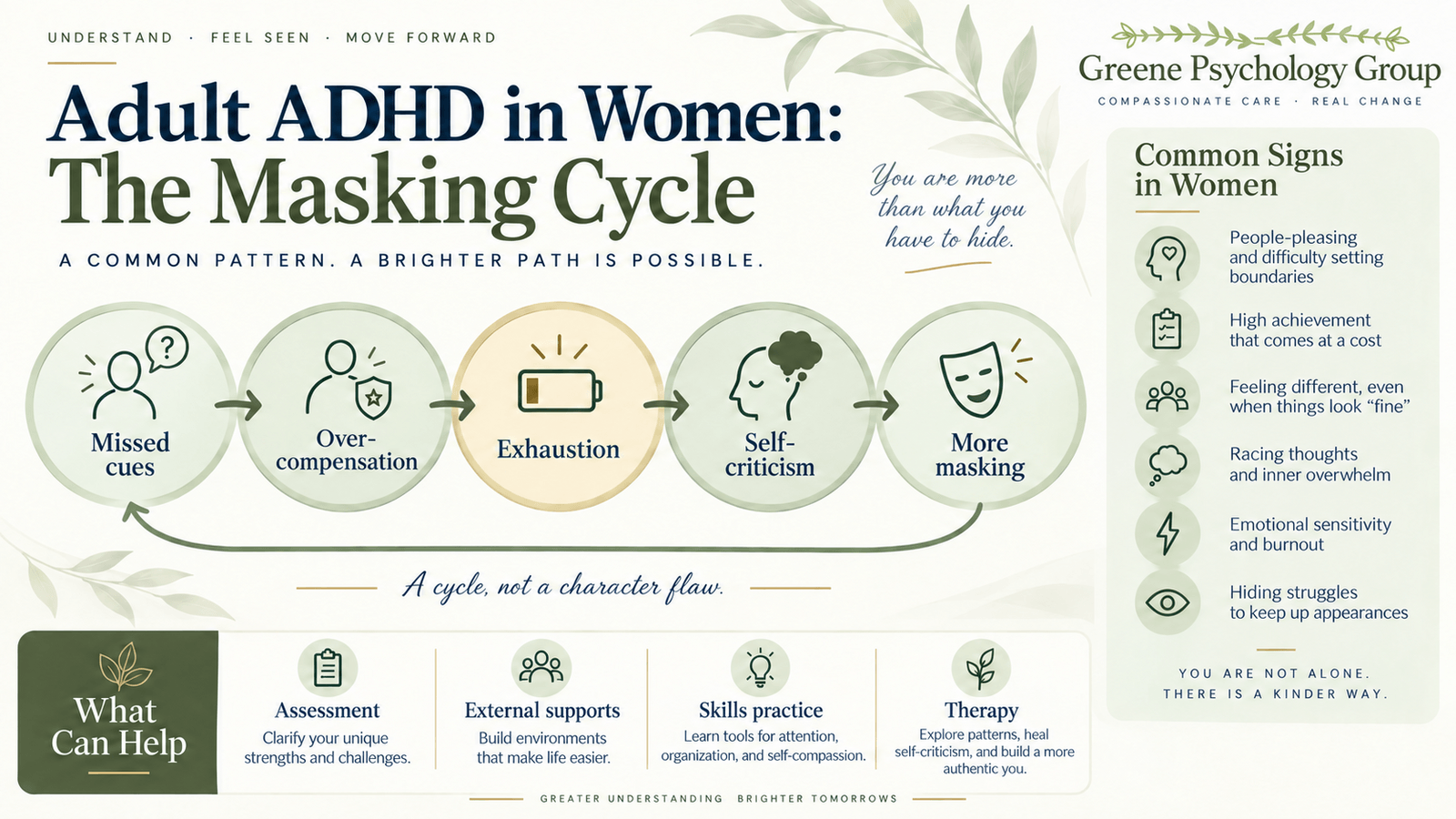
Masking in adult ADHD in women refers to efforts to hide, compensate for, or prevent other people from noticing attention and executive-function difficulties. Masking is not deception. It is often a learned response to criticism, social pressure, misunderstanding, or fear of being seen as careless or unreliable.
Examples can include arriving extremely early to prevent lateness, rehearsing conversations, checking work repeatedly, avoiding unfamiliar tasks, keeping dozens of alarms, working much longer than peers, volunteering less to avoid exposure, or relying on perfectionism to prevent mistakes. Some supports are genuinely helpful. The problem arises when a system is driven by fear, consumes disproportionate energy, or collapses whenever life becomes more demanding.
Masking can create a confusing picture. Other people see achievement; the individual experiences strain. When compensation succeeds, the underlying difficulty may be dismissed. When it fails, the person may blame herself rather than recognize that the workload and support system need closer examination.
How can ADHD affect work, relationships, and daily life?
At work or school, adult ADHD in women may affect prioritizing, estimating time, completing low-interest tasks, shifting between projects, following lengthy instructions, or remembering details after interruptions. Some people perform well under urgency and then feel depleted. Others avoid advancement because greater responsibility would expose systems that already feel fragile.
In relationships, forgotten plans, interruptions, uneven household follow-through, emotional reactivity, or difficulty transitioning attention can be interpreted as a lack of care. Repeated misunderstandings may create defensiveness on both sides. Clear requests, shared systems, realistic division of labor, and repair after conflict can be more useful than moral labels.
Daily life may involve unpaid bills despite available funds, unfinished chores, misplaced essentials, irregular sleep, appointment difficulties, or a cycle of clutter and intense cleanups. These patterns do not define a person’s character. They are information about where the current environment, demands, and skills are not working well together.
Is it ADHD, anxiety, depression, trauma, or something else?
Adult ADHD in women cannot be reliably distinguished from other concerns using one symptom or online quiz. Anxiety can make concentration difficult because attention is captured by threat and worry. Depression may reduce energy, motivation, processing speed, and initiation. Trauma-related symptoms can include distractibility, hypervigilance, avoidance, sleep disruption, and emotional reactivity. Medical conditions, hormonal changes, medication effects, substance use, and chronic sleep loss can also affect attention.
A timeline is particularly useful. ADHD symptoms begin in childhood, although they may not have been recognized. A clinician may ask about school reports, childhood routines, repeated feedback, family observations, work history, and whether symptoms occur during both calm and stressful periods. With permission, information from someone who knew the person earlier in life can sometimes add context.
| Question | What it helps explore |
|---|---|
| Were similar difficulties present before age 12? | The developmental history required for an ADHD diagnosis |
| Do the difficulties appear in more than one setting? | Whether the pattern extends beyond one stressful job, class, or relationship |
| What changed when symptoms became more noticeable? | Increased demands, loss of structure, sleep, health, trauma, or mood factors |
| When does focus improve? | The effects of interest, novelty, urgency, structure, environment, and support |
| What is the functional cost? | Impact on work, learning, relationships, finances, health, caregiving, and self-care |
| Which other symptoms occur at the same time? | Possible anxiety, depression, trauma, sleep, substance-use, or medical explanations |
What does an adult ADHD evaluation involve?
An evaluation for adult ADHD in women generally involves a detailed clinical history rather than a single test. A healthcare or mental-health professional may use an interview, standardized rating scales, symptom checklists, records, and information from people who know the individual well. The process examines current symptoms, childhood evidence, impairment, strengths, coping strategies, medical history, medications, sleep, substance use, and co-occurring mental-health concerns.
Screening tools can identify whether further evaluation is appropriate, but a positive screen is not a diagnosis. Psychological or cognitive testing may be useful in some situations, especially when learning, memory, or other diagnostic questions need clarification, but no single cognitive score confirms or excludes ADHD.
Before scheduling, ask what the provider evaluates and what the appointment includes. Psychotherapy, diagnostic assessment, psychological testing, and medication management are different services. Do not assume that every therapist or practice provides all of them.
How can therapy help women with ADHD?
Psychotherapy for adult ADHD in women may help someone understand patterns, build practical systems, address emotional consequences, and improve functioning. Cognitive behavioral approaches can examine beliefs and behaviors that intensify avoidance, such as “If I cannot do this perfectly, there is no point starting.” Behavioral strategies can make tasks smaller, cues more visible, and accountability more immediate.
Therapy may also address shame, grief, anxiety, depression, relationship conflict, or years of interpreting inconsistent performance as a personal failure. A diagnosis, when appropriate, may offer an explanation, but treatment still needs to be individualized. The goal is not to erase personality or force constant productivity. It is to reduce preventable impairment and help the person act more consistently with her priorities.
Practical targets in therapy may include
- Turning vague projects into small, visible next actions
- Using external cues instead of relying only on memory
- Estimating time in ranges and reviewing estimates without shame
- Designing routines that survive imperfect days
- Reducing all-or-nothing standards and avoidance
- Practicing emotional regulation and recovery after frustration
- Communicating needs and repairing relationship misunderstandings
- Identifying supports that reduce friction without becoming exhausting
Therapy does not prescribe medication unless the clinician is separately qualified and authorized to do so. Medication questions should be discussed with an appropriate prescriber. Some adults use psychotherapy, medication, skills support, workplace accommodations, or a combination. What is appropriate depends on the individual’s diagnosis, health, preferences, risks, and goals.
What strategies can support daily functioning?
Useful strategies for adult ADHD in women reduce the number of steps between intention and action. They should be simple enough to use repeatedly, not impressive enough to display once. Start with one problem that has a clear cost, test one change, and review the result.
- Define the next visible action. Replace “work on report” with “open the report and write three headings.”
- Place cues where the action happens. A reminder that appears in the right context is usually more useful than another item on a distant master list.
- Reduce setup. Prepare materials in advance, keep frequently used items visible, or create a consistent landing place for essentials.
- Use short work intervals. A limited starting period can lower the barrier to initiation. The goal is beginning, not forcing endless concentration.
- Add appropriate accountability. A scheduled check-in, shared work period, or clearly defined deadline can create structure without shame.
- Plan transitions and recovery. Allow time to stop, shift tasks, eat, rest, and reset. Overloading the schedule can make even good systems fail.
- Review the environment. Noise, visual distraction, unclear instructions, interruptions, and competing priorities may need practical changes.
If a strategy repeatedly fails, treat that as data. The task may be too large, the cue may appear too late, the environment may conflict with the plan, or another health or mental-health factor may need attention.
When should someone seek professional support?
Consider professional support for adult ADHD in women when attention or organization difficulties are persistent, distressing, or interfering with work, school, relationships, finances, health, caregiving, or self-care. Support can also be appropriate when coping systems require unsustainable effort, anxiety is increasing, or shame is narrowing a person’s choices.
Bring a few recent examples, a rough timeline, relevant childhood information, current medications, sleep patterns, substance use, major stressors, and strategies already tried. You do not need a perfectly organized story. Uncertainty and contradictions are useful parts of an assessment.
If symptoms appeared suddenly, changed substantially, or occur with significant physical or neurological changes, medical evaluation may be important. If you may harm yourself or someone else, cannot stay safe, or face immediate danger, call 911 or go to the nearest emergency department. In the United States, call or text 988 for crisis support. A therapy practice’s routine phone, email, and contact form are not emergency services.
Finding therapy in Raleigh or Asheville
Greene Psychology Group provides psychotherapy for adolescents and adults and lists offices in Raleigh and Asheville. The practice also provides information about online therapy. Telehealth availability and suitability depend on the clinician, the client’s location during sessions, clinical needs, privacy, technology, and applicable licensure rules.
When choosing a therapist, ask about current licensure, experience with adult attention and executive-function concerns, therapeutic approach, how progress is reviewed, and what services are or are not included. If you need formal diagnostic testing or medication management, confirm whether those services are available or whether a referral is appropriate.
Insurance coverage and benefits vary by plan. Review the practice’s current insurance information, and verify eligibility, deductibles, copays, authorizations, visit limits, and out-of-network benefits with both the insurer and the practice. Submitting an inquiry does not establish a therapist-client relationship or guarantee availability.
Ask About Therapy at Greene Psychology Group
If attention difficulties, masking, anxiety, or chronic overwhelm are affecting daily life, a conversation with a qualified professional may help clarify the next step. Contact Greene Psychology Group or call 919-205-5339 to ask about current services, clinician fit, locations, telehealth, insurance, and scheduling.
Frequently Asked Questions
Can a woman have ADHD even if she did well in school?
Yes. Good grades do not rule out adult ADHD in women. Some women succeed because of strong ability, family structure, anxiety-driven effort, repeated checking, late-night work, or environments that provide clear routines. An evaluation considers the amount of effort required, consistency across settings, childhood patterns, and functional impairment—not academic performance alone.
What does high-functioning ADHD in women mean?
“High-functioning ADHD” is not a formal diagnosis. In conversations about adult ADHD in women, people often use the phrase when someone appears successful while privately struggling with organization, time, attention, or exhaustion. Outward achievement can coexist with real impairment. A clinician focuses on symptoms, coping costs, developmental history, and effects on daily life rather than the informal label.
Is ADHD masking the same as pretending?
No. Masking generally describes attempts to hide or compensate for difficulties, often to avoid criticism, embarrassment, or negative consequences. It may involve overpreparing, repeated checking, rigid routines, or avoiding situations that expose a challenge. These strategies can be adaptive, but they may become exhausting or obscure the need for appropriate support.
Can anxiety look like ADHD in adult women?
Yes. Anxiety can impair concentration, working memory, sleep, decision-making, and task completion. Anxiety and adult ADHD in women can also occur together and intensify each other. A careful evaluation reviews when symptoms began, what triggers them, whether they occur during calmer periods, and how they affect different settings rather than assuming one explanation.
Can hormonal changes affect ADHD symptoms?
Some women report changes in attention, mood, or executive functioning around hormonal transitions, but individual experiences vary and symptoms can have multiple causes. New or significant changes deserve an individualized medical and mental-health review. Hormonal timing alone neither confirms nor rules out ADHD, and treatment decisions should not be based on a blog.
Does an online ADHD test provide a diagnosis?
No. An online questionnaire may help organize concerns about adult ADHD in women or indicate that further evaluation could be useful, but it cannot establish ADHD by itself. Diagnosis requires a qualified professional to assess childhood onset, persistence, symptoms across settings, functional impairment, and alternative explanations such as anxiety, depression, trauma, sleep problems, substance use, or medical conditions.
Can therapy help adult ADHD without medication?
Therapy for adult ADHD in women may help with planning, task initiation, emotional regulation, shame, communication, and sustainable routines. Some adults use therapy without medication, while others benefit from medication, psychotherapy, accommodations, or combined support. The right plan depends on diagnosis, health, risks, preferences, and goals. Medication decisions belong with an appropriate prescriber.
How long does therapy for ADHD take?
There is no universal timeline. Duration depends on the person’s goals, symptom severity, co-occurring concerns, therapeutic approach, consistency, outside demands, and available support. A responsible therapist should define observable goals, explain the treatment approach, review progress, and adjust or recommend another service when the current plan is not helping.
Can teletherapy help women with ADHD?
Teletherapy can be useful for some adults when the clinician is authorized to practice where the client is physically located and the person has adequate privacy, technology, and clinical stability. It is not suitable for every situation. Fit depends on risk, needs, preferences, distractions, accessibility, and whether in-person or higher-level care would be safer or more effective.
What should I bring to an adult ADHD evaluation?
Bring recent examples of difficulties, a rough timeline, childhood records if available, family observations when appropriate, current medications, relevant medical history, sleep information, substance use, major stressors, and coping strategies already tried. Requirements vary by provider, so ask what is needed before the appointment. You do not need to organize everything perfectly.
Sources
- National Institute of Mental Health: ADHD in Adults—4 Things to Know
- Centers for Disease Control and Prevention: ADHD in Adults
- National Institute of Mental Health: Psychotherapies
- Substance Abuse and Mental Health Services Administration: 988 Suicide & Crisis Lifeline
Educational notice: This article provides general information and does not diagnose ADHD, replace an individualized evaluation, or establish a therapist-client relationship. Services, clinician fit, telehealth eligibility, insurance benefits, and appointment availability must be confirmed directly with the practice.