
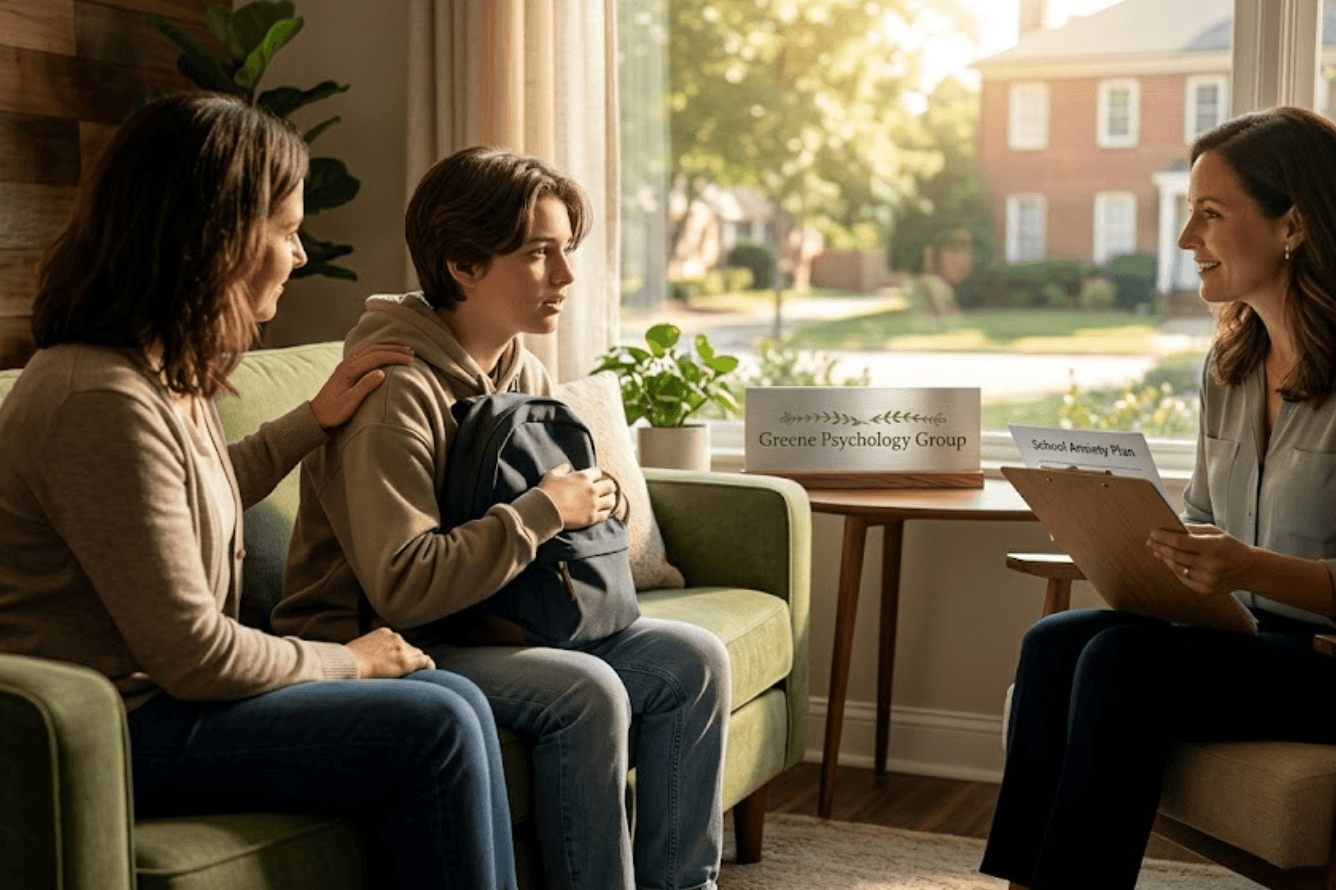
If you are the parent of a teenager, you have probably already felt the shift in the air. August arrives, the back‑to‑school ads flood your social media feeds, and your teen's mood changes. Maybe they become irritable, withdrawn, or suddenly have trouble sleeping. Maybe they complain of headaches or stomachaches that seem to appear just as you mention the first day of school.
You are not imagining it. Back‑to‑school anxiety in teens is real, and it is on the rise. Research from the National Institute of Mental Health (NIMH) shows that anxiety disorders affect approximately 31.9% of adolescents aged 13–18, and the transition back to school is a common trigger for both new and existing anxiety.
As a parent, you are caught between two impossible questions: Is this normal nervousness, or is something really wrong? And if something is wrong: How do I help without pushing them away?
Greene Psychology Group in Raleigh, NC, specializes in evidence‑based treatment for adolescent anxiety, using Cognitive Behavioral Therapy (CBT), family‑involved care, and skills‑based approaches. This guide is a complete, research‑backed resource for parents: how to recognize the signs of back‑to‑school anxiety, how to talk to your teen, what evidence‑based treatment looks like, and how to find the right help.
Part 1: Why Back‑to‑School Anxiety Is So Common
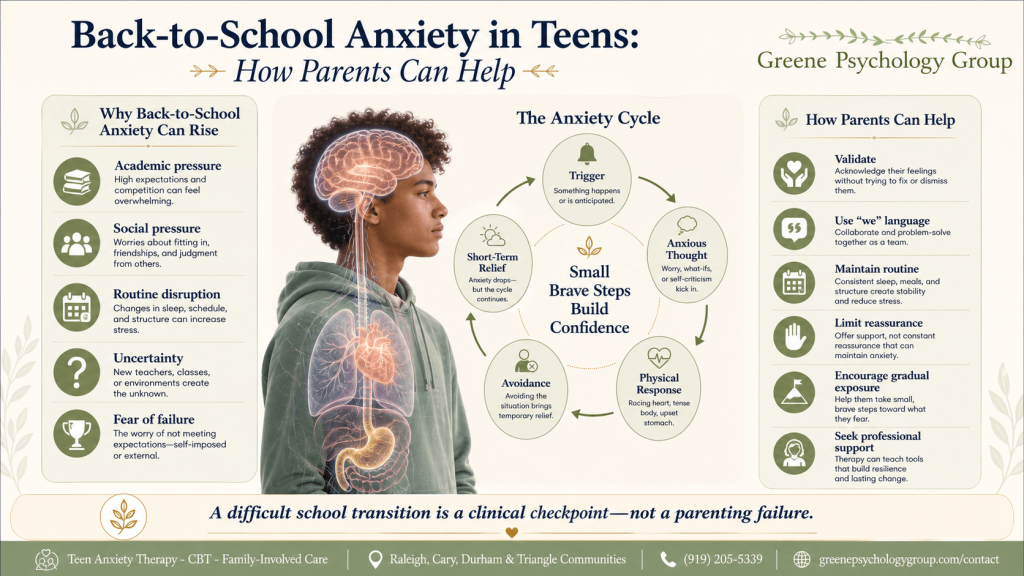
The transition from summer to school is one of the most significant changes in a teen's year. It involves a cascade of stressors:
Academic pressure: New teachers, higher expectations, tests, grades
Social pressure: Navigating friendships, cliques, social media, and the fear of being judged
Schedule change: From unstructured summer days to rigid school schedules, early mornings, and homework
Uncertainty: New classes, new routines, new social dynamics
Performance anxiety: For some teens, the fear of not being "good enough" is overwhelming
Back‑to‑school anxiety in teens can look like a lot of things: defiance, avoidance, physical complaints, or angry outbursts. It is not always the tearful, frightened child we imagine. Teens often express anxiety through irritability and withdrawal.
Research from Duke University's Center for Child and Family Policy has shown that the transition back to school is a significant stressor for adolescents, particularly those with pre‑existing anxiety or perfectionistic tendencies.
Part 2: Signs of Back‑to‑School Anxiety – What to Look For
Not all worry is a disorder. But when worry interferes with daily functioning, it is time to pay attention.
Emotional Signs
Excessive worry: Your teen worries about school constantly – not just the night before, but for weeks in advance
Irritability: Your teen snaps at you over small things, especially when school is mentioned
Mood swings: Rapid shifts from calm to anxious to angry
Fear of failure: Your teen expresses intense fear of failing, being judged, or being "found out"
Panic attacks: Sudden episodes of intense fear with physical symptoms (racing heart, shortness of breath, dizziness)
Behavioral Signs
Avoidance: Your teen makes excuses to avoid school – sleeping in, pretending to be sick, hiding
Procrastination: Putting off school‑related tasks (homework, shopping, organization)
School refusal: Refusing to attend school, or attending only with significant distress
Loss of interest: Withdrawing from activities they once loved (sports, clubs, hobbies)
Social isolation: Pulling away from friends and family
Physical Signs
Headaches: Frequent, unexplained headaches, especially in the morning
Stomachaches: Nausea, stomach pain, or digestive issues before school
Sleep disturbances: Trouble falling asleep, staying asleep, or waking up
Changes in appetite: Eating too much or too little
Fatigue: Exhaustion despite adequate sleep.
The "New School" Factor
If your teen is starting a new school – moving from middle to high school, switching schools, or starting college – the anxiety can be more intense. There is more uncertainty, more social pressure, and higher expectations.
What to watch for: Escalating avoidance, physical symptoms that do not improve, or resistance to any form of support.
Part 3: The Anxiety Cycle – Why It Keeps Getting Worse
Back‑to‑school anxiety in teens operates on a predictable cycle. Understanding this cycle is the first step to breaking free.
The Cycle
Trigger: Something activates anxiety – the first day of school, a test, a social situation, a physical sensation (racing heart).
Anxious Thought: The teen interprets the trigger as dangerous. "I'm going to fail." "Everyone will judge me." "Something bad is going to happen."
Physical Response: The body responds: racing heart, rapid breathing, muscle tension, stomach churning.
Avoidance or Safety Behaviors: The teen avoids the situation (skipping school, staying in their room) or uses "safety behaviors" (asking for reassurance, checking, having a parent nearby).
Temporary Relief: Avoidance provides short‑term relief – but the anxiety is reinforced. The next time the teen faces a similar trigger, the anxiety is stronger.
How Parents Can Accidentally Reinforce Anxiety
It is natural to want to protect your child from distress. But when you accommodate anxiety – by letting them stay home, answering repeated reassurance questions, or doing things for them that they could do themselves – you are unintentionally reinforcing the anxiety.
Example:
Teen: "I can't go to school today. I feel sick."
Parent (accommodating): "Okay, stay home. I'll call the school."
Message to the brain: "School is dangerous. I was right to be afraid."
Alternative:
Parent (supportive but firm): "I know you're feeling anxious. Let's figure out how to get you there – even if it's just for one class."
Message to the brain: "Anxiety is uncomfortable, but I can handle it."
Part 4: How to Talk to Your Teen About School Anxiety – Without Pushing Them Away
This is the most common question we hear from parents: My teen is clearly anxious about school, but they refuse to talk about it. How do I start the conversation?
What Does NOT Work
Accusation: "You have a problem and you need to see someone."
Minimizing: "It's not that bad. Just relax."
Comparison: "When I was your age, I didn't have this."
Ambush: Surprising them with a therapist without warning.
Lecturing: Long speeches about the importance of school.
What DOES Work
Step 1: Normalize, Don't Pathologize
Instead of: "You are so anxious about school. It's not normal."
Try: "Lots of teens feel this way. Going back to school is a big transition. It makes sense to feel nervous."
Step 2: Use "We" Language
Instead of: "You need help."
Try: "We are going to figure this out together. I want to understand what you are going through."
Step 3: Validate Their Experience
Instead of: "There's nothing to worry about."
Try: "I can see that you are really worried about this. I want to understand what you are most scared of."
Step 4: Offer Choice and Control
Instead of: "You are going to therapy on Tuesday at 4 PM."
Try: "Would you prefer a therapist who is a man or a woman? Do you want to try in‑person or online? You can meet the therapist first and decide if they are a good fit."
Step 5: Address the Stigma Head‑On
Many teens refuse therapy because they fear being labeled "crazy" or "weak." Say: "Therapy is not for broken people. It is for smart people who want to learn skills. Every athlete has a coach. You are the athlete, and the therapist is your mental coach."
Part 5: What Evidence‑Based Therapy for School Anxiety Looks Like
If you are searching for back‑to‑school anxiety in teens support, you should know what quality care looks like. Not all therapy for teens is the same.
Cognitive Behavioral Therapy (CBT) – The Gold Standard
CBT is the most researched and effective treatment for adolescent anxiety. At Greene Psychology Group, licensed psychologists and therapists use CBT to help teens rewrite unhelpful patterns, reduce anxiety and depressive symptoms, and build coping tools that last beyond the therapy room.
How CBT works for school anxiety:
1. Psychoeducation
Teens learn how anxiety works – the fight‑or‑flight response, the role of the amygdala, and why their body reacts the way it does. This alone reduces anxiety because the unknown is scarier than the known.
2. Cognitive Restructuring
Teens learn to identify anxious thoughts ("I'm going to fail this test") and challenge them with evidence. Over time, this changes the neural pathways that maintain anxiety.
3. Exposure Therapy
This is the active ingredient. Teens gradually and repeatedly face feared situations – starting with something that causes mild anxiety and working up to the scariest triggers – without using avoidance or safety behaviors. Over time, the anxiety decreases. CBT teaches parents coaching techniques to support these exposures in small, supported steps.
4. Relaxation and Mindfulness Skills
Teens learn breathing techniques, progressive muscle relaxation, and mindfulness practices to manage physical symptoms of anxiety.
Family‑Involved Care
Research shows that parent involvement significantly improves outcomes for teen anxiety. Family‑involved care may include:
Parent‑only sessions to learn how to reduce accommodation
Family sessions to improve communication
Skills practice at home with parent support
At Greene Psychology Group, we offer in‑person and secure telehealth sessions with clinicians trained in CBT, DBT, and family‑involved care. We serve teens and families in Raleigh, Cary, Durham, and surrounding Triangle communities. Contact us at (919) 205-5339.
Part 6: Practical Strategies for Parents – What You Can Do at Home
While therapy is the most effective treatment for anxiety, there are practical steps you can take at home to support your teen.
1. Establish a Consistent Routine
Anxiety thrives on uncertainty. A predictable routine reduces stress and builds a sense of safety.
Set consistent bedtimes and wake times: Sleep is essential for managing anxiety.
Create a morning routine: A calm, predictable morning reduces the stress of getting out the door.
Structure homework time: Set a regular time and place for homework.
2. Limit Reassurance
Reassurance provides temporary relief but reinforces the anxiety cycle.
Instead of: "You'll be fine. Don't worry."
Try: "I know you're worried. Let's make a plan to handle it."
3. Encourage Gradual Exposure
If your teen is avoiding school, start small.
Example: Attend one class, then two classes, then a full day.
Celebrate progress: Acknowledge every step forward, no matter how small.
4. Teach Relaxation Skills
Breathing exercises: Inhale for 4 counts, hold for 4, exhale for 6.
Mindful grounding: "What can you see, hear, touch, taste, smell right now?"
5. Model Healthy Coping
Teens learn from what you do, not what you say. Model calmness, healthy communication, and self‑care.
Part 7: When to Seek Professional Help – The Warning Signs
If your teen's anxiety is interfering with daily functioning – school attendance, grades, friendships, family life – it is time to seek professional help.
Red Flags
School refusal: Your teen refuses to attend school or is frequently absent.
Physical symptoms: Frequent headaches, stomachaches, or other unexplained physical complaints.
Panic attacks: Recurrent, unexpected panic attacks.
Avoidance: Your teen avoids social situations, school events, or extracurricular activities.
Mood changes: Persistent irritability, sadness, or anger.
Sleep disturbances: Difficulty falling asleep, staying asleep, or waking up.
Loss of interest: Withdrawal from activities they once loved.
What to Do
Talk to your teen: Use the strategies in Part 4.
Contact your school: Ask about school‑based mental health services.
Seek professional help: Contact Greene Psychology Group at (919) 205-5339 or schedule an appointment.
Part 8: Putting It All Together – Three Teen Anxiety Archetypes
Archetype A: The Academic Overachiever
Presentation: 16‑year‑old, straight‑A student, panicking about the upcoming school year. Has been waking up at 3 AM with racing thoughts. Has started avoiding study groups and practice tests.
Bottleneck: Performance anxiety with perfectionism.
Treatment map: 12 weeks of CBT with exposure (mock tests, timed practice) → Parent coaching on reducing reassurance → Teen learns to tolerate uncertainty → At 12 weeks, reports "I still get nervous, but I can handle it."
Archetype B: The Socially Anxious Teen
Presentation: 15‑year‑old, previously social, now refuses to attend school events. Has panic attacks before social gatherings. Avoids group projects and lunch with friends.
Bottleneck: Social anxiety with avoidance.
Treatment map: 12 weeks of CBT → Exposure hierarchy: starting with small social interactions (ordering food, asking a classmate a question) and working up to larger situations (attending a party) → Parent supports exposures without rescuing → At 12 weeks, reports "I still get nervous, but I can go to social events now."
Archetype C: The Chronically Worried Teen
Presentation: 14‑year‑old, worries about everything – health, school, family, the future. Difficulty sleeping. Constant reassurance seeking. Has stopped hanging out with friends.
Bottleneck: Generalized anxiety disorder with rumination and reassurance seeking.
Treatment map: 12 weeks of CBT → Cognitive restructuring: challenging anxious thoughts → Parent learns to reduce reassurance ("I can't tell you whether you'll be okay, but I know you can handle it") → Relaxation and mindfulness skills → At 12 weeks, reports "I still worry, but it doesn't control my life anymore."
The information provided in this blog is for educational and informational purposes only and is not intended as medical advice, diagnosis, or treatment. It does not create a therapist-patient relationship between you and Greene Psychology Group. Always seek the advice of a qualified mental health professional or physician with any questions you may have regarding a mental health condition. If you are in crisis or experiencing a medical emergency, please call 911 immediately or contact the 988 Suicide & Crisis Lifeline.
FAQ
Back‑to‑school anxiety is excessive worry or fear about the academic, social, or logistical aspects of returning to school. It can include physical symptoms, avoidance, and emotional distress.
Mild anxiety before the start of school is common and normal. When it becomes intense, persistent, or interferes with daily functioning, it may be an anxiety disorder requiring professional help.
Use the framework: duration (more than 2 weeks), intensity (extreme reactions or avoidance), and impairment (grades, friendships, functioning). Any change in functioning lasting >2 weeks warrants an evaluation.
Use the framework: duration (more than 2 weeks), intensity (extreme reactions or avoidance), and impairment (grades, friendships, functioning). Any change in functioning lasting >2 weeks warrants an evaluation.
Signs include excessive worry, irritability, avoidance of school, physical symptoms (headaches, stomachaches), sleep disturbances, and panic attacks.
Cognitive Behavioral Therapy (CBT) is the gold‑standard treatment for teen anxiety. It includes psychoeducation, cognitive restructuring, and exposure therapy.
For non‑urgent concerns, cooperation improves outcomes. Use the motivational strategies in Part 4. For urgent safety concerns (suicide, self‑harm), you can bring them to an ER or call mobile crisis.
Yes. Greene Psychology Group offers online therapy for teens. Research shows online CBT is equally effective for adolescent anxiety.
That is common. A skilled adolescent therapist will not force conversation. They may play games, draw, use worksheets, or simply sit in silence. Many resistant teens open up after 3–4 sessions.
Parents are usually involved in some way: parent check‑ins, parent‑only sessions to learn how to reduce accommodation, and family sessions when family dynamics are contributing to the anxiety.
Greene Psychology Group can refer you to a child and adolescent psychiatrist in Raleigh. Many teens benefit from medication (SSRI) plus CBT. Start with therapy; medication is added if insufficient response.
Look for licensed providers who list specific training in adolescent CBT, exposure therapy, or DBT. Ask: "Do you involve parents? Do you use exposure therapy for anxiety? Do you track progress with questionnaires?"
Yes, most plans cover mental health treatment for minors. Greene Psychology Group accepts Blue Cross NC, Cigna, UnitedHealthcare, Aetna, MedCost, CBHA, NC State Health Plan, Medicare, and TriCare.
External Sources
Duke University Center for Child and Family Policy – Parent identification of teen anxiety
UNC Chapel Hill School of Social Work – Talking to teens about anxiety
Johns Hopkins Bloomberg School of Public Health – Adolescent anxiety prevalence
National Institute of Mental Health (NIMH) – Child and adolescent mental health
If you are worried about your teenager's back‑to‑school anxiety – even if you are not sure whether it is "serious enough" – trust your instincts. Therapy for teen anxiety in Raleigh, NC, using evidence‑based CBT and family‑involved care, can help your teen break free from the cycle of fear and avoidance. Call Greene Psychology Group at (919) 205-5339 or schedule an appointment online. We offer teen therapy with parent check‑ins, evidence‑based approaches, and flexible scheduling (evenings available). Same‑week appointments for urgent concerns.