

Caring for a parent, partner, child, relative, or friend can be meaningful—and relentlessly demanding. When appointments, medications, household tasks, emotional support, and constant vigilance leave little room for your own needs, ordinary stress can develop into caregiver burnout. Recognizing the pattern early can help you protect your health without abandoning the person you love.
Quick answer
Caregiver burnout is a state of physical, emotional, and mental exhaustion related to prolonged caregiving demands. Common signs include persistent fatigue, irritability, withdrawal, sleep changes, hopelessness, reduced patience, and difficulty keeping up with daily responsibilities. Recovery usually requires more than trying harder: it involves sharing the workload, setting boundaries, obtaining respite, tending to your health, and seeking professional support when symptoms persist.
What Is Caregiver Burnout?
Caregiver burnout describes exhaustion that develops when caregiving demands repeatedly exceed the time, energy, or resources available to meet them. It is not a sign that you do not care enough. In many cases, it reflects how long you have cared without reliable relief.
Burnout is not itself a formal mental health diagnosis. However, its symptoms can overlap with anxiety, depression, grief, trauma responses, and medical conditions. A qualified healthcare professional can help determine what is contributing to your symptoms and recommend appropriate care.
Caregiving also exists on a wide spectrum. One person may coordinate transportation and finances from another city. Another may provide round-the-clock personal care in the same home. The intensity of a task matters, but so do uncertainty, responsibility, interrupted sleep, family conflict, and the feeling that you can never fully switch off.
Caregiver Stress, Burnout, and Depression: What Is the Difference?
These experiences can overlap, but they are not identical. The following comparison is a guide, not a diagnostic tool.
| Experience | Common pattern | What may help |
|---|---|---|
| Caregiver stress | Feeling overloaded, worried, rushed, or tense while still having some capacity to recover. | Practical help, rest, planning, clearer roles, and regular breaks. |
| Caregiver burnout | Deeper depletion, detachment, reduced empathy, hopelessness, or the sense that even rest is not enough. | Meaningful workload change, respite, healthcare, boundaries, and psychological support. |
| Depression | Persistent low mood or loss of interest that may affect many areas of life, not only caregiving. | Assessment by a mental health or medical professional and an individualized treatment plan. |
If your distress continues when you are away from caregiving, interferes substantially with daily life, or includes thoughts of death or self-harm, seek professional help promptly.
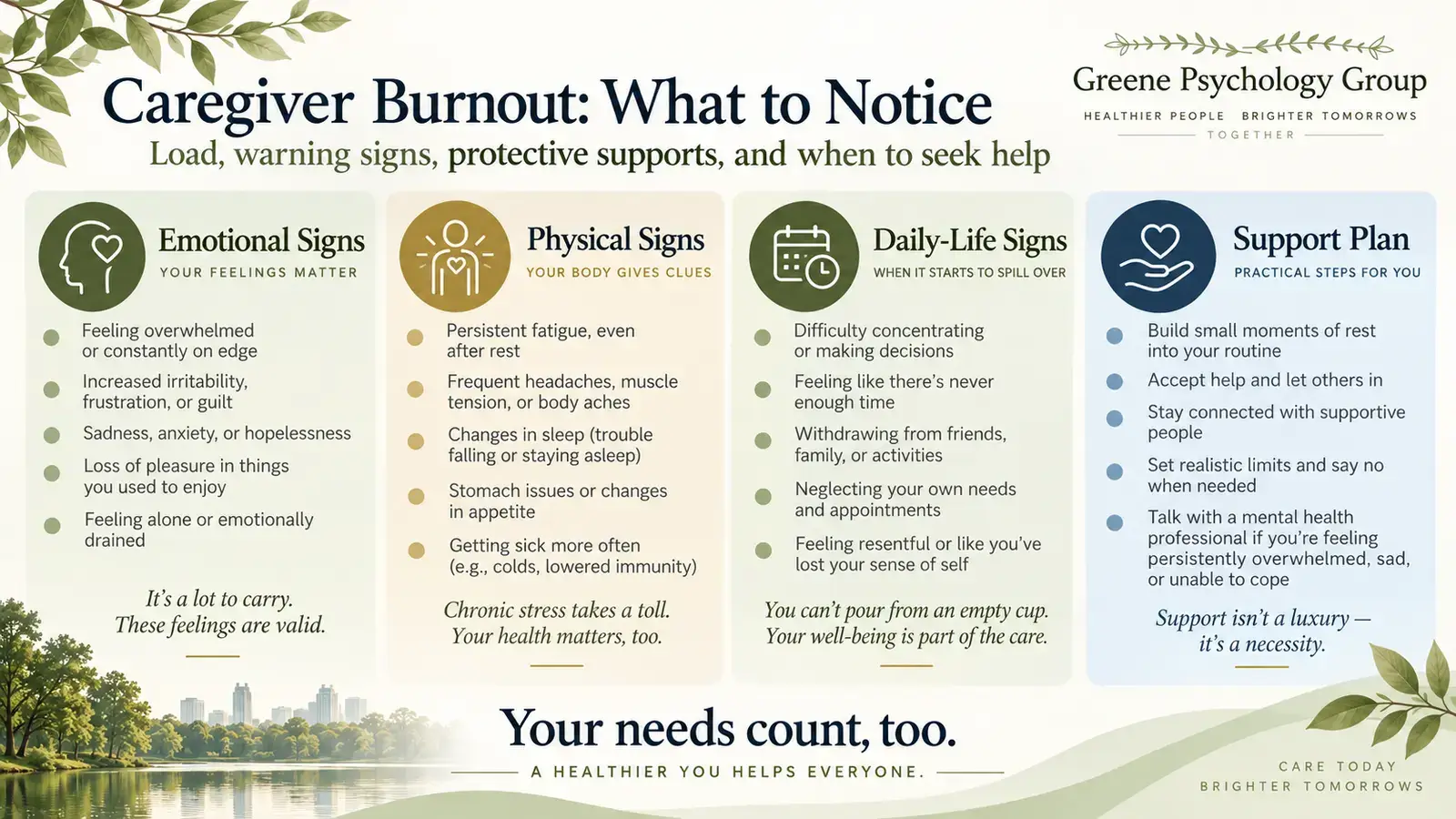
7 Warning Signs of Caregiver Burnout
The signs may build gradually, which makes them easy to normalize. Pay attention to changes from your usual functioning.
- Exhaustion that does not resolve. You may wake tired, feel physically heavy, or struggle to recover even after a quieter day.
- Irritability or reduced patience. Minor requests may feel unbearable, and you may react more sharply than you intend.
- Emotional numbness or detachment. You may feel disconnected from the person receiving care or go through tasks on autopilot.
- Withdrawal. Calls, friendships, hobbies, or activities you once valued may begin to disappear.
- Sleep or appetite changes. You may have trouble falling asleep, wake to monitor someone, sleep excessively, skip meals, or eat for comfort.
- Difficulty concentrating. Decisions, paperwork, schedules, and routine tasks may feel unusually confusing.
- Hopelessness or loss of meaning. You may believe nothing will improve or feel trapped by responsibilities with no acceptable exit.
Why the Caregiving Load Accumulates
Caregiving is rarely one task. It is often an entire system of visible and invisible work: researching conditions, remembering medication changes, watching for symptoms, communicating with clinicians, arranging transportation, managing insurance, anticipating crises, and absorbing another person’s fear or frustration.
Constant vigilance
When something could go wrong at any time, the nervous system may remain on alert. Even during a break, part of your attention may stay fixed on the next call, fall, appointment, or change in symptoms.
Ambiguous loss and grief
You can grieve while a person is still present. Illness or disability may change roles, communication, shared plans, or the relationship itself. Love and grief can exist together.
Time, work, and financial pressure
Reduced work hours, care expenses, travel, and administrative tasks can create chronic pressure. Caregivers may also postpone their own appointments or use every available day off for someone else’s needs.
Family roles and unequal responsibility
One person often becomes the default caregiver because they live nearby, appear capable, or have historically managed family needs. When expectations remain unspoken, resentment and caregiver exhaustion can intensify.
Who Is at Greater Risk?
Anyone can become overwhelmed, but risk may be higher when care is intensive, unpredictable, or unsupported. Factors may include:
- providing many hours of care or being available around the clock;
- frequent sleep interruption;
- supporting someone with dementia, complex medical needs, or behavioral changes;
- living with the person receiving care;
- limited finances, transportation, or access to services;
- family conflict or lack of shared responsibility;
- your own health condition, anxiety, depression, trauma history, or grief;
- believing that asking for help means failing.
Why Guilt Makes Boundaries Difficult
Guilt often tells caregivers, “If I can do it, I should,” or “No one else will do it correctly.” But capacity is not the same as endless availability. A boundary identifies what you can sustainably offer; it is not a punishment or proof that you care less.
Healthy caregiver boundaries may involve time, tasks, communication, money, privacy, or safety. They work best when they are specific and paired with a realistic alternative.
Boundary scripts you can adapt
- “I can take you to appointments on Tuesdays, but I cannot be the only transportation plan.”
- “I am unavailable between 9 p.m. and 7 a.m. unless there is an emergency.”
- “I can manage the medication list, or I can handle insurance calls, but I cannot manage both.”
- “I want to help. I need us to choose which task is most important today.”
- “I cannot lend money, but I can help identify community resources.”
Other people may dislike a new boundary because the old arrangement benefited them. Discomfort does not automatically mean the boundary is wrong. Safety and essential care still require planning, so involve healthcare professionals or community services when a change could affect the care recipient’s well-being.
How to Build a Realistic Support Plan
Vague offers such as “Let me know if you need anything” can be hard to use. Turn the workload into visible, assignable tasks.
- List the full workload. Include direct care, cleaning, meals, transportation, phone calls, paperwork, emotional support, and overnight monitoring.
- Mark what only you can do. Legal authority or specialized knowledge may limit who can complete a few tasks—not all of them.
- Assign named tasks. Ask one person to deliver dinner on Thursdays or make two insurance calls, rather than asking for general help.
- Create a backup plan. Identify who can step in if you become sick, need sleep, or face an emergency.
- Review the plan regularly. Needs and capacities change. A workable arrangement today may need revision next month.
A shared calendar, medication list, emergency contact sheet, and short written care summary can reduce the amount of information held in one person’s memory.
What to Do When You Are Already Overwhelmed
When caregiver burnout is already affecting concentration, a long improvement plan can become another burden. Start by reducing immediate risk and making the next day slightly more manageable.
- Check safety first. Decide whether you or the care recipient needs urgent medical or crisis support. If essential care cannot be provided safely, contact the person’s healthcare team, emergency services, or another responsible adult.
- Choose one task to postpone. Identify something nonessential that can wait without serious consequences. Reducing demand is a legitimate intervention.
- Make one direct request. Contact a specific person and name a specific need: a grocery delivery, one phone call, two hours of supervision, or transportation to an appointment.
- Meet one physical need. Drink water, eat something nourishing, take necessary medication, or lie down. Basic care becomes easier to neglect under sustained pressure.
- Schedule the next support step. Put a call to your doctor, therapist, care coordinator, or respite provider on the calendar rather than relying on memory.
This short plan is not a complete solution to caregiver burnout. Its purpose is to create enough space for safer, more durable changes.
Respite Is Part of Care, Not a Reward
Respite care provides temporary relief for a primary caregiver. Depending on the situation, it may come from trusted relatives, friends, adult day programs, in-home professionals, community organizations, or short-term residential care. Availability and cost vary, so a medical social worker, local aging agency, or care coordinator may help identify options.
A useful break is not necessarily a vacation. A protected hour to sleep, attend an appointment, walk outside, or sit without monitoring anyone can matter. Regular, predictable relief is often more sustainable than waiting until a crisis forces a break.
Practical Steps for Recovery
Self-care cannot compensate for an impossible workload, but small actions can support recovery while larger changes are arranged.
- Protect basic health needs. Keep your medical appointments, eat consistently, take prescribed medication, and discuss persistent fatigue or sleep problems with a clinician.
- Use small recovery windows. Five quiet minutes, gentle movement, a shower, music, or slow breathing can interrupt continuous activation.
- Reconnect with one person. Choose someone who can listen without immediately giving advice or minimizing the situation.
- Lower nonessential standards. Simplify meals, postpone optional tasks, and accept “good enough” where perfection is costly.
- Notice what drains and restores you. A brief daily note can reveal patterns that are hard to see in survival mode.
- Make one structural change. Delegate a task, schedule respite, or establish a communication limit. Recovery needs a change in demand, not only a change in attitude.
Common Myths That Keep Caregivers Stuck
“A good caregiver should handle everything.”
No individual can sustainably perform the work of a family, healthcare team, transportation service, and support network. Competence does not remove human limits. Sharing responsibility can protect both the caregiver and the person receiving care.
“Taking a break is abandoning the person.”
A planned break with appropriate coverage is not abandonment. Rest can support attention, patience, judgment, and physical health—all of which matter for safe caregiving.
“My needs can wait until caregiving ends.”
Many caregiving situations last months or years, and the endpoint may be uncertain. Deferring every personal need can worsen health problems and deepen caregiver burnout. Your well-being needs a place in the current plan.
“If I feel resentful, I must be a bad person.”
Resentment often signals overload, unfairness, grief, or a boundary that has been crossed. It is information—not a verdict on your character. You can love someone and still dislike the demands or losses associated with caregiving.
How Therapy Can Help Caregivers
Therapy offers a confidential place to address family caregiver mental health without centering every conversation on the person receiving care. Treatment should be tailored to your needs, symptoms, culture, relationships, and practical circumstances.
A therapist may help you identify unhelpful beliefs about responsibility, build coping skills, process grief, manage anxiety, communicate more effectively, and develop boundaries you can maintain. Cognitive behavioral strategies may examine cycles involving guilt, overcommitment, exhaustion, and self-criticism. Acceptance-based approaches may help you make room for painful emotions while acting in line with your values.
Therapy cannot create more hours in the day or solve inadequate services. It can, however, help you distinguish what is controllable, ask for support more directly, and make decisions with less shame. If travel or scheduling is difficult, online therapy may offer a more accessible option.
How Family and Friends Can Provide Useful Support
If someone you know is showing signs of caregiver burnout, avoid waiting for them to organize your help. Offer something concrete and follow through.
- Take ownership of a recurring task rather than helping once.
- Learn the routine so the caregiver does not have to supervise you closely.
- Ask, “Would food, transportation, paperwork, or two hours off help most?”
- Include the caregiver socially without pressuring them to attend.
- Listen without comparing, correcting, or insisting they remain positive.
- Respect the caregiver’s boundaries and encourage professional support when needed.
When to Seek Professional Help
Consider contacting a therapist, primary care clinician, or other qualified professional when symptoms last for several weeks, continue to worsen, affect work or relationships, interfere with sleep or physical health, or make caregiving feel unsafe. Increasing alcohol or substance use, frequent panic, uncontrolled anger, profound hopelessness, or an inability to complete essential tasks also deserve prompt attention.
Before a first appointment, you may find it helpful to note your symptoms, when they began, sleep patterns, caregiving hours, current medications, major stressors, available support, and what you most want to change. You do not need to arrive with a perfect explanation.
Urgent support: If you may harm yourself or someone else, cannot safely provide care, or face an immediate emergency, call 911 or go to the nearest emergency department. In the United States, call or text 988 for the Suicide & Crisis Lifeline.
Caregiver Therapy in Raleigh, NC
You do not have to wait until you are completely depleted to ask for support. Greene Psychology Group provides therapy for adults navigating chronic stress, family demands, grief, anxiety, and difficult life transitions. Learn more about stress therapy in Raleigh or explore remote care through online therapy.
Support for the person who supports everyone else
To ask about availability or find out whether our services may fit your needs, contact Greene Psychology Group.
Contact Us Call 919-205-5339Frequently Asked Questions About Caregiver Burnout
1. What does caregiver burnout feel like?
It may feel like deep exhaustion, irritability, emotional numbness, dread, guilt, isolation, or a reduced ability to manage tasks that once felt possible. Experiences vary, and a clinician can help evaluate overlapping medical or mental health concerns.
2. How is caregiver burnout different from normal stress?
Stress often includes feeling overwhelmed but still able to recover. Burnout tends to involve more persistent depletion, detachment, hopelessness, or reduced functioning, especially when demands continue without adequate relief.
3. Can caregiving cause depression or anxiety?
Long-term caregiving strain may contribute to anxiety or depressive symptoms, although many factors influence mental health. Seek an assessment if symptoms are persistent, severe, or affecting several areas of life.
4. How long does recovery take?
There is no fixed timeline. Recovery depends on symptom severity, health, available help, and whether the caregiving load changes. Consistent relief and support are generally more helpful than a single short break.
5. What is respite care?
Respite care is temporary support that gives a primary caregiver time away. It may occur at home, in a community program, or in a residential setting, depending on local options and the care recipient’s needs.
6. How can I set boundaries without feeling selfish?
Start with one specific limit, explain what you can offer, and identify alternatives where possible. Guilt can accompany a healthy decision; it does not prove that the decision is selfish.
7. What if my family will not help?
Document the tasks, make concrete requests, and clarify what you cannot continue doing. A social worker, care coordinator, therapist, faith community, or local caregiver organization may help identify resources beyond relatives.
8. Can therapy help if the caregiving situation cannot change?
Yes. Therapy may help with grief, anxiety, communication, guilt, problem-solving, and sustainable limits. It cannot remove every external demand, but it can support clearer choices and healthier coping.
9. When should a caregiver seek urgent help?
Seek urgent help if there are thoughts of self-harm or harming someone else, an inability to provide safe care, severe confusion, or another immediate danger. Call 911 for emergencies or call or text 988 for crisis support in the United States.
10. Where can caregivers find support in Raleigh?
Caregivers can ask healthcare systems, local aging agencies, community organizations, and mental health professionals about support groups, respite, care coordination, and therapy. Greene Psychology Group can discuss available therapy options in Raleigh and online.
Sources and Further Reading
- National Institute on Aging: Caregiving
- National Institute on Aging: What Is Respite Care?
- Centers for Disease Control and Prevention: Caring for Yourself While Caregiving
- National Institute of Mental Health: Caring for Your Mental Health
This article is for educational purposes only and is not a substitute for diagnosis, treatment, or individualized advice from a qualified healthcare professional.