

If you have been feeling stuck in negative thoughts or overwhelming anxiety or depression, you are not alone. Cognitive Behavioral Therapy (CBT) is one of the most trusted, research‑supported approaches to help people in Raleigh NC, Cary, Durham, and the Triangle understand their patterns and start feeling more in control of their lives.apa+1
At Greene Psychology Group, licensed psychologists and mental health clinicians provide compassionate, evidence‑based CBT to individuals, couples, and families. Their approach blends scientific methods with a warm, non‑judgmental space so you can grow and heal at your own pace.pmc.ncbi.nlm.nih+1
If you are in Raleigh, Cary, Durham, or surrounding Triangle communities and have questions about CBT or other services, call (919‑205‑5339) or use the contact form to arrange a free consultation or first session.
What Is Cognitive Behavioral Therapy Raleigh(CBT)?
Cognitive Behavioral Therapy (CBT) is a structured, goal‑oriented form of psychotherapy that helps you see how your thoughts, emotions, and behaviors are connected and how to change unhelpful patterns over time. Rather than focusing mainly on the distant past, CBT focuses on “here and now” problems and practical tools you can use in everyday life.ncbi.nlm.nih+1
Key features of CBT:
- Present‑focused: Targets current symptoms and situations (for example, anxiety about work or social situations).
- Skill‑building: Teaches coping strategies such as thought‑challenging, problem‑solving, and behavior experiments.
- Collaborative: You and your therapist work together to set goals and ways to reach them.mirecc.va+1
- Time‑limited for many concerns: Often delivered in clear blocks of sessions (for example, around 8–16 sessions for some conditions), though this depends on your goals and needs.
Greene Psychology Group offers CBT services tailored to anxiety, depression, stress, PTSD‑related symptoms, and everyday life challenges, all grounded in recognized professional guidelines.apa+1
Why Does CBT Work? An Evidence‑Based Overview
Many national and research‑based organizations highlight CBT as a first‑line, effective treatment for common mental health concerns such as anxiety, depression, and PTSD‑related symptoms. Large reviews and meta‑analyses show that CBT can meaningfully reduce symptoms in adults and young people, sometimes equaling or complementing medication when needed.
Some key findings:
- CBT helps change how people interpret events and respond to them, which can reduce anxiety and panic symptoms.
- People with depression often gain new ways to handle negative thoughts and improve daily functioning.
- For children and adolescents, trauma‑focused and other forms of CBT are widely recommended in trauma and anxiety research.nimh.nih+1
Greene Psychology Group’s use of CBT aligns with these evidence‑based practice standards, even though your experience will be personalized to you rather than “one‑size‑fits‑all.”
What Can Cognitive Behavioral Therapy Help With in Raleigh NC?
CBT at Greene Psychology Group is highly adaptable and can support many difficulties common in the Raleigh, Cary, and Durham area, including:
- Anxiety (generalized worry, panic attacks, social anxiety, specific fears)pubmed.ncbi.nlm.nih+1
- Depression and low mood (persistent sadness, lack of motivation, feelings of hopelessness)
- Stress and life transitions (job changes, school, moving, relationship shifts)
- Trauma‑related symptoms (trouble relaxing, nightmares, intrusive thoughts tied to past events)
- Anger and frustration (reactivity, conflicts at home or work)
- Everyday habits and routines (procrastination, difficulty sleeping, poor self‑care)
Crucially, CBT is not only for people with a formal diagnosis; it can also help anyone who wants better coping skills or more confidence in handling everyday stress.
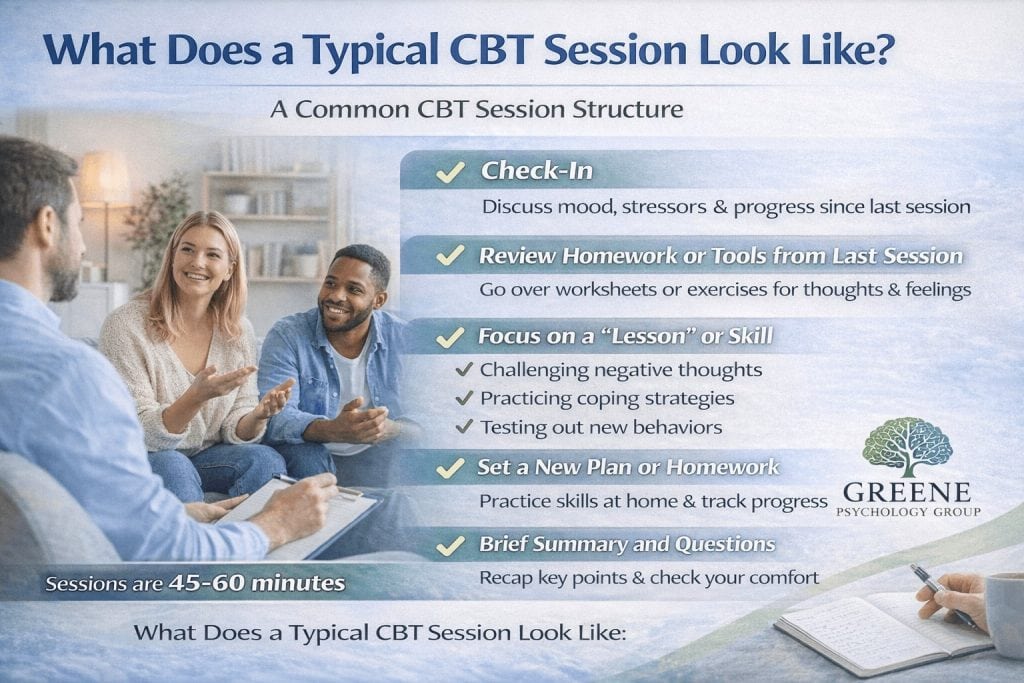
What Does a Typical CBT Session Look Like?
CBT sessions at Greene Psychology Group are structured but flexible enough to stay responsive to you. There is no script that fits every person, but many sessions share a similar flow.
A Common CBT Session Structure
- Check‑in
You start by discussing how you have been doing since the last session: your mood, stressful events, and any progress or setbacks. - Review homework or tools from the last session
For example, you might review a brief worksheet on thoughts and feelings, a mood tracking sheet, or exercises around coping strategies. - Focus on a “lesson” or skill
Together with your therapist, you explore a specific technique such as:- Identifying automatic negative thoughts (e.g., “I always mess up interviews”).
- Learning thought‑challenging questions (e.g., “What evidence supports or contradicts this?”).
- Practicing small behavior experiments (e.g., trying a brief social interaction to test a fear).
- Set a new plan or homework
Your therapist may suggest practicing the skill at home, using a simple worksheet, or tracking situations that trigger anxiety or anger. - Brief summary and questions
Before ending, your clinician recaps the key points and checks in about how comfortable you feel with the tools.
Sessions are typically 45–60 minutes, with adjustments for children or brief check‑ins as needed.
The Basic Steps of Cognitive Behavioral Therapy (Simple Process)
Although every CBT journey is personal, most follow a core set of steps over several weeks:
- Understand your patterns
Through conversation and sometimes simple charts or diagrams (for example, a “CBT triangle: thoughts–feelings–behaviors”), your therapist helps you see how your mind and body respond to stress or criticism.wikipedia+1 - Spot automatic negative thoughts
You practice noticing “worst‑case” or self‑critical thoughts that pop up, especially in situations that feel hard or overwhelming.apa+1 - Challenge unhelpful thinking
Instead of assuming your first thought is “true,” you explore alternative explanations, evidence, and perspective‑shifting questions grounded in CBT methods. - Build coping and behavior skills
You try new behaviors—different ways of facing fears, saying “no,” setting boundaries, or relaxing—that support healthier emotions over time. - Practice and review
Homework and gentle, regular practice help these skills become more automatic so you can use them long after treatment ends.
Greene Psychology Group’s licensed clinicians tailor these steps to your age, background, and comfort level, so CBT feels manageable rather than overwhelming.
How Many CBT Sessions Are Usually Needed?
There is no fixed rule, but many guidelines suggest Cognitive Behavioral Therapy can produce noticeable changes in roughly 8–16 sessions for common concerns like anxiety or depression. Some people benefit from fewer sessions if they are working on a specific issue, while others choose to continue longer for more in‑depth personal growth or more complex difficulties.
Factors that can influence how many sessions you may need include:
- The type and severity of what you are experiencing
- How consistently you practice skills between sessions
- Support and stress level in your life (relationship issues, school, work changes)
During your first visit with Greene Psychology Group, the clinician will discuss with you a general timeline and then adjust it over time based on your progress and preferences—never with rigid promises or guarantees of quick “fixes.”
Is Cognitive Behavioral Therapy Safe and Appropriate for Children and Teens?
Yes. CBT is one of the best‑studied and most widely recommended treatments for children and teens struggling with anxiety, depression, and stress‑related symptoms. Research shows specially adapted CBT can reduce symptoms and improve functioning in school and social settings.
For younger clients, therapists may:
- Use more visuals, games, or stories to explain CBT concepts.
- Involve parents or caregivers in parts of the process (with your permission) so the whole family understands what is happening at home.
- Practice skills in small, manageable steps rather than asking for big leaps.
Greene Psychology Group’s clinicians have experience working with children, adolescents, and families, and can explain in plain language how CBT would look for your child in Raleigh, Cary, Durham, or nearby Triangle communities.
Costs, Insurance, and What “How Much” Means
Costs for CBT in Raleigh NC depend on several factors, including:
- Whether you attend individual, family, or online sessions
- Your insurance coverage and whether the clinician is in‑network
- Any sliding‑scale or self‑pay arrangements offered by the practice
Most practices like Greene Psychology Group provide:
- Fee estimates and basic information on what your insurance may cover
- Clear explanations of co‑pays, deductibles, and billing procedures
- Options for self‑pay or flexible scheduling if insurance access is limited
Because this information can vary so much person to person, the most accurate way to understand cost is to:
- Call (919‑205‑5339)
- Or use the contact page to ask specific questions about session fees, insurance, or teletherapy billing
No help is worth working from a place of confusion or financial stress, so Greene Psychology Group aims to make your first conversation about logistics and options just as important as your first therapy conversation.
What Should You Expect Before, During, and After CBT?
Here is a simple three‑part roadmap that many people find reassuring.
Before Your First CBT Session
Before starting, you are not expected to “figure everything out” on your own. Common steps include:
- Scheduling a free consultation or first appointment (in‑person or online through Greene Psychology Group’s online therapy platform).
- Briefly describing the concerns that brought you to therapy (anxiety, sadness, anger, relationship stress, etc.).
- Deciding whether you want individual sessions, family or relationship counseling, or another format.[
From there, your clinician will help you clarify goals so your first session has direction but still feels open and collaborative
During CBT Treatment
Over the course of treatment you might:
- Gradually notice more awareness of your thoughts and feelings, instead of feeling “overwhelmed without understanding why.”
- Develop go‑to strategies for calming anxiety or challenging self‑criticism in tough moments.
- Begin to recognize cycles (for example, withdrawal → more sadness → more isolation) and ways to gently break them.
CBT is not a quick magic wand. Some weeks may feel hopeful; others may feel heavy or challenging. Part of working with a therapist is having someone walk alongside you through those ups and downs with respect and curiosity rather than judgment.
After CBT (Ongoing Use of Skills)
Even when formal CBT “ends,” most people continue to benefit by keeping their new skills alive, such as:
- Occasionally using Cognitive Behavioral Therapy worksheets or thought records when stress spikes.
- Re‑reviewing coping strategies during big life changes or setbacks.
- Reaching back out for a booster or check‑in sessions if symptoms re‑emerge.
Greene Psychology Group encourages viewing Cognitive Behavioral Therapy as part of an ongoing journey to wellness rather than a one‑time “treatment cure.”
Blended and Online CBT: Teletherapy in Cary NC and Durham
CBT can be delivered face‑to‑face or through online therapy (teletherapy) across North Carolina, including Raleigh, Cary, and Durham. Research suggests that for most people, teletherapy is at least as effective as in‑person visits for conditions such as anxiety and depression, especially when delivered with secure, encrypted platforms and strong therapeutic connection.pmc.ncbi.nlm.nih+1
Benefits of online Cognitive Behavioral Therapy:
- No commute; easier to fit into busy Raleigh, Cary, or Durham schedulesuclahealth+1
- Access to the same licensed clinicians from home or another private space
- Often smoother participation across distance or mobility challenges
Greene Psychology Group’s online therapy service uses encrypted video and follows HIPAA‑compliant security so your sessions stay private.
If you are wondering “Is online therapy right for me?” your clinician can help decide what format works best based on your comfort with technology and your safety and privacy needs.
A Simple Cognitive Behavioral Therapy Self‑Check & Coping Table (Not a Diagnosis)
Here is a gentle self‑check you can use at home, not as a replacement for professional help but as a way to notice patterns. This matches the kind of pattern recognition your Greene Psychology Group clinician might explore with you in Cognitive Behavioral Therapy.
Cognitive Behavioral Therapy “Thought–Feeling–Behavior” Snapshot
| Situation (What Happened) | What You Thought | Feeling (Approx. 1‑5) | What You Did | Helpful CBT Question to Ask Yourself |
| Received work email that felt critical | “I’m always messing up” | Very anxious (4–5) | Avoided replying; shut computer | Is there evidence I always mess up, or just in this moment? |
| Had a small disagreement with a partner | “They’re going to leave me” | Sad / scared (4) | Sent an anxious text message | What else could be happening in this situation besides the worst‑case story? |
| Thought about a social event | “Everyone will judge me” | Nervous (4–5) | Canceled plans | Have there been times people were kinder than you feared? What can be a smaller next step? |
By filling in a brief table like this in a journal or on a worksheet, you can begin to see how your thoughts influence your emotions and your actions—and then work with your therapist to gently “edit” the thoughts that feel excessively harsh or unkind to you.
Is Cognitive Behavioral Therapy Right For You? Common Questions
Sometimes people feel unsure whether therapy is “for them.” Here are a few simple reflection questions that match CBT’s “works for many, individual results vary” philosophy:
- Are you willing to try new ways of thinking or acting, even if they feel awkward at first?
- Are you comfortable doing a little bit of practice between sessions (short reflections or small behavioral experiments)?
- Are you looking for structure, clarity, and skills, not only emotional support (though caring support is still very much part of CBT)?
You do not need to have a formal diagnosis or “huge trauma” to use CBT; many people seek it for everyday stress, relationship concerns, or wanting to feel more in control of their mind and emotions.
A licensed clinician at Greene Psychology Group can help you decide whether Cognitive Behavioral Therapy, another therapy approach, or a mix of methods fits you best.
FAQs For Cognitive Behavioral Therapy Raleigh
Cognitive behavioral therapy (CBT) for anxiety is a structured, evidence‑based therapy that helps you see how your thoughts, feelings, and behaviors are linked. It teaches skills like thought‑challenging, relaxation techniques, and small exposure practices so worries feel less overwhelming over time. CBT does not promise to eliminate all anxiety, but many people find their symptoms become more manageable with consistent practice.
Most people notice some changes in 8–16 sessions, depending on their symptoms, goals, and how much they practice skills between sessions. Some people benefit from fewer sessions for specific issues; others prefer longer‑term work for deeper personal growth. A clinician at Greene Psychology Group will review your needs and suggest a general timeline, adjusting it as treatment progresses.
Many insurance plans cover outpatient mental health services, including CBT, when provided by licensed psychologists or therapists. Coverage depends on your specific plan, whether the clinician is in‑network, and your deductible and co‑pay rules. Greene Psychology Group can help clarify what your insurance may cover and answer questions about co‑pays, billing, and telehealth sessions at (919‑205‑5339) or through the contact page.
Research suggests that online CBT (teletherapy) can be at least as effective as in‑person therapy for common issues like anxiety and depression, especially when delivered by licensed clinicians through secure platforms. Online sessions remove commute barriers, making it easier to fit therapy into busy Raleigh, Cary, or Durham schedules while still building a strong therapeutic relationship.
Your first CBT session is usually focused on getting to know each other and understanding what brought you to therapy—whether it’s anxiety, depression, relationship stress, or everyday overwhelm. The clinician will ask about your concerns, goals, and history, then explain how CBT works and how it might help you. You can ask questions, talk about pacing, and decide together whether the approach feels like a good fit for you.
Yes. CBT principles can support individual, couples, and family counseling by helping people notice unhelpful communication patterns, manage emotional reactions, and practice healthier ways of responding. Greene Psychology Group offers family and relationship counseling that may include CBT‑based tools alongside other supportive, systemic approaches. A clinician will explain how your needs might be best met in individual, couples, or family therapy.
Absolutely. You do not need a formal diagnosis of anxiety, depression, or PTSD to benefit from CBT. Many people seek CBT for everyday stress, work pressure, relationship difficulties, or simply wanting better tools to handle strong emotions. CBT can help anyone who wants to understand their patterns more clearly and build practical coping skills. A clinician will talk with you about whether CBT, another therapy approach, or a combination best fits your needs.