
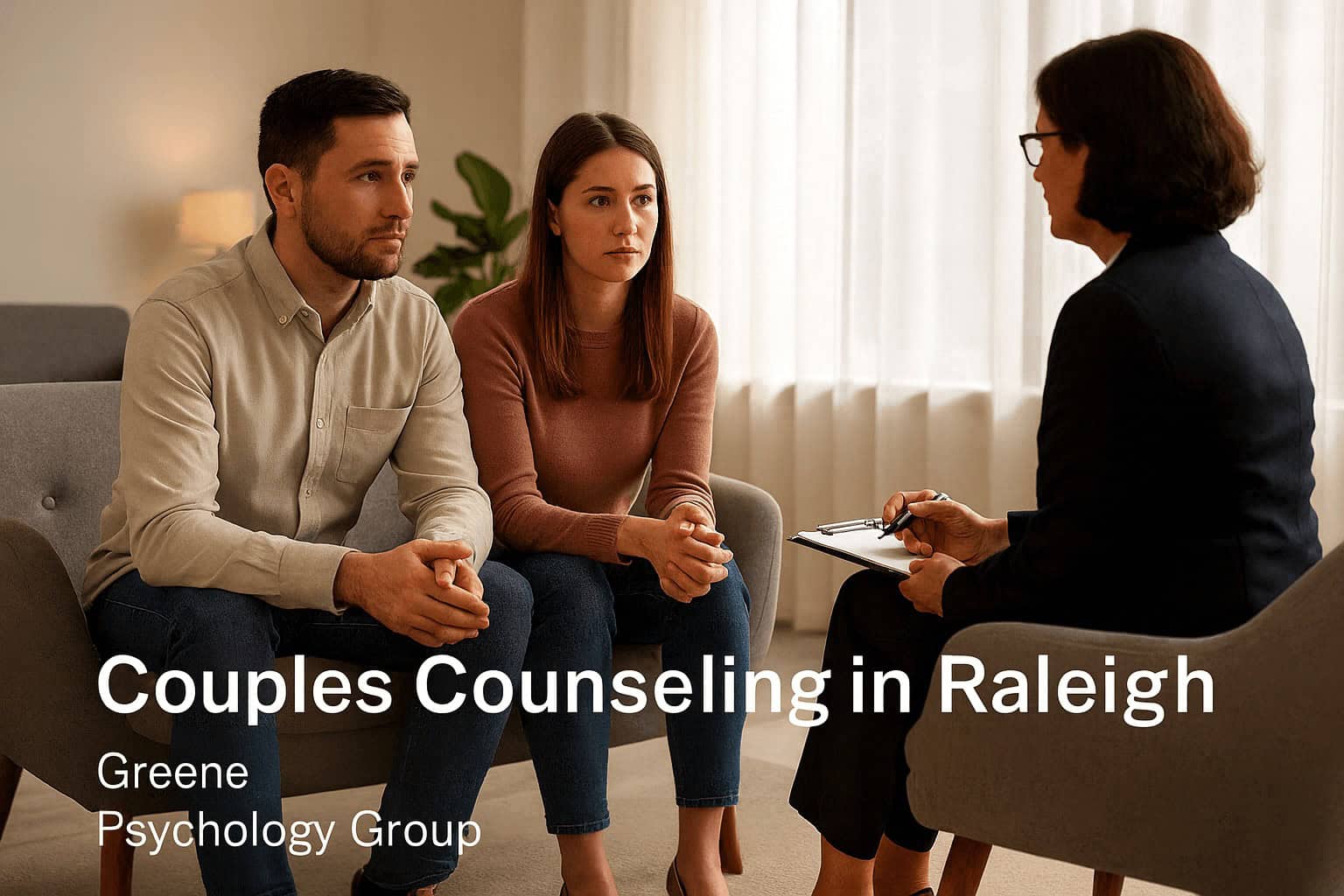
Healthy relationships aren’t built on luck. They’re made from daily habits, honest conversations, and the ability to work through predictable friction: finances, time, intimacy, parenting, in‑laws, and phones that won’t stop buzzing. When those pressures pile up, Couples Counseling in Raleigh gives you a structure—clear steps, not guesswork—to repair patterns and strengthen the bond you came in to protect.
What “evidence‑based” means here: your therapist uses approaches that research has shown help distressed partners improve satisfaction and reduce conflict. Two of the best‑studied models are Integrative Behavioral Couple Therapy (IBCT) and Emotionally Focused Therapy for Couples (EFT), with strong support in randomized trials and follow‑ups showing durable gains. (SpringerLink)
Why Seek Couples Counseling in Raleigh
- Conversations keep derailing. You start on dishes; you end on who cares more about the relationship.
- Small hurts don’t heal. Old arguments resurface. Resentment lingers.
- Trust feels shaky. After a breach (financial secrecy, emotional or physical infidelity), you want a path forward that’s structured and fair.
- Life transitions strain the system. New baby, blended family, a move, or caregiving for a parent means less time, more stress.
- You want prevention, not crisis response. Counseling isn’t just for “the brink.” It’s coaching for long‑term stability.
Bottom line: evidence‑based couples counseling gives you a plan, teaches skills you can reuse, and measures progress—so you’re not left wondering whether anything is changing. Meta‑analyses and major trials indicate these approaches improve relationship satisfaction and reduce distress compared to waitlist or less structured supports. (Europe PMC)
What “evidence‑based” looks like in the room
IBCT (Integrative Behavioral Couple Therapy) blends behavior change with acceptance‑based strategies. You’ll learn to reduce “polarization” (when each partner doubles down) and co‑create new responses to recurring flashpoints. Long‑term trials show IBCT’s benefits can persist years after treatment. (SpringerLink)
EFT (Emotionally Focused Therapy) uses attachment science to help partners move from protest/withdraw cycles into secure connection. EFT targets the underlying emotional signals—not just the surface argument—so the conversation becomes safer and more productive. Contemporary reviews and meta‑analyses support EFT’s effectiveness across diverse couples. (Europe PMC)
CBCT/Behavioral Couple Therapy emphasizes problem‑solving, communication, and reinforcement of positive interactions; it’s frequently integrated with the above models. Reviews indicate this family of approaches helps reduce distress and improve functioning, including in populations with added stressors (e.g., health or substance use challenges). (ScienceDirect)
Is online couples counseling effective?
Yes couples counseling in Raleigh is very effective when the approach is structured. Programs built from empirically supported models (e.g., IBCT‑derived curricula) show measurable gains in relationship satisfaction, even when delivered via web modules with brief coaching touchpoints. Recent randomized trials and systematic reviews of digital couples interventions support online delivery as a viable path for many partners. (Europe PMC)
Local logistics: Greene Psychology Group provides secure telehealth for North Carolina residents alongside in‑office appointments in the Raleigh area. Book couples counseling today
What to expect in the first 6–8 sessions
1) Assessment & goals
Your therapist learns the “cycle” (how conflict starts, escalates, and ends), your strengths, and your non‑negotiables. You’ll set a few concrete goals (e.g., “reduce blow‑ups from 3×/week to 1×/week,” “rebuild trust with agreed boundaries”).
2) Shared language for conflict
You’ll map triggers, “meaning bridges” (why a topic hits so hard), and each partner’s typical moves (pursue/withdraw, defend/attack). Naming the pattern lowers blame.
3) Communication skills
Short, structured turns; specific requests; clarity around time‑outs; and repair attempts that actually land. Think: fewer monologues, more signal; less mind‑reading, more checking.
4) Problem‑solving & acceptance
Some differences are solvable; others are chronic. IBCT helps you decide which is which—and adopt “unified detours” around stuck points without giving up your values. (SpringerLink)
5) Emotion work
EFT sessions help partners recognize and respond to core attachment needs (“Do I matter?” “Are you here when I reach?”) so defensive cycles soften. (Europe PMC)
6) Consolidation
You’ll build a relapse‑prevention plan: what worked, what to watch for, and how to repair quickly when old patterns flicker back.
Common goals we tackle together
- De‑escalate fast. Recognize early signs and use a 20‑minute reset without stonewalling.
- Repair injuries. After a breach of trust, you’ll use a stepwise plan: disclosure scope, boundaries, transparency practices, and paced reconnection.
- Share influence. Replace score‑keeping with joint problem‑solving (budget, chores, parenting, tech boundaries).
- Rebuild friendship and intimacy. Schedule small, frequent deposits: appreciations, shared novelty, and time protected from phones.
- Clarify next steps. For ambivalent partners, counseling can include a brief discernment track to choose between reconnection work and a respectful separation process.
Micro‑exercises you can try this week
- Two‑column debrief (10 minutes):
Left column: “What I meant.” Right column: “What you heard.” Compare and circle mismatches; each partner picks one fix for next time. - “5–1–0” appreciation rep (2 minutes):
5 words of respect (“Thanks for planning dinner”), 1 sentence of impact (“It helped me finish the report”), 0 requests tacked on. - Timeout script (30 seconds):
“I’m heated and don’t want to make it worse. I’m taking 20. I’ll be back at 7:30 to keep working on this.”
Practice reps between sessions turn insight into habit.
Why choose Greene Psychology Group
You’ll work with clinicians who use structured, research‑aligned methods and tailor them to your values and goals. Care options include in‑person and secure telehealth with practical scheduling.
- Learn about the practice
- Explore therapy services
- Online therapy (NC)
- Stress resources
- Self‑improvement
How to get ready for your first appointment
- Choose one recurring conflict you’d like to improve first.
- Write two specific requests you can make this week (clear, doable, time‑bound).
- Pick a fair‑fighting rule you’ll both try (no interruptions, no name‑calling, stick to one topic).
- Agree to a 20‑minute timeout protocol you’ll both honor.
Contact Greene Psychology Group
Ready to begin couples counseling in Raleigh, NC—or want a brief consult to check fit?
Schedule couples counseling in Raleigh here: https://greenepsychologygroup.com/contact/
FAQs
Q1: How many sessions does couples counseling usually take?
Most couples notice a shift within 6–8 sessions. Timelines vary depending on severity, goals, and consistency between sessions.
Q2: What if my partner is hesitant?
Start with a single consult to discuss goals and concerns. Many partners agree once they see counseling is structured, fair, and focused on workable steps.
Q3: Will counseling bring up old fights?
Sometimes—but with containment. Your therapist will slow the cycle, keep each partner heard, and translate complaints into requests.
Q4: Which approaches do you use?
Therapists often blend IBCT (acceptance + behavior change), EFT (attachment‑based connection work), and CBCT/BCT (skills and problem‑solving), tailored to your goals. (SpringerLink)
Q5: Does online couples therapy work?
For many couples, yes. Web‑delivered, structured programs and coaching have RCT support and recent meta‑analytic backing for improving satisfaction. (Europe PMC)
Q6: Can counseling help after infidelity?
It can provide a transparent roadmap for boundaries, repair, and paced reconnection. Outcomes depend on participation and consistency.
Q7: Do you assign homework?
Usually. Brief skills practice between sessions accelerates progress and makes gains stick.
Q8: What if we’re considering separation?
Therapy can include a short discernment track to help you decide next steps with clarity and respect.
Sources
- Europe PMC – Efficacy of Emotionally Focused Couples Therapy & Behavioral Couple Therapy (meta‑analysis): https://europepmc.org/article/MED/29781200 (Europe PMC)
- Springer (reference entry summarizing IBCT & long‑term outcomes; cites JCCP follow‑up): https://link.springer.com/rwe/10.1007/978-3-319-15877-8_109-2 (SpringerLink)
- Europe PMC / J Consult Clin Psychol – Web‑based OurRelationship RCT: https://europepmc.org/article/MED/26999504 (Europe PMC)
- BMC Psychology (2025) – Digital interventions for couple satisfaction (systematic review/meta‑analysis): https://bmcpsychology.biomedcentral.com/articles/10.1186/s40359-025-03444-y (BioMed Central)
- ScienceDirect – Integrative vs. Traditional Behavioral Couple Therapy (trial synthesis/overview): https://www.sciencedirect.com/science/article/pii/S1130527413700021 (ScienceDirect)
ScienceDirect – CBCT overview and outcomes across conditions: https://www.sciencedirect.com/science/article/pii/S2352250X1630118X (ScienceDirect)