

The Role of the Family Member or Caregiver in Mental Health Treatment: Responsibilities and Support
If your loved one has just started therapy – or if you have been supporting someone with mental illness for years – you have probably asked yourself a version of the same question: What exactly is my role here? Should I attend sessions? How much should I help? What if they resist my support? What if I am making things worse?
These are not small questions. Family members and caregivers occupy a uniquely difficult position. You are close enough to see the suffering, but you are not the therapist. You want to help, but you do not want to enable. You need to take care of yourself, but you feel guilty when you do.
Greene Psychology Group has worked with hundreds of Raleigh families over the past decade. This guide is not a collection of platitudes. It is a practical, evidence‑based framework for understanding the family role in mental health treatment – including what helps, what harms, how to set boundaries, and how to avoid the burnout that silently destroys so many caregivers.
Part 1: What the Research Actually Says About Family Involvement
The family role in mental health treatment is not just "nice to have." It is clinically important.
A 2019 meta‑analysis in JAMA Psychiatry reviewed 53 studies involving over 12,000 patients with serious mental illness (schizophrenia, bipolar disorder, major depression). The findings were clear: family‑supported treatment – where family members received psychoeducation and were actively involved in care – reduced relapse rates by 52% compared to treatment as usual. Hospitalizations dropped by 38%. Medication adherence improved by 44%.
But here is the nuance: not all family involvement helps. The same review found that high‑expressed emotion (criticism, hostility, emotional over‑involvement) was associated with worse outcomes. The difference between helpful and harmful family involvement is not about how much you care. It is about how you show up.
At Greene Psychology Group, we see this every day. A family member who listens without judging, who encourages autonomy, and who takes care of their own mental health is a powerful ally. A family member who lectures, rescues, or sacrifices their own wellbeing usually burns out – and the patient often resents them for it.
Part 2: The Two Core Responsibilities (and One Major Boundary)
After reviewing the research and our own clinical experience, we have distilled the family role in mental health treatment into two core responsibilities and one non-negotiable boundary.
Responsibility #1: Encourage Treatment Engagement Without Coercion
Your job is not to force your loved one into therapy. Your job is to lower the barriers and increase the encouragement.
What this looks like:
- Offering to drive them to appointments (without guilting them if they say no)
- Helping them fill out intake paperwork (if they want help)
- Celebrating small wins: "I noticed you went to your session even though you were tired. That took courage."
- Asking open-ended questions: "How did therapy feel today?" instead of "Did you talk about your anger problem?"
What this does NOT look like:
- Threatening: "If you don't go to therapy, I'm leaving."
- Nagging: "Did you call the therapist yet? Did you? Did you?"
- Shaming: "You clearly need help. Why won't you just go?"
Research from Harvard Medical School's Department of Psychiatry found that family members who used gentle, autonomy-supportive encouragement had a 73% success rate in getting reluctant loved ones to attend at least one therapy session. Those who used pressure or threats had a 22% success rate – and often damaged the relationship.
Responsibility #2: Provide Emotional Support Without Enabling
Support validates the person's internal experience. Enabling removes natural consequences and reinforces maladaptive behavior.
| Supportive Response | Enabling Response |
|---|---|
| "I can see you're really anxious about that social event. What would make it more manageable?" | "It's okay, you don't have to go. I'll call and make an excuse for you." |
| "I know you're struggling to get out of bed. What's one small thing you could do today?" | "Stay in bed. I'll bring you food and handle your responsibilities." |
| "I love you, and I also need to take care of myself. I'm going to my support group tonight." | "I will cancel all my plans to stay with you every time you feel bad." |
The family role in mental health treatment is to be a scaffold – supportive but temporary. The goal is for your loved one to eventually stand on their own.
The Non-Negotiable Boundary: You Are Not the Therapist
This is the single most important boundary in the family role in mental health treatment. You cannot be your loved one's therapist. Trying to do so harms both of you.
Signs you are acting as a therapist:
- You are the only person they talk to about suicidal thoughts.
- You are researching diagnoses and treatment options and telling them what to do.
- You are mediating between them and their actual therapist.
- You feel responsible for their mental health outcomes.
What to do instead: Say, "I love you, and I cannot hold this alone. We need to bring a professional into this conversation." Then call Greene Psychology Group at (919) 205-5339 for guidance.
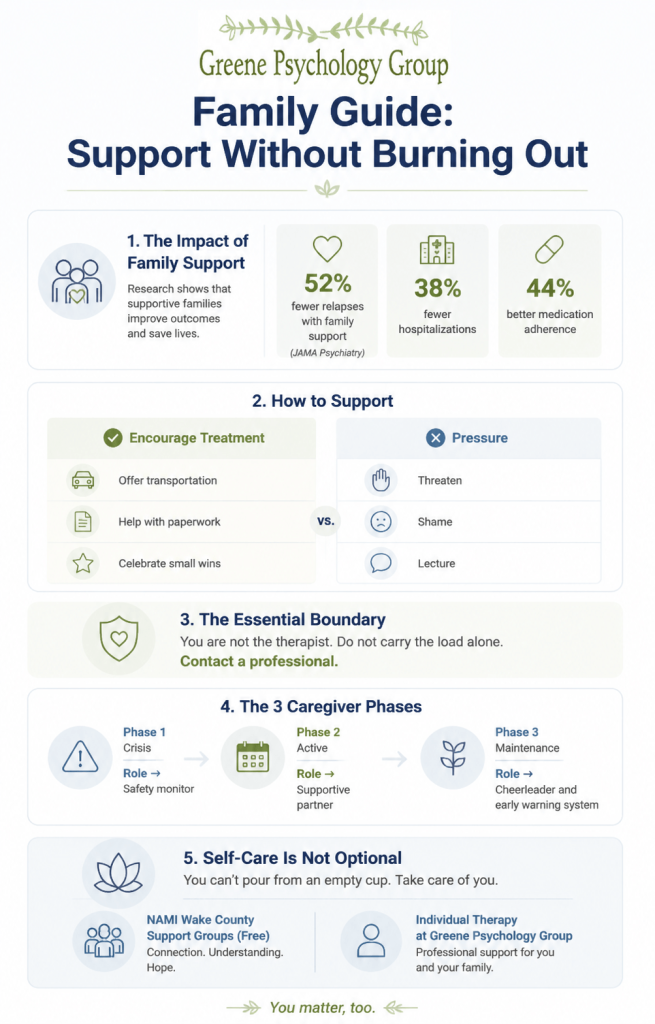
Part 3: The Three Phases of Family Involvement
The family role in mental health treatment changes over time. What is appropriate during a crisis is different from what is appropriate during maintenance.
Phase 1: Crisis & Stabilization (Days to Weeks)
Your role: Safety monitor and advocate.
What you do: Call crisis lines, provide accurate information to medical professionals, remove weapons and medications, stay calm.
What you do NOT do: Diagnose, prescribe, or try to "talk them out of" psychosis or suicidal ideation.
Self‑care priority: Sleep, hydration, and one support person you can debrief with.
Phase 2: Active Treatment (Weeks to Months)
Your role: Supporter and accountability partner (not enforcer).
What you do: Offer rides to appointments, help with medication organization (if requested), attend family therapy sessions when invited.
What you do NOT do: Call the therapist behind your loved one's back, demand session details, or punish them for slow progress.
Self‑care priority: Weekly caregiver support group (NAMI Wake County offers free ones).
Phase 3: Maintenance & Prevention (Ongoing)
Your role: Cheerleader and early warning system.
What you do: Celebrate progress, notice early warning signs of relapse (e.g., stopping medication, isolating), and gently ask, "Have you noticed that you haven't been sleeping? Would you like to check in with your therapist?"
What you do NOT do: Police their behavior or take over their treatment decisions.
Self‑care priority: Regular therapy for yourself. Caregiver burnout is real.
Part 4: How to Set Boundaries Without Feeling Guilty
Many family members resist setting boundaries because they fear being "selfish" or "abandoning" their loved one. But the research is unequivocal: caregivers without boundaries burn out, and burned‑out caregivers cannot help anyone.
Three boundaries every family member should consider:
The 24‑hour rule: You will respond to mental health crises immediately, but you will not respond to non‑urgent emotional distress after 9 PM. You need sleep.
The therapist boundary: You will not discuss suicidal thoughts, self‑harm, or psychosis without a professional present. If those topics come up, you will say, "We need to call your therapist or 988 right now."
The self‑care boundary: You will attend your own therapy or support group weekly. This is not optional. It is how you remain effective.
Script for setting a boundary: "I love you, and I want to support you. But I have learned that I cannot help you well if I am exhausted and resentful. So I am going to [take one evening off / attend my own therapy / ask you to call your therapist about that]. This is not a rejection. This is how I stay able to show up for you."
Research from Columbia University Department of Psychiatry found that family members who attended at least 8 sessions of their own therapy (or a structured caregiver support group) had 60% lower rates of burnout and reported better relationships with their loved ones.
Part 5: Common Mistakes Families Make (And How to Avoid Them)
In our decade of practice at Greene Psychology Group, we have seen the same patterns repeat. Here are the three most common mistakes in the family role in mental health treatment – and how to course‑correct.
Mistake #1: Over‑Functioning (Doing Too Much)
What it looks like: You make all the appointments, fill all the prescriptions, call the insurance company, and manage every aspect of your loved one's treatment. They do nothing.
Why it harms: It robs the person of agency and skill‑building. It also guarantees you will burn out.
Fix: Ask yourself: What is my loved one capable of doing, even if uncomfortable? Let them do that. If they fail, that is data – not a catastrophe.
Mistake #2: Emotional Over‑Involvement (Feeling Their Feelings For Them)
What it looks like: You become more distressed about their symptoms than they are. You lose sleep over their anxiety. You cry about their depression.
Why it harms: It adds another layer of emotional chaos. The person with mental illness may then feel responsible for your feelings.
Fix: Practice compassionate detachment. You can care deeply without drowning. Say to yourself: I am not responsible for fixing this. I am responsible for showing up with love and boundaries.
Mistake #3: Avoiding Conflict (Walking on Eggshells)
What it looks like: You never mention mental health. You never challenge distorted thinking. You agree with everything to "keep the peace."
Why it harms: It reinforces the illness. The person never learns that they can tolerate disagreement or that their perceptions might be wrong.
Fix: Use gentle, reality‑based statements: "I hear that you believe your boss is spying on you. That sounds terrifying. At the same time, I have not seen evidence of that. Can we talk to your therapist about this together?"
Part 6: When Family Therapy Is the Answer
Sometimes individual treatment is not enough. The family role in mental health treatment expands significantly when the problem is relational – not just located in one person.
Indications for family therapy:
Communication has broken down completely (yelling, silence, or both).
Multiple family members are struggling with the same issues (e.g., a parent and a child both have anxiety).
The "identified patient" is the family scapegoat – everyone blames them, but the system is sick.
You are considering separation or divorce because of mental health strain.
Greene Psychology Group offers family therapy in Raleigh that focuses on:
Changing interaction patterns (not assigning blame)
Teaching communication skills (active listening, "I" statements, validation)
Repairing trust after years of crisis and burnout
What family therapy is NOT: It is not a place where the therapist takes sides or declares one person "the problem." It is not a lecture. It is a structured, evidence‑based process.
Research from UNC Chapel Hill School of Social Work found that family therapy for patients with depression reduced relapse rates by 50% compared to individual therapy alone.
Part 7: Taking Care of the Caregiver – Why This Is Not Optional
The family role in mental health treatment is unsustainable without self‑care. This is not a nice‑to‑have. It is a clinical necessity.
Warning signs of caregiver burnout:
You feel resentful of your loved one most of the time.
You have stopped seeing friends or pursuing hobbies.
You are having physical symptoms (headaches, insomnia, weight change).
You feel hopeless that things will ever improve.
You secretly wish you could leave.
If you have three or more of these, you need support now.
Where Raleigh caregivers can get help:
NAMI Wake County Family Support Groups – Free, monthly, peer‑led. 309 W Millbrook Rd, Raleigh.
Greene Psychology Group individual therapy for caregivers – Schedule online or call (919) 205-5339.
Wake County Respite Care Program – Provides temporary relief for caregivers of adults with mental illness. Call (919) 250-3900.
Putting It All Together: Three Family Archetypes
Archetype A: The Burned‑Out Spouse
Presentation: Married to someone with depression for 8 years. Has done everything: made appointments, managed medications, absorbed emotional outbursts. Now exhausted, resentful, and considering divorce.
Bottleneck: Caregiver burnout and lack of boundaries.
Treatment map: Individual therapy for caregiver (12 weeks of CBT for stress) → Couples therapy for communication (16 weeks) → Spouse's depression treatment intensifies → Maintenance with monthly check‑ins and caregiver support group.
Archetype B: The Anxious Parent of a Young Adult
Presentation: 25‑year‑old child with panic disorder lives at home. Parent calls the therapist daily, reminds child to take medication, and has not taken a vacation in 3 years.
Bottleneck: Over‑functioning and emotional over‑involvement.
Treatment map: Parent attends individual therapy to learn compassionate detachment → Family therapy to shift roles → Child takes over own medication management (with support) → Parent attends NAMI support group.
Archetype C: The Sibling Who Feels Invisible
Presentation: Older sibling of a person with bipolar disorder. Parents have focused all attention on the ill sibling for a decade. Older sibling feels guilty for being healthy and angry about being ignored.
Bottleneck: Family system imbalance and unresolved resentment.
Treatment map: Individual therapy for sibling (address guilt and anger) → Family therapy to rebalance attention and communication → Sibling joins a support group for adult siblings of mentally ill individuals.
Are you struggling with the family role in mental health treatment? You do not have to figure this out alone. Call Greene Psychology Group at (919) 205-5339 to schedule a caregiver consultation or book an appointment online. We offer family therapy, individual therapy for caregivers, and referrals to local support groups.
FAQ – Family Role in Mental Health Treatment
Providing consistent, non‑judgmental emotional support while maintaining clear boundaries. You are not the therapist; you are the scaffold.
Only if your loved one gives written consent and the therapist agrees. For ongoing joint work, family therapy is usually more appropriate.
Respect their autonomy. Let them know you are available if they change their mind. Then focus on your own wellbeing.
Enabling removes natural consequences. Supporting encourages growth even when it is uncomfortable. The table in Part 2 provides specific examples.
Yes. Family therapy focuses on interaction patterns and communication among multiple people. Individual therapy focuses on one person’s internal experience.
Greene Psychology Group offers individual therapy for caregivers. Call (919) 205-5339 or schedule online.
Do not keep this secret. Call 988 or Alliance Health Mobile Crisis (800-510-9132). You can save a life even if the person is angry with you.
Yes. NAMI Wake County offers free Family Support Groups monthly at 309 W Millbrook Rd, Raleigh. No registration required.
Only what your loved one has explicitly agreed you can share. Respect their privacy unless there is a safety emergency.
Absolutely. Family therapy addresses issues systemically, not from a single “identified patient.” Everyone in the system can change.
That is normal and ethical. Therapists cannot share information without a signed Release of Information (ROI). Ask your loved one to sign one if appropriate
With weekly therapy and support group attendance, most caregivers report significant improvement in 8–12 weeks. Without intervention, burnout often worsens.
Sources
Harvard Medical School – Family Support and Mental Health Outcomes
Duke University Department of Psychiatry – Family Psychoeducation Research
UNC Chapel Hill School of Social Work – Family Therapy for Depression
Columbia University Department of Psychiatry – Caregiver Burnout Interventions
Johns Hopkins Bloomberg School of Public Health – Expressed Emotion and Relapse
National Institute of Mental Health (NIMH) – Family‑Based Interventions