

Is therapy working? 7 practical signs to notice
Quick answer: If you are asking, “is therapy working,” look for movement toward goals named collaboratively with your therapist, not a perfect mood or a fixed timeline. Possible signs include clearer priorities, more workable coping skills, better self-awareness, changes in daily functioning or relationships, and a stronger ability to talk honestly in sessions. These signs are not a test, and they do not diagnose whether a treatment is right for you. If progress feels unclear, the next step is usually to bring that question into therapy and revisit your goals with your clinician.
It is very common to wonder whether counseling is helping, especially when life still feels hard. Therapy can involve insight, discomfort, relief, practice, setbacks, and slow changes that are easier to see in hindsight than in the moment. The American Psychological Association explains that psychotherapy often involves the client and therapist working together to set goals, and that this collaborative goal-setting matters because both people need to be invested in the work. That means therapy progress is best understood in conversation, not by silently grading yourself after each appointment.
What “working” means in therapy
Therapy is not usually “working” or “not working” in one simple way. A more useful question is: Are the sessions helping you move toward the concerns and goals that brought you in? For one person, that may mean responding differently to anxiety. For another, it may mean understanding grief, communicating more clearly, reducing avoidance, changing relationship patterns, or making daily life feel more manageable.
The National Institute of Mental Health describes psychotherapy as a range of treatment approaches that may help people identify and change troubling emotions, thoughts, and behaviors. NIMH’s overview of psychotherapies also notes that different approaches can be used depending on a person’s concerns and needs. That variety is one reason therapy progress should be connected to the plan you and your clinician are actually using.
Progress may include symptom relief, but it is not limited to symptom relief. A person might still feel sadness, stress, or worry and also be making meaningful changes in how they respond. Another person might gain insight before behavior changes are visible. Someone else may first notice that sessions feel safer, more focused, or more honest.
It can help to think of counseling as a shared process with several moving parts: goals, therapeutic relationship, treatment approach, practice between sessions, life circumstances, and timing. If one part feels unclear, that does not automatically mean therapy has failed. It may mean the plan needs to be clarified, slowed down, adjusted, or discussed more directly.
If you wonder, “is therapy working,” start with goals
The most grounded place to begin is with the goals discussed with your therapist. Therapy goals may be formal and written down, or they may be discussed in plain language during sessions. Either way, they give you something more useful than a vague hope that you should “feel better” by now.
Therapy goals can be specific without being rigid. Examples might include understanding panic triggers, reducing conflict with a partner, practicing boundaries, improving school or work routines, managing anger more safely, grieving a loss, or learning how to respond when depression makes daily tasks harder. These examples are not guarantees or treatment recommendations; they are illustrations of the kinds of directions people often bring to therapy.
Good goals also leave room for revision. APA notes that as therapy continues, the client and psychologist may assess progress and decide whether original goals need to be reformulated or expanded. In everyday language, that means it is normal for therapy goals to change as you understand yourself, your situation, or your needs more clearly.
Sometimes therapy progress begins with simply becoming more honest about what you want from treatment. You might realize that the original goal was too broad, too focused on pleasing other people, or not specific enough to guide sessions. Naming that is not a setback. It can be useful information.
It may help to ask yourself:
- Can I describe what we are working on right now?
- Do my current therapy goals still match what feels most important?
- Do I understand how the session topics connect to those goals?
- Have my priorities changed since I started?
- Is there something I have avoided bringing up because it feels uncomfortable?
Therapy progress is usually uneven, not a straight line
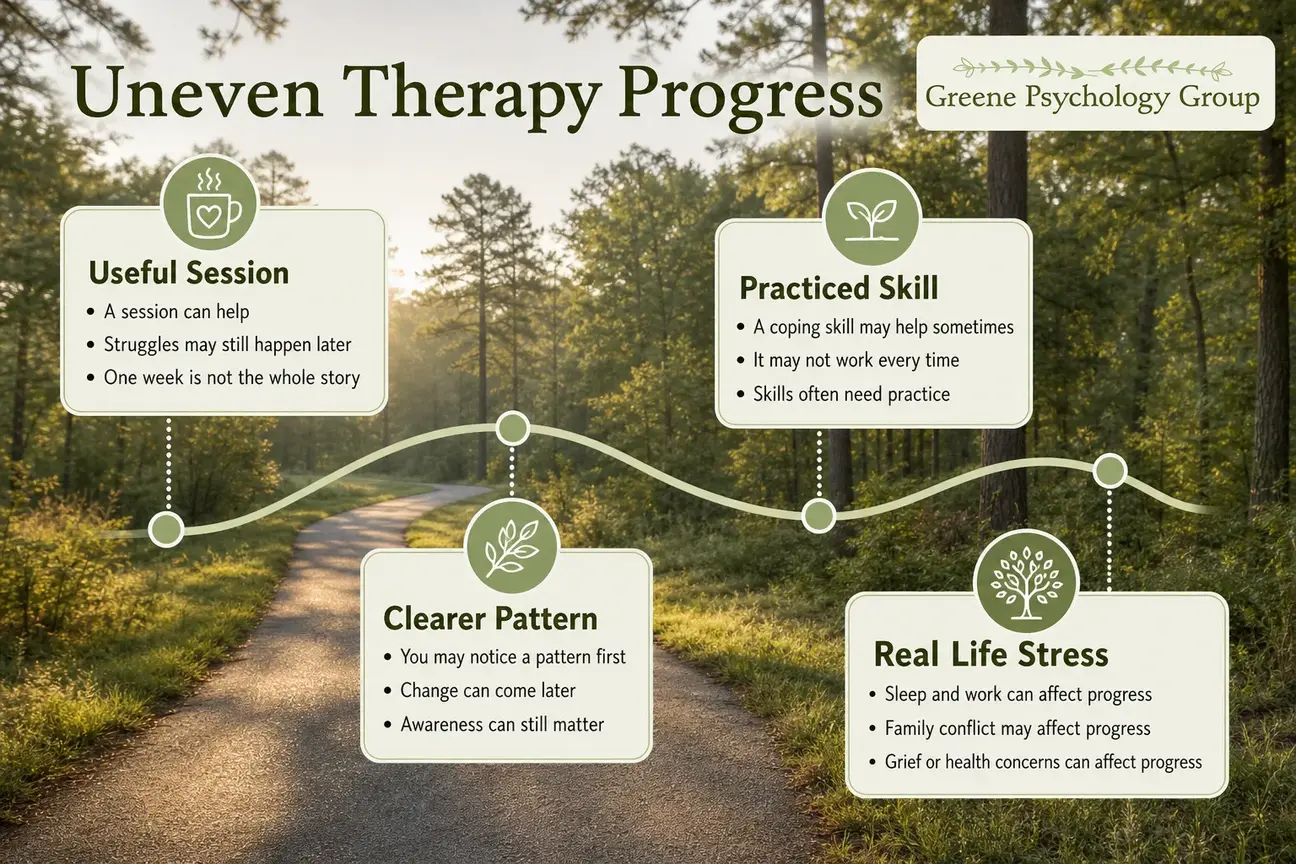
Many people expect therapy progress to feel like steady improvement from week to week. In real life, change is often less tidy. You may have a useful session and still struggle later that week. You may notice a pattern more clearly before knowing how to change it. You may try a coping skill and find that it helps sometimes but not every time.
Uneven therapy progress can be frustrating, but it is not automatically a sign that counseling is ineffective. Life events, stress, sleep, work demands, family conflict, school pressure, health concerns, trauma reminders, grief, and relationship changes can all affect how progress feels. Therapy is happening inside a real life, not in a controlled setting.
It is also possible for progress to feel uncomfortable at first. For example, a person who usually avoids conflict may feel anxious when practicing direct communication. Someone who is learning to notice emotions may feel more aware of sadness or anger before those emotions feel easier to manage. These experiences should be discussed with the therapist, especially if the work feels overwhelming, unsafe, confusing, or disconnected from goals.
A helpful distinction is whether discomfort has a purpose that makes sense. Therapy should not require pushing through distress without explanation. Your clinician should be able to talk about pacing, safety, consent, and how the work relates to therapy goals.
7 signs therapy helps without promising a timeline
There is no universal checklist that proves counseling is working. Still, there are common areas where people may notice signs therapy helps. Think of the following as reflection points to discuss with your clinician, not as a scorecard.
1. Your goals are becoming clearer
One of the early signs therapy helps may be that you can name what you want to understand or change more clearly than before. You may come into sessions with a better sense of what matters, what feels stuck, or what patterns keep repeating. You may also notice that sessions feel more connected to your priorities.
Clarity alone does not prove that therapy is working, but it can be a meaningful part of therapy progress. If the starting point was “I just feel overwhelmed,” a later statement might be, “I notice I shut down when I think I disappointed someone,” or “I want to work on how I handle conflict with my family.” That kind of clarity can help therapy goals become more specific.
2. You are developing more workable coping skills
Coping skills are not meant to erase every difficult feeling. They are tools that may help you respond with more choice. Therapy progress might look like noticing stress sooner, pausing before reacting, using a grounding strategy, asking for support, leaving a conversation before it escalates, or returning to a routine after a hard day.
More workable coping skills often give you a little more room between a feeling and a response. That room can matter. It may help you choose whether to send the text, take a break, use a communication skill, practice a relaxation strategy, or bring the situation to therapy instead of handling it alone.
It is also normal for coping skills to need practice and adjustment. A strategy that helps with work stress may not be enough during grief. A tool that helps an adult may need to look different for an adolescent. If a skill does not seem useful, that is not a personal failure. It is information to bring back to the session.
3. You understand your patterns more clearly
Another one of the signs therapy helps is greater awareness of patterns. You might begin to notice links among thoughts, emotions, body sensations, behavior, relationships, and circumstances. You may recognize withdrawing when shame shows up, overfunctioning when anxiety rises, or becoming irritable when overwhelmed.
Self-awareness is not the same as self-diagnosis. A licensed clinician assesses symptoms, functioning, context, safety, and treatment needs. Still, greater self-awareness can support therapy progress because it gives you and your therapist more information to work with.
For some people, awareness comes before visible change. That can feel discouraging: “Now I see the pattern, but I am still doing it.” This is a useful moment to talk with your therapist about what needs to happen next. You may need more practice, a different approach, more support outside sessions, or a clearer plan for applying insight in daily life.
4. Daily functioning is shifting in small ways
Therapy progress may show up in everyday life. You might return a message that felt hard to answer, follow through on one responsibility, attend class more consistently, take a break before burnout, start a difficult conversation, or make a decision that aligns more closely with your values.
Daily functioning can include sleep routines, work or school participation, household tasks, parenting, communication, decision-making, and follow-through. These changes may be small and uneven. They should not be used as a diagnostic test or as proof that therapy will work the same way for everyone.
It can help to track changes gently rather than obsessively. For example, you might notice, “I still felt anxious, but I went to the appointment,” or “I still felt sad, but I reached out instead of isolating all weekend.” Those observations can help you and your therapist understand what is changing and what still needs attention.
5. Relationships or communication are changing
Therapy progress may involve how you relate to other people. You might express a need more clearly, set a boundary, apologize without collapsing into shame, recognize an old relationship pattern, or pause before escalating a conflict. For some people, therapy helps them notice which relationships feel supportive and which interactions leave them feeling depleted or unsafe.
It is important to keep this balanced. Therapy cannot guarantee that another person will respond well, change behavior, or share your goals. If relationship concerns are central, your therapist may help you clarify what is within your control and what is not. Some people may also explore family therapy or relationship counseling when the work needs to involve more than one person.
For partners, family members, and caregivers, signs therapy helps may be visible in communication, boundaries, and less reactive patterns. But outside observations are not a diagnosis and should not replace the client’s own goals or the clinician’s assessment.
6. The therapeutic relationship feels more collaborative
The relationship with your therapist matters. APA describes the therapeutic alliance as what happens when the psychologist and client work together toward the client’s goals. A collaborative therapeutic relationship does not mean you always agree or that every session feels easy. It means you can ask questions, raise concerns, and expect a respectful conversation about the plan.
Therapy progress can include becoming more able to say, “I do not understand why we are focusing on this,” “That suggestion did not fit,” or “I felt misunderstood last session.” Those conversations can feel vulnerable, especially if avoiding conflict or trying to be an “easy” client is a familiar pattern.
A therapist should be able to explain the general rationale for the approach, invite feedback, and discuss whether the work still fits your therapy goals. If honesty feels difficult, or if concerns are repeatedly dismissed, that is important information to discuss or reassess.
7. Setbacks feel more understandable or manageable
Progress does not mean symptoms, conflict, or painful emotions disappear permanently. Sometimes therapy progress looks like understanding a setback sooner, recovering more intentionally, or using support before things escalate. You might still have a difficult week, but you may be less alone with it or less confused by it.
This does not mean every setback is “growth” or that painful experiences should be minimized. If symptoms worsen, safety concerns arise, or daily life becomes harder to manage, those are important reasons to talk with your therapist promptly. The goal is not to force a positive interpretation. The goal is to notice what the setback shows about needs, supports, pacing, and treatment direction.
Can therapy feel difficult and still be helping?
Yes, therapy can feel difficult and still be useful, but difficulty by itself does not prove that therapy is helping. Sessions may bring up painful memories, grief, anxiety, shame, conflict, or long-avoided choices. Learning new ways to respond can also feel unfamiliar.
The key question is whether the difficulty is being handled with care, consent, and a clear purpose. You should be able to talk about intensity and pacing. You can ask why a topic is being explored, how it connects to therapy goals, and what support is available between sessions or after a hard session.
Some clients worry that raising discomfort will offend the therapist. In a collaborative therapy relationship, feedback is part of the work. You might say, “The last session felt intense, and I had trouble functioning afterward. Can we talk about pacing?” Or, “I understand why we are discussing this, but I need more grounding before we go further.”
If therapy consistently feels confusing, shaming, unsafe, or disconnected from the concerns that brought you in, it is reasonable to talk about that directly. Sometimes the plan can be adjusted. Sometimes the fit may need to be reconsidered. A licensed clinician can help reassess what is clinically appropriate for your situation.
How therapy goals can be revisited over time
Therapy goals are not a contract you must keep forever. They are working guideposts. As you learn more, your goals may become more specific, broader, or simply different. Revisiting therapy goals can be especially helpful when progress feels unclear, life circumstances change, or sessions begin to feel unfocused.
A goal review does not have to be formal to be useful. It can begin with a few straightforward questions: What brought me here originally? What has changed? What has stayed the same? What feels more difficult? What feels more possible? What do I want therapy to focus on now?
The American Psychological Association encourages clients and psychologists to assess progress as therapy continues and determine whether goals need to be reformulated or expanded. In practice, that may mean narrowing a broad goal like “feel less anxious” into “practice responding to work stress without avoiding every difficult conversation,” or expanding a goal from individual coping into relationship communication.
Sometimes therapy goals shift because the original concern was only part of the picture. For example, a person may begin therapy for stress and later realize grief, perfectionism, family roles, or relationship patterns need attention. That does not mean the original goal was wrong. It means therapy progress has given the work more information.
How to talk to your therapist when progress feels unclear
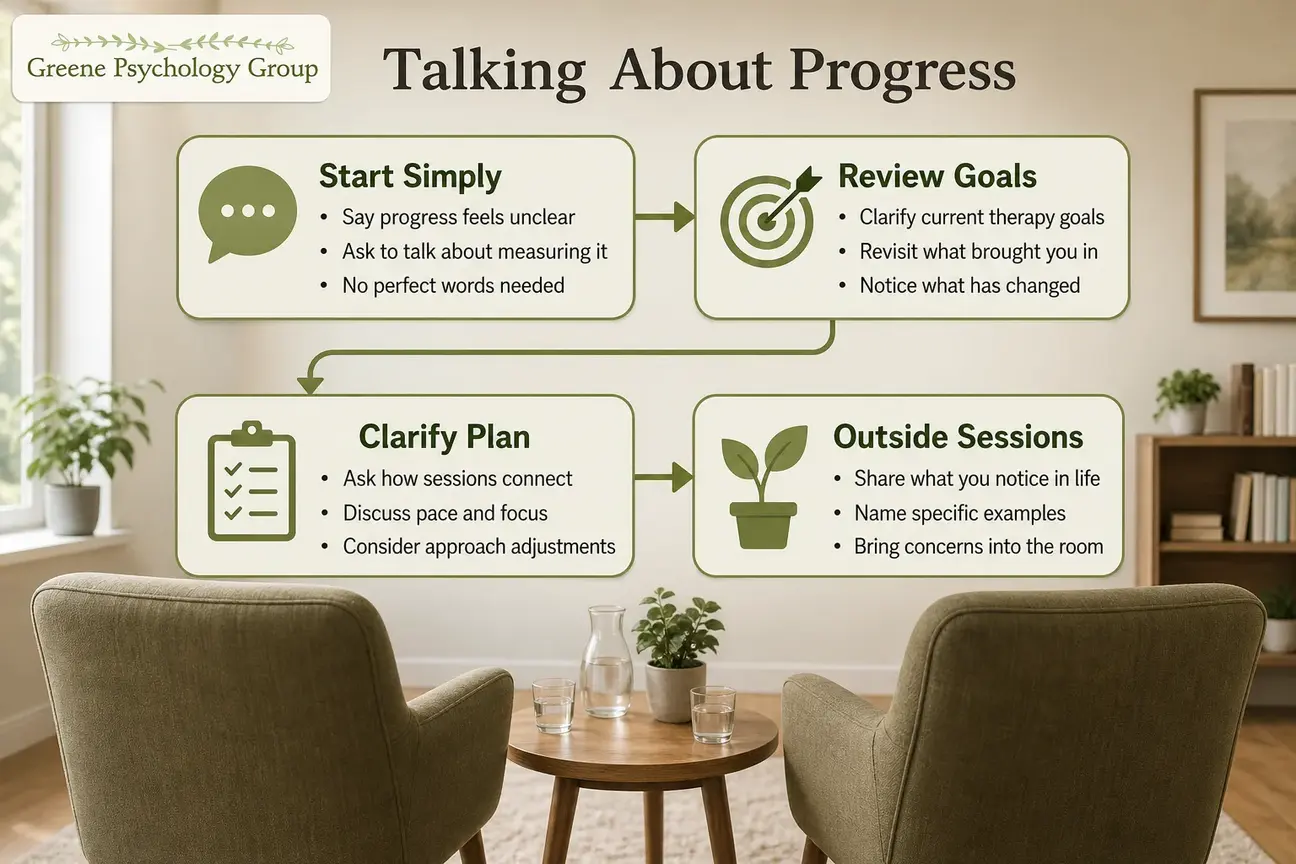
It can feel awkward to talk to therapist about whether counseling is helping. Many people worry they will sound critical, impatient, or ungrateful. But this conversation is often clinically useful. APA advises that if a client is not seeing signs of progress, they should discuss it with the psychologist rather than silently continuing or assuming the work has failed.
You do not need perfect words. You can start with something simple: “I am not sure whether I am making progress, and I would like to talk about how we are measuring it.” That gives the therapist a chance to clarify the plan, revisit therapy goals, and ask what you are noticing outside the session.
If you want to talk to therapist but feel nervous, consider writing down your concerns before the appointment. Bring a short list rather than a long report. You might include what feels helpful, what feels repetitive, what feels confusing, and what you hoped would be different by now.
Questions to use when you talk to therapist about progress
Useful questions include:
- What goals are we working toward right now?
- How will we know whether I am making progress?
- What changes would be useful to notice between sessions?
- I understand myself better, but I am not seeing much change in daily life. How should we think about that?
- Do we need to revise my therapy goals?
- Does this approach fit what I need right now?
- I am feeling discouraged. Can we talk about the pace and focus of therapy?
- What should we do if this approach is not helping enough?
- What would you want to reassess before we continue?
When you talk to therapist about progress, try to be as specific as you can without judging yourself. “I still have panic at work” is more useful than “I am failing at therapy.” “I do not know what we are working on” is more useful than “This is pointless.” Specific information gives the clinician something to respond to.
What if the signs therapy helps are not showing up?
If you are not noticing signs therapy helps, it does not mean anything was done wrong. It may mean the goals are unclear, the approach needs adjustment, the pace is off, outside stressors are interfering, the therapeutic relationship needs attention, or a different type of support should be considered.
A clinician may respond by reassessing your concerns, clarifying the treatment plan, modifying strategies, changing what happens between sessions, suggesting a different focus, or discussing referral options. The right next step depends on your situation, goals, symptoms, functioning, safety, and preferences.
It is also possible that you and your therapist have different understandings of therapy progress. You may be measuring symptom change, while the therapist is noticing insight or skill development. Or the therapist may think the plan is clear, while you are feeling lost. Naming that mismatch can help.
If you feel stuck, consider asking for a dedicated session to review progress. You might say, “Could we spend part of next session looking at what has changed, what has not changed, and whether we should adjust the plan?” This can make the conversation feel less like a confrontation and more like shared problem-solving.
Try not to make the decision in isolation if you can safely discuss it. Quietly disappearing from therapy may feel easier in the moment, but it can leave important questions unanswered. A direct conversation may clarify whether the work can be improved, whether the fit is not right, or whether another option would better match your needs.
How progress may look different for adults, teens, and families
For adults, therapy progress may be tied to work stress, parenting, relationships, grief, identity, health changes, burnout, anxiety, depression, or life transitions. Progress might involve making decisions with more clarity, communicating needs, returning to routines, noticing emotional patterns, or feeling less alone with a concern.
For adolescents, progress may look different. A teen might become more willing to attend sessions, name feelings, use coping skills, communicate with a parent, participate more consistently at school, or identify what kind of support feels useful. Parents may notice changes, but those observations should not be treated as a diagnosis or a complete measure of the teen’s inner experience.
Parents can ask how goals, consent, and confidentiality are handled for adolescent therapy. Because teens need appropriate privacy and parents need to understand how to support safety and treatment, these conversations are best addressed directly with the practice and clinician rather than assumed.
Partners and family members can also misunderstand progress if they expect therapy to make someone “different” on demand. Therapy may support healthier choices and communication, but it cannot guarantee another person’s behavior. If relationship dynamics are the main concern, a clinician can help clarify whether individual work, family work, relationship counseling, or another resource may fit the situation.
Ways to notice therapy progress between sessions
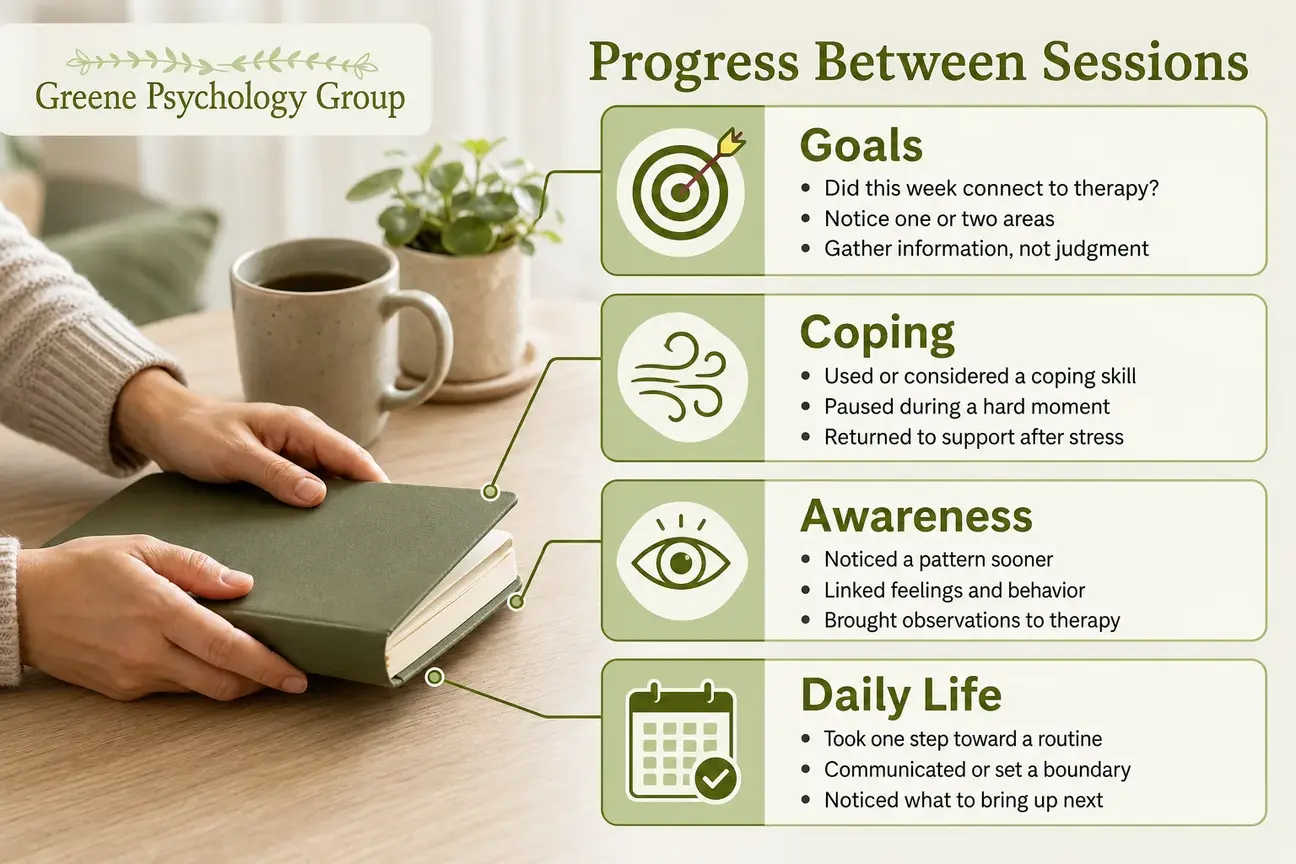
You do not have to track everything. In fact, overly detailed tracking can become stressful for some people. A light, compassionate check-in may be enough. The goal is to gather information, not to judge yourself.
Consider noticing one or two areas at a time:
- Goals: Did this week connect to what I am working on in therapy?
- Coping: Did I use or consider any coping skills before, during, or after a hard moment?
- Awareness: Did I notice a pattern sooner than I might have before?
- Functioning: Did I take one step toward a responsibility, routine, or value?
- Relationships: Did I communicate, pause, set a boundary, or repair in a way that matters to me?
- Collaboration: Is there something I need to bring back to therapy?
These prompts are reflection tools, not mental-health tests. They cannot tell you whether a diagnosis is present, whether a specific treatment is right for your situation, or what your clinician should do next. They can, however, help you arrive at session with clearer information.
NIMH’s guidance on caring for your mental health emphasizes paying attention to mental health and seeking help when needed. In the context of therapy, paying attention can include noticing what is changing, what remains difficult, and what needs to be discussed more openly.
Practical next steps if you are considering a change
If you are already in therapy and feel uncertain, the first practical step is usually to talk to therapist directly. Ask for a progress review. Clarify therapy goals. Discuss whether the approach, pacing, or focus needs to change. If you are considering ending or switching therapy, it can still be useful to talk through what did and did not help so you can make a more informed next decision.
If you are not currently in therapy, or you are looking for a different fit, Greene Psychology Group offers individual therapy for adults and adolescents. You can also learn more about what to expect in your first session, including therapy approaches and first-session considerations.
Some people prefer in-person care, and others need the flexibility of online therapy in North Carolina. Practical questions, including benefits and payment, can be reviewed through the practice’s insurance and payment information. Greene Psychology Group is in-network with most BCBS and Aetna plans, and clients should verify benefits with both their insurer and the practice.
To ask about scheduling, you can contact Greene Psychology Group, call 919-205-5339, or email [email protected]. The site notes that phones may not be working properly, so email may be preferable. Because the contact form and email are unencrypted, share only contact details, a brief reason for reaching out, whether you prefer Raleigh, Asheville, or online sessions, and insurance information. Do not send detailed health information through email or the contact form.
A balanced way to answer the question
So, is therapy working? The most honest answer is that therapy should be evaluated through a collaborative conversation about your goals, lived experience, functioning, coping, relationships, and the treatment plan. No single sign proves success, and no difficult week automatically proves failure.
Therapy progress may look like clearer therapy goals, more workable coping skills, better awareness of patterns, improved communication, small shifts in daily functioning, or a stronger therapeutic relationship. It may also involve discovering that something needs to change in the plan. Both kinds of information can be useful.
If you are unsure, bring the uncertainty into the room. You are allowed to ask what you are working toward, how progress is being understood, and whether the plan still fits. A thoughtful conversation with your therapist can often provide more clarity than trying to decide alone.
This article is for general education and isn't a substitute for diagnosis or treatment from a licensed professional. If you are in crisis, call or text 988 or call 911.
Greene Psychology Group is not a crisis service. For immediate danger, call 911 or go to the nearest emergency room. For a mental-health or suicidal crisis, call or text 988; SAMHSA provides information about the 988 Suicide & Crisis Lifeline.
Frequently Asked Questions
What are common signs that therapy may be helping?
Possible signs include clearer goals, more workable coping strategies, greater awareness of patterns, changes in relationships or daily functioning, and a collaborative therapeutic relationship. None of these signs is a universal test, and progress should be discussed with your therapist.
How long does it take to know whether therapy is working?
There is no universal timeline or session count. The pace can vary based on the concern, personal history, goals, life circumstances, therapeutic fit, and what is happening outside therapy.
Can therapy be working if I still have difficult emotions or symptoms?
Yes. Progress does not always mean complete symptom removal. You may still have difficult emotions while also building awareness, coping skills, communication, or daily functioning. Ongoing symptoms and setbacks are important to discuss with your therapist.
What should I do if I do not feel like therapy is helping?
Tell your therapist directly. The conversation may involve revisiting goals, clarifying the treatment plan, adjusting the pace or focus, addressing therapeutic fit, or considering other options. Try to be specific about what feels unclear or unchanged.
Should therapy goals change over time?
They may. Goals can become clearer, narrower, broader, or different as you learn more about your needs. Revisiting goals can be especially helpful when sessions feel unfocused or progress feels hard to see.
Does a good relationship with my therapist matter?
Yes. A collaborative relationship can help you ask questions, raise concerns, and work toward goals together. A good fit does not mean every session feels easy, but you should be able to talk about confusion, disagreement, or concerns respectfully.
How can parents tell whether therapy is helping a teenager?
Parents may notice changes in communication, coping, participation, or daily functioning, but observations are not a diagnosis. Parents and teens should ask the practice how goals, consent, confidentiality, and parent involvement are handled.