
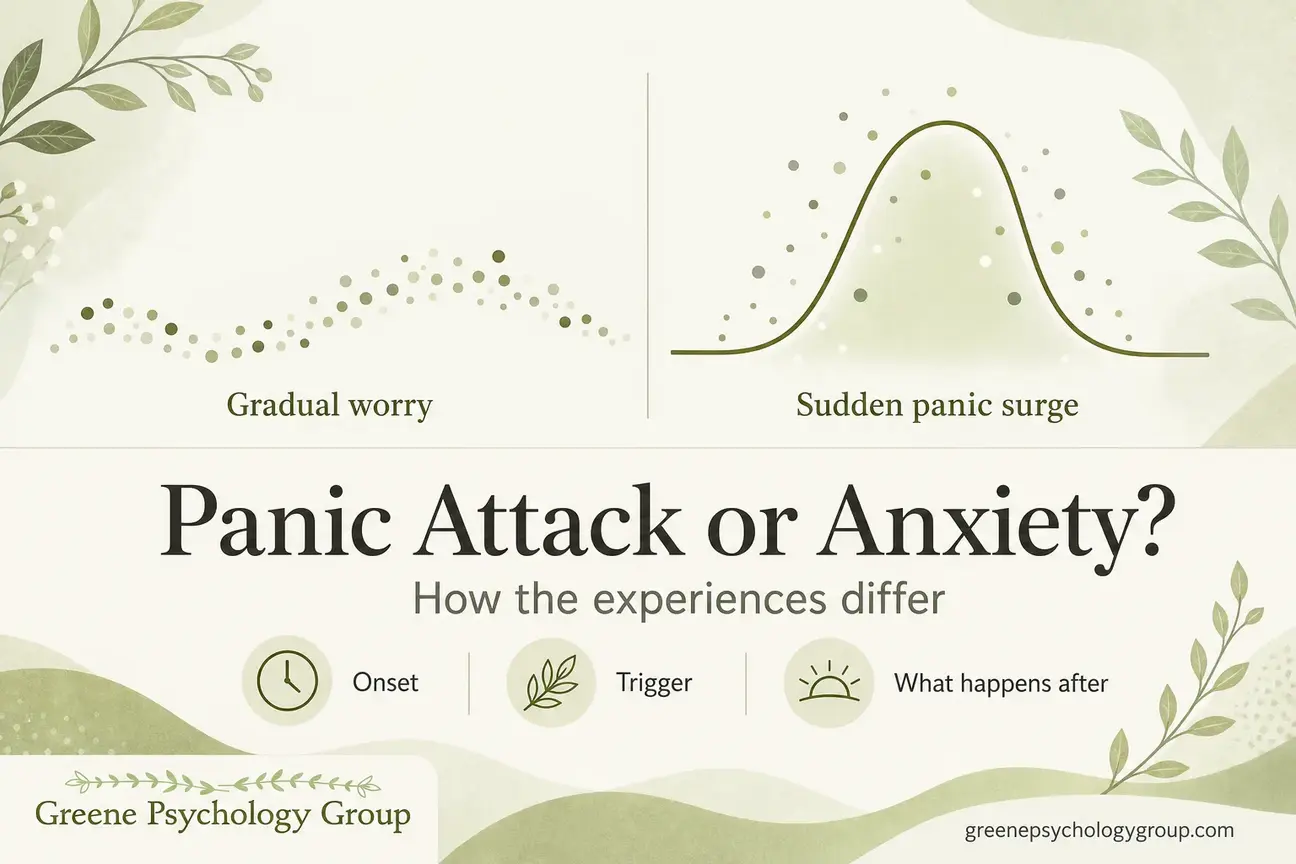
Panic Attack or Anxiety? How the Experiences Differ
If you are trying to tell whether an episode was a panic attack or anxiety, the most helpful place to start is the pattern: panic tends to arrive suddenly and intensely, while anxiety more often builds around ongoing worry, uncertainty, or anticipated stress. The two can overlap, and this article cannot determine the cause of your symptoms. Similar physical sensations can also have medical causes, so a new, severe, or unusual episode should not automatically be assumed to be anxiety.
Quick answer: panic attack or anxiety
A panic attack is generally a sudden surge of intense fear or discomfort that may happen with or without an obvious trigger. Anxiety more often develops around a concern that continues in the background, though it can still feel very intense. “Anxiety attack” is common everyday language, but it is not a formal DSM-5-TR term. A licensed clinician can help sort through what happened, and urgent medical care may be needed if symptoms could signal an emergency.
Why the difference can feel confusing
Many people do not experience panic and anxiety as neat categories. A person may have ongoing worry for days, then suddenly feel overwhelmed by a racing heart and fear. Another person may have a panic-like episode “out of nowhere,” then spend the next week worrying that it will happen again. A parent may notice a teen saying their stomach hurts before school, asking for reassurance repeatedly, or avoiding activities they used to handle.
That overlap is why it is usually more useful to ask, “How did it start, what did it feel like, what happened afterward, and is it changing how life works?” than to debate the label. The phrase panic versus anxiety can be helpful for education, but it is not a way to label yourself or someone you love without professional input.
It also helps to separate three related ideas. A panic attack is an episode. Anxiety is a broader experience that can include worry, fear, tension, and physical stress sensations. Panic disorder is a specific diagnosis that involves a recurring pattern and ongoing concern or behavior change after attacks. A licensed clinician makes that diagnosis after an assessment; an article cannot.
A panic versus anxiety comparison can give you language for a conversation with a therapist, primary-care clinician, or trusted support person. It should not replace medical care when symptoms are new, severe, or unusual, and it should not become another reason to repeatedly check your body in a way that increases fear.
What a panic attack can feel like
A panic attack is often described as a sudden wave of intense fear or discomfort. The National Institute of Mental Health explains that panic attacks can happen even when there is no clear danger or trigger. Some people feel as if something terrible is happening in the body or mind, even if they cannot identify a specific threat in the moment.
Panic attack symptoms can include a racing or pounding heart, sweating, trembling, shortness of breath, dizziness, chest discomfort, nausea, chills or heat sensations, numbness or tingling, feeling detached from reality, fear of dying, or fear of losing control. These examples are not a self-test. They are common experiences people may report, and they can overlap with medical conditions or other mental-health concerns.
One important point can be reassuring without minimizing the experience: an isolated panic attack is not, by itself, a mental disorder. NIMH distinguishes an occasional panic attack from panic disorder, which involves recurrent, unexpected attacks plus ongoing concern, worry about what the attacks mean, or behavior changes intended to avoid future attacks.
Panic attack symptoms can also leave a strong after-effect. A person may feel exhausted, embarrassed, confused, or afraid to return to the place where it happened. That reaction does not mean the person did anything wrong. It is often the body and mind trying to make sense of an intense event.
Describing panic attack symptoms clearly can help a professional understand the episode. Useful details include whether the sensations came on abruptly, whether fear peaked quickly, whether there was an obvious trigger, and what happened afterward. The goal is not to prove a label; it is to tell the story accurately enough to guide the next step.
What anxiety symptoms often look like
Anxiety is broader than a single episode. It can involve worry, fear, tension, restlessness, difficulty concentrating, irritability, sleep disruption, muscle tension, stomach discomfort, or feeling on edge. The NIMH anxiety disorders resource describes anxiety disorders as conditions involving anxiety or fear that can interfere with daily activities, but everyday anxiety can also occur without meeting criteria for a disorder.
Anxiety symptoms often build around something anticipated: a work deadline, school performance, health uncertainty, finances, conflict, travel, social situations, parenting concerns, or the possibility of another panic episode. The worry may rise and fall, but it can feel as though the nervous system never fully settles.
For some people, anxiety shows up more physically than mentally. They may not think of themselves as “worried,” but they notice a tight chest, clenched jaw, upset stomach, headaches, trouble sleeping, or a sense of dread. For others, the main feature is mental looping: reviewing conversations, seeking reassurance, planning for every possible outcome, or feeling unable to stop thinking about what could go wrong.
Anxiety symptoms can become intense enough that a person says they are having an “anxiety attack.” That phrase can be understandable and useful in ordinary conversation. Clinically, though, it is less precise than describing the onset, body sensations, thoughts, triggers, recurrence, and effect on daily life.
Writing down anxiety symptoms over several days can show patterns that are hard to see in the moment. For example, a person might notice that tension rises before certain meetings, that stomach discomfort appears before school, or that reassurance-seeking increases after stressful conversations. These notes are for reflection and professional discussion, not for self-labeling.
What people usually mean by “anxiety attack”
People use “anxiety attack” in different ways. Some mean a period of overwhelming worry. Some mean a panic attack. Some mean a mix of crying, shaking, racing thoughts, stomach distress, and the urge to leave a situation. “Anxiety attack” is common everyday language, but it is not a formal DSM-5-TR term, so a therapist will usually ask what actually happened rather than relying only on the label.
This distinction matters because two people can use the same words for very different experiences. One person may describe an “anxiety attack” that came on during a stressful meeting and eased once they left. Another may describe an abrupt, intense episode at home with chest tightness and fear of dying. Both deserve to be taken seriously, but the assessment questions may differ.
It is also not accurate to say that an “anxiety attack” is always milder, slower, or less serious than a panic attack. Anxiety can be deeply distressing and disruptive. The safer approach is to notice the pattern without turning the pattern into a diagnosis.
If you are comparing panic attack symptoms with a period of overwhelming worry, focus on onset and recovery. Did the fear surge quickly? Did worry build over hours or days? Did the event create ongoing avoidance? These questions can clarify panic versus anxiety without forcing a conclusion before assessment.
Panic versus anxiety: the main pattern differences
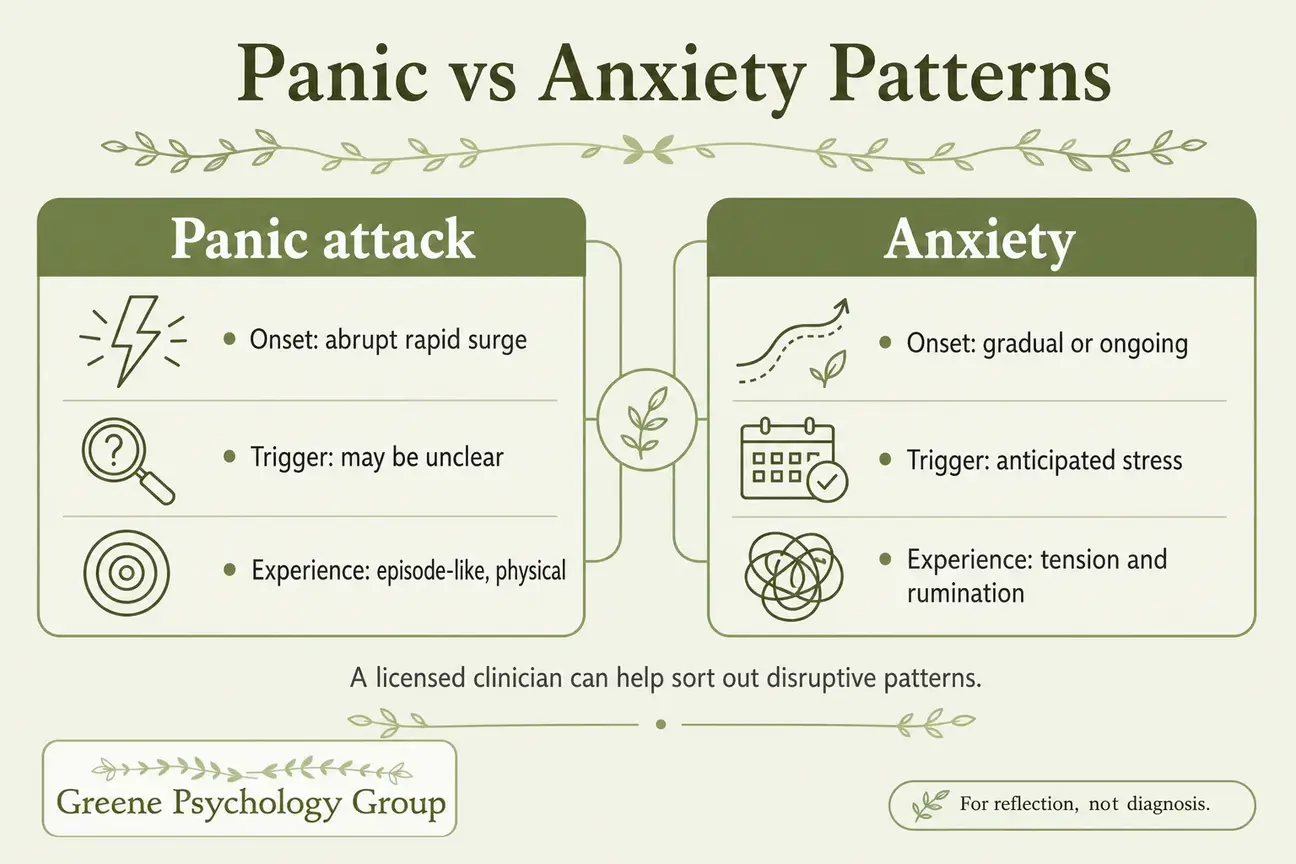
The table below offers a plain-language comparison. It is meant for reflection, not diagnosis. Panic attacks and anxiety can occur together, and symptoms that feel emotional can still deserve medical evaluation when they are new, severe, unusual, or potentially dangerous.
| Feature | Panic attack | Anxiety |
|---|---|---|
| Onset | Often abrupt, with a rapid surge of intense fear or discomfort. | Often gradual or connected to ongoing worry, stress, or uncertainty. |
| Trigger | May happen with or without an obvious trigger. | Commonly linked to anticipated stress, repeated concerns, or perceived threat. |
| Experience | Episode-like and often physically intense. | May feel like persistent tension, apprehension, rumination, or difficulty relaxing. |
| Pattern | May be one-time, occasional, or recurrent. | Can continue, fluctuate, or return while the concern remains active. |
| Afterward | Fear of another attack or avoidance may develop. | Reassurance-seeking, overthinking, avoidance, or fatigue may continue. |
| Diagnostic meaning | One attack does not automatically mean panic disorder. | Anxiety symptoms alone do not establish a specific anxiety disorder. |
Panic versus anxiety is often clearest when the onset and aftermath are considered. Did the experience arrive suddenly and feel like a wave? Did it build around a specific worry? Did fear of another episode start changing behavior? Did the worry continue long after the situation ended? These questions can help with describing the experience to a clinician.
Still, there are limits to what pattern recognition can do. A person can have anxiety for weeks and also experience panic attacks. A person can have panic attacks without panic disorder. A person can have body symptoms that feel like panic but need medical attention. The goal is not to pick the “right” label alone; the goal is to understand what kind of support may be appropriate.
Another useful panic versus anxiety question is whether the main problem is the episode itself, the ongoing worry around it, or both. Some people need help with recurring sudden surges. Others need help with persistent apprehension, overthinking, and avoidance. Many people need support for a combination.
Panic attack symptoms that should not be treated as a self-test
It is natural to search for panic attack symptoms after a frightening episode. Lists can help people find language for what happened, but they can also create false certainty. A racing heart, chest discomfort, shortness of breath, dizziness, trembling, nausea, numbness, or fear of dying may occur during panic. Similar sensations can also occur for other reasons.
For that reason, a symptom list should be used as a conversation aid, not a verdict. If notes seem useful, include the time, setting, what was happening beforehand, how quickly symptoms escalated, how long the intense part seemed to last, what helped with staying safe, and what changed afterward. Those notes may help a clinician or medical professional ask better questions.
Try not to use the list to prove that “it was only panic.” That phrase can accidentally dismiss the seriousness of the experience and may lead someone to ignore concerning physical signs. Panic can feel intensely real in the body, and medical uncertainty deserves care rather than self-blame.
It is also common for people to feel embarrassed after an episode. Embarrassment can make someone avoid talking about it, but silence often leaves the person alone with fear. If the episode has stayed on your mind, disrupted sleep, changed where you go, or made being alone feel frightening, it may be worth discussing with a licensed clinician.
When describing panic attack symptoms, include what happened before and after the episode. A clinician may ask whether there was sustained stress, whether another attack became a fear, whether places were avoided afterward, and whether other mental-health or medical factors could be relevant.
Anxiety symptoms in adults and teens
Anxiety symptoms can look different depending on age, setting, and personality. Adults may describe overthinking, muscle tension, work stress, trouble sleeping, irritability, digestive discomfort, dread, or avoiding tasks that feel overwhelming. They may also appear highly functional while feeling internally tense much of the time.
Teens may not always say, “I feel anxious.” Parents might notice irritability, reassurance-seeking, school avoidance, physical complaints, changes in sleep, withdrawal from activities, or intense distress before certain situations. Those changes do not automatically mean an anxiety disorder is present. They do suggest that a calm conversation and, when needed, professional assessment may be helpful.
For parents, the most useful first response is often curiosity rather than labeling. It may help to ask what the teen noticed in their body, what they were afraid would happen, whether anything has started to feel harder, and what kind of support would feel respectful. If therapy becomes a possibility, parents and teens should ask the practice about consent and confidentiality during the intake process.
A partner, family member, or caregiver may also notice changes before the person names them. Repeated reassurance requests, avoiding driving or social plans, needing to leave places quickly, or seeming constantly braced for something bad can all be signs that the experience is affecting daily life. Supportive observation is different from diagnosing. It means saying, “I’ve noticed this seems hard, and I’m willing to help you find support.”
Because anxiety symptoms can be internal, others may underestimate how much effort the person is using to get through the day. Someone may keep working, parenting, or attending school while feeling tense, exhausted, or afraid much of the time. Functioning on the outside does not always mean the person feels well on the inside.
When medical evaluation may be appropriate
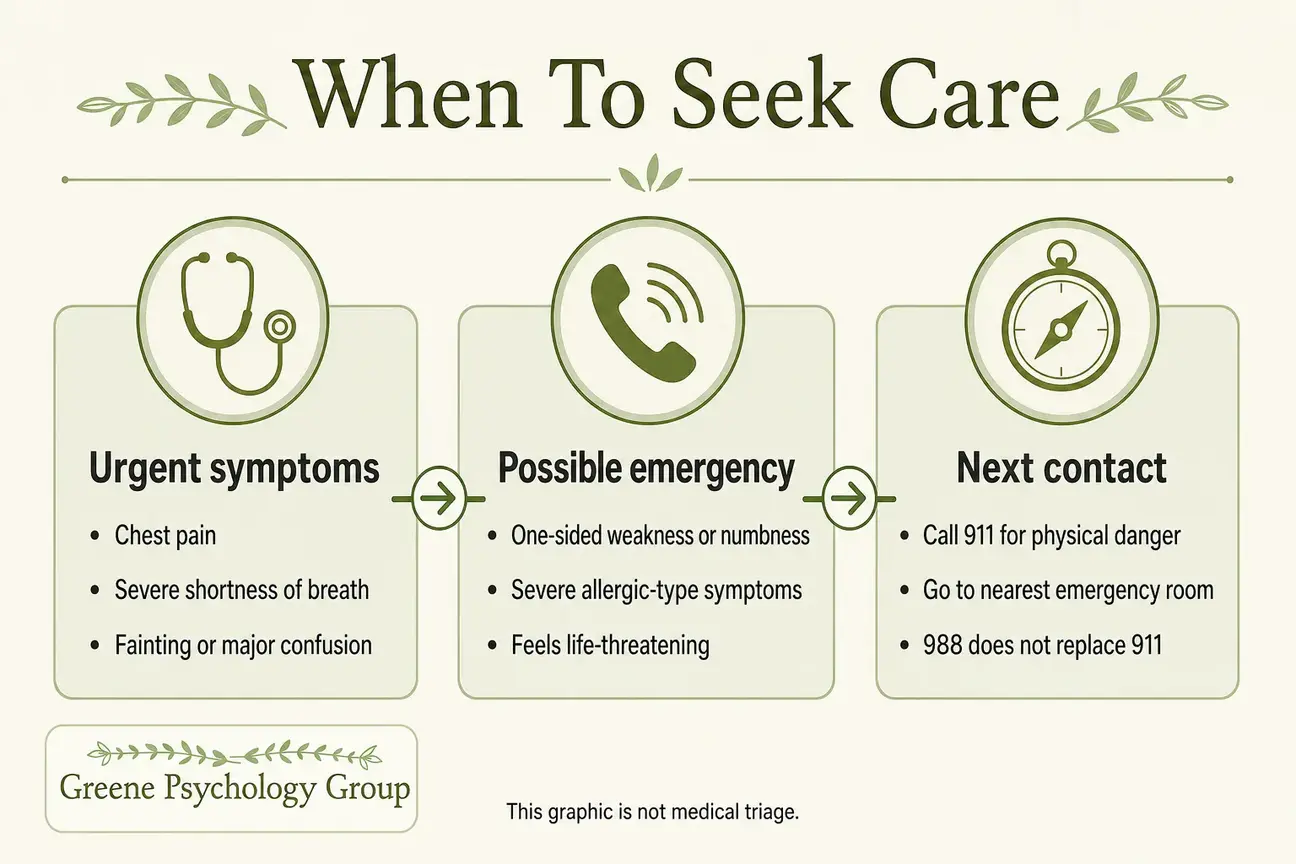
Because panic and anxiety can feel physical, it can be tempting to explain every body sensation as stress. That is not always safe. New, severe, unusual, rapidly worsening, or frightening symptoms deserve medical attention, especially if the symptoms could be an emergency.
Consider urgent medical evaluation for chest pain, severe shortness of breath, fainting, major confusion, weakness or numbness on one side, severe allergic-type symptoms, or any situation that feels life-threatening. This article cannot provide medical triage. If immediate physical danger is present, call 911 or go to the nearest emergency room. The SAMHSA 988 FAQ notes that 988 is not designed to replace 911 for emergency medical services.
Even when panic attack symptoms happened before, a new pattern should be taken seriously. The fact that panic is possible does not mean panic is the only possible explanation. A medical professional can help decide whether physical evaluation is needed.
Medical evaluation and mental-health support can also work together. A medical professional may help rule out or address physical contributors, while a therapist can help assess patterns of fear, worry, avoidance, and daily impact. Neither path means anyone is “overreacting.” It means the symptoms are being taken seriously.
When recurring episodes may point toward panic disorder help
People often search for panic disorder help after panic-like episodes begin repeating or after fear of another episode starts shaping daily life. Panic disorder is not the same as having one frightening attack. NIMH describes panic disorder as involving recurrent, unexpected panic attacks and ongoing concern, worry about the implications, or behavior changes related to avoiding future attacks.
If you are wondering about panic disorder help, consider whether the pattern has become disruptive rather than trying to decide the diagnosis alone. Are stores, driving, travel, exercise, social events, school, work, or being alone becoming harder because of fear of another episode? Is body-checking for signs of another attack taking more time? Is significant energy going toward planning escape routes or seeking reassurance?
These questions are not a test. They are examples of the kinds of patterns a licensed clinician may explore. A clinician may also ask about sleep, health history, substance use, medications, stressors, trauma history, mood symptoms, family context, and what has already been tried. Greene Psychology Group does not provide medication prescribing or medication management; medication questions belong with a prescriber.
Panic disorder help can include psychotherapy focused on understanding the fear cycle, reducing avoidance, and building coping skills that fit the person’s needs. The right approach depends on the assessment, the person’s preferences, and whether other concerns are present. No therapy approach is the right fit for everyone.
Seeking panic disorder help does not mean someone has failed to cope. It can mean the pattern has become too distressing, confusing, or limiting to manage alone. A therapist can help sort out whether recurring panic, ongoing anxiety, medical concerns, trauma-related triggers, or another factor should be considered.
How therapy may help with anxiety and panic patterns
Therapy for panic and anxiety usually starts with understanding the pattern, not judging it. A therapist may ask what the first signs were, what fear came up, how the person responded, what was avoided afterward, and how the experience is affecting work, school, relationships, parenting, sleep, or daily routines.
The NIMH psychotherapy resource describes psychotherapy as a treatment that can help people identify and change troubling emotions, thoughts, and behaviors. In practice, therapy may include education about the anxiety cycle, skills for responding to distress, attention to avoidance patterns, and support for broader stressors that keep the nervous system on alert.
Some people seek anxiety treatment because worry or panic-like episodes are the main concern. Others need broader mental health therapy because panic or anxiety is connected with depression, grief, trauma, relationship stress, burnout, life transitions, or family concerns. A licensed clinician can help decide what kind of therapy focus makes sense.
For adults and adolescents, individual therapy may provide a place to describe the experience in detail, identify patterns, and consider next steps. Therapy does not require perfect words for what happened. It is enough to say, “I had an episode that scared me,” or “My worry is changing what I do.”
Therapy may also help people tell the difference between anxiety symptoms that come from ongoing stress and panic attack symptoms that arrive as a sudden surge. That distinction can shape coping plans, but the work is still individualized. A clinician may adjust the focus if depression, trauma, grief, family conflict, or life transitions are part of the picture.
What a licensed clinician may assess
A mental-health assessment is not just a symptom checklist. A clinician may ask when the episode began, whether it came on suddenly or gradually, what was happening beforehand, how often it has occurred, whether there were clear triggers, and what thoughts or fears showed up during the experience.
The clinician may also ask about physical sensations, medical history, sleep, caffeine or substance use, medications, life stressors, family history, mood, trauma exposure, avoidance, reassurance-seeking, school or work impact, and relationship strain. These questions help distinguish possible patterns and identify whether medical evaluation or another type of support is needed.
Diagnosis, when relevant, comes from a licensed clinician. A clinician may determine that the experience fits a panic attack, panic disorder, another anxiety disorder, stress-related distress, a medical issue that needs follow-up, or a combination of concerns. Sometimes the most honest first answer is, “We need more information.”
A careful assessment can also reduce shame. Many people worry that they should have been able to control the experience. Therapy can help reframe the episode as information about the nervous system and current stress load, not as a personal failure.
During assessment, a clinician may ask how panic versus anxiety makes sense in the person’s own words. The answer does not have to be clinically precise. It can simply describe what felt sudden, what felt ongoing, what scared the person most, and what has changed since the episode.
What to do after an episode without trying to label it
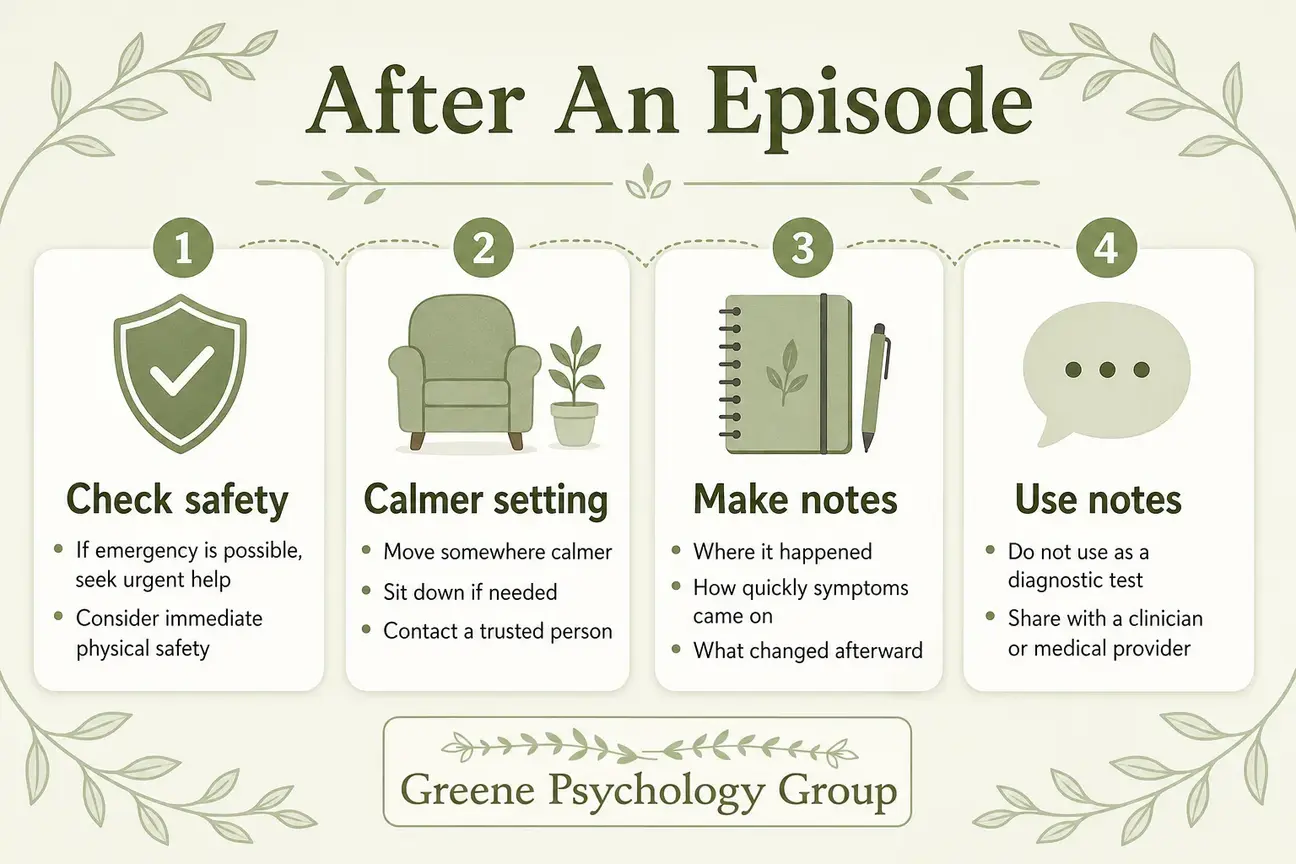
After a frightening episode, the safest first step is to consider immediate safety. If symptoms might represent a medical emergency, seek urgent medical help. If physical safety is clear but the episode was shaking, it may help to move to a calmer setting, sit down if needed, and contact a trusted person.
When it feels possible, write down a simple account of what happened. Include where the episode occurred, what was happening before the symptoms started, how quickly they came on, what showed up in the body, what thoughts or fears appeared, what happened next, and whether anything was avoided afterward. Do not use these notes as a diagnostic test. Use them as memory support for a medical or therapy conversation.
Try to be careful with internet searching in the hours after the episode. Searching can sometimes provide language and reassurance, but it can also increase checking and fear. If searching the same symptoms keeps leading to more alarm, that may be a sign to pause and reach out to a professional or trusted support person.
It is also okay to reduce immediate demands while recovering from the stress of the episode. That does not mean avoiding life indefinitely. It means recognizing that a frightening body alarm can leave someone tired. Longer-term avoidance, especially if it starts shrinking daily life, is a good reason to seek support.
If the event repeats, bring notes about both anxiety symptoms and panic attack symptoms to an appointment. A clinician can help look at the full pattern: what comes before, what happens during, what fear appears afterward, and what parts of life are becoming smaller because of worry or avoidance.
How to talk with someone you are worried about
If you are supporting a partner, teen, friend, or family member, start with what was noticeable rather than what the diagnosis might be. For example, “I noticed you seemed really scared after your heart started racing,” or “I’ve noticed you are avoiding driving since that episode.” This keeps the conversation grounded and less likely to feel like criticism.
Avoid arguing about whether it was “really panic” or “just anxiety.” The experience may have felt frightening even if the cause is unclear. You can ask whether they want help thinking through next steps, whether they would like company while contacting a clinician, or whether they need medical care because symptoms feel unsafe.
For teens, parents can validate distress while still setting steady expectations. It may help to say, “I believe that felt scary. Let’s figure out what support makes sense,” rather than immediately removing every stressor or insisting they push through. If school, activities, sleep, or family life are changing significantly, professional guidance may help the family respond in a balanced way.
If someone is asking for panic disorder help, try to respond with calm support rather than alarm. You can help them write down questions, gather insurance information, or choose what to share in an initial message. Support does not require solving the problem.
Local options for therapy and next steps
Greene Psychology Group offers psychotherapy for adolescents and adults, including support for anxiety concerns. The practice has offices in Raleigh and Asheville and offers online therapy in North Carolina for people physically located in the state during the session.
If panic-like episodes, worry, or avoidance are becoming disruptive, you can contact Greene Psychology Group to ask about next steps. Share a brief reason for reaching out, whether you prefer in-person or online sessions, and your insurance information. Please do not send detailed health information through the contact form or email because they are unencrypted.
You may also call 919-205-5339 or email [email protected]. Because phone issues have been noted on the site, using phone and email together may be helpful. Greene Psychology Group is in-network with most BCBS and Aetna plans, but clients should verify benefits with their insurer and the practice.
A grounded way to think about the label
If you remember only one distinction, let it be this: panic is often more sudden and episode-like, while anxiety is often more connected to ongoing worry and anticipation. But the label is less important than safety, recurrence, avoidance, and impact. The question is not only “Was this panic attack or anxiety?” It is also “Do I need medical care, support, or a fuller assessment?”
Using panic versus anxiety language can help explain the experience, but it should not become pressure to decide everything alone. If the experience was frightening, repeating, or changing how life works, it is reasonable to talk with a licensed clinician. If it felt medically dangerous, urgent medical evaluation is the safer path.
For some people, the next useful step is anxiety treatment focused on worry, avoidance, and coping skills. For others, recurring episodes and fear of future attacks make panic disorder help worth discussing. Either way, the goal is a careful assessment and support that fits the whole person, not a rushed label.
This article is for general education and isn't a substitute for diagnosis or treatment from a licensed professional.
Greene Psychology Group is not an emergency or crisis service. For immediate danger, call 911 or go to the nearest emergency room. For a mental-health or suicidal crisis, call or text 988. The SAMHSA 988 overview explains that 988 provides access to support for people experiencing suicidal, mental-health, substance-use, or emotional distress.
Frequently Asked Questions
Is a panic attack the same as anxiety?
No. A panic attack is generally a sudden episode of intense fear or discomfort, while anxiety more often builds around ongoing worry or anticipated stress. They can overlap, and neither description diagnoses a condition.
What is the difference between a panic attack and an anxiety attack?
“Anxiety attack” is commonly used, but it is not a formal diagnosis. People may use it to describe anxiety becoming overwhelming, so the specific onset, symptoms, triggers, recurrence, and impact matter more than the label.
Can a panic attack happen without an obvious trigger?
Yes. Panic attacks can happen even when there is no clear danger or trigger. That does not mean every sudden physical symptom is panic, so new or concerning symptoms may still need medical evaluation.
Does one panic attack mean someone has panic disorder?
No. One panic attack does not automatically mean panic disorder. Panic disorder involves a recurring pattern of unexpected attacks along with ongoing concern, worry about what the attacks mean, or behavior changes related to future attacks.
Should someone go to the emergency room for panic symptoms?
New, severe, unusual, or potentially dangerous symptoms should not automatically be assumed to be panic. Chest pain, severe shortness of breath, fainting, major confusion, or other emergency signs call for urgent medical care. For immediate danger, call 911 or go to the nearest emergency room.
When can therapy help with panic or anxiety?
Consider contacting a licensed clinician when episodes or worry recur, lead to avoidance, interfere with daily life, or create persistent fear about another episode. A clinician can assess the situation and discuss whether anxiety treatment or broader mental-health therapy may help.
Can parents seek help when a teenager has panic or anxiety symptoms?
Yes. Parents can focus on changes in functioning, listen without immediately labeling the experience, and ask a licensed clinician about assessment and therapy. Parents and teens should ask the practice about consent and confidentiality during the intake process.