

Therapy After Pregnancy Loss: 7 Gentle Ways It Can Help
Losing a pregnancy through miscarriage, stillbirth, or another pregnancy loss can affect grief, daily functioning, relationships, sleep, anxiety, and the way a person feels in their body. Therapy after pregnancy loss may offer a confidential place to talk about what happened, what has changed, and what kind of support feels right now. It is not required for everyone, and it does not promise that grief will follow a clear timeline. But for some people, talking with a licensed clinician can help them understand whether they are experiencing pregnancy loss grief, depression, anxiety, trauma-related responses, or overlapping concerns.
Quick answer
Therapy can help after pregnancy loss by offering a structured, private space to talk about grief, fear, guilt, anger, numbness, relationship strain, and changes in daily life. A licensed clinician can assess what is happening, discuss coping skills, and help you consider whether individual counseling, medical follow-up, support groups, couples counseling, or another referral fits your needs. Counseling is not necessary for every person after miscarriage or stillbirth, and grief does not need to look a certain way before support is appropriate.
Pregnancy loss grief can look different from person to person
There is no single correct way to grieve a pregnancy loss. Some people feel intense sadness immediately. Others feel numb, focused on practical decisions, or unsure what they are “supposed” to feel. Some feel grief in waves, especially around medical appointments, an expected due date, a holiday, a pregnancy announcement, or an anniversary. Pregnancy loss grief may also include anger, guilt, relief, confusion, envy, fear about the future, or a sense of being disconnected from people who have not had a similar experience.
The American Psychological Association describes grief as a response that can include emotional and physical reactions after a significant loss. That matters because a person may be back at work, caring for other children, answering messages, or managing daily tasks while still feeling emotionally raw. Physical routines and emotional healing can move on different timelines.
The American College of Obstetricians and Gynecologists offers pregnancy-loss guidance for both miscarriage and stillbirth. In its early pregnancy loss guidance, ACOG says that “talking with your ob-gyn or a counselor about your feelings can help” after miscarriage. Its stillbirth guidance also notes that support groups “can be very helpful” and that therapists can help people process the emotions they experience after loss. Those statements are important because support is framed as something that can help, not as a universal requirement or a guaranteed outcome.
Partners and family members may grieve differently, too. One person may want to talk often, while another may cope by staying busy. One person may cry openly, while another feels grief privately. Differences in outward expression do not necessarily mean one person cared more or less. They may simply have different ways of surviving a painful experience.
Pregnancy loss grief can also feel complicated because other people may not know how to respond. Some comments that are meant to comfort can feel dismissive. Some people may avoid mentioning the loss because they are afraid of saying the wrong thing. Others may expect someone to “move on” before that person feels ready. Counseling can provide a setting where the loss is allowed to matter without needing to protect everyone else from discomfort.
Grief is not a disorder by itself. At the same time, grief can overlap with symptoms of depression, anxiety, trauma-related distress, or stress reactions. That overlap is one reason some people seek therapy: not because their grief is wrong, but because they want help understanding what they are carrying.
Miscarriage support when grief, guilt, or fear feels isolating
People often look for miscarriage support when they feel alone, even if there are caring people around them. Miscarriage can happen early enough that few people knew about the pregnancy, or after a person had already imagined a future, made plans, or shared the news. Some people feel unsure whether open grief is allowed. Others feel pressure to explain medical details they would rather keep private.
Miscarriage support in therapy may include naming the loss, exploring what the pregnancy meant, and noticing how grief is showing up in daily life. A therapist may ask about sleep, appetite, concentration, work, caregiving, self-care, medical follow-up, social support, and relationship strain. These questions are not meant to reduce the loss to symptoms. They help the clinician understand functioning and what kind of support may be useful.
The ACOG early pregnancy loss FAQ notes that emotional healing can take longer than physical healing and says talking with an ob-gyn or counselor about feelings can help. In therapy, that kind of support may involve slowing down the thoughts, fears, and “what ifs” that keep replaying. It may also help separate questions for a medical clinician from emotions that need room in grief work.
Guilt is common after miscarriage, even when a medical professional has not identified anything a person did to cause the loss. A therapist should not assume what the guilt means. Instead, counseling may help someone notice the difference between responsibility, uncertainty, longing for an answer, and the mind’s effort to make sense of something painful.
Some people seeking miscarriage support are also facing decisions about future pregnancy, fertility treatment, medical testing, or family planning. Therapy does not replace medical care. An ob-gyn or other medical professional is the appropriate source for medical questions. But counseling can give space for the emotional side of uncertainty, including fear, resentment, hope, dread, and ambivalence.
Miscarriage support can also include communication planning. Therapy might focus on what to say to a family member, how to answer unwanted questions, or how to set limits around events that feel painful. Counseling does not require the whole story to be repeated again and again. A good fit should allow movement at a pace that feels emotionally safe enough.
Stillbirth mental health concerns may need room for grief and trauma
Stillbirth mental health concerns can involve deep grief, shock, body memories, medical memories, and changes in how safe the world feels. Some people have intrusive images, nightmares, panic-like sensations, avoidance of reminders, or a feeling of being constantly on alert. Others feel emotionally shut down, detached, or unable to connect with people who expect them to function normally.
These experiences can be part of grief, trauma-related distress, depression, anxiety, or more than one concern at the same time. A blog article cannot determine which is true for any reader. A licensed clinician can assess symptoms, history, current functioning, medical context, safety, and support system to better understand what may be happening.
The ACOG stillbirth FAQ describes possible grief responses and notes that talking about what happened can be painful but may help with healing. It also says therapists can help people process the emotions they experience. This is not a promise that one conversation or one type of therapy will resolve grief. It is a careful way of saying that professional support can be one part of care after a major loss.
Stillbirth mental health support should not force a person to process traumatic memories before readiness and enough support are present. For trauma-related concerns, therapy often begins with safety, stabilization, coping skills, and understanding triggers. The goal is not to erase the loss or make someone “get over it.” It is to help the person live with what happened in a way that may feel less isolating or overwhelming over time.
Stillbirth can also affect identity. A person may wonder whether they are a parent, how to talk about the baby, what to do with reminders, or how to respond when others avoid the subject. These questions can be tender and personal. Therapy may help a person explore them without being pushed toward one “right” answer.
For partners, stillbirth mental health concerns may show up as distance, irritability, silence, conflict, or mismatched coping. One partner may want rituals or conversation; another may find reminders unbearable. Couples counseling may be one possible support when communication feels strained, though not every clinician provides couples work or perinatal grief therapy. Asking directly about a clinician’s experience is appropriate.
How grief, depression, anxiety, and trauma can overlap
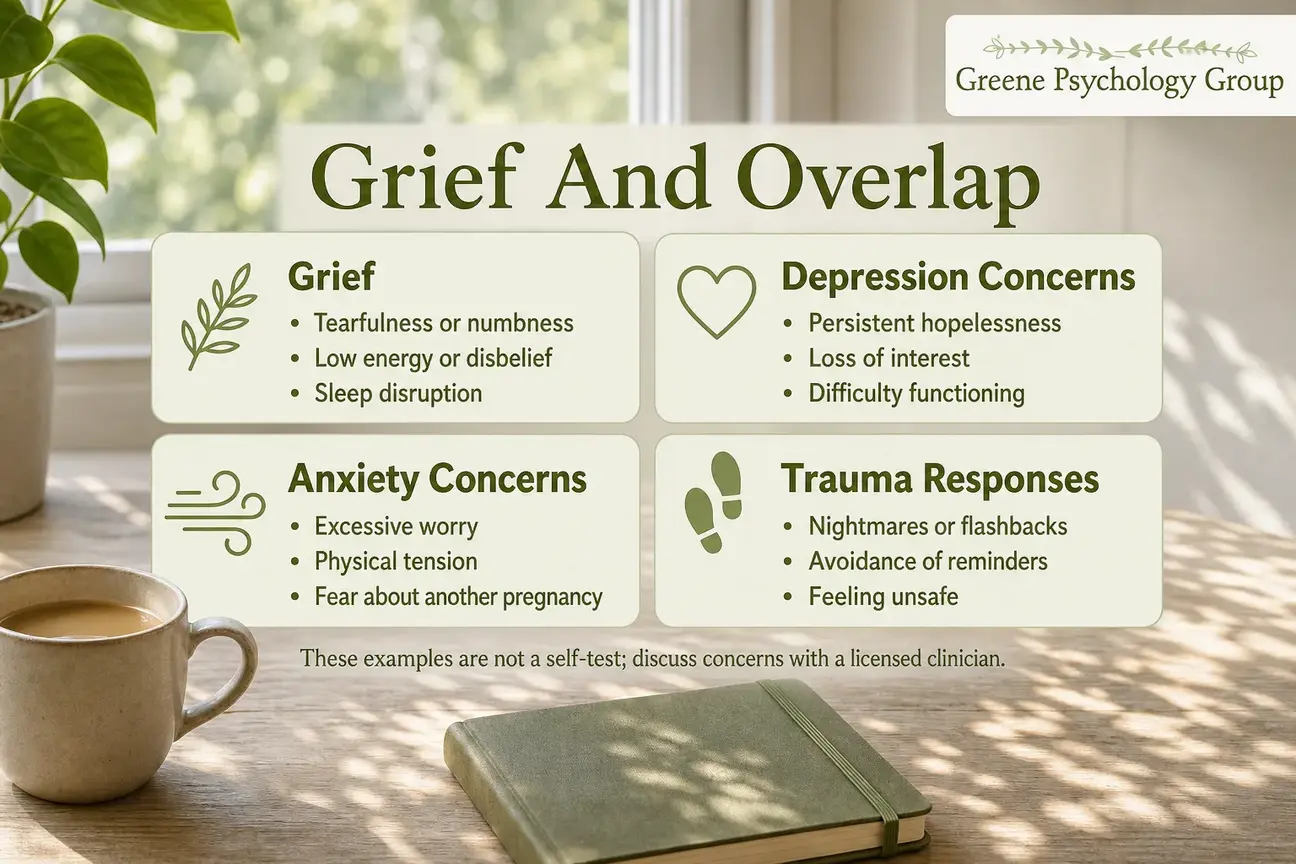
Pregnancy loss can affect the mind and body in ways that are difficult to separate. Grief may bring tearfulness, low energy, numbness, difficulty concentrating, sleep disruption, or moments of disbelief. Depression-related concerns may involve persistent hopelessness, loss of interest, difficulty functioning, or feeling worthless. Anxiety may bring excessive worry, physical tension, racing thoughts, or fear about another pregnancy. Trauma-related responses may include nightmares, flashbacks, avoidance, or feeling unsafe in situations that resemble the loss.
These descriptions are not a self-test. They are examples of experiences that may be worth discussing with a licensed clinician, especially if they persist, intensify, or interfere with daily responsibilities. Diagnosis comes from professional assessment, not from matching a list online.
Professional help may be especially important if someone is having difficulty handling feelings after the loss, feels persistently distressed, cannot manage daily responsibilities, feels hopeless, has repeated flashbacks or nightmares, avoids reminders in ways that make life smaller, or has thoughts of self-harm. These concerns do not mean a person has done anything wrong. They are reasons to seek timely support and assessment.
It can be especially confusing when grief and anxiety arrive together. A person may deeply miss the pregnancy while also feeling frightened by medical settings, future pregnancy conversations, or uncertainty. Another person may not cry much but may feel tense, irritable, foggy, or unable to rest. A clinician can help sort out patterns without judging whether grief is being expressed “correctly.”
Medical follow-up also remains important. Physical recovery, bleeding, pain, hormonal changes, lactation, infection concerns, or questions about future pregnancy belong with an ob-gyn or another qualified medical professional. Therapy can support emotional and mental-health concerns, but it does not replace medical care.
What therapy after pregnancy loss may involve
Therapy after pregnancy loss may begin with a therapist asking what happened, what support is available, what has changed since the loss, and what feels hardest right now. There is no requirement to share every detail in the first session. A therapist may help identify immediate needs, such as sleep disruption, panic, intrusive memories, communication strain, decision fatigue, or feeling unable to return to ordinary routines.
In practice, counseling might mean making space for sadness, anger, guilt, love, relief, resentment, fear, or numbness without forcing any one emotion to be the “real” one. It may also mean helping a person find words for an experience that can feel private, misunderstood, or difficult to explain.
Individual therapy may include assessment and collaborative goal-setting. Goals might involve coping with reminders, reducing avoidance that is making life smaller, communicating with a partner, preparing for medical appointments, deciding how much to share with family, or understanding how anxiety and grief interact. Goals should be tailored to the person. They should not promise a specific outcome or timeline.
The American Psychological Association describes psychotherapy as a collaborative treatment based on the relationship between a person and a psychologist, with dialogue in a supportive environment. While therapists vary by license and approach, that collaborative frame is useful: therapy is not simply advice-giving, and it is not a requirement to relive painful details before readiness is present.
Some clinicians use approaches that focus on thoughts and behaviors, emotion regulation, mindfulness, acceptance, interpersonal patterns, trauma responses, or meaning-making. No single approach is universally recommended for every person after pregnancy loss. The best fit depends on needs, symptoms, preferences, safety, culture, relationship context, medical situation, and the clinician’s training.
Counseling may also include discussing whether another form of support should be added. A therapist may encourage medical follow-up for medical questions, a psychiatric referral for medication-related evaluation when appropriate, a support group if peer connection feels important, or couples counseling if relationship communication is a major concern. Greene Psychology Group provides psychotherapy and does not provide medication prescribing or emergency services.
Perinatal grief therapy and questions to ask before scheduling
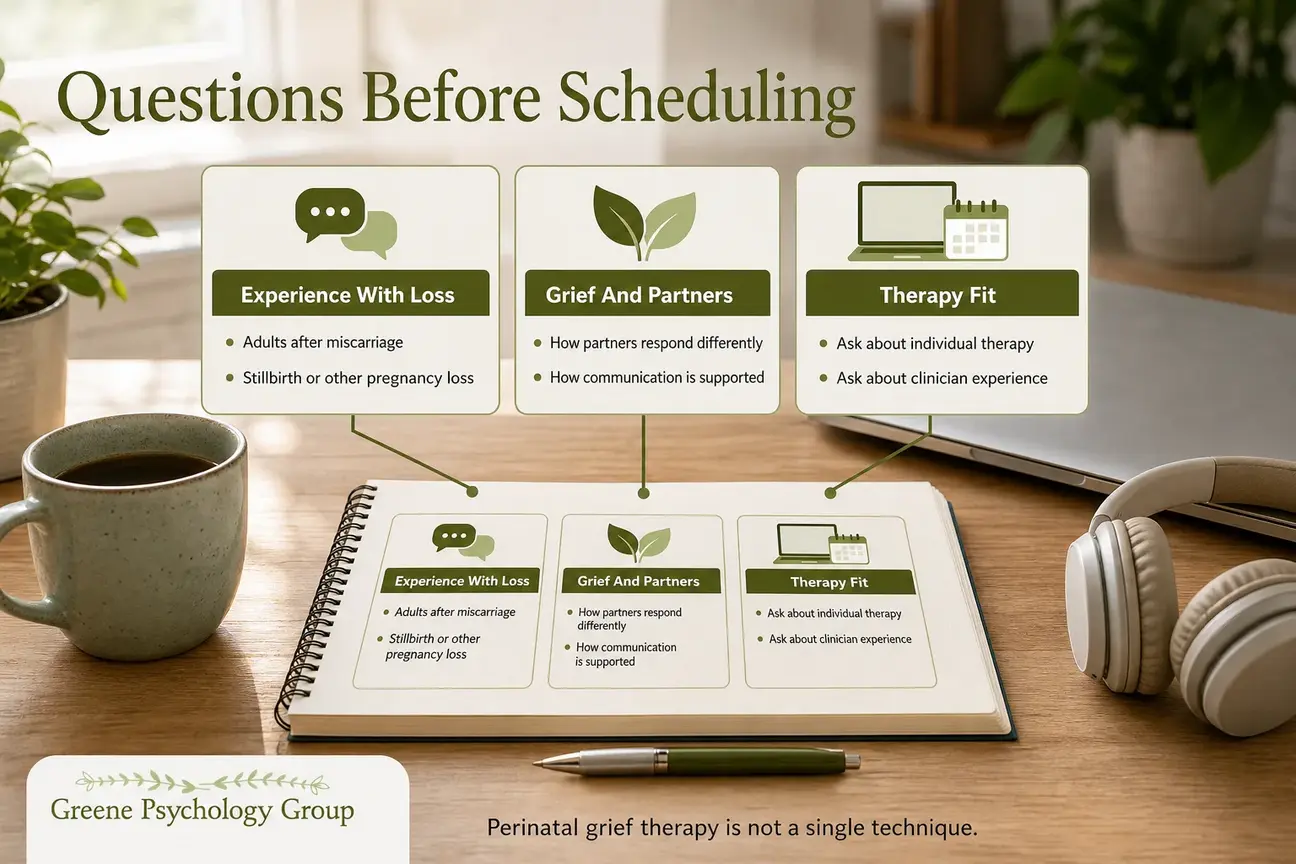
Perinatal grief therapy is not a single technique. It is a way of describing therapy that attends to grief related to pregnancy, birth, postpartum experiences, infertility, miscarriage, stillbirth, or related losses. Not every therapist has the same experience with these concerns, and not every practice can promise a perinatal specialist. It is reasonable to ask direct questions before scheduling.
If perinatal grief therapy is the goal, consider asking whether the clinician works with adults after miscarriage, stillbirth, or other pregnancy loss. Questions can also include how the clinician approaches grief when partners respond differently, whether they provide individual therapy, whether they offer couples counseling or referrals, and how they assess anxiety, depression, trauma-related symptoms, or fertility-related stress.
It may also help to ask what happens if medical, psychiatric, or crisis support is needed. A therapist should be able to explain the limits of their role and how referrals are handled. If medication questions come up, those decisions belong with a qualified prescriber. If there is immediate safety risk, crisis resources are more appropriate than a routine therapy inquiry.
For practical planning, ask whether sessions are in person or online, what license the clinician holds, how confidentiality and its limits are explained during intake, and whether insurance may apply. If contacting a practice by email or an online form, share only basic contact information and a brief reason for reaching out, not detailed medical or mental-health information.
| Question to ask | Why it may matter |
|---|---|
| Do you work with adults after miscarriage, stillbirth, or other pregnancy loss? | This helps clarify whether the clinician has relevant experience with pregnancy loss grief. |
| How do you assess depression, anxiety, trauma responses, and grief? | Symptoms can overlap, and a licensed clinician should assess rather than assume. |
| Do you offer individual therapy, couples counseling, or referrals to support groups? | Support needs vary, and no single format fits everyone. |
| What should I do if I feel unsafe or in crisis? | Routine therapy is not crisis care, so safety planning and crisis resources matter. |
| Do you offer online sessions, and where must I be located? | Teletherapy rules depend on the clinician’s license and the client’s location during the session. |
| How do I verify insurance benefits? | Coverage varies, so both the insurer and practice should confirm details. |
When counseling may be worth considering
Counseling may be worth considering when pregnancy loss grief feels too heavy to carry alone, when daily functioning has changed significantly, or when worry, low mood, numbness, sleep disruption, or distress continues or intensifies. No diagnosis is needed before asking for support. Wanting a place to talk is enough reason to explore options.
Counseling is an option, not a requirement for every person. Some people feel supported by family, friends, faith communities, medical professionals, or peer groups. Others find that private therapy offers something different: a consistent place where the loss can be discussed without managing everyone else’s reactions.
Therapy may be worth considering if memories or reminders feel overwhelming, if avoidance is making life smaller, or if anxiety about another pregnancy is taking over daily thoughts. Support may also help when isolation feels intense because others do not understand, when a relationship feels strained, or when basic self-care feels difficult.
Stillbirth mental health concerns, miscarriage support needs, and perinatal grief therapy questions can also emerge months later. Some people cope by staying busy at first, then feel the grief more strongly when life becomes quieter. Others feel a new wave of grief when a friend becomes pregnant, when a due date passes, or when medical decisions arise. Delayed distress does not mean failure. It may simply mean the loss is meeting a person in a new context.
If there are thoughts of self-harm, a sense of being unable to stay safe, or worry about harming oneself or someone else, do not wait for a therapy appointment. Use the crisis resources described near the end of this article.
Other forms of support can work alongside counseling
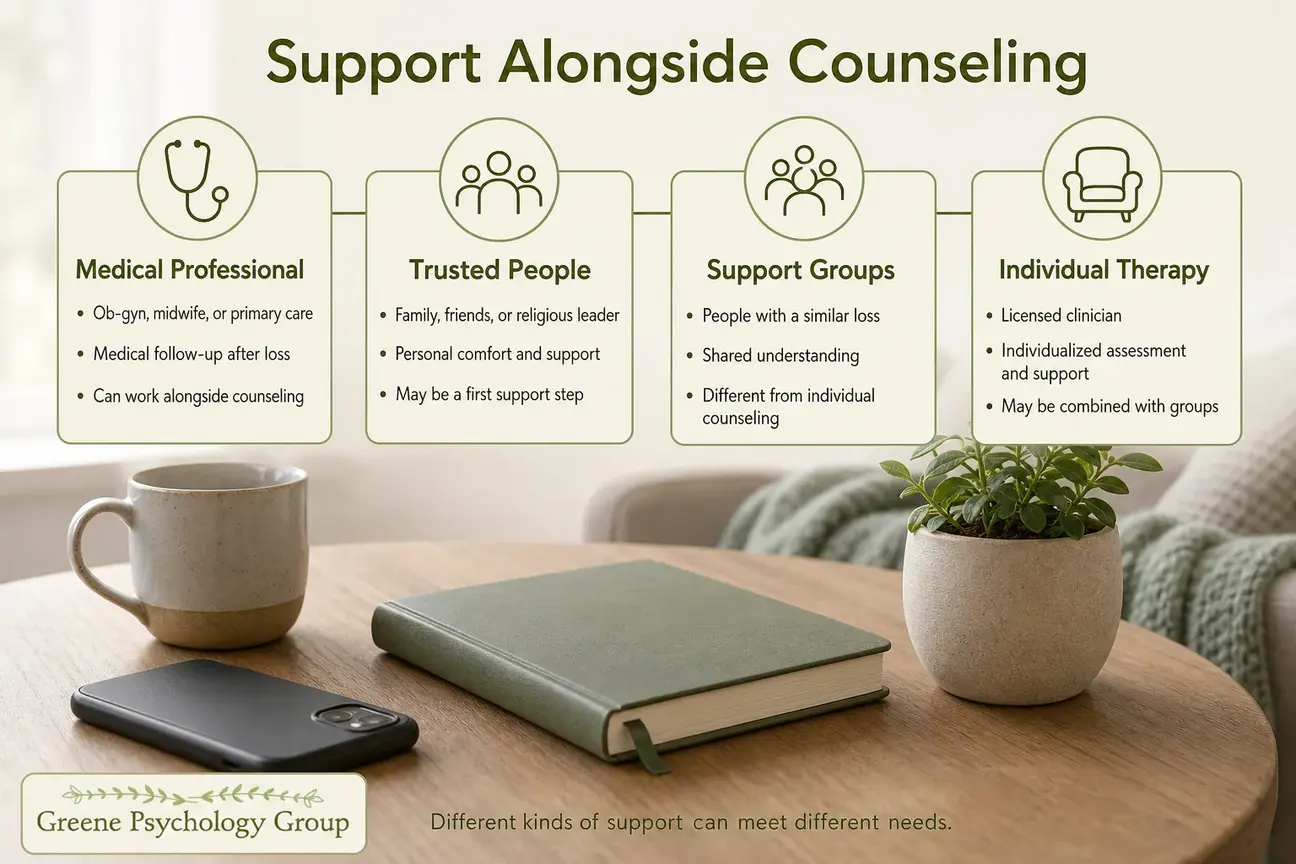
Therapy is one possible support after pregnancy loss, but it is not the only one. Some people start with an ob-gyn, midwife, primary care clinician, or other medical professional. Others talk with trusted family members, close friends, a religious leader, or people who have had a similar loss. Different kinds of support can meet different needs.
Support groups may be helpful for people who want to hear from others who understand the experience in a personal way. A group is different from individual counseling; it may offer shared understanding, while therapy may offer more individualized assessment and support. Some people benefit from both. Others prefer one private support person rather than a group setting.
Couples counseling may be an option when partners are grieving differently, arguing more often, avoiding the topic, or feeling disconnected. This does not mean the relationship is failing. Pregnancy loss can put pressure on communication, intimacy, family planning, and daily routines. Couples counseling is not offered by every clinician, so it is important to ask whether that format is available and appropriate.
Friends and family can help by listening without trying to explain the loss away. Practical support, such as meals, childcare, transportation, or help with daily tasks, can also matter. For someone grieving, it may help to ask for one concrete thing rather than trying to explain everything at once. For loved ones, it may help to say, “I’m here and I can listen,” rather than searching for the perfect words.
Pregnancy loss grief can also interact with work, parenting, caregiving, and social expectations. Support may include deciding what to tell an employer, whether to attend a baby shower, how to respond to questions, or how to handle reminders at home. Therapy can help with these decisions, but trusted people in daily life may also be part of the support system.
Online and in-person therapy considerations
Some people prefer in-person therapy because it gives them a separate place to sit with what happened. Others prefer online therapy because leaving home feels difficult, schedules are complicated, or privacy can be arranged more easily at home. Neither format is automatically better for everyone. The right fit depends on safety, privacy, technology, comfort, symptoms, and the clinician’s availability and scope.
Greene Psychology Group offers individual therapy for adults and adolescents and mental health therapy for a range of concerns. The practice also offers online therapy in North Carolina for clients who are physically in the state during the session. Readers should ask directly whether a clinician works with pregnancy-loss concerns and whether the preferred format is available.
If partner communication is a central concern, relationship counseling may be worth asking about. If anxiety or depression symptoms are prominent, it may also help to ask how the clinician assesses those concerns and whether anxiety therapy or depression treatment is an appropriate fit. A linked service page does not mean every clinician provides pregnancy-loss or perinatal grief therapy, so asking about fit remains important.
Privacy is part of the practical decision. For online sessions, a private space is needed for speaking freely and safely. For in-person sessions, transportation, timing, and emotional readiness to leave home may matter. If a session brings up intense feelings, consider what support or grounding may be useful afterward.
How to contact Greene Psychology Group for individual therapy
If counseling after miscarriage, stillbirth, or another pregnancy loss feels worth exploring, you can contact Greene Psychology Group to ask about scheduling and fit. You may call 919-205-5339 or email [email protected]. Because phone issues may affect the practice, it is helpful to keep both contact options available.
When reaching out, share your name, contact information, a brief reason for seeking therapy, whether Raleigh, Asheville, or online sessions are preferred, and insurance information if insurance will be used. Please do not send detailed health information through email or the contact form. The contact form and email are not the place for a full history, medical records, or sensitive details.
Greene Psychology Group is in network with most BCBS and Aetna plans, out of network for most other plans, and accepts self-pay clients. Coverage can vary by plan, so confirm benefits with both the insurer and the practice. You can also review the practice’s insurance and payment information. Do not assume a specific plan is covered until it has been verified.
Reaching out does not create an obligation to start therapy, and it does not guarantee that a specific clinician, format, or specialty service is available. It is simply a step toward asking whether the practice may be a fit for current needs.
What to expect emotionally when talking about the loss
Many people worry that therapy will make them feel worse by bringing up painful memories. It is possible to feel more emotional after beginning to talk, especially when everything has been held in. A thoughtful therapist should help pace the conversation, check in about what feels manageable, and support coping before going deeper into painful material.
Perinatal grief therapy or pregnancy loss counseling may include silence, tears, anger, uncertainty, or moments without words. There is no need to perform grief for a therapist. There is no need to prove that the loss mattered. Grief can also include mixed emotions, including love, sadness, anger, fear, numbness, and moments of relief from distress.
Miscarriage support and stillbirth mental health care may also involve identifying what helps outside the session. That could include routines, boundaries, rest, supportive conversations, grounding skills, medical follow-up, or reducing exposure to situations that feel overwhelming while capacity builds. Coping skills are not meant to minimize the loss. They are meant to help someone get through difficult moments with more support.
Counseling after pregnancy loss may also help with future stress points. These might include returning to work, seeing pregnant friends, attending family events, receiving medical news, or considering another pregnancy. Preparation does not remove pain, but it can make distress feel less unexpected and less isolating.
7 gentle ways therapy can help after pregnancy loss
These seven supports are not treatment instructions, and they will not fit every person. They are examples of what counseling may help with when grief, anxiety, trauma reminders, or relationship strain feel difficult to carry alone. Use what feels relevant and leave what does not.
1. Make room for grief without requiring a “right” reaction
A therapist can help create space for sadness, numbness, anger, guilt, fear, relief, confusion, or love without deciding which feeling is acceptable. Pregnancy loss grief may shift hour to hour. Counseling can help a person notice those shifts without treating them as failure or proof that grief is being done incorrectly.
2. Slow down guilt, self-blame, and unanswered questions
After miscarriage or stillbirth, the mind may search for a reason, even when clear answers are not available. A therapist can help explore guilt gently, identify repeated thought loops, and separate emotional pain from medical questions that belong with an ob-gyn or other qualified medical professional.
3. Support communication with a partner or family
Pregnancy loss can make conversations feel loaded. Therapy may help someone decide what to share, what to keep private, and how to set boundaries around unwanted questions. When partners grieve differently, counseling may help clarify needs and reduce the assumption that different coping styles mean a lack of care.
4. Prepare for reminders, anniversaries, and medical appointments
Due dates, holidays, pregnancy announcements, baby showers, medical visits, or future pregnancy conversations can bring grief back sharply. Therapy may help a person plan for these moments, identify supportive people, and choose boundaries that fit their capacity.
5. Notice trauma-related responses without rushing trauma processing
For some people, pregnancy loss includes frightening medical memories, nightmares, flashbacks, panic-like sensations, or avoidance. Therapy can help with grounding, stabilization, and understanding triggers before deeper trauma work is considered. No one should be pushed to describe painful details before they feel ready enough and supported enough.
6. Clarify what other support belongs nearby
A therapist may help someone think through whether a support group, medical follow-up, couples counseling, psychiatric evaluation, workplace support, or trusted family support could be useful. Perinatal grief therapy does not have to stand alone. Different kinds of care can meet different needs.
7. Identify when distress needs more urgent help
Therapy may help someone recognize when grief has become harder to manage safely, especially if hopelessness, impaired functioning, thoughts of self-harm, or feeling unable to stay safe are present. Routine counseling is not crisis care, so immediate safety concerns need emergency or crisis support rather than waiting for a scheduled appointment.
These supports are not a substitute for professional assessment when distress is persistent, intense, or affecting safety. They are a way to understand how counseling can be used thoughtfully after loss. If pregnancy loss grief feels unmanageable, asking for help is a reasonable and compassionate step.
Crisis support after pregnancy loss
Greene Psychology Group is not a crisis service. If immediate danger is present, call 911 or go to the nearest emergency room. If there is a mental-health or suicidal crisis, call or text 988 or use the 988 Lifeline chat. SAMHSA describes 988 as a resource for people experiencing suicidal, mental-health, or substance-use-related crisis. Crisis support is not the same as ongoing therapy, but it can help connect someone with immediate support when safety cannot wait.
If concern is focused on someone else after a pregnancy loss, take signs of immediate danger seriously. Stay with the person if it is safe to do so, reduce delays in getting help, and contact emergency or crisis resources. Avoid debating whether their pain is “serious enough.” Safety concerns deserve prompt support.
A gentle closing thought
Pregnancy loss can leave a person carrying grief, unanswered questions, body memories, fear, and love with nowhere obvious to put them. Therapy after pregnancy loss is one possible place to bring those experiences. It may help with understanding reactions, considering coping options, and deciding what support belongs nearby. It does not require grief to fit a script, and it does not promise a fixed outcome.
If perinatal grief therapy, miscarriage support, or help with stillbirth mental health concerns feels worth exploring, it is okay to ask careful questions before choosing a clinician. Support should respect the loss, the complexity of the emotions involved, and the pace that feels right.
This article is for general education and isn't a substitute for diagnosis or treatment from a licensed professional. If you are in crisis, call or text 988 or call 911.
For immediate danger, call 911 or go to the nearest emergency room. For a mental-health or suicidal crisis, call or text 988 or use the 988 Lifeline chat.
Frequently Asked Questions
Is it normal to still feel grief after a miscarriage or stillbirth?
Yes. Grief after miscarriage, stillbirth, or another pregnancy loss can last longer than physical recovery and may change over time. Some people feel intense sadness right away, while others feel numb, delayed grief, anger, guilt, or waves of emotion around reminders. Partners may also grieve differently.
When should someone consider therapy after pregnancy loss?
Therapy may be worth considering when grief, anxiety, low mood, trauma-related experiences, relationship strain, or difficulty functioning feels hard to manage. There is no need to wait until things feel unbearable. A licensed clinician can help assess what is happening and discuss support options.
Can therapy diagnose depression, anxiety, or trauma after pregnancy loss?
A licensed clinician can assess whether symptoms may reflect grief, depression, anxiety, trauma-related concerns, another condition, or overlapping experiences. An article, checklist, or symptom list cannot diagnose anyone. Medical concerns should also be discussed with an ob-gyn or another qualified medical professional.
What can a therapist help with after pregnancy loss?
A therapist may help with processing emotions, understanding changes in sleep or daily functioning, exploring guilt or fear, communicating with a partner, coping with reminders, and deciding whether additional support or referral is appropriate. Therapy should be collaborative and paced to the person’s needs.
What if my partner and I are grieving differently?
Different grief responses are common. One partner may want to talk often while another copes privately or stays busy. Individual support, shared conversations, support groups, or couples counseling may help when communication feels strained. Ask a prospective clinician whether couples work is available and appropriate.
Does every therapist provide pregnancy-loss or perinatal grief counseling?
No. Therapists vary in training, experience, and scope. Before scheduling, ask whether the clinician works with miscarriage, stillbirth, pregnancy loss grief, anxiety, depression, trauma-related responses, or fertility-related stress. It is appropriate to ask about fit before beginning therapy.
Can online therapy help after pregnancy loss?
Online therapy is one possible format, but it depends on the person’s needs, privacy, technology, safety, and preferences. Some people prefer in-person support, while others prefer teletherapy. For Greene Psychology Group, online sessions are for people physically in North Carolina during the session.
What should I do if I am in immediate danger or having a suicidal crisis?
For immediate danger, call 911 or go to the nearest emergency room. For a mental-health or suicidal crisis, call or text 988 or use the 988 Lifeline chat. Greene Psychology Group is not a crisis service, so crisis concerns should not wait for a routine therapy appointment.