

If you are reading this, you may have already achieved a great deal in your life—perhaps a successful career, a loving family, or meaningful accomplishments—yet still feel that something is off. Maybe you are your own harshest critic, constantly setting impossibly high standards and then beating yourself up when you fall short. Maybe you say "yes" to everyone else's requests while your own needs go unmet. Maybe you feel stuck in the same frustrating patterns—in relationships, at work, or in how you treat yourself—and you are tired of repeating the same mistakes.
Here is the truth that self‑improvement culture often hides from you: willpower and motivation are not enough. You cannot think your way out of patterns that were shaped by years of experience, conditioning, and deeply held beliefs. Real change requires understanding why you do what you do—and then learning new skills, not just trying harder.
Self‑improvement therapy is not about "fixing" something that is broken. It is about clarifying what matters to you, removing the internal obstacles that get in the way, and building the confidence to live in alignment with your values.
Greene Psychology Group offers evidence‑based self‑improvement therapy in Raleigh, NC, using Cognitive Behavioral Therapy (CBT), Acceptance and Commitment Therapy (ACT), and mindfulness‑based approaches. This guide is a complete, research‑backed overview: what self‑improvement therapy actually is, how it differs from "self‑help," the specific skills you will learn, and how to find the right support.
Part 1: What Self‑Improvement Therapy Actually Is – Beyond "Self‑Help"
The self‑help industry is a multi‑billion dollar machine. Books, podcasts, apps, and influencers promise transformation—if you just read the right book, follow the right system, or adopt the right morning routine. And yet, most people who consume self‑help content find themselves still struggling with the same patterns years later.
Self‑Help vs. Self‑Improvement Therapy
| Self‑Help | Self‑Improvement Therapy |
|---|---|
| One‑size‑fits‑all advice | Personalized to your unique history, values, and goals |
| Focus on motivation and willpower | Focus on understanding patterns and building skills |
| Surface‑level solutions | Addresses root causes (beliefs, conditioning, nervous system regulation) |
| No accountability | Structured support with a trained professional |
| Can create shame ("Why can't I just do it?") | Creates self‑compassion and realistic expectations |
What Self‑Improvement Therapy Is
Self‑improvement therapy is a structured, evidence‑based process that helps you:
Clarify your values: What truly matters to you—not what you should want, but what you actually want?
Identify patterns: What beliefs, habits, or emotional responses are keeping you stuck?
Build skills: Learn practical tools to change behavior, regulate emotions, and communicate effectively.
Develop self‑compassion: Replace harsh self‑criticism with a more balanced, supportive inner voice.
Create sustainable change: Not quick fixes, but lasting shifts that align with your goals.
Who Benefits from Self‑Improvement Therapy?
You do not need a diagnosable mental health condition to benefit from self‑improvement therapy. Many people seek it for:
Perfectionism and impostor syndrome
People‑pleasing and difficulty setting boundaries
Procrastination and lack of motivation
Career transitions and identity shifts
Relationship patterns (choosing unavailable partners, conflict avoidance)
Low self‑esteem and self‑criticism
Feeling "stuck" or unfulfilled despite external success
Research from Harvard Medical School has shown that structured, goal‑oriented therapy produces significant improvements in life satisfaction, self‑esteem, and goal attainment—even for individuals without clinical diagnoses.
Part 2: The Science of Change – Why We Stay Stuck
Before we talk about how to change, it helps to understand why change is so hard.
The Neuroscience of Habit and Pattern
Your brain is wired for efficiency. Repeated thoughts and behaviors create neural pathways—like trails in a forest. The more you walk a trail, the clearer and easier it becomes. This is why patterns (even painful ones) feel so automatic. Your brain is not trying to sabotage you; it is trying to save energy.
The problem: The pathways that helped you survive in the past may no longer serve you. The perfectionism that helped you get straight A's may now be causing burnout. The people‑pleasing that kept you safe in childhood may now be eroding your sense of self.
The Role of Beliefs
Your behaviors are driven by beliefs—often unconscious ones. Common beliefs that keep people stuck include:
| Belief | How It Shows Up |
|---|---|
| "I'm not good enough." | Perfectionism, impostor syndrome, avoiding challenges |
| "I don't deserve success/happiness." | Self‑sabotage, settling for less, difficulty accepting praise |
| "If I say no, people will reject me." | People‑pleasing, overcommitment, resentment |
| "I should be able to handle this on my own." | Refusing help, isolation, burnout |
| "Mistakes are unacceptable." | Paralysis, procrastination, harsh self‑criticism |
The good news: Beliefs are not facts. They are learned—and they can be unlearned. Self‑improvement therapy helps you identify these beliefs, test their accuracy, and replace them with more helpful alternatives.
Research from Stanford University's Department of Psychology has shown that "growth mindset" interventions—helping people see their abilities as developable rather than fixed—produce significant improvements in motivation, resilience, and achievement.
Part 3: The Core Pillars of Self‑Improvement Therapy
At Greene Psychology Group, self‑improvement therapy is built on four core pillars.
Pillar 1: Cognitive Restructuring (CBT)
Your thoughts shape your feelings and behaviors. If you constantly tell yourself "I'm not good enough," you will feel anxious and avoid challenges. Cognitive restructuring helps you:
Identify automatic negative thoughts
Examine the evidence for and against them
Develop more balanced, realistic alternatives
Example:
Automatic thought: "I'm going to mess up this presentation and everyone will think I'm incompetent."
Evidence for: "I've felt nervous before presentations."
Evidence against: "I have prepared thoroughly. I have given successful presentations before. Even if I stumble, people will not think less of me."
Balanced thought: "I'm nervous, but I am prepared. I can handle this."
Pillar 2: Behavioral Activation
Change does not start with feeling ready—it starts with action. Behavioral activation helps you:
Identify activities that align with your values
Schedule them, even when you do not "feel like it"
Build momentum through small, achievable steps
The key insight: Motivation often follows action, not the other way around. You do not wait to feel motivated; you act, and motivation follows.
Pillar 3: Mindfulness and Self‑Compassion
Self‑improvement without self‑compassion is just self‑criticism in disguise. Mindfulness helps you:
Notice your patterns without judgment
Observe your thoughts as mental events, not facts
Respond to yourself with kindness rather than harshness
Research from UNC Chapel Hill's School of Social Work has shown that self‑compassion—treating yourself with the same kindness you would offer a friend—is a stronger predictor of wellbeing than self‑esteem.
Pillar 4: Values Clarification and Committed Action (ACT)
Acceptance and Commitment Therapy (ACT) helps you:
Clarify what truly matters to you (your values)
Identify the internal obstacles (fear, self‑doubt, avoidance) that keep you from living those values
Take committed action—small, purposeful steps toward the life you want
The question is not: "How do I feel better?"
The question is: "What kind of life do I want to live—and what is getting in the way?"
At Greene Psychology Group, we integrate CBT, mindfulness therapy, and values‑based approaches to help you create lasting change.
Part 4: What a Self‑Improvement Therapy Session Looks Like
If you are new to self‑improvement therapy, you might wonder what happens in a session. Here is a typical structure.
Typical Session Structure (50 minutes)
| Time | Activity |
|---|---|
| 0–10 min | Check‑in: "How has your week been? Any progress on your goals? Any challenges?" |
| 10–30 min | Active work: Identifying a pattern, practicing a new skill, challenging a belief, or planning a behavioral experiment |
| 30–40 min | Processing: "What did you notice? What did you learn about yourself?" |
| 40–45 min | Planning: "What will you practice between now and next session?" |
| 45–50 min | Homework assignment: Specific, actionable steps to take before the next session |
What You Will NOT Experience
Judgment: Your therapist is not there to judge you. They are there to help you understand yourself.
Vague advice: You will leave each session with specific, actionable steps.
Pressure to be "positive": You will learn to accept your full range of emotions—not pretend they do not exist.
The Role of Homework
Self‑improvement therapy is not something that happens only in the therapy room. Between‑session practice is essential. Your therapist will give you specific assignments—thought records, behavioral experiments, mindfulness practices—that help you build skills in real life.
Part 5: Common Patterns Self‑Improvement Therapy Addresses
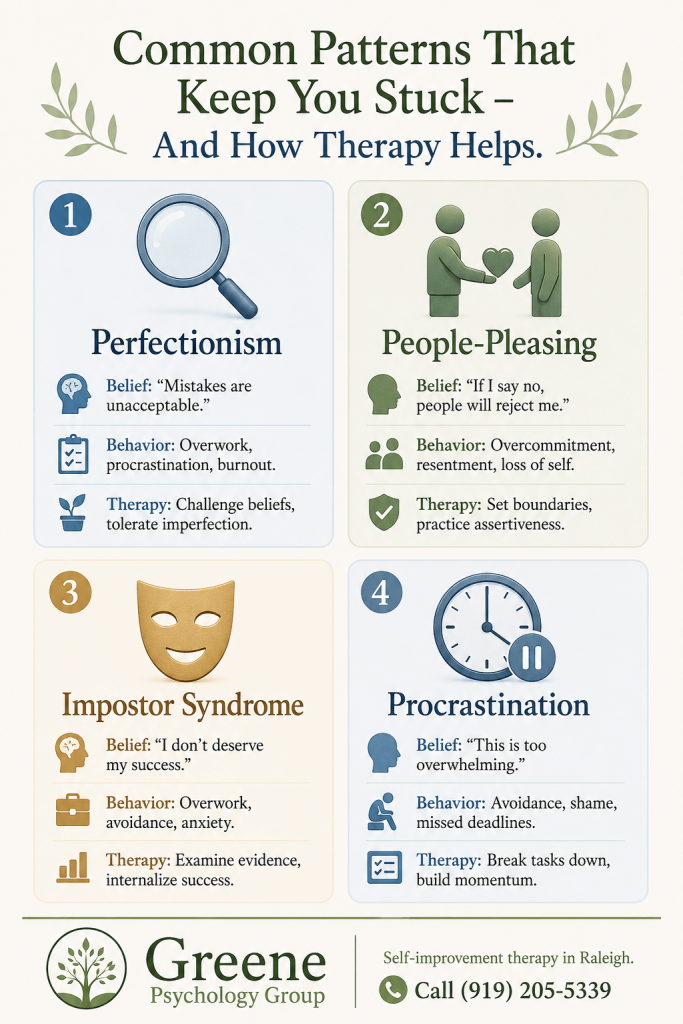
Perfectionism
Perfectionism is not about high standards—it is about fear of failure, fear of judgment, and an inability to accept imperfection. It leads to procrastination, burnout, and chronic dissatisfaction.
Therapy targets:
Identifying the beliefs driving perfectionism ("If I make a mistake, I am a failure")
Learning to tolerate imperfection
Setting realistic, achievable goals
Celebrating progress, not just outcomes
People‑Pleasing
People‑pleasing is not kindness—it is fear of rejection, conflict avoidance, and a belief that your worth depends on others' approval. It leads to resentment, exhaustion, and loss of self.
Therapy targets:
Identifying the beliefs driving people‑pleasing ("If I say no, people will reject me")
Learning to set boundaries
Practicing assertive communication
Tolerating others' discomfort
Impostor Syndrome
Impostor syndrome is the belief that you do not deserve your success—that you are a fraud who will eventually be "found out." It leads to anxiety, overwork, and avoidance of new challenges.
Therapy targets:
Identifying the beliefs driving impostor syndrome ("I'm not really qualified")
Examining the evidence (you are qualified)
Learning to internalize success
Taking risks despite fear
Procrastination
Procrastination is not laziness—it is avoidance of discomfort. You avoid tasks because they feel overwhelming, boring, or anxiety‑provoking.
Therapy targets:
Identifying the discomfort driving procrastination
Breaking tasks into small, manageable steps
Using behavioral activation to build momentum
Tolerating discomfort without avoidance
Part 6: Self‑Improvement Therapy vs. Other Approaches – How to Choose
| Factor | Self‑Improvement Therapy | Coaching | Self‑Help |
|---|---|---|---|
| Training | Licensed mental health professional | Varies (often unregulated) | None |
| Addresses root causes | Yes (beliefs, conditioning, patterns) | Sometimes (surface level) | Rarely |
| Accountability | Structured, regular sessions | Varies | None |
| Evidence‑based | Yes | Rarely | Rarely |
| Best for | Deep patterns, self‑criticism, perfectionism, impostor syndrome | Goal setting, accountability for already‑functional individuals | Inspiration, basic information |
The bottom line: If you have tried self‑help and coaching and still feel stuck, self‑improvement therapy may be the missing piece. It addresses the root causes—not just the surface symptoms.
Part 7: How to Find a Self‑Improvement Therapist in Raleigh – What to Look For
Not all therapists are trained in self‑improvement or personal growth work. Finding the right fit matters.
What to Look For
Training in evidence‑based approaches: CBT, ACT, mindfulness, or other structured modalities
Experience with your specific concerns: Perfectionism, people‑pleasing, impostor syndrome, procrastination
Goal‑oriented approach: You should leave sessions with clear, actionable steps
Warmth and collaboration: You should feel like a partner in the process, not a passive recipient
Questions to Ask Before Booking
Do you work with clients on personal growth, self‑improvement, or life transitions?
What approaches do you use (CBT, ACT, mindfulness)?
Do you assign between‑session homework?
What is your experience with [your specific concern—e.g., perfectionism, impostor syndrome]?
Red Flags
"I can fix your life in 6 sessions" (unrealistic)
No license or using a coaching credential only
No clear approach or structure
No homework or between‑session practice
At Greene Psychology Group, our therapists are licensed and trained in evidence‑based approaches including CBT, ACT, and mindfulness. Contact us for a consultation.
Part 8: Putting It All Together – Three Self‑Improvement Archetypes
Archetype A: The Perfectionist Professional
Presentation: 34‑year‑old, successful in career but constantly anxious. Spends hours revising emails, cannot delegate, feels like a fraud. Has been passed over for promotion despite excellent performance.
Bottleneck: Perfectionism and impostor syndrome.
Treatment map: 12 sessions of CBT → Identify beliefs: "If I make a mistake, I am a failure" → Behavioral experiments: delegate a task, submit work without excessive revision → At 12 weeks, reports "I still have high standards, but I don't torture myself anymore."
Archetype B: The People‑Pleaser
Presentation: 42‑year‑old, always says yes to everyone. Overcommitted, exhausted, resentful. Has not taken a real vacation in years. Feels like she has lost herself.
Bottleneck: People‑pleasing and boundary difficulties.
Treatment map: 12 sessions of CBT + assertiveness training → Identify beliefs: "If I say no, people will reject me" → Practice assertive scripts: "I'm not able to take that on right now" → Tolerate others' discomfort → At 12 weeks, reports "I still feel uncomfortable saying no, but I do it anyway—and the world hasn't ended."
Archetype C: The Procrastinator
Presentation: 28‑year‑old, intelligent and capable but chronically procrastinates. Has failed to complete multiple projects. Feels shame and self‑loathing. Avoids starting anything new.
Bottleneck: Procrastination driven by fear of failure and perfectionism.
Treatment map: 12 sessions of CBT + behavioral activation → Identify avoidance patterns → Break tasks into tiny, achievable steps → Practice tolerating discomfort without avoiding → At 12 weeks, reports "I still procrastinate sometimes, but I catch myself earlier and get started anyway."
You do not have to stay stuck in the same patterns forever. Self‑improvement therapy in Raleigh, NC, using CBT, ACT, and mindfulness, can help you build confidence, break unhelpful patterns, and create lasting change. Call Greene Psychology Group at (919) 205-5339 or schedule an appointment online. We offer self‑improvement therapy, evening appointments, and free insurance verification. Same‑week availability for new clients.
FAQs
Self‑improvement therapy is a structured, evidence‑based process that helps you clarify your values, identify unhelpful patterns, build skills, and create lasting change—without needing a clinical diagnosis.
Self‑help is one‑size‑fits‑all advice. Self‑improvement therapy is personalized, addresses root causes, and provides structured support and accountability.
No. Many people seek self‑improvement therapy for personal growth, life transitions, or pattern change without a clinical diagnosis.
Common approaches include CBT (cognitive restructuring), ACT (values clarification), behavioral activation, and mindfulness.
Most people see significant progress in 12–16 sessions. Some continue longer for deeper work.
Yes. CBT for perfectionism helps you identify the beliefs driving perfectionism, tolerate imperfection, and set realistic goals.
Yes. Therapy helps you examine the evidence for and against your beliefs about yourself and learn to internalize success.
Yes, in most cases. Self‑improvement therapy is typically covered when delivered by a licensed mental health professional. Greene Psychology Group accepts major insurance plans.
Yes. Research shows that CBT and ACT can be effectively delivered via telehealth. Greene Psychology Group offers online therapy.
That is common. Self‑help often addresses symptoms, not root causes. Therapy provides the structure, personalization, and accountability that self‑help lacks.
Look for a licensed therapist with training in evidence‑based approaches like CBT or ACT. Ask about their experience with personal growth and pattern change.
Yes. Many people combine self‑improvement therapy with medication, couples counseling, or other treatments. Your therapist will help you coordinate care.
Sources
Duke University Department of Psychiatry – CBT for personal growth
UNC Chapel Hill School of Social Work – Self‑compassion research
Johns Hopkins Bloomberg School of Public Health – Behavioral activation
Stanford University Department of Psychology – Growth mindset interventions
National Institute of Mental Health (NIMH) – Psychotherapies