
If you are reading this, you are probably in the middle of a significant life change. Maybe you have just graduated and are entering the workforce for the first time. Maybe you have been laid off or are starting a new job. Maybe you are moving to a new city, getting married, going through a divorce, or becoming a parent for the first time. Maybe you have lost a loved one, or your children have left home, and you are wondering who you are now.
Life transitions are inevitable. They are also one of the most common triggers for anxiety, depression, and stress. Even positive changes – like a promotion, a wedding, or the birth of a child – can be overwhelming. Your brain craves predictability, and change, even good change, disrupts that predictability.
Here is the truth that life transitions try to hide from you: you are not supposed to have it all figured out. Transitions are inherently disorienting. They involve loss (of the old) and uncertainty (about the new). And while some discomfort is normal, prolonged distress is a signal that you may need support.
Greene Psychology Group in Raleigh, NC, offers evidence‑based therapy for life transitions, using Cognitive Behavioral Therapy (CBT), Acceptance and Commitment Therapy (ACT), and mindfulness‑based approaches. This guide is a complete, research‑backed overview: the psychology of life transitions, common challenges, how therapy can help, and how to find the right support.
Part 1: The Psychology of Life Transitions – Why Change Is So Hard
Life transitions are not just external events. They are internal processes that affect your identity, your relationships, and your sense of purpose.
The Three Phases of Transition (Based on William Bridges' Model)
1. The Ending (Letting Go)
Before you can move forward, you must let go of the old. This is often the hardest part. It involves grieving what you are leaving behind – even if you are leaving something negative.
2. The Neutral Zone (The In‑Between)
This is the disorienting space between the old and the new. You are not who you used to be, but you are not yet who you will become. This is where uncertainty, confusion, and anxiety thrive.
3. The New Beginning (Moving Forward)
You have integrated the change. You have a new sense of identity, new routines, and new meaning. You feel grounded again.
Why Transitions Are So Stressful
Research from Harvard Medical School has shown that major life transitions activate the brain's stress response system. The amygdala (fear center) becomes hyperactive, and the prefrontal cortex (which regulates emotion) becomes less effective. This is why you may feel more irritable, anxious, or overwhelmed during transitions.
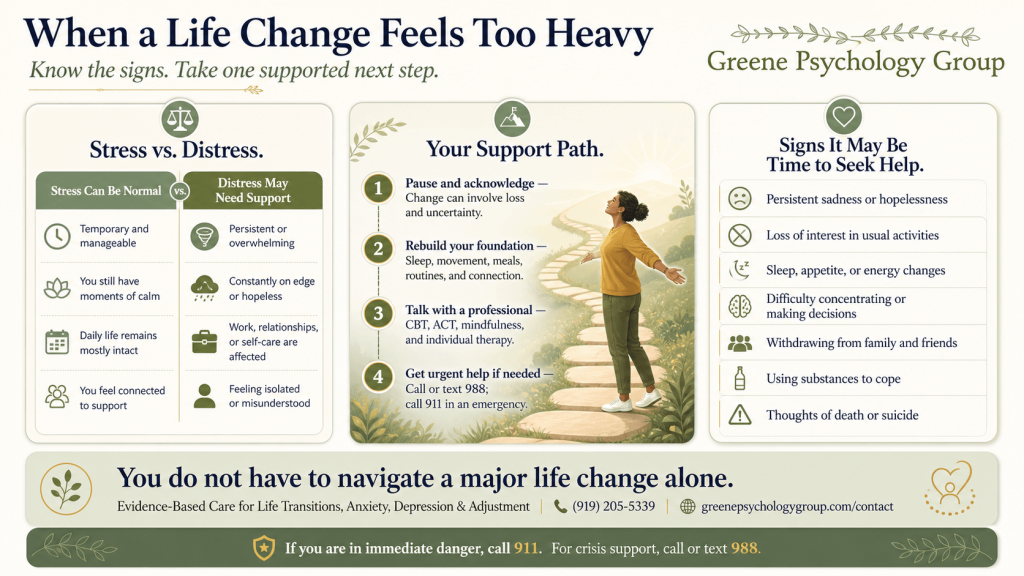
The Difference Between Stress and Distress
| Stress (Normal) | Distress (Needs Support) |
|---|---|
| Temporary, manageable | Persistent, overwhelming |
| Does not impair daily functioning | Interferes with work, relationships, or self‑care |
| You can still find moments of peace | You feel constantly on edge or hopeless |
| You have support systems | You feel isolated or misunderstood |
If your distress is persistent, it is time to seek help.
Part 2: Common Life Transitions – And Their Unique Challenges
1. Career Transitions
Starting a new job: Excitement mixed with fear of failure, impostor syndrome, and the stress of learning new systems
Job loss: Grief, shame, financial stress, and loss of identity
Retirement: Loss of purpose, social isolation, and the challenge of finding new meaning
2. Relationship Transitions
Getting married: Navigating merging lives, managing expectations, and adjusting to new roles
Divorce or separation: Grief, anger, loss of identity, parenting challenges, and financial stress
Becoming a parent: Sleep deprivation, identity shift, relationship strain, and the overwhelming responsibility of caring for a new life
3. Health Transitions
Chronic illness diagnosis: Grief, fear, uncertainty, and the challenge of adapting to new limitations
Injury or disability: Loss of function, identity shift, and the challenge of rebuilding
Aging: Loss of independence, grief over physical changes, and confronting mortality
4. Relocation and Environmental Changes
Moving to a new city: Loss of social network, navigating unfamiliar systems, and the stress of finding community
Children leaving home (empty nest): Loss of purpose, identity shift, and redefining your relationship with your partner
5. Developmental Transitions
Adolescence: Identity formation, peer pressure, academic stress, and the push‑pull of independence
Young adulthood: Graduation, career decisions, dating, and the challenge of building a life
Midlife: Reassessing priorities, confronting mortality, and potential relationship strain
Later life: Loss of loved ones, health decline, and the search for meaning
Research from UNC Chapel Hill shows that people who experience multiple significant life transitions within a short period are at higher risk of depression and anxiety.
Part 3: The Transition Cycle – Why It Keeps You Stuck
Life transitions operate on a predictable cycle. Understanding this cycle is the first step to breaking free.
The Cycle
Trigger: A life change occurs – a job loss, a move, a relationship change.
Loss of Familiarity: You lose the routines, roles, and relationships that provided stability.
Anxiety/Uncertainty: You feel disoriented and anxious about the future.
Avoidance: You avoid making decisions or taking steps forward.
Temporary Relief: Avoidance provides short‑term relief – but it also keeps you stuck.
Reinforcement: The anxiety grows, and you feel even less capable of moving forward.
The Role of Identity
Transitions are so hard because they challenge your sense of identity. When you lose a job, you may lose the identity of "worker." When you become a parent, you may lose the identity of "free individual." When your children leave home, you may lose the identity of "parent."
Therapy helps you separate who you are from what you do.
Part 4: Evidence‑Based Therapies for Life Transitions
Cognitive Behavioral Therapy (CBT)
CBT is one of the most effective therapies for navigating life transitions. It targets the negative thoughts and behaviors that keep you stuck.
How CBT works for life transitions:
1. Cognitive Restructuring
You learn to identify and challenge unhelpful thoughts. "I'll never find another job" becomes "The job market is competitive, but I have skills that are valuable."
2. Behavioral Activation
You learn to engage in activities that bring you a sense of purpose and connection – even when you do not feel like it.
3. Problem‑Solving Therapy
You learn to break overwhelming problems into manageable steps.
Acceptance and Commitment Therapy (ACT)
ACT is particularly helpful for life transitions because it helps you accept uncertainty while moving toward what matters to you.
Core ACT skills:
Acceptance: Making room for difficult emotions without trying to push them away
Cognitive Defusion: Watching your thoughts as mental events, not facts
Values Clarification: Identifying what truly matters to you
Committed Action: Taking small, purposeful steps toward your values
Mindfulness‑Based Therapy
Mindfulness helps you stay grounded in the present moment, rather than getting lost in worry about the future or rumination about the past.
At Greene Psychology Group, we offer CBT, mindfulness therapy, and individual therapy for life transitions.
Part 5: What a Therapy Session for Life Transitions Looks Like
If you are new to therapy for life transitions, you might wonder what happens in a session.
Typical Session Structure (50 minutes)
| Time | Activity |
|---|---|
| 0–10 min | Check‑in: "How has your week been? Any progress on your goals? Any challenges?" |
| 10–30 min | Active work: Exploring the transition, identifying fears and hopes, planning next steps |
| 30–40 min | Processing: "What did you learn about yourself? What do you want to hold onto?" |
| 40–45 min | Planning: "What is one small step you can take this week?" |
| 45–50 min | Homework assignment: Specific, achievable actions |
What You Will NOT Experience
Judgment: Your therapist has worked with many people in transition. They understand.
Pressure: You set the pace. You decide what to explore and when.
Empty reassurances: You will learn practical skills, not just "feel better" platitudes.
Part 6: Practical Strategies for Navigating Life Transitions – What You Can Do Today
1. Acknowledge the Loss
Before you can move forward, you must honor what you are leaving behind. This is not about dwelling – it is about acknowledging.
Write a goodbye letter: To the job, the relationship, the city, or the version of yourself you are leaving behind.
Create a ritual: A small ceremony, a walk, a moment of silence.
2. Focus on What You Can Control
Transitions are full of uncertainty. Instead of worrying about what you cannot control, focus on what you can.
Your actions: What small steps can you take today?
Your attitude: How can you be kind to yourself through this process?
3. Build a New Routine
Routines provide stability. Create a new routine that supports your wellbeing.
Morning routine: A consistent wake‑up time, movement, and nutrition
Evening routine: Wind‑down time, reflection, and preparation for the next day
4. Connect with Others
Transitions are isolating. Make a point to connect – even if it feels hard.
Reach out: Call a friend, join a group, or attend a community event
Be honest: Let people know you are going through a transition
5. Practice Self‑Compassion
Be kind to yourself. Transitions are hard. You are allowed to struggle.
Instead of: "I should be handling this better."
Try: "This is hard, and it makes sense that I am struggling."
Part 7: When to Seek Professional Help – The Warning Signs
If your transition is interfering with your ability to function, it is time to seek professional help.
Red Flags
Persistent sadness or hopelessness lasting more than two weeks
Loss of interest in activities you once loved
Significant changes in sleep, appetite, or energy
Difficulty concentrating or making decisions
Withdrawal from friends and family
Thoughts of death or suicide
Substance use to cope with the transition
What to Do
Talk to someone you trust. You are not alone.
Seek professional help. Contact Greene Psychology Group at (919) 205-5339 or schedule an appointment.
In a crisis: Call 988 or Alliance Health Mobile Crisis at (800) 510-9132.
Part 8: Raleigh‑Specific Resources for Life Transitions
Crisis and Urgent Support
988 Suicide & Crisis Lifeline: Call or text 988
Alliance Health Mobile Crisis: (800) 510-9132 – 24/7, free
Career Support
NC Works Career Center: Job search assistance, career counseling, and training programs
Wake County Public Libraries: Career resources, classes, and networking events
Community Programs
Raleigh Parks and Recreation: Classes, groups, and community events
Wake County Community Services: Support for families, seniors, and individuals in transition
Outpatient Therapy (Greene Psychology Group)
We offer in‑person and online therapy for life transitions, anxiety, and depression. Contact us at (919) 205-5339.
Part 9: Putting It All Together – Three Transition Archetypes
Archetype A: The Career Changer
Presentation: 32‑year‑old, left a stable corporate job to start a business. Feeling anxious about finances, overwhelmed by the learning curve, and questioning the decision.
Bottleneck: Career transition with anxiety and self‑doubt.
Treatment map: 12 weeks of CBT → Identify thoughts: "I made a mistake" → Challenge with evidence: "I am learning and building something meaningful" → Behavioral activation: building a daily routine → At 12 weeks, reports "I still have anxiety, but I believe in what I am building."
Archetype B: The New Parent
Presentation: 29‑year‑old, first baby is 4 months old. Exhausted, overwhelmed, and feeling disconnected from partner. Struggling with identity shift.
Bottleneck: Transition to parenthood with relationship strain and identity loss.
Treatment map: 12 weeks of CBT + couples counseling → Explore the identity shift: "Who am I now?" → Partner communication: expressing needs and fears → Behavioral activation: carving out time for self‑care → At 12 weeks, reports "I feel more like myself, and my partner and I are communicating better."
Archetype C: The Empty Nester
Presentation: 55‑year‑old, youngest child left for college. Feeling lost, purposeless, and disconnected from partner. Uncertain about what comes next.
Bottleneck: Empty nest with loss of identity and relationship strain.
Treatment map: 12 weeks of individual therapy → Grief work: acknowledging the loss of the parenting identity → Values clarification: what matters now? → Re‑connecting with partner: exploring shared interests → At 12 weeks, reports "I still miss my kids, but I am excited about this next chapter."
The information provided in this blog is for educational and informational purposes only and is not intended as medical advice, diagnosis, or treatment. It does not create a therapist-patient relationship between you and Greene Psychology Group. Always seek the advice of a qualified mental health professional or physician with any questions you may have regarding a mental health condition. If you are in crisis or experiencing a medical emergency, please call 911 immediately or contact the 988 Suicide & Crisis Lifeline. For non-emergency mental health support, call Greene Psychology Group at (919) 205-5339 or visit our website to schedule an appointment.
Sources
Duke University Department of Psychiatry – Life transitions and mental health
Johns Hopkins Bloomberg School of Public Health – Life transitions and health
Stanford University Department of Psychology – Acceptance and Commitment Therapy for transitions
National Institute of Mental Health (NIMH) – Stress and life changes
FAQs
Therapy for life transitions is a structured, evidence‑based approach that helps you navigate major life changes, manage the associated stress, and build resilience.
Yes. Even positive changes – like a promotion, a wedding, or a move – can be stressful. Therapy helps you manage the stress and adjust to the new reality.
Cognitive Behavioral Therapy (CBT) and Acceptance and Commitment Therapy (ACT) are both highly effective for life transitions. They help you manage uncertainty, accept difficult emotions, and move toward what matters to you.
Most people see significant improvement in 12–16 sessions. Some need longer for more complex transitions.
ACT is a therapy that helps you accept difficult emotions while taking committed action toward your values. It is particularly helpful for navigating uncertainty.
Yes. Greene Psychology Group offers online therapy for life transitions, anxiety, and depression.
Many people experience depression during transitions. CBT can be adapted for both conditions. Medication may also be helpful.
Yes, in most cases. Life transitions can be addressed under diagnoses like adjustment disorder, anxiety, or depression. Greene Psychology Group accepts major insurance plans.
That is normal. Many people come to therapy without a clear goal. A skilled therapist will help you clarify what you want and need.
Look for a licensed therapist with training in CBT, ACT, or mindfulness. Greene Psychology Group offers evidence‑based therapy for life transitions – call (919) 205-5339.
Yes. Therapy helps you separate who you are from what you do. It helps you build a stronger, more flexible sense of self.
Acknowledge the change and allow yourself to feel the loss. Then, start by taking one small step toward what matters to you.
Life transitions are hard – but you do not have to navigate them alone. Evidence‑based therapy for life transitions in Raleigh, NC, using CBT, ACT, and mindfulness, can help you find meaning, build resilience, and move forward with confidence. Call Greene Psychology Group at (919) 205-5339 or schedule an appointment online. We offer individual therapy, evening appointments, and free insurance verification. Same‑week availability for new clients.