
If you are reading this, you may already know the quiet ache of loneliness. Maybe you live alone and the silence feels heavier some days. Maybe you are surrounded by people – at work, at home, at social events – yet still feel disconnected, unseen, or misunderstood. Maybe you have withdrawn from others because it feels easier than risking rejection, or because you have convinced yourself that no one would really understand.
Here is the truth that loneliness tries to hide from you: loneliness is not a failure. It is a signal. It is your brain's way of telling you that your need for social connection is not being met. And like hunger or thirst, it is a biological drive that, when ignored, can have serious consequences for your mental and physical health.
But here is the other truth: loneliness is not permanent. It is a state, not a trait. And with the right support and strategies, you can move through it toward meaningful connection.
August is National Loneliness Awareness Week, making it the perfect time to explore the profound impact of loneliness on mental health. Greene Psychology Group in Raleigh, NC, offers evidence‑based therapy for loneliness, anxiety, and depression, using Cognitive Behavioral Therapy (CBT), interpersonal therapy, and mindfulness‑based approaches. This guide is a complete, research‑backed overview: the impact of loneliness on mental health, the physical and emotional consequences, when to seek help, and how to find the right support.
Part 1: What Loneliness Actually Is – Beyond Being Alone
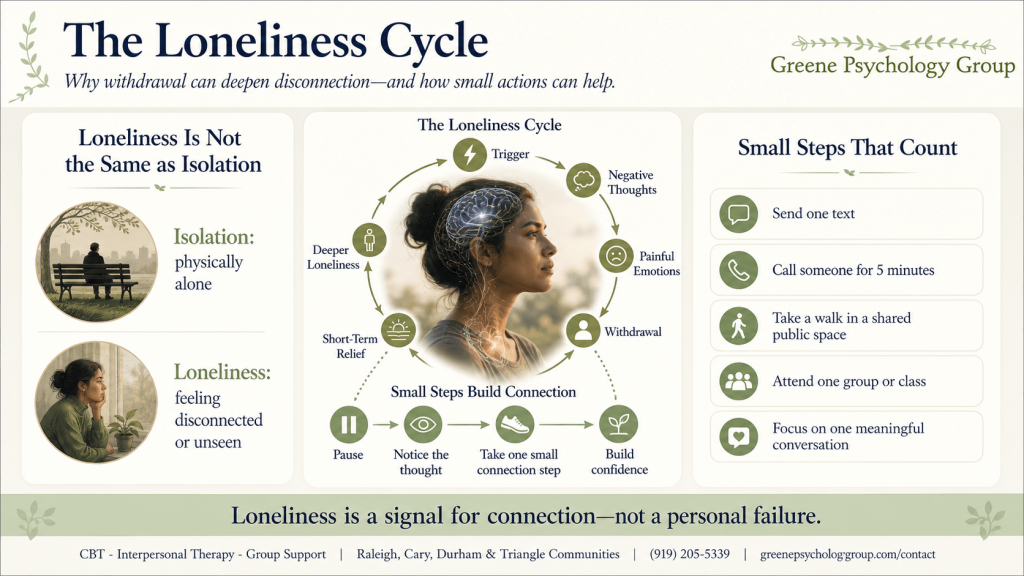
Most people confuse loneliness with isolation. They think loneliness is simply being physically alone. But that is not accurate.
Loneliness vs. Isolation
| Isolation | Loneliness |
|---|---|
| Objective: physically alone | Subjective: feeling disconnected |
| Measurable: social contact count | Emotional: perception of being misunderstood |
| Can be chosen (solitude) | Usually unwanted and distressing |
You can be isolated and not feel lonely – many people enjoy solitude. And you can be surrounded by people and feel profoundly lonely. Loneliness is about the quality, not the quantity, of your connections.
The Neuroscience of Loneliness
Research from Harvard Medical School has shown that loneliness activates the same brain regions as physical pain. The brain perceives social rejection as a threat to survival, triggering the stress response system. Chronic loneliness keeps the stress response activated, leading to a cascade of negative health effects.
Research from UCLA has also shown that loneliness alters immune function, increasing inflammation and reducing the body's ability to fight off viruses.
The takeaway: Loneliness is not "just in your head." It is a biological reality with measurable effects on your brain and body.
Part 2: The Impact of Loneliness on Mental Health
The impact of loneliness on mental health is profound and well‑documented. Here are the most significant effects.
Depression
Loneliness and depression share a bidirectional relationship. Loneliness can trigger depression, and depression can make loneliness worse. A 2021 meta‑analysis found that loneliness was a significant predictor of depressive symptoms, independent of social support and social networks.
What it looks like: Persistent sadness, loss of interest, fatigue, sleep disturbances
Why it happens: Social connection is a fundamental human need. When it is not met, it is natural to feel hopeless and despairing
Anxiety
Loneliness fuels social anxiety. When you feel disconnected, you may become hyper‑vigilant to signs of rejection, leading to avoidance of social situations.
What it looks like: Excessive worry about being judged, avoiding social events, physical symptoms (racing heart, sweating, trembling)
Why it happens: The brain's threat detection system becomes overactive when social connection is perceived as unreliable
Suicidal Ideation
Loneliness is a significant risk factor for suicidal thoughts and behaviors. A 2020 study found that loneliness was associated with a 2.5‑fold increased risk of suicidal ideation.
What it looks like: Thoughts of death, feeling like a burden, hopelessness, withdrawal
Why it happens: When social connection is absent, the sense of being "held" by others disappears, making life feel meaningless
Substance Use
People who are lonely are more likely to use alcohol, drugs, or food to cope with the pain of isolation.
What it looks like: Increased drinking, binge eating, or using substances alone
Why it happens: Substances provide temporary relief from the distress of loneliness but create a vicious cycle of isolation and dependence
Cognitive Decline
Loneliness is associated with cognitive decline and dementia in older adults. A 2022 study found that loneliness was linked to a 40% increased risk of dementia.
What it looks like: Memory problems, difficulty concentrating, slower processing speed
Why it happens: Social connection is essential for brain health. Without it, cognitive reserve declines
Part 3: The Physical Health Consequences of Loneliness
The impact of loneliness on mental health is matched by its impact on physical health. Loneliness is a known risk factor for:
Cardiovascular disease: Loneliness increases blood pressure, inflammation, and the risk of heart disease
Weakened immune system: Loneliness reduces immune function, making you more susceptible to infections and slower to heal
Sleep disturbances: Loneliness is associated with poor sleep quality and fragmented sleep
Chronic pain: Loneliness amplifies pain perception
Early mortality: A 2022 meta‑analysis found that loneliness increased the risk of early death by 26%
Research from Johns Hopkins University found that loneliness is as harmful to health as smoking 15 cigarettes a day.
Part 4: Loneliness in Specific Populations – Who Is Most at Risk?
Loneliness does not discriminate, but certain groups are at higher risk.
Young Adults and College Students
The transition to college, work, or a new city is a common trigger for loneliness. Young adults are often far from family and navigating new social networks.
Signs: Withdrawing from social activities, spending excessive time on social media, difficulty making friends
Treatment: CBT, social skills training, group therapy, and college counseling services
Older Adults
Older adults face unique challenges: loss of spouse, friends, and siblings; retirement; health issues; and reduced mobility.
Signs: Spending most of their time alone, declining invitations, lack of interest in activities
Treatment: Grief therapy, support groups, community‑based programs, and home‑based therapy
Parents and Caregivers
Caregivers of young children or aging parents are at high risk of loneliness. They may be isolated by caregiving responsibilities and lack of adult social contact.
Signs: Feeling invisible, loss of identity, resentment
Treatment: Support groups, respite care, individual therapy
LGBTQ+ Individuals
LGBTQ+ individuals may experience rejection from family, discrimination, and lack of community.
Signs: Hiding identity, avoidance of social situations, internalized shame
Treatment: Affirming therapy, LGBTQ+ support groups, community connection
At Greene Psychology Group, we offer individual therapy and group therapy for loneliness, anxiety, and depression.
Part 5: The Loneliness Cycle – Why It Keeps Getting Worse
Loneliness operates on a predictable cycle. Understanding this cycle is the first step to breaking free.
The Cycle
Trigger: Something activates loneliness – a life transition (move, job loss), a loss (death, break‑up), or a perception of rejection.
Thoughts: You interpret the situation negatively. "No one really cares about me." "I'm unlikeable." "Why bother?"
Emotions: Sadness, hopelessness, shame, and anxiety.
Behavioral Withdrawal: You avoid social situations or withdraw from relationships.
Temporary "Relief": Withdrawal provides short‑term relief from the fear of rejection.
Reinforcement: The withdrawal confirms your belief ("See, no one reached out. I really am alone"). The loneliness deepens.
The Role of Negative Thoughts
Loneliness is fueled by negative thoughts about yourself, others, and the world.
| Negative Thought | More Balanced Alternative |
|---|---|
| "No one wants to be around me." | "I haven't reached out to anyone lately. Maybe I could try." |
| "I'm unlikeable." | "I have had positive relationships in the past. I can build new ones." |
| "It's not worth the effort." | "Even small connections can make a difference." |
| "Everyone else is happy and connected." | "I can't see others' struggles. Loneliness is common." |
Part 6: Evidence‑Based Treatments for Loneliness
Loneliness is not a condition you have to accept. It is a problem that can be solved – with the right tools and support.
Cognitive Behavioral Therapy (CBT)
CBT is the most researched and effective treatment for loneliness. It targets the negative thoughts and behaviors that maintain isolation.
How CBT works for loneliness:
1. Cognitive Restructuring
You learn to identify and challenge the negative thoughts that fuel loneliness. "No one cares about me" becomes "I haven't reached out to anyone lately. Maybe I could try."
2. Behavioral Activation
You learn to engage in activities that bring you into contact with others – even when you do not feel like it. Over time, these behaviors build social connection.
3. Social Skills Training
Some people with loneliness have not had the opportunity to develop social skills. You may practice conversation starters, listening, and assertiveness.
Interpersonal Therapy (IPT)
IPT focuses on improving the quality of your relationships. It addresses issues like unresolved grief, role transitions, and interpersonal deficits.
Group Therapy
Group therapy is particularly effective for loneliness because it provides a safe space to practice social connection. You get feedback, support, and the experience of belonging.
Mindfulness‑Based Therapy
Mindfulness helps you notice your thoughts and feelings without judgment. It can help you tolerate the discomfort of loneliness without spiraling into despair.
At Greene Psychology Group, we offer CBT, group therapy, and mindfulness therapy. Contact us at (919) 205-5339.
Part 7: What a Therapy Session for Loneliness Looks Like
If you are new to therapy for loneliness, you might wonder what happens in a session.
Typical Session Structure (50 minutes)
| Time | Activity |
|---|---|
| 0–10 min | Check‑in: "How has your week been? Any social contact? Any progress?" |
| 10–30 min | Active work: Cognitive restructuring (identifying and challenging negative thoughts) or behavioral activation (planning social activities) |
| 30–40 min | Processing: "What did you notice? What was the hardest part? What surprised you?" |
| 40–45 min | Planning: "What will you practice between now and next session?" |
| 45–50 min | Homework assignment: Specific, achievable social tasks |
What You Will NOT Experience
Judgment: Your therapist has worked with many people who feel lonely. They understand.
Forced socialization: You decide the pace and the approach.
Empty reassurances: You will learn practical skills, not just "feel better" platitudes.
Part 8: Practical Strategies for Overcoming Loneliness – What You Can Do Today
While therapy is the most effective treatment for loneliness, there are practical steps you can take at home.
1. Start Small
Do not try to overhaul your social life overnight. Start with small, achievable steps:
Send a text to one friend
Call a family member for 5 minutes
Go for a walk in a public place
Join a local group or class
2. Quality Over Quantity
Focus on deepening existing relationships, not just expanding your network.
Instead of: Trying to meet 50 new people
Try: Investing in 2–3 meaningful connections
3. Challenge Negative Thoughts
When you notice yourself thinking "No one cares about me," ask:
What is the evidence for and against this thought?
Is there a more balanced way to see this?
What would I say to a friend who thought this?
4. Practice Self‑Compassion
Be kind to yourself. Loneliness is not a failure – it is a signal. Treat yourself with the same compassion you would offer a friend.
5. Limit Social Media
Social media can make loneliness worse by presenting an idealized version of others' lives.
Instead of: Scrolling through posts that make you feel inadequate
Try: Making a plan to connect with someone in person
Part 9: Raleigh‑Specific Resources for Loneliness
If you are struggling with loneliness in Raleigh, these resources can help.
Crisis and Urgent Support
988 Suicide & Crisis Lifeline: Call or text 988 – confidential, available 24/7
Alliance Health Mobile Crisis: (800) 510-9132 – 24/7, free, sends a crisis team to your location
Community Programs
Raleigh Parks and Recreation: Offers classes, groups, and community events
Wake County Public Libraries: Programs, book clubs, and community events
NC State University Counseling Center: Open to the community for some services
Outpatient Therapy (Greene Psychology Group)
We offer in‑person and online therapy for loneliness, anxiety, and depression. We serve individuals, children, adolescents, and families seeking support for anxiety, depression, stress, anger, relationships, life transitions, and personal growth. Contact us at (919) 205-5339.
Part 10: Putting It All Together – Three Loneliness Archetypes
Archetype A: The Isolated Professional
Presentation: 35‑year‑old, recently moved to Raleigh for work. Has no friends, no social network. Spends evenings alone. Feels disconnected and depressed.
Bottleneck: Loneliness with social isolation and emerging depression.
Treatment map: 12 weeks of CBT → Cognitive restructuring: challenging negative thoughts about social connection → Behavioral activation: joining a class, attending a meetup → At 12 weeks, reports "I still feel lonely sometimes, but I have a few people I can call."
Archetype B: The Grieving Spouse
Presentation: 62‑year‑old, lost spouse 8 months ago. Has stopped socializing. Feels like no one understands. Has withdrawn from family and friends.
Bottleneck: Loneliness with unresolved grief.
Treatment map: 12 weeks of grief therapy + loneliness support → Individual therapy and grief group → At 12 weeks, reports "I still miss her, but I don't feel so alone anymore."
Archetype C: The Socially Anxious Young Adult
Presentation: 22‑year‑old, graduated college, struggling to make friends in a new city. Avoids social situations. Has panic attacks before events.
Bottleneck: Loneliness with social anxiety.
Treatment map: 16 weeks of CBT → Exposure hierarchy: starting with small social interactions → Group therapy for practice → At 16 weeks, reports "I still get nervous, but I can go to social events now."
The information provided in this blog is for educational and informational purposes only and is not intended as medical advice, diagnosis, or treatment. It does not create a therapist-patient relationship between you and Greene Psychology Group. Always seek the advice of a qualified mental health professional or physician with any questions you may have regarding a mental health condition. If you are in crisis or experiencing a medical emergency, please call 911 immediately or contact the 988 Suicide & Crisis Lifeline. For non-emergency mental health support, call Greene Psychology Group at (919) 205-5339 or visit our website to schedule an appointment.
FAQs
Loneliness is a subjective feeling of disconnection. Isolation is the objective state of being physically alone. You can be isolated and not lonely, and you can be surrounded by people and feel lonely.
Loneliness is associated with depression, anxiety, suicidal thoughts, substance use, and cognitive decline.
Loneliness increases the risk of cardiovascular disease, weakened immune function, sleep disturbances, chronic pain, and early mortality. It is as harmful as smoking 15 cigarettes a day.
Yes. Loneliness and depression share a bidirectional relationship. Loneliness can trigger depression, and depression can make loneliness worse.
Cognitive Behavioral Therapy (CBT) is the most researched and effective treatment for loneliness. It targets the negative thoughts and behaviors that maintain isolation.
Yes. Group therapy is particularly effective for loneliness because it provides a safe space to practice social connection and receive support from others who understand.
That is common. Negative social experiences can reinforce loneliness. Therapy can help you process those experiences and develop new strategies.
Yes. Greene Psychology Group offers online therapy for loneliness, anxiety, and depression. Research shows online therapy is equally effective.
No. Loneliness is a biological signal that your need for connection is not being met. It is not a character flaw.
Look for a licensed therapist with training in CBT, interpersonal therapy, or group therapy. Greene Psychology Group offers evidence‑based therapy for loneliness – call (919) 205-5339.
Start small: text a friend, join a class, or go for a walk in a public place. Quality over quantity – invest in 2–3 meaningful connections rather than trying to meet many people.
The timeline varies. With consistent effort and support, most people see significant improvement in 12–16 weeks of therapy.
Sources
Loneliness is not a life sentence. Evidence‑based therapy for loneliness in Raleigh, NC, using CBT, interpersonal therapy, and group therapy, can help you break free from isolation and build meaningful connections. Call Greene Psychology Group at (919) 205-5339 or schedule an appointment online. We offer individual therapy, group therapy, evening appointments, and free insurance verification. Same‑week availability for new clients.