
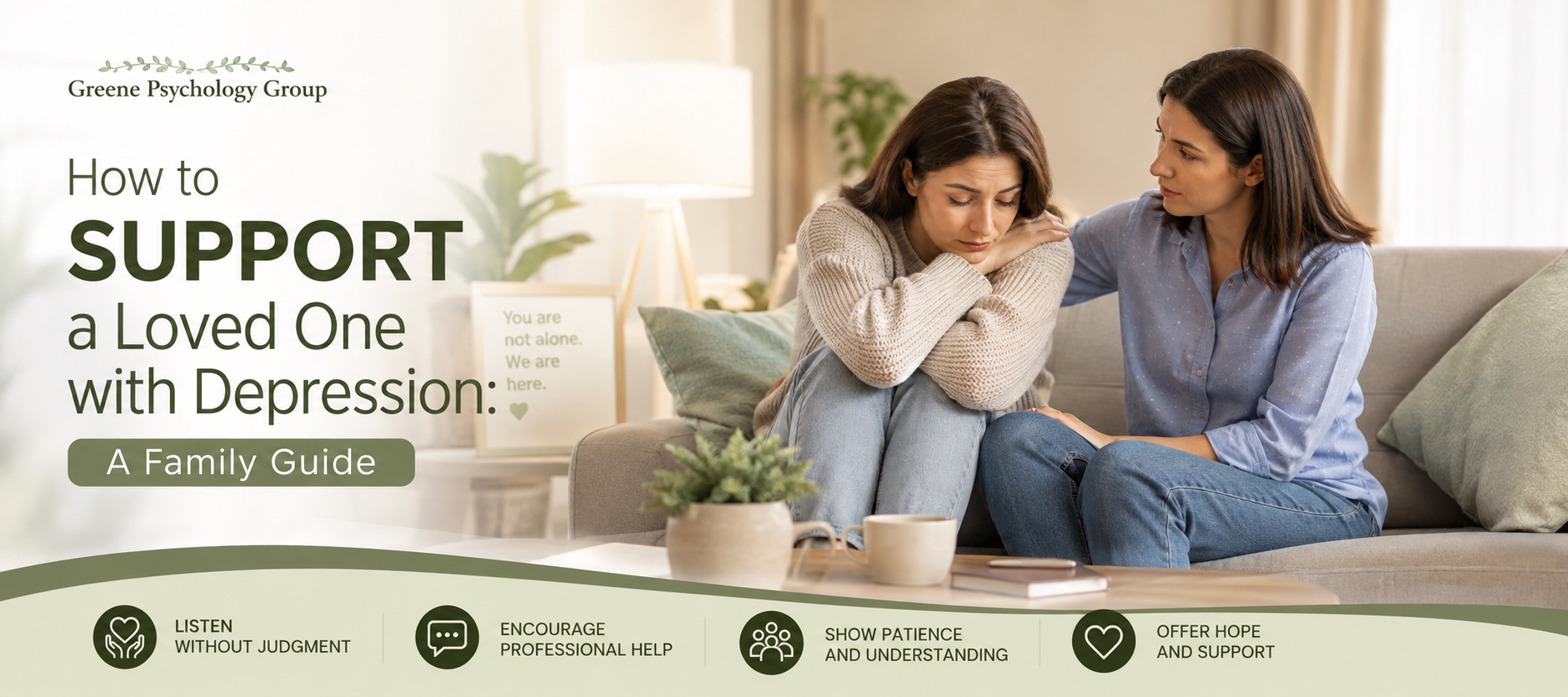
If you are reading this, you are probably watching someone you love struggle with depression—and feeling helpless. Maybe they have withdrawn from you, spending hours alone in their room. Maybe they have lost interest in activities they once loved, and you cannot reach them. Maybe they are irritable, snapping at you over nothing, then retreating into silence. Maybe you have tried to help, but nothing seems to work—and you are starting to feel exhausted, frustrated, or even hopeless yourself.
Here is the truth that depression tries to hide from both of you: you are not powerless, and you are not alone.
Supporting a loved one with depression is one of the most challenging things you can do. It requires patience, compassion, and a willingness to learn. But it is also one of the most important things you can do. Research shows that family support is a critical factor in depression recovery. Family psychoeducation (FPE) has been shown to improve depressive symptoms in patients with major depressive disorder and enhance the wellbeing of family members. Supportive relationships are linked to lower risk of developing depression and better recovery.
Greene Psychology Group in Raleigh, NC, offers evidence‑based therapy for depression and family‑involved care. This guide is a complete, research‑backed resource for families: how to recognize depression, how to talk to your loved one, what supportive actions actually help, what to avoid, how to set boundaries, and how to take care of yourself.
Part 1: Understanding Depression – What Your Loved One Is Experiencing
Before you can support someone with depression, it helps to understand what they are going through.
What Depression Is
According to the National Institute of Mental Health (NIMH), major depressive disorder involves persistent sadness, loss of interest or pleasure, and functional impairment lasting at least two weeks. It is not just "feeling sad" or "having a bad day." It is a medical condition that affects mood, thinking, sleep, appetite, energy, and the ability to function.
What Depression Is NOT
Not a choice: No one chooses to be depressed
Not a character flaw: Depression is not a sign of weakness
Not something they can "snap out of": Willpower alone cannot overcome depression
Not a reflection of you: Your loved one's depression is not your fault
Common Symptoms of Depression
| Category | Symptoms |
|---|---|
| Emotional | Persistent sadness, emptiness, hopelessness, irritability, anxiety |
| Cognitive | Difficulty concentrating, indecisiveness, negative thoughts, guilt, worthlessness |
| Physical | Fatigue, sleep disturbances (insomnia or hypersomnia), appetite changes, aches and pains |
| Behavioral | Withdrawal from activities, social isolation, reduced productivity, neglect of responsibilities |
Depression May Look Like Irritability
Many people do not realize that depression often manifests as irritability or anger—especially in men, adolescents, and certain cultural groups. If your loved one seems angry, short‑tempered, or defensive, they may be experiencing depression, not just "being difficult."
Part 2: The Support Cycle – Why Your Help Matters (and Why It Can Be Hard)
Supporting a loved one with depression is not always straightforward. Depression can make your loved one push you away, reject your help, or even lash out at you. This can lead to frustration, resentment, and burnout.
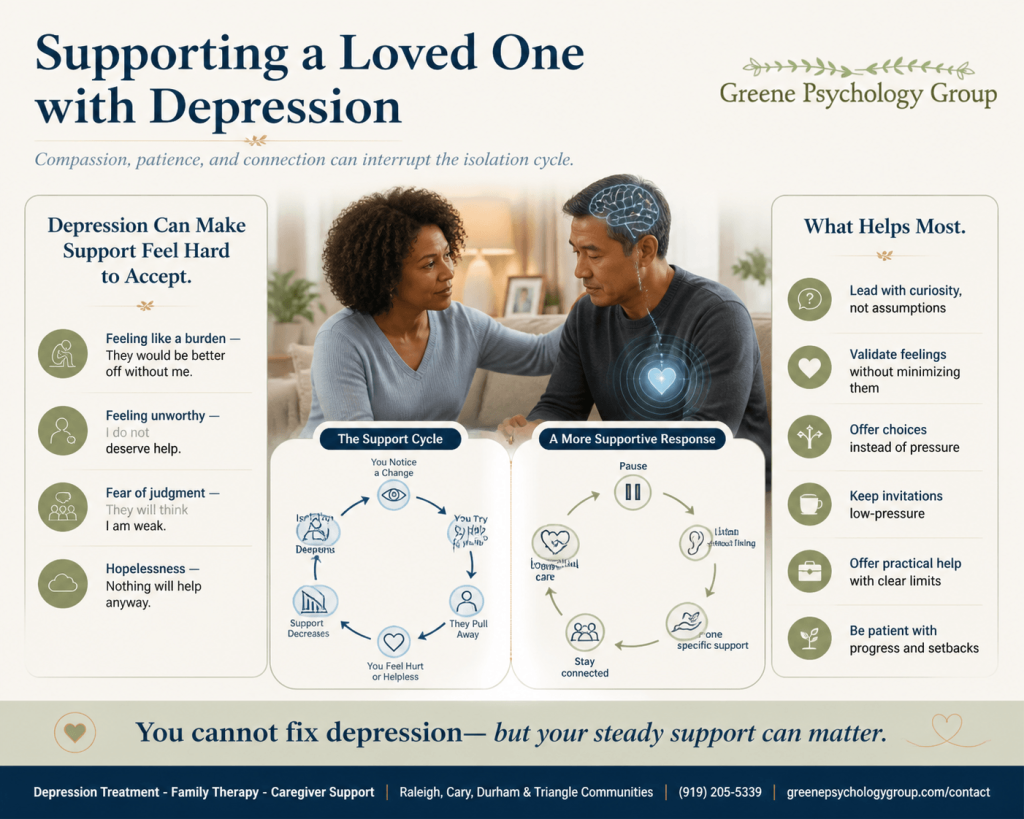
The Support Cycle
You notice symptoms: Your loved one is withdrawn, sad, or irritable
You try to help: You offer support, advice, or encouragement
They reject it: They push you away, dismiss your concern, or get angry
You feel frustrated: You feel helpless, hurt, or resentful
You withdraw: You stop trying to help—or you help less effectively
They feel more isolated: Your withdrawal confirms their belief that no one cares
Why This Happens
Depression distorts thinking. Your loved one may:
Believe they are a burden: "I'm just dragging them down. They'd be better off without me."
Feel unworthy of help: "I don't deserve support. I'm a failure."
Fear being judged: "They'll think I'm weak or crazy."
Feel hopeless: "Nothing will help anyway. Why bother?"
Understanding these distortions does not make them less frustrating—but it can help you respond with compassion rather than frustration.
Part 3: What Helps – Evidence‑Based Ways to Support Your Loved One
Research and clinical experience have identified specific strategies that are most helpful when supporting a loved one with depression.
1. Listen Without Judgment
One of the most powerful things you can do is simply listen. Your loved one may need to talk about how they are feeling—without being told to "cheer up" or "look on the bright side."
What helps:
Use open‑ended questions: "Can you tell me how you're feeling?"
Reflect what you hear: "It sounds like you're feeling really overwhelmed."
Validate their feelings: "That sounds so hard. I can see why you're struggling."
Be present: Sometimes sitting in silence together is more helpful than any words
What does NOT help:
"Just snap out of it."
"You have so much to be grateful for."
"I know exactly how you feel."
"You just need to stay positive."
2. Encourage Professional Help
The best thing you can do is help your loved one get treatment or stay in treatment. Depression is highly treatable, but many people do not seek help—or they stop treatment too early.
What helps:
Offer to help find a therapist or psychiatrist
Offer to accompany them to appointments
Help them make a schedule for meals, medication, and appointments
Encourage them to stick with treatment even when it feels hard
What does NOT help:
Forcing them to go to therapy (this can create resistance)
Giving ultimatums ("If you don't get help, I'm leaving")
3. Encourage Social Connection
Depression makes people want to isolate. Encouraging gentle, low‑pressure social connection can help.
What helps:
Invite them to join you for a walk, a coffee, or a quiet activity
Be patient if they say no—keep inviting
Focus on connection, not "fixing" them
What does NOT help:
Pressuring them to attend large social events
Making them feel guilty for not wanting to be social
4. Support Healthy Habits
Depression often disrupts sleep, appetite, and physical activity. Gentle encouragement toward healthy habits can help.
What helps:
Suggest going for a walk together
Offer to cook a healthy meal together
Encourage a consistent sleep schedule
What does NOT help:
Nagging or criticizing ("You never get out of bed")
Making them feel guilty for struggling
5. Educate Yourself
Learn about depression—its symptoms, treatment options, and what recovery looks like. The more you understand, the better you can support your loved one—and the less personally you will take their symptoms.
Resources:
National Institute of Mental Health (NIMH): www.nimh.nih.gov[reference:18]
Families for Depression Awareness: www.familyaware.org[reference:19]
Mayo Clinic: www.mayoclinic.org[reference:20]
6. Offer Practical Help
Depression can make everyday tasks feel overwhelming. Offering practical help can make a big difference.
What helps:
"I'm going to the grocery store. Can I pick anything up for you?"
"I'll make dinner tonight. What sounds good?"
"I can help you organize your medication."
What does NOT help:
Doing everything for them (this can create dependency)
7. Be Patient
Recovery from depression takes time. Your loved one may have good days and bad days. Be patient—and celebrate small victories.
Part 4: What to Avoid – Common Mistakes That Can Make Things Worse
1. Don't Take It Personally
When your loved one is irritable, withdrawn, or critical, it is the depression talking—not them. Remind yourself: "This is not about me. This is their illness."
2. Don't Try to "Fix" Them
You cannot cure your loved one's depression. Your role is to support, not to fix. Trying to fix them can make them feel like a project, not a person.
3. Don't Enable
Enabling means making excuses, covering up problems, or doing things for your loved one that they are capable of doing themselves. While it is natural to want to help, enabling can prevent your loved one from seeking the help they need.
Examples of enabling:
Calling in sick for them when they are not physically ill
Lying to cover up their behavior
Doing their responsibilities for them (e.g., their work, their chores)
4. Don't Minimize Their Feelings
Telling someone to "cheer up" or "look on the bright side" can make them feel misunderstood and invalidated.
Instead of:
"It's not that bad."
"You have so much to be grateful for."
"Just stay positive."
Try:
"I can see you're really struggling. I'm here for you."
"I'm sorry you're going through this."
"That sounds incredibly hard."
5. Don't Ignore Self‑Harm or Suicidal Thoughts
If your loved one talks about suicide, self‑harm, or feeling like a burden, take it seriously. Do not dismiss it as "dramatic" or "attention‑seeking."
What to do:
Ask directly: "Are you thinking about suicide?"
Listen without judgment
Do not leave them alone
Call 988 (Suicide & Crisis Lifeline) or go to the nearest emergency room
Part 5: Setting Healthy Boundaries – Protecting Yourself While Supporting Your Loved One
Supporting a loved one with depression can be exhausting. Setting boundaries is not selfish—it is necessary.
Why Boundaries Matter
Without boundaries, you risk burnout, resentment, and compassion fatigue. You cannot pour from an empty cup. Research shows that family members of people with depression often carry substantial emotional and practical responsibilities. Taking care of yourself is not optional—it is essential.
Examples of Healthy Boundaries
"I love you, and I want to support you. But I cannot talk about this right now. Can we take a break and revisit it later?"
"I will drive you to your appointment, but I cannot call your employer for you."
"I need one hour each day for myself. That is not a rejection of you. It is how I stay able to show up for you."
How to Set Boundaries
Be clear: State your boundary directly and kindly
Be consistent: Follow through on your boundary
Be compassionate: Remind your loved one that your boundary is not a rejection
Part 6: Taking Care of Yourself – You Cannot Pour from an Empty Cup
Supporting a loved one with depression is one of the most challenging roles you can take on. You need support too.
Self‑Care Strategies for Family Members
1. Prioritize Your Own Mental Health
Consider seeing a therapist yourself
Join a family support group
Talk to trusted friends or family about your own feelings
2. Maintain Your Own Routine
Exercise regularly—daily exercise reduces stress
Eat well and get enough sleep
Make time for activities you enjoy
3. Find a Balance
Decide how you can and cannot help your loved one. Be realistic about what you can offer.
4. Seek Support
You do not have to do this alone. Ask others to help you or join a support group.
5. Be Realistic
Recovery takes time. Do not expect overnight changes. Celebrate small victories.
6. Practice Mindfulness
Mindfulness and relaxation techniques can help reduce stress and improve emotional well‑being.
At Greene Psychology Group, we offer individual therapy for family members and family therapy to support the whole system.
Part 7: Family Therapy – When to Consider Professional Support for the Whole Family
Add Your Heading Text Here
Sometimes individual therapy is not enough. Family therapy can help when:
Communication has broken down: You are arguing constantly or not speaking at all
Family dynamics are contributing to the depression: The "identified patient" is the family scapegoat, but the system is struggling
Multiple family members are struggling: Depression affects everyone in the family
You are considering separation or divorce because of the strain
Research shows that family psychoeducation (FPE) improves depressive symptoms in patients with major depressive disorder and enhances the wellbeing of family members. Family therapy is effective in the prevention of relapse in adult patients with major depression.
Greene Psychology Group offers family therapy and couples counseling to help families heal together.
Part 8: Raleigh‑Specific Resources for Families
If you are supporting a loved one with depression in Raleigh, these resources can help.
Crisis and Urgent Support
988 Suicide & Crisis Lifeline: Call or text 988 – 24/7, confidential
Alliance Health Mobile Crisis: (800) 510-9132 – 24/7, free, sends a crisis team to your location
Family Support Groups
NAMI Wake County: Free family support groups for loved ones of people with mental illness
Families for Depression Awareness: Online resources and support
Outpatient Therapy (Greene Psychology Group)
We offer in‑person and online therapy for individuals, couples, and families. We treat depression, anxiety, and related conditions, and we involve family members when appropriate. Contact us at (919) 205-5339.
Part 9: Putting It All Together – Three Family Archetypes
Archetype A: The Exhausted Spouse
Presentation: 45‑year‑old, married to someone with depression for 10 years. Has tried everything—encouragement, tough love, patience, ultimatums. Now exhausted, resentful, and considering leaving.
Bottleneck: Caregiver burnout with boundary difficulties.
Treatment map: Individual therapy for caregiver (12 weeks of CBT) → Couples therapy to improve communication → Setting healthy boundaries → At 12 weeks, reports "I still love my partner, but I am learning to take care of myself too."
Archetype B: The Confused Parent
Presentation: 52‑year‑old, adult child (28) has been depressed for 2 years. Child has moved back home, refuses to get help, spends all day in bed. Parent is frustrated and worried.
Bottleneck: Enabling with unclear boundaries.
Treatment map: Family therapy → Psychoeducation about depression → Setting boundaries ("You need to be in treatment to live here") → Encouraging independence → At 12 weeks, child is in treatment, parent feels less resentful.
Archetype C: The Overwhelmed Sibling
Presentation: 30‑year‑old, younger sibling (24) has depression. Parents are elderly and cannot help. Sibling feels responsible for everything—appointments, medication, emotional support.
Bottleneck: Over‑functioning with no support.
Treatment map: Individual therapy for sibling → Joining a support group → Delegating tasks to other family members → Learning to say "no" → At 12 weeks, reports "I still help my sibling, but I don't do everything anymore."
The information provided in this blog is for educational and informational purposes only and is not intended as medical advice, diagnosis, or treatment. It does not create a therapist-patient relationship between you and Greene Psychology Group. Always seek the advice of a qualified mental health professional or physician with any questions you may have regarding a mental health condition. If you are in crisis or experiencing a medical emergency, please call 911 immediately or contact the 988 Suicide & Crisis Lifeline. For non-emergency mental health support, call Greene Psychology Group at (919) 205-5339 or visit our website to schedule an appointment.
FAQs
Start with an open, non‑judgmental conversation. Use "I" statements: "I've noticed you seem really down lately. I'm worried about you. I'm here if you want to talk."
Avoid minimizing statements like "Just snap out of it," "You have so much to be grateful for," or "It's not that bad." These can make your loved one feel invalidated
Listen without judgment, encourage professional help, offer practical support, and be patient
Offer to help them find a therapist, accompany them to appointments, or help them make a schedule for treatment. Avoid forcing or giving ultimatums.
You cannot force someone to get help unless they are in immediate danger. Focus on what you can control: setting boundaries, taking care of yourself, and being there when they are ready.
Be clear, kind, and consistent. "I love you, and I want to support you. But I cannot talk about this right now. Can we take a break?"
Caregiver burnout is exhaustion, resentment, and compassion fatigue from caring for someone. Avoid it by setting boundaries, prioritizing self‑care, and seeking support
Yes. Many family members benefit from individual therapy to process their own feelings and learn coping strategies
Take it seriously. Ask directly: "Are you thinking about suicide?" Do not leave them alone. Call 988 or go to the nearest emergency room
Yes. Family psychoeducation (FPE) improves depressive symptoms in patients and enhances the wellbeing of family members. Family therapy is effective in preventing relapse.
Recovery varies. Some people improve in weeks; others take months or longer. Be patient and celebrate small victories.
Look for a licensed therapist with experience treating depression. Greene Psychology Group offers evidence‑based therapy for depression and family‑involved care – call (919) 205-5339.
Sources
Duke University Department of Psychiatry – Family psychoeducation research
UNC Chapel Hill School of Social Work – Family support for depression
Johns Hopkins Bloomberg School of Public Health – Depression and family support
University of Rochester Medical Center – Supporting a loved one with mental illness
Supporting a loved one with depression is hard—but you do not have to do it alone. Evidence‑based therapy in Raleigh, NC, can help your loved one recover and help you find the support you need. Call Greene Psychology Group at (919) 205-5339 or schedule an appointment online. We offer individual therapy, family therapy, couples counseling, evening appointments, and free insurance verification. Same‑week availability for new clients.