
If you are reading this, you have probably already taken the brave step of considering therapy. Maybe you have been struggling with anxiety, depression, or relationship issues. Maybe you have been feeling stuck and unsure how to move forward. Maybe you have heard about different types of therapy – CBT, DBT, EMDR, ACT – and felt overwhelmed by the alphabet soup of options.
Here is the truth that no one tells you: there is no single "best" therapy for everyone. The right therapy depends on your specific concerns, your personality, your history, and your goals. What works for one person may not work for another – and that is okay.
Understanding the different types of therapy is the first step to finding the right fit. Each approach has its own theory of change, its own techniques, and its own evidence base. Some are structured and skills‑based. Others are more exploratory and insight‑oriented. Some focus on the present. Others delve into the past.
Greene Psychology Group in Raleigh, NC, offers a range of evidence‑based therapies, including Cognitive Behavioral Therapy (CBT), Dialectical Behavior Therapy (DBT), Eye Movement Desensitization and Reprocessing (EMDR), and mindfulness‑based approaches. This guide is a complete, research‑backed overview: the most common types of therapy, how they work, what conditions they treat, and how to choose the right one for you.
Part 1: Why Understanding Therapy Types Matters
Many people enter therapy without understanding what type of therapy they are receiving – or what options are available. This can lead to frustration if the approach does not fit their needs.
The Problem with "One‑Size‑Fits‑All" Therapy
Imagine going to a physical therapist for back pain. You would expect them to assess your specific condition and recommend exercises tailored to your needs. You would not expect them to use the same approach for every patient. The same should be true for mental health therapy.
Different therapies work for different issues:
CBT is excellent for anxiety, depression, and OCD
DBT is ideal for emotion dysregulation and self‑harm
EMDR is the treatment of choice for trauma and PTSD
ACT helps with acceptance and values‑based living
IPT focuses on relationship and life transitions
The Importance of a Good Fit
Research shows that the therapeutic relationship – the connection between you and your therapist – is one of the strongest predictors of therapy success. But the type of therapy also matters. If you are doing exposure therapy for OCD but your therapist is using a supportive talk therapy approach, you are unlikely to see improvement.
At Greene Psychology Group, we match clients with the therapy that best fits their needs. Contact us at (919) 205-5339 to learn more.
Part 2: Cognitive Behavioral Therapy (CBT) – The Gold Standard
What It Is
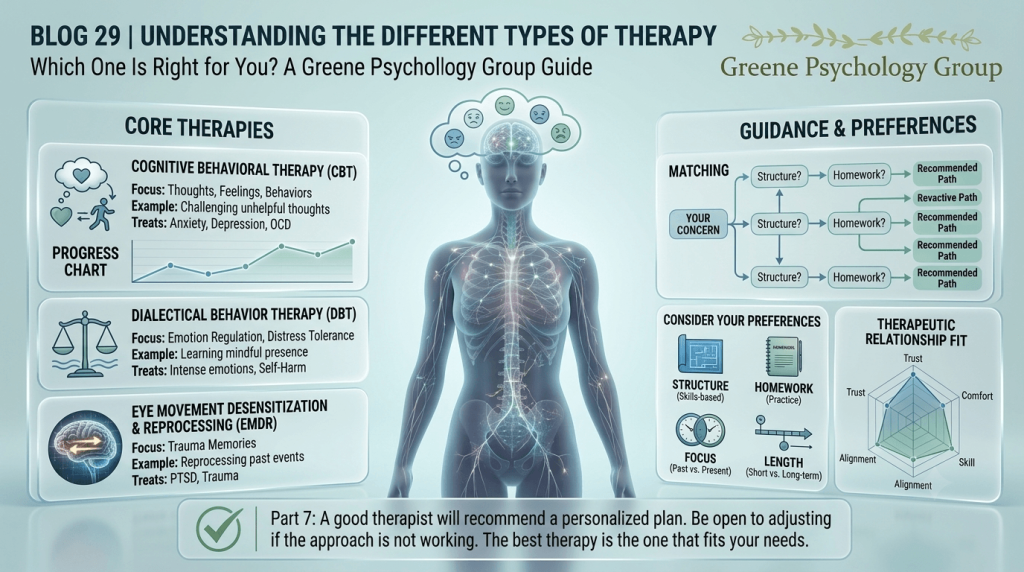
Cognitive Behavioral Therapy (CBT) is a short‑term, goal‑oriented therapy that focuses on the connection between thoughts, feelings, and behaviors. It is one of the most researched and effective therapies for a wide range of conditions.
How It Works
CBT is based on the idea that your thoughts influence your feelings, which influence your behaviors. By changing unhelpful thoughts and behaviors, you can change how you feel.
Key components:
Cognitive restructuring: Identifying and challenging unhelpful thoughts
Behavioral activation: Engaging in activities that improve mood
Exposure therapy: Gradually facing feared situations
Skills training: Learning coping strategies
What It Treats
Anxiety disorders (GAD, social anxiety, panic disorder)
Depression
Obsessive‑compulsive disorder (OCD)
Post‑traumatic stress disorder (PTSD)
Eating disorders
Insomnia
Chronic pain
What a Session Looks Like
CBT sessions are structured and goal‑oriented. You will typically start with a check‑in, then work on a specific skill or thought pattern, and end with homework to practice between sessions.
Evidence: CBT is strongly supported by research and is recommended as a first‑line treatment for many conditions by the National Institute for Health and Care Excellence (NICE) and the American Psychological Association.
At Greene Psychology Group, we offer CBT for a wide range of conditions.
Part 3: Dialectical Behavior Therapy (DBT) – For Emotion Regulation
What It Is
Dialectical Behavior Therapy (DBT) is a type of CBT that was originally developed to treat borderline personality disorder. It has since been adapted for a range of conditions involving intense emotions, self‑harm, and suicidal behavior.
How It Works
DBT is based on the idea that some people have a biological predisposition to feel emotions more intensely and take longer to recover. It teaches skills to manage these intense emotions.
Key components:
Mindfulness: Staying present in the moment
Distress tolerance: Coping with intense emotions without making things worse
Emotion regulation: Understanding and managing emotions
Interpersonal effectiveness: Navigating relationships assertively
What It Treats
Borderline personality disorder
Suicidal behavior
Self‑harm
Substance use disorders
Eating disorders
Post‑traumatic stress disorder (PTSD)
Depression with intense emotional reactivity
What a Session Looks Like
DBT typically includes weekly individual therapy and a weekly skills group. You will also have phone coaching for crisis moments between sessions.
Evidence: DBT has been shown to be effective in reducing suicidal behavior, self‑harm, and hospitalization in multiple randomized controlled trials.
At Greene Psychology Group, we offer DBT‑informed therapy and skills groups.
Part 4: Eye Movement Desensitization and Reprocessing (EMDR) – For Trauma
What It Is
Eye Movement Desensitization and Reprocessing (EMDR) is a therapy specifically designed to treat trauma and post‑traumatic stress disorder (PTSD). It uses bilateral stimulation (eye movements, taps, or tones) to help the brain reprocess traumatic memories.
How It Works
Trauma memories are "stuck" in the brain – they retain the same intense emotions and sensations as when the trauma occurred. EMDR helps "unstick" these memories so they can be integrated into your life story.
The eight phases of EMDR:
History taking
Preparation (resourcing and grounding)
Assessment (identifying the target memory)
Desensitization (processing the memory with bilateral stimulation)
Installation (strengthening a positive belief)
Body scan (checking for residual tension)
Closure (returning to a calm state)
Re‑evaluation (checking progress)
What It Treats
Post‑traumatic stress disorder (PTSD)
Complex trauma
Childhood abuse
Sexual assault
Motor vehicle accidents
Combat trauma
Natural disasters
What a Session Looks Like
EMDR sessions are typically 60–90 minutes. You will not be asked to describe your trauma in detail. Instead, you will focus on the image, negative belief, and body sensations associated with the memory.
Evidence: EMDR is recognized as a first‑line treatment for PTSD by the World Health Organization, the American Psychological Association, and the Department of Veterans Affairs.
At Greene Psychology Group, we offer EMDR therapy for trauma and PTSD.
Part 5: Acceptance and Commitment Therapy (ACT) – For Values‑Based Living
What It Is
Acceptance and Commitment Therapy (ACT) is a mindfulness‑based therapy that helps you accept what is out of your control and commit to actions that align with your values.
How It Works
ACT is based on the idea that suffering comes from trying to control or avoid difficult experiences. Instead of fighting your thoughts and feelings, you learn to accept them and move toward what matters to you.
Key components:
Acceptance: Making room for difficult emotions
Cognitive defusion: Watching your thoughts as mental events, not facts
Present moment awareness: Mindfulness
Self‑as‑context: The observing self
Values clarification: Identifying what truly matters
Committed action: Taking purposeful steps toward your values
What It Treats
Anxiety
Depression
Chronic pain
Substance use disorders
OCD
Stress and burnout
Grief
What a Session Looks Like
ACT sessions are collaborative and experiential. You might do mindfulness exercises, values‑clarification exercises, or work on taking committed action.
Evidence: ACT has been shown to be effective for a wide range of conditions in hundreds of randomized controlled trials.
At Greene Psychology Group, we offer mindfulness therapy incorporating ACT principles.
Part 6: Other Evidence‑Based Therapies
Interpersonal Therapy (IPT)
What it is: A short‑term therapy focused on improving the quality of your relationships.
How it works: IPT is based on the idea that relationship difficulties contribute to mental health problems. It focuses on four areas: unresolved grief, role transitions, role disputes, and interpersonal deficits.
What it treats: Depression, anxiety, eating disorders, and relationship difficulties.
Evidence: IPT is a recommended treatment for depression by NICE and the American Psychiatric Association.
Psychodynamic Therapy
What it is: An insight‑oriented therapy that explores how past experiences (especially childhood) influence current behavior.
How it works: Psychodynamic therapy focuses on unconscious patterns, defense mechanisms, and the therapeutic relationship itself.
What it treats: Depression, anxiety, personality disorders, and relationship difficulties.
Evidence: Psychodynamic therapy has a strong evidence base for a range of conditions.
Mindfulness‑Based Cognitive Therapy (MBCT)
What it is: A therapy that combines mindfulness practices with CBT to prevent relapse in recurrent depression.
How it works: MBCT teaches you to recognize and disengage from ruminative thought patterns that can trigger depression.
What it treats: Recurrent depression, anxiety, and stress.
Evidence: MBCT is recommended for preventing depression relapse by NICE.
At Greene Psychology Group, we offer mindfulness therapy for depression, anxiety, and stress.
Part 7: How to Choose the Right Therapy for You
Choosing the right therapy can feel overwhelming. Here is a framework to help you decide.
Step 1: Identify Your Primary Concern
Anxiety, depression, OCD: CBT is often the best starting point
Trauma or PTSD: EMDR or trauma‑focused CBT
Intense emotions, self‑harm: DBT
Chronic pain, stress, values‑based living: ACT
Relationship difficulties: IPT or couples therapy
Recurrent depression: MBCT
Step 2: Consider Your Preferences
Structure: Do you want a structured, skills‑based approach (CBT, DBT) or a more exploratory approach (psychodynamic)?
Homework: Are you willing to do between‑session practice? CBT, DBT, and ACT all involve homework
Length: Are you looking for short‑term (12–20 sessions) or long‑term (open‑ended) therapy?
Focus: Do you want to focus on the present (CBT, ACT) or explore the past (psychodynamic)?
Step 3: Talk to a Therapist
The best way to choose is to talk to a therapist. Most therapists offer a free consultation. Use that time to ask questions and get a sense of their approach.
Questions to ask:
What is your training and experience with [your specific concern]?
What type of therapy do you use? Why?
How long do you typically see clients?
What does a typical session look like?
Part 8: Comparing Therapies – A Summary Table
| Therapy | Focus | Key Techniques | Best For | Evidence |
|---|---|---|---|---|
| CBT | Thoughts, feelings, behaviors | Cognitive restructuring, exposure, behavioral activation | Anxiety, depression, OCD, PTSD | Strong (first‑line) |
| DBT | Emotion regulation, distress tolerance | Mindfulness, distress tolerance, emotion regulation, interpersonal effectiveness | BPD, self‑harm, suicidal behavior | Strong |
| EMDR | Trauma memories | Bilateral stimulation, reprocessing | PTSD, trauma | Strong (first‑line) |
| ACT | Acceptance, values‑based action | Acceptance, defusion, values clarification | Anxiety, depression, chronic pain, stress | Strong |
| IPT | Relationships, life transitions | Communication, role transitions, grief work | Depression, relationship issues | Strong |
| Psychodynamic | Past experiences, unconscious patterns | Free association, interpretation | Depression, anxiety, personality disorders | Strong |
| MBCT | Preventing depression relapse | Mindfulness, cognitive restructuring | Recurrent depression | Strong |
Part 9: What If You Don't Know What You Need?
It is completely normal to not know what type of therapy you need. That is what the initial consultation is for.
What a Good Therapist Will Do
Ask about your concerns, history, and goals
Explain different therapy options
Make a recommendation based on your needs
Be open to adjusting if the approach is not working
What You Can Expect
First session: Assessment and planning. You will discuss what brought you to therapy and what you hope to achieve.
Ongoing: Your therapist will explain their approach and check in regularly to see if it is working.
At Greene Psychology Group, we offer individual therapy with a range of approaches. We will help you find the right fit. Contact us at (919) 205-5339.
Part 10: Putting It All Together – Three Therapy Archetypes
Archetype A: The Anxious Overthinker
Presentation: 28‑year‑old, chronic worry, panic attacks, trouble sleeping. Has tried "just relaxing" – does not work.
Bottleneck: Generalized anxiety with panic.
Recommended therapy: CBT with exposure therapy
Why: CBT directly targets anxious thoughts and avoidance behaviors. Exposure therapy is the active ingredient for panic.
Archetype B: The Trauma Survivor
Presentation: 35‑year‑old, history of childhood abuse. Flashbacks, avoidance, hypervigilance. Has tried talk therapy before – it made things worse.
Bottleneck: PTSD with avoidance of trauma memories.
Recommended therapy: EMDR or trauma‑focused CBT
Why: EMDR does not require describing the trauma in detail, which is helpful for people who have been retraumatized by talk therapy.
Archetype C: The Emotionally Overwhelmed
Presentation: 22‑year‑old, intense emotions, self‑harm, suicidal thoughts, chaotic relationships. Has been in and out of therapy with limited improvement.
Bottleneck: Emotion dysregulation with self‑harm.
Recommended therapy: DBT
Why: DBT was specifically developed for people with intense emotions and self‑harm. It teaches skills for managing emotions without making things worse.
The information provided in this blog is for educational and informational purposes only and is not intended as medical advice, diagnosis, or treatment. It does not create a therapist‑patient relationship between you and Greene Psychology Group. Always seek the advice of a qualified mental health professional or physician with any questions you may have regarding a mental health condition. If you are in crisis or experiencing a medical emergency, please call 911 immediately or contact the 988 Suicide & Crisis Lifeline. For non‑emergency mental health support, call Greene Psychology Group at (919) 205-5339 or visit our website to schedule an appointment.
FAQs
Cognitive Behavioral Therapy (CBT) is one of the most common and widely researched types of therapy.
Consider your primary concern, your preferences (structure, homework, focus), and talk to a therapist about their approach.
Yes. Many people try more than one therapist or approach before finding the right fit.
CBT focuses on changing thoughts and behaviors. DBT is a type of CBT that focuses on emotion regulation, distress tolerance, and interpersonal skills, often for people with intense emotions.
EMDR is a therapy for trauma that uses bilateral stimulation (eye movements, taps, or tones) to help the brain reprocess traumatic memories.
CBT focuses on changing thoughts. ACT focuses on accepting thoughts and committing to actions that align with your values.
Yes. Psychodynamic therapy is still practiced and has a strong evidence base, especially for depression, anxiety, and personality disorders.
CBT is typically 12–20 sessions. DBT is often 6–12 months. EMDR is typically 8–12 sessions for single‑event trauma. Psychodynamic therapy can be longer‑term.
Yes. Research shows that many types of therapy – including CBT, DBT, and EMDR – can be effectively delivered via telehealth.
It may have been the wrong approach or the wrong therapist. Different approaches and different therapists can produce completely different outcomes.
No. Different therapies work for different people and conditions. The best therapy is the one that fits your needs.
Look for a licensed therapist with training in evidence‑based approaches. Greene Psychology Group offers a range of therapies – call (919) 205-5339.
Sources
Understanding the different types of therapy is the first step to finding the right help. At Greene Psychology Group in Raleigh, NC, we offer a range of evidence‑based therapies – including CBT, DBT, EMDR, and ACT – and we will help you find the right fit. Call us at (919) 205-5339 or schedule an appointment online. We offer evening appointments and free insurance verification. Same‑week availability for new clients.