

If you are reading this, you have probably heard the advice before: "Exercise is good for your mental health." Maybe you have even tried to follow it – you started a workout routine, felt motivated for a week or two, and then life got in the way. Or maybe you have been struggling with depression or anxiety, and the thought of exercising feels overwhelming.
Here is the truth that no one tells you: exercise is not a cure‑all, but it is one of the most powerful tools you have for managing mental health.
The connection between physical activity and mental health is not just anecdotal – it is backed by decades of rigorous research. Exercise has been shown to reduce symptoms of depression and anxiety, improve sleep, boost self‑esteem, and even protect against cognitive decline. A 2023 study published in The BMJ found that physical activity is highly beneficial for improving symptoms of depression, anxiety, and distress across a wide range of adult populations.
But here is the other truth: starting an exercise routine when you are struggling with your mental health is genuinely hard. Depression saps your motivation. Anxiety makes you avoid new things. Fatigue makes everything feel impossible. You are not lazy – you are dealing with a condition that makes movement feel like climbing a mountain.
Greene Psychology Group in Raleigh, NC, offers evidence‑based therapy that integrates physical activity into mental health treatment. This guide is a complete, research‑backed overview: the science behind the connection between physical activity and mental health, the specific benefits for different conditions, practical strategies for getting started, and how to find support.
Part 1: The Science of Movement – What Happens in Your Brain When You Exercise
Exercise is not just about your muscles or your heart. It is about your brain.
Neurochemical Changes
When you exercise, your brain releases a cascade of neurochemicals that directly affect your mood:
Endorphins: Often called "feel‑good" chemicals, endorphins reduce pain perception and create feelings of euphoria
Serotonin: Exercise increases serotonin production, which regulates mood, sleep, and appetite. Low serotonin is linked to depression
Dopamine: Exercise increases dopamine, which is involved in motivation, reward, and pleasure
Norepinephrine: Exercise increases norepinephrine, which helps your brain respond to stress
BDNF (Brain‑Derived Neurotrophic Factor): Exercise increases BDNF, which supports the growth of new neurons and protects existing ones. Low BDNF is linked to depression and cognitive decline
Research from Harvard Medical School has shown that exercise is effective for depression and anxiety, with effects comparable to medication for mild to moderate cases.
Structural Brain Changes
Regular exercise does not just change your brain chemistry – it changes your brain structure. Studies have shown that exercise increases:
Hippocampal volume: The hippocampus is involved in memory and emotion regulation. It shrinks with depression and stress. Exercise helps it grow.
Prefrontal cortex activity: The prefrontal cortex is involved in attention, decision‑making, and impulse control. Exercise strengthens it.
Prefrontal cortex volume and white matter integrity: Research shows that exercise increases prefrontal cortex volume and white matter integrity in older adults.
The Stress Response
Exercise helps regulate the HPA axis (hypothalamic‑pituitary‑adrenal axis), which controls your body's stress response. Regular physical activity reduces cortisol levels and helps your body recover from stress more quickly.
Part 2: The Impact of Physical Activity on Mental Health – Specific Conditions
Depression
Exercise is one of the most effective non‑pharmacological treatments for depression. A 2024 systematic review and meta‑analysis found that physical activity is highly beneficial for improving symptoms of depression, anxiety, and distress across a wide range of adult populations.
How it helps: Exercise increases serotonin and dopamine, reduces inflammation, and promotes neuroplasticity
What works: Aerobic exercise (walking, running, swimming) and resistance training are both effective
Dose: 30–45 minutes, 3–5 times per week is associated with large benefits
Anxiety
Exercise is also effective for anxiety. Regular physical activity reduces worry, physical tension, and fear.
How it helps: Exercise burns off excess adrenaline, reduces muscle tension, and provides a healthy distraction
What works: Aerobic exercise and mindful movement (yoga, tai chi) are particularly helpful
Dose: 20–30 minutes, 3–4 times per week
PTSD and Trauma
Exercise has been shown to reduce PTSD symptoms, particularly hyperarousal and avoidance.
How it helps: Exercise helps regulate the nervous system and provides a sense of mastery
What works: Aerobic exercise, yoga, and mindful movement
Dose: 30 minutes, 3–4 times per week
Sleep Disorders
Exercise improves sleep quality and duration. It is particularly effective for insomnia.
How it helps: Exercise regulates circadian rhythms and reduces anxiety
What works: Aerobic exercise in the morning or afternoon (not too close to bedtime)
Dose: 30 minutes, 3–5 times per week
Cognitive Decline and Dementia
Exercise protects against cognitive decline and dementia. It increases BDNF and promotes neuroplasticity.
How it helps: Exercise supports brain health and reduces inflammation
What works: Aerobic exercise and strength training
Dose: 150 minutes of moderate‑intensity exercise per week
Substance Use Disorders
Exercise can reduce cravings and improve mood during recovery.
How it helps: Exercise increases dopamine and provides healthy alternatives to substance use
What works: Aerobic exercise and mindful movement
Dose: 30 minutes, 3–5 times per week
Research from Duke University has shown that exercise can be as effective as medication for mild to moderate depression, with lower relapse rates.
Part 3: The Exercise and Mental Health Cycle – Why It Keeps Getting Better (or Worse)
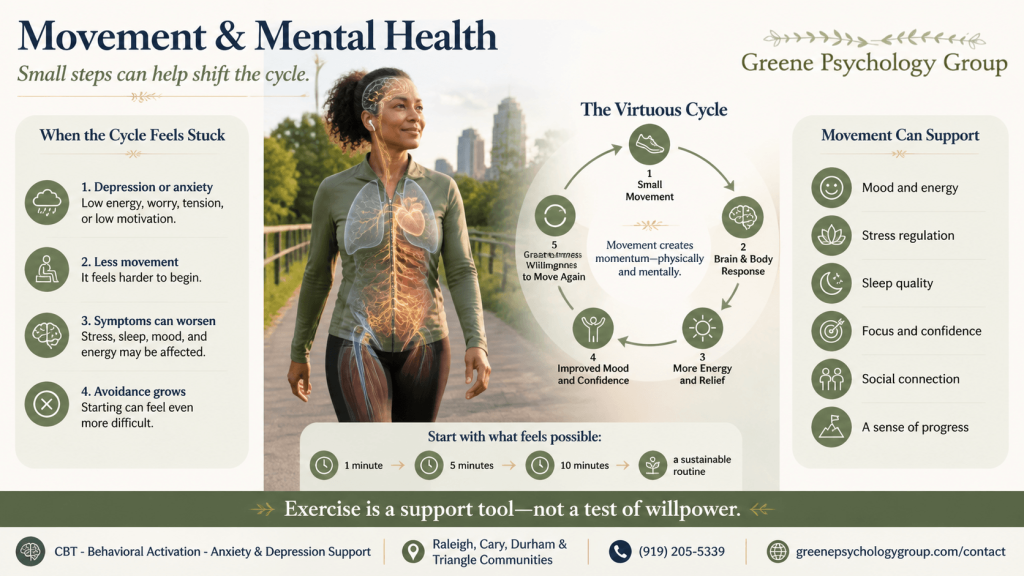
The relationship between physical activity and mental health is bidirectional. Exercise improves mental health, and better mental health makes exercise easier. But the reverse is also true.
The Virtuous Cycle
Mood: You feel good, so you feel motivated to exercise
Exercise: You move your body
Reward: Your brain releases endorphins, dopamine, and serotonin
Improved Mood: You feel better
Reinforcement: You are more likely to exercise again
The Vicious Cycle
Depression/Anxiety: You feel bad, so you lack motivation
Inactivity: You stop moving
Worsened Symptoms: Without exercise, symptoms worsen
More Inactivity: It becomes even harder to start
The key is to interrupt the vicious cycle. Even small amounts of movement can start the virtuous cycle.
Part 4: How Much Exercise Do You Actually Need?
The good news: you do not need to run a marathon to experience the mental health benefits of exercise.
General Guidelines
Adults: 150 minutes of moderate‑intensity exercise per week (or 75 minutes of vigorous‑intensity)
Moderate intensity: You can talk but not sing (e.g., brisk walking, light cycling, dancing)
Vigorous intensity: You can only say a few words without pausing (e.g., running, swimming, HIIT)
What If You Cannot Do 150 Minutes?
Start smaller. Research shows that even small amounts of exercise have benefits.
10 minutes: Walking for 10 minutes has been shown to improve mood and reduce anxiety
5 minutes: Even 5 minutes of movement can boost energy and reduce tension
1 minute: If 5 minutes feels impossible, start with 1 minute. Build from there
The "Exercise Snack" Approach
Break your exercise into small chunks throughout the day.
10 minutes in the morning
10 minutes at lunch
10 minutes in the evening
This is just as effective as 30 minutes all at once.
Research from Johns Hopkins Bloomberg School of Public Health shows that even small amounts of exercise are associated with better mental health.
Part 5: Types of Exercise – What Works Best for Mental Health
Aerobic Exercise
Aerobic exercise is the most studied form of exercise for mental health.
Examples: Walking, jogging, cycling, swimming, dancing, brisk walking
Benefits: Reduces depression and anxiety, improves sleep, boosts energy
Why it works: Increases heart rate, releases endorphins, improves cardiovascular health
Resistance Training
Strength training also has significant mental health benefits.
Examples: Weightlifting, resistance bands, bodyweight exercises
Benefits: Improves self‑esteem, reduces anxiety, builds confidence
Why it works: Provides a sense of mastery, builds physical strength
Mindful Movement
Mindful movement combines exercise with mindfulness.
Examples: Yoga, tai chi, qigong
Benefits: Reduces stress, improves mood, enhances body awareness
Why it works: Combines physical activity with mindfulness, which reduces stress
Outdoor Exercise
Exercising in nature has additional benefits.
Examples: Hiking, walking in a park, trail running
Benefits: Reduces stress, improves mood, increases connection to nature
Why it works: Green spaces reduce cortisol and improve mental wellbeing
Social Exercise
Exercising with others adds a social component.
Examples: Team sports, group fitness classes, walking groups
Benefits: Reduces loneliness, provides accountability, boosts mood
Why it works: Combines physical activity with social connection
At Greene Psychology Group, we integrate movement into therapy when appropriate. Contact us to learn more.
Part 6: Practical Strategies for Getting Started – When Motivation Is Low
Starting an exercise routine when you are struggling with your mental health is genuinely hard. Here is how to make it easier.
1. Start Smaller Than You Think
Instead of: "I will exercise for 30 minutes every day"
Try: "I will walk for 5 minutes today"
2. Remove Barriers
Instead of: Going to a gym that is 20 minutes away
Try: Walking around your neighborhood or doing a home workout
Instead of: Needing to change into workout clothes
Try: Walking in the clothes you are already wearing
3. Use the "5‑Minute Rule"
Tell yourself you will do the activity for just 5 minutes. After 5 minutes, you can stop. Most of the time, you will keep going.
4. Pair Exercise with Something You Enjoy
Instead of: Exercising alone with no distraction
Try: Listening to a podcast, audiobook, or music while walking
Try: Exercising with a friend
5. Be Flexible
Instead of: Sticking to a rigid schedule
Try: Exercising when you have the energy, even if it is not at the same time every day
Instead of: Committing to one type of exercise
Try: Doing different activities based on your mood
6. Celebrate Small Wins
Instead of: "I only walked for 10 minutes, that's not enough"
Try: "I walked for 10 minutes! That's 10 more minutes than yesterday."
7. Use Behavioral Activation
Behavioral activation is a CBT technique where you schedule activities even when you do not feel like it. The motivation often comes after you start.
Example:
"I don't feel like walking. I will walk for 5 minutes anyway."
After 5 minutes: "I feel a little better. I will walk for 10 more minutes."
At Greene Psychology Group, we offer CBT with behavioral activation for depression and anxiety therapy to help you build healthy habits.
Part 7: Exercise as Part of a Comprehensive Treatment Plan
Exercise is powerful, but it is not a substitute for professional mental health treatment. For many people, exercise works best when combined with therapy, medication, or both.
Exercise and Therapy
Exercise can enhance the effects of therapy by improving mood, energy, and motivation
Therapy can help you address the psychological barriers to exercise
Exercise and Medication
Exercise can be as effective as medication for mild to moderate depression
For moderate to severe depression, a combination of exercise and medication is often best
Always talk to your doctor before starting or stopping medication
When to Seek Professional Help
If you are struggling with depression or anxiety and finding it impossible to exercise, you may need additional support.
Signs you need support:
You have been feeling down, anxious, or hopeless for more than two weeks
You have lost interest in activities you once loved
You are having thoughts of death or suicide
You are using alcohol or drugs to cope
You are having trouble functioning at work, school, or home
What to do: Contact Greene Psychology Group at (919) 205-5339 or schedule an appointment.
Part 8: Raleigh‑Specific Resources for Physical Activity
If you are looking for ways to get active in Raleigh, here are some resources.
Parks and Outdoor Spaces
Shelley Lake Park: Walking trails, beautiful scenery, multiple loops
Lake Johnson Park: Walking, jogging, kayaking, peaceful and scenic
NC Museum of Art Park: Walking trails, open spaces, art installations
William B. Umstead State Park: Hiking, trail running, mountain biking, nature connection
Fitness Centers
YMCA of the Triangle: Multiple locations, sliding scale fees, group fitness classes
Raleigh Parks and Recreation: Affordable classes, community centers, walking groups
Local gyms: LA Fitness, Planet Fitness, and independent studios
Walking Groups
Raleigh Walking Club: Free, open to all, weekly walks
Meetup.com: Search for "walking groups" or "hiking groups" in Raleigh
Therapy (Greene Psychology Group)
We offer in‑person and online therapy for depression, anxiety, and stress. We can help you build the motivation and skills to incorporate exercise into your life. Contact us at (919) 205-5339.
Part 9: Putting It All Together – Three Exercise Archetypes
Archetype A: The Depressed and Exhausted
Presentation: 35‑year‑old, major depression, fatigue, no motivation. Has not exercised in over a year. Feels guilty about inactivity.
Bottleneck: Depression with low energy and motivation.
Treatment map: 12 weeks of CBT with behavioral activation → Start with 2‑minute walks → Gradually increase to 5 minutes, then 10 minutes → Pair with therapy to address negative thoughts about exercise → At 12 weeks, reports "I still don't love exercise, but I feel better when I move."
Archetype B: The Anxious and Avoidant
Presentation: 28‑year‑old, social anxiety. Avoids gyms and group fitness. Fears being judged. Has not exercised in public for years.
Bottleneck: Anxiety with avoidance of physical activity.
Treatment map: 12 weeks of CBT + exposure therapy → Start with at‑home workouts → Gradually walk in less crowded areas → Build to walking in a park → At 12 weeks, reports "I still get nervous, but I can walk in public now."
Archetype C: The Stressed and Burned‑Out
Presentation: 48‑year‑old, high‑stress job, burnout, insomnia, never exercises. Knows exercise would help but feels too tired.
Bottleneck: Chronic stress with insomnia and fatigue.
Treatment map: 12 weeks of CBT + mindfulness → Start with evening walks to improve sleep → Mindful movement (yoga) to reduce stress → At 12 weeks, reports "I sleep better and feel less overwhelmed."
The information provided in this blog is for educational and informational purposes only and is not intended as medical advice, diagnosis, or treatment. It does not create a therapist-patient relationship between you and Greene Psychology Group. Always seek the advice of a qualified mental health professional or physician with any questions you may have regarding a mental health condition. If you are in crisis or experiencing a medical emergency, please call 911 immediately or contact the 988 Suicide & Crisis Lifeline. For non-emergency mental health support, call Greene Psychology Group at (919) 205-5339 or visit our website to schedule an appointment.
Add Your Heading Text Here
Exercise releases endorphins, serotonin, dopamine, and norepinephrine – all of which improve mood. It also reduces cortisol and promotes neuroplasticity.
Yes. Exercise is highly effective for depression, with effects comparable to medication for mild to moderate depression.
Yes. Regular physical activity reduces worry, physical tension, and fear. Aerobic exercise and mindful movement are particularly helpful.
150 minutes of moderate‑intensity exercise per week is ideal. Smaller amounts still have benefits.
Aerobic exercise is the most studied, but resistance training, mindful movement, outdoor exercise, and social exercise all have benefits.
Start smaller than you think. Five minutes of walking is better than nothing. Behavioral activation (scheduling activity even when you don't feel like it) can help.
For mild to moderate depression, exercise can be as effective as medication. For moderate to severe depression, a combination is often best. Always talk to your doctor.
Talk to your doctor about what is safe. Many forms of exercise (walking, swimming, chair exercises) are accessible.
Some benefits (mood improvement, stress reduction) happen immediately. Long‑term benefits (reduced depression, anxiety) typically take 4–8 weeks.
Yes. Indoor walking, home workouts, yoga, and dance are all effective.
Start at home. There are many free online workouts. Gradually, you can build confidence to exercise in public.
Look for a therapist who uses CBT with behavioral activation. Greene Psychology Group offers evidence‑based therapy that integrates movement – call (919) 205-5339.
Sources
Duke University Department of Psychiatry – Exercise for depression
Johns Hopkins Bloomberg School of Public Health – Exercise and mental health
UNC Chapel Hill School of Social Work – Exercise and wellbeing
Stanford University Department of Psychology – Exercise and anxiety
National Institute of Mental Health (NIMH) – Exercise and mental health
Exercise is one of the most powerful tools for managing mental health – but it is not always easy to start, especially when you are struggling. Evidence‑based therapy in Raleigh, NC, using CBT and behavioral activation, can help you build the motivation and skills to move your body and improve your mood. Call Greene Psychology Group at (919) 205-5339 or schedule an appointment online. We offer individual therapy, evening appointments, and free insurance verification. Same‑week availability for new clients.