
If you are reading this, you are probably familiar with the feeling. Your mind races with worst‑case scenarios. Your shoulders are tight. You lie awake at night rehashing conversations from three years ago or worrying about a meeting next Tuesday. You have been told to "just relax" – but if you knew how, you would have done it already.
You are not alone. Chronic stress is widespread – a 2022 survey from the American Psychological Association found that 76% of adults reported experiencing at least one symptom of stress in the previous month. And for many, stress has become so normal that they do not even notice it anymore.
Here is what most people do not know: stress is not the enemy. The problem is not stress itself – it is how we relate to it. When we fight stress, avoid it, or get consumed by it, we make it worse. Mindfulness offers a different way: instead of fighting or fleeing, you learn to observe your stress with curiosity and compassion – and then let it go.
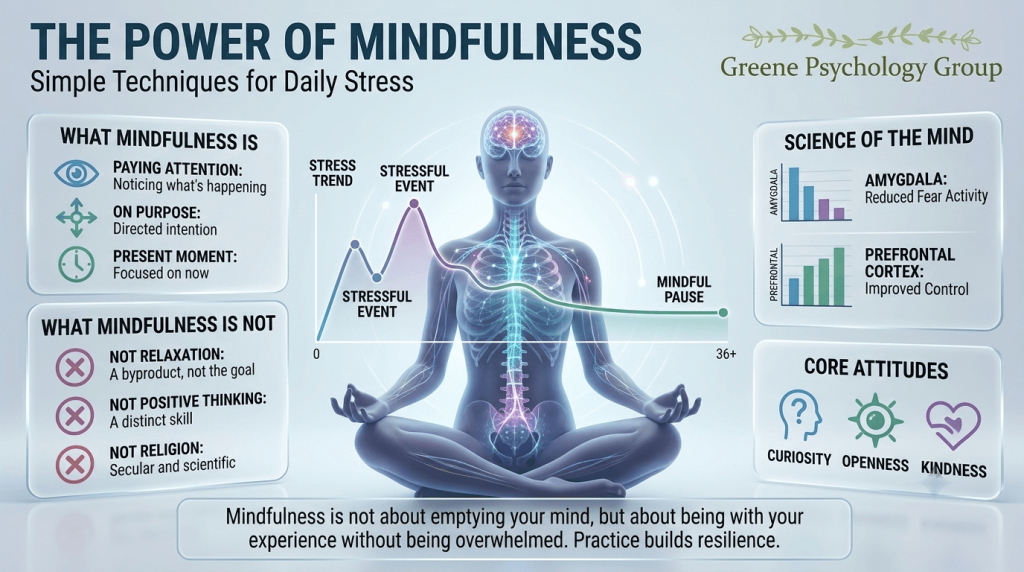
Mindfulness is the practice of paying attention, on purpose, in the present moment, without judgment. It is not about emptying your mind or achieving eternal calm. It is about learning to be with your experience – even the uncomfortable parts – without being overwhelmed by them.
Greene Psychology Group in Raleigh, NC, offers evidence‑based mindfulness therapy for stress, anxiety, and depression. This guide is a complete, research‑backed overview: what mindfulness actually is, the science behind it, simple techniques you can use today, and how to find support.
Part 1: What Is Mindfulness – Beyond the Buzzword
Mindfulness has become a buzzword. But behind the marketing, there is a robust scientific framework.
The Core Definition
The most widely accepted definition comes from Jon Kabat‑Zinn, founder of Mindfulness‑Based Stress Reduction (MBSR): "Paying attention, on purpose, in the present moment, without judgment."
Let's break that down:
Paying attention: Noticing what is happening, rather than operating on autopilot
On purpose: Choosing to direct your attention, rather than letting it be hijacked
In the present moment: Focusing on what is happening now, not the past or future
Without judgment: Observing without labeling things as "good" or "bad," "right" or "wrong"
What Mindfulness Is NOT
Not relaxation: Relaxation is a byproduct, not the goal
Not positive thinking: You are not trying to replace "bad" thoughts with "good" ones
Not a religion: Mindfulness is a secular psychological skill
Not avoidance: You face your experience, not run from it
The Two Components of Mindfulness
1. Attention: The ability to focus on the present moment
2. Attitude: The quality of attention – curiosity, openness, and kindness
Without the right attitude, mindfulness can become just another form of self‑criticism. "I can't focus. I'm terrible at this." That is not mindfulness – that is judgment. The practice is to notice the judgment, and gently return to the present moment.
Part 2: The Science of Mindfulness – What Happens in Your Brain
Mindfulness is not "woo‑woo." It is one of the most rigorously studied psychological interventions of the past 30 years.
What Happens in the Brain
Research from Harvard Medical School using functional MRI has shown that mindfulness practice:
Reduces activation in the amygdala: The brain's fear center becomes less reactive to threat
Increases activation in the prefrontal cortex: The brain's attention and impulse control center becomes stronger
Increases gray matter density: In the hippocampus (memory, learning) and insula (body awareness)
Decreases stress biomarkers: Cortisol, inflammation, and blood pressure
Key Research Findings
For stress: A 2019 meta‑analysis in Psychological Bulletin found that MBSR significantly reduced perceived stress, burnout, and physiological markers (cortisol, blood pressure)
For anxiety: A 2018 meta‑analysis in JAMA Internal Medicine found that mindfulness‑based interventions produced moderate to large effects on anxiety, comparable to CBT
For depression: MBCT reduces relapse rates by approximately 40% in patients with recurrent depression
The Stress‑Mindfulness Cycle
Stress: You encounter a stressor, and your body reacts
Awareness: You notice the stress – the racing heart, the tight shoulders
Mindfulness: You observe the stress without fighting it
Regulation: Your nervous system calms down
Reinforcement: You are more likely to be mindful next time
Part 3: The Three Core Mindfulness Techniques
These are the foundational practices. They are simple, but not easy. Like any skill, they require practice.
1. Breath Awareness (Mindfulness of Breath)
What you do:
Sit comfortably, with your back straight but not rigid
Bring your attention to the physical sensations of breathing – the rise and fall of your chest, the air moving through your nostrils
When your mind wanders (it will), gently return your attention to the breath
What you learn:
Attention regulation – noticing when you are distracted and returning to the present
How to be with your experience without judgment
Why it helps:
The breath is always in the present moment. By anchoring to the breath, you stop rehearsing the future or replaying the past
How long:
Start with 5 minutes. Build to 10, then 15, then 20
2. Body Scan
What you do:
Lie down or sit comfortably
Systematically move your attention through your body – toes, feet, ankles, knees, thighs, pelvis, abdomen, chest, back, shoulders, arms, hands, neck, head
Notice sensations without trying to change them
What you learn:
Interoception – awareness of internal body states
Distinguishing between physical sensations and emotional reactions
Why it helps:
Stress and anxiety live in the body. The body scan helps you be with those sensations without fighting them – which paradoxically reduces their intensity
How long:
15–30 minutes
3. The 3‑Minute Breathing Space
This is a portable practice for moments of stress. It takes 3 minutes and can be done anywhere.
Minute 1 – Acknowledge:
"What is happening right now? Thoughts, feelings, body sensations?"
Name them without judgment
Minute 2 – Gather:
Bring your attention to the breath in the belly
Feel the breath moving in and out
Minute 3 – Expand:
Expand your awareness to the whole body, riding the breath
Feel the breath moving through your entire body
Why it helps:
Interrupts the automatic escalation of stress and worry before it spirals
Part 4: Practical Mindfulness Techniques for Everyday Life
You do not need to sit on a cushion for an hour to benefit from mindfulness. Here are techniques you can use in your daily life.
1. Mindful Morning
Before you get out of bed, take 3 conscious breaths
Notice the sensations in your body – the warmth of the blankets, the sounds in the room
Set an intention for the day: "Today, I will be kind to myself"
2. Mindful Eating
Take one bite of food, and put down your fork
Notice the colors, textures, and smells of the food
Chew slowly, noticing the taste and the sensations in your mouth
3. Mindful Walking
Feel your feet on the ground with each step
Notice the sensations in your legs and feet
Notice the sounds around you, the feeling of the air on your skin
4. Mindful Listening
When someone is speaking to you, focus on their words – not what you are going to say next
Notice the tone of their voice, their body language, their facial expressions
5. Mindful Pause
Before responding to a stressful situation, take one conscious breath
This 3‑second pause can be enough to shift from reaction to response
Part 5: Mindfulness for Specific Conditions
Mindfulness for Anxiety
Anxiety thrives on worry about the future. Mindfulness brings you back to the present moment – where you are safe.
What works:
Breath awareness when you feel anxious
The 3‑minute breathing space for panic moments
Labeling anxious thoughts: "I am having the thought that I might fail"
Mindfulness for Depression
Depression thrives on rumination about the past. Mindfulness helps you disengage from repetitive negative thinking.
What works:
Body scan for disconnection from the body
Leaves on a stream (watching thoughts float by)
MBCT (Mindfulness‑Based Cognitive Therapy)
Mindfulness for Stress
Stress is the body's reaction to a perceived threat. Mindfulness helps you regulate the stress response.
What works:
Daily practice (10‑15 minutes)
Mindful pause before meetings or stressful events
Mindful walking to reduce tension
Mindfulness for Pain
Chronic pain is worsened by resistance. Mindfulness helps you relate to pain differently.
What works:
Body scan to notice pain without judgment
Breath awareness to anchor in the present
MBSR (Mindfulness‑Based Stress Reduction)
At Greene Psychology Group, we offer mindfulness therapy, CBT, and anxiety therapy.
Part 6: Mindfulness vs. Other Stress Management Techniques
| Factor | Mindfulness | Relaxation | Distraction |
|---|---|---|---|
| Mechanism | Observing experience without judgment | Reducing physical tension | Avoiding the stressor |
| Goal | Awareness and acceptance | Physical relaxation | Temporary relief |
| Long‑term effect | Builds resilience | Provides temporary relief | Avoidance reinforces fear |
| Best for | Chronic stress, anxiety, depression | Acute stress, tension | When you need a break |
| Evidence | Strong (hundreds of RCTs) | Moderate | Limited |
The bottom line: Mindfulness builds resilience over time. Relaxation and distraction are helpful in the moment, but they do not change your relationship with stress.
Part 7: How to Build a Mindfulness Practice – Practical Tips
1. Start Small
Instead of: "I will meditate for 30 minutes every day"
Try: "I will do the 3‑minute breathing space every morning"
2. Use Guided Recordings
There are many free apps and recordings
Insight Timer, Calm, Headspace, and YouTube have guided mindfulness practices
3. Be Consistent
Practice at the same time each day – morning is often best, but whenever works
Consistency matters more than duration
4. Let Go of Perfection
Your mind will wander. That is not a failure – it is the practice
Each time you notice your mind wandering and return your attention, you are strengthening the muscle of attention
5. Practice Throughout the Day
Mindful moments do not have to be long – a few conscious breaths count
Use transitions as reminders – before meals, before meetings, when you wake up
6. Find a Community
Group meditation classes can provide motivation and accountability
Consider MBSR or MBCT programs
Part 8: When to Seek Professional Help – The Warning Signs
Mindfulness is a powerful tool, but it is not a substitute for professional treatment. If you are experiencing significant distress, seek help.
Red Flags
Persistent sadness or anxiety: Lasting more than two weeks
Loss of interest: In activities you once loved
Sleep disturbances: Insomnia or hypersomnia
Appetite changes: Significant weight loss or gain
Difficulty functioning: At work, school, or home
Suicidal thoughts: Thoughts of death or suicide
Substance use: Using alcohol or drugs to cope
What to Do
Talk to someone you trust
Seek professional help: Contact Greene Psychology Group at (919) 205-5339 or schedule an appointment
In a crisis: Call 988 or Alliance Health Mobile Crisis at (800) 510-9132
Part 9: Putting It All Together – Three Mindfulness Archetypes
Archetype A: The Stressed Professional
Presentation: 38‑year‑old, high‑stress job, constant anxiety, trouble sleeping. Has tried "everything" – vacations, exercise, wine. Nothing works.
Bottleneck: Chronic stress with poor stress regulation.
Treatment map: 8‑week MBSR program → Daily practice starts at 10 minutes → Begins to notice stress earlier and regulate it → Reports sleeping better, more present with family → Maintenance: 3‑minute breathing space, daily practice 4x/week.
Archetype B: The Anxious Overthinker
Presentation: 28‑year‑old, anxiety with rumination. Worries constantly about the future. Difficulty concentrating. Avoids social situations.
Bottleneck: Generalized anxiety with rumination.
Treatment map: 12 weeks of MBCT → Learns to notice ruminative thoughts earlier → Uses 3‑minute breathing space to interrupt the cycle → Reports "I still worry, but I don't get stuck in it anymore."
Archetype C: The Burned‑Out Caregiver
Presentation: 55‑year‑old, caring for aging parent with dementia. Exhausted, resentful, no time for herself. Feels guilty for needing a break.
Bottleneck: Caregiver burnout with guilt and resentment.
Treatment map: 8 weeks of MBSR + individual therapy → Mindfulness to notice stress and guilt → Self‑compassion to be kind to herself → At 8 weeks, reports "I still get overwhelmed, but I can pause and breathe."
The information provided in this blog is for educational and informational purposes only and is not intended as medical advice, diagnosis, or treatment. It does not create a therapist-patient relationship between you and Greene Psychology Group. Always seek the advice of a qualified mental health professional or physician with any questions you may have regarding a mental health condition. If you are in crisis or experiencing a medical emergency, please call 911 immediately or contact the 988 Suicide & Crisis Lifeline. For non-emergency mental health support, call Greene Psychology Group at (919) 205-5339 or visit our website to schedule an appointment.
FAQs
Mindfulness is paying attention, on purpose, in the present moment, without judgment. It is a skill of attention regulation and self‑awareness.
Lorem ipsum dolor sit amet, consectetur adipiscing elit. Ut elit tellus, luctus nec ullamcorper mattis, pulvinar dapibus leo.
Yes. Hundreds of randomized controlled trials show mindfulness significantly reduces stress, anxiety, depression, and chronic pain.
MBSR focuses on stress reduction, MBCT on preventing depression relapse, and ACT on psychological flexibility. All use mindfulness as a core skill.
No. Research shows 10–15 minutes of daily practice produces significant benefits. Start where you are.
No one can. The goal is not to stop thoughts but to notice them and return to the present. Wandering is not failure; it is the practice.
Yes, but panic disorder is often best treated with CBT (exposure) first, then mindfulness to manage residual anxiety.
Secular mindfulness (as used in MBSR, MBCT, ACT) has no religious content. It is a psychological skill.
Yes. Guided mindfulness practices work well via telehealth. Greene Psychology Group offers online therapy with guided recordings.
Most people notice reduced stress within 4 weeks of consistent practice. Significant anxiety reduction typically takes 8 weeks.
Yes, if delivered by a licensed mental health professional for a diagnosed condition (anxiety disorder, adjustment disorder, etc.). Greene Psychology Group accepts most major insurance.
Yes. Many patients use mindfulness alongside SSRIs. Mindfulness can also help manage medication side effects (e.g., emotional blunting).
Call Greene Psychology Group at (919) 205-5339 or schedule online. Your therapist will teach you the first practice in your first session.
Sources
UNC Chapel Hill School of Social Work – Mindfulness for depression relapse
Johns Hopkins Bloomberg School of Public Health – Mindfulness meta‑analysis
Stanford University Department of Psychology – Self‑compassion and mindfulness
University of Massachusetts Medical School – MBSR founder research
National Institute of Mental Health (NIMH) – Mindfulness and mental health
You do not have to be a prisoner of chronic stress. Mindfulness therapy in Raleigh, NC, can teach you to relate differently to stress, anxiety, and worry – so you can stop fighting and start living. Call Greene Psychology Group at (919) 205-5339 or schedule an appointment online. We offer individual therapy with guided mindfulness practices, evening appointments, and free insurance verification. Same‑week availability for new clients.