

How Do You Choose a Therapist in North Carolina? 9 Safe, Practical Factors
Quick answer: To choose a therapist, start with what you want help with, who needs to be involved, and whether you prefer in-person or online sessions. Then compare license, experience with your concern, therapy approach, insurance process, privacy practices, and how the first conversation feels. A diagnosis is not required before reaching out; a licensed clinician can help clarify what is happening and whether their services are an appropriate fit. The goal is not to find a perfect person on paper, but to find someone regulated, understandable, respectful, and practical for your life.
Choosing between therapists can feel surprisingly personal. A profile may list credentials, approaches, ages served, insurance plans, and office options, but still leave you wondering, “Would I feel comfortable talking with this person?” That question matters. For adults, parents of teens, partners, and caregivers, the search often includes both emotional fit and practical details: privacy, cost, scheduling, online therapy, and whether the clinician works with the concern you are bringing.
This guide focuses on what to evaluate before you make contact and what to notice during an initial conversation. It is not a substitute for clinical advice, and it does not diagnose any condition. It is meant to help you organize the search so your first outreach feels more informed and less overwhelming.
A practical way to choose a therapist before you call
A useful way to choose a therapist is to think in layers: clinical fit, practical fit, and personal fit. Clinical fit means the therapist works with your age group, concern, and therapy goals. Practical fit includes format, location, insurance, payment, communication, and privacy. Personal fit is how you feel when you ask questions: whether the therapist or practice responds clearly, respects your choices, and helps you understand what comes next.
Before reading clinician profiles, write down a few basics. You might include “stress at work,” “relationship conflict,” “parenting a teen who seems withdrawn,” “grief,” “anxiety,” “low mood,” or “life transition.” These are starting points, not self-diagnoses. You can also note whether therapy is for you individually, for an adolescent, for a couple or family conversation, or for support as a caregiver.
If you are trying to find a therapist while already feeling depleted, keep the process simple. You do not have to compare every possible approach before contacting someone. You can begin with a short list of needs and ask focused therapist questions during the first exchange. The most useful questions usually connect directly to your concern, your schedule, your privacy needs, and how therapy would begin.
The exact 9 safe, practical fit factors to compare
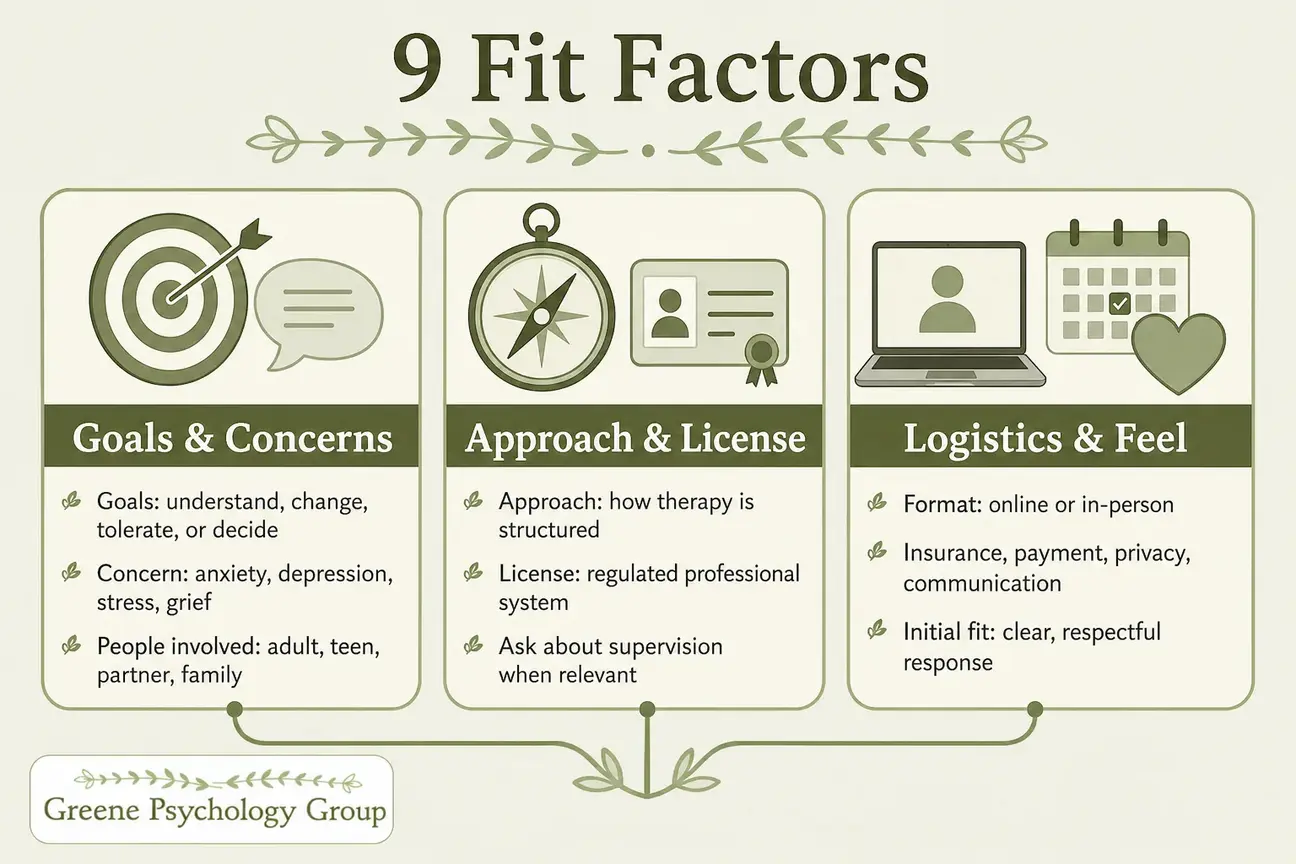
The following table gives the exact nine factors promised in the title: goals, concern, age and people involved, approach, license, format, insurance and payment, privacy and communication, and initial fit. You may not know every answer in advance, and that is okay. Many people use the first call or message to clarify the most important details. Clear therapist questions can make the search feel less like guessing and more like gathering information.
| Fit factor | What to consider | Helpful question |
|---|---|---|
| Goals | What you hope therapy will help you understand, change, tolerate, or decide. | “How would we clarify what to focus on first?” |
| Concern | Whether the therapist commonly works with anxiety, depression, stress, relationships, grief, trauma, ADHD-related concerns, or life changes. | “Do you work with people bringing concerns like mine?” |
| Age and people involved | Whether therapy is for an adult, adolescent, parent, partner, couple, family, or caregiver. | “Who would be included in sessions, and when?” |
| Approach | How the therapist generally thinks about change and what sessions may involve. | “How would your approach connect to my goals?” |
| License | Whether the clinician has an active license and whether they practice independently or under supervision. | “What license do you hold, and how can I verify it?” |
| Format | Whether in-person, online, or a combination is available and appropriate. | “Do you offer in-person sessions, online therapy, or both?” |
| Insurance and payment | Whether your specific plan may apply, what you should verify, and what happens if you use self-pay. | “What should I confirm with my insurer before starting?” |
| Privacy and communication | How information is handled, what communication methods are used, and what not to send electronically. | “How are messages and private information handled?” |
| Initial fit | Whether you feel heard, respected, and able to ask direct questions. | “What if we decide this is not the right fit?” |
Find a therapist by naming the concern without diagnosing yourself
When people try to find a therapist, they often feel pressure to label the problem before reaching out. A diagnosis can be helpful when a licensed clinician makes one, but you do not need one to begin. It is enough to say what you are noticing and what you want help understanding.
For example, an adult might say, “I am more irritable and overwhelmed than usual,” or “I keep replaying conversations and cannot relax.” A parent might say, “My teen seems more withdrawn, and I am not sure how to talk about it.” A partner might say, “We keep having the same argument and need help communicating.” These are useful descriptions even when they do not name a diagnosis.
Greene Psychology Group offers individual therapy for adolescents and adults. If your concern involves anxiety, depression, stress, relationships, grief, ADHD-related concerns, trauma history, parenting, or a life transition, you can ask whether the practice or a specific clinician works with that concern. If a different level of care or service is needed, a clinician can discuss that boundary rather than promising that every need is a fit.
When you find a therapist, remember that a clinician does not need to have lived through the same situation to offer appropriate care. It may be more important that they understand the concern, explain their approach clearly, and respond without dismissing your experience. If your main goal is to find a therapist who can help you sort through several overlapping concerns, say that directly; it is a reasonable starting point.
Match therapy approach to your goals, not buzzwords
Therapy approaches can be useful, but they can also become confusing when every profile uses different terms. Cognitive behavioral therapy, acceptance and commitment therapy, DBT-informed skills, EMDR, psychodynamic therapy, interpersonal therapy, humanistic therapy, mindfulness-based approaches, solution-focused work, motivational interviewing, IFS, somatic approaches, and trauma-focused approaches all describe different ways clinicians may understand distress and support change. The American Psychological Association’s overview of psychotherapy explains that psychotherapy can include a range of approaches and is a collaborative process between a person and a psychologist or other licensed mental health professional.
No approach is right for every person or every situation. A helpful therapist should be able to explain, in plain language, how their approach connects to your goals. If you are interested in structured skills, you might ask about coping tools and between-session practice. If you want to understand relationship patterns, you might ask how the therapist explores recurring themes. If trauma is part of the concern, you can ask what assessment, stabilization, and preparation happen before any trauma-focused work.
Greene Psychology Group has a confirmed service page for cognitive behavioral therapy, and individual clinician profiles may describe additional approaches. A profile can help you prepare therapy consultation questions, but it should not be treated as an assurance that a particular approach, clinician, format, or outcome is available or appropriate for every person. A few thoughtful questions can help you understand whether the therapist explains their approach in a way that fits your needs.
| Approach or style | What to ask |
|---|---|
| CBT | “How would we look at patterns between thoughts, feelings, body responses, and actions?” |
| ACT | “How would therapy address values, difficult emotions, and meaningful action?” |
| DBT-informed work | “How would therapy support emotion regulation, distress tolerance, or relationship skills?” |
| EMDR or trauma-focused work | “What assessment and preparation occur before trauma-focused treatment?” |
| Psychodynamic or interpersonal work | “How might relationships and recurring patterns be explored?” |
| Humanistic or person-centered work | “How would the therapeutic relationship and my perspective shape the work?” |
Therapist license types to understand in NC
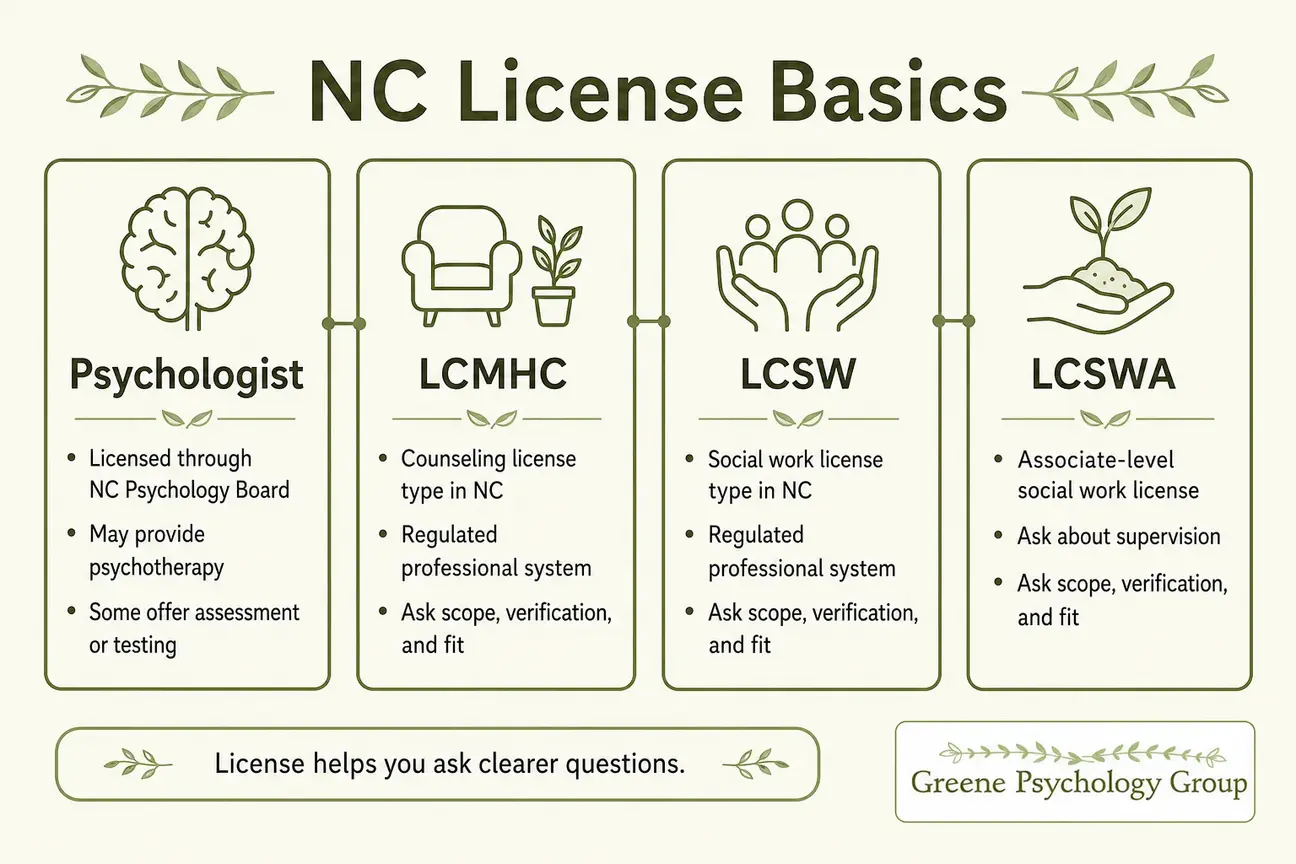
Therapist license types can feel like alphabet soup: psychologist, LCMHC, LCSW, LCSWA, and sometimes associate-level counseling licenses. License type is important because it tells you the clinician is regulated within a professional system. It does not automatically tell you who will feel like the best personal fit. Knowing the basic categories can also help you ask clearer questions about supervision, scope, and verification.
A licensed psychologist is licensed through the North Carolina Psychology Board. Psychologists may provide psychotherapy, and some psychologists may provide assessment or testing in certain settings, but you should not assume that every psychologist offers every service. If testing, documentation, or a particular kind of evaluation matters to you, ask directly before scheduling.
An LCMHC is a Licensed Clinical Mental Health Counselor. The North Carolina Board of Licensed Clinical Mental Health Counselors describes the LCMHC as an unrestricted, independent counseling license, and the board is the relevant place to review counseling licensure information. An LCMHCA, by contrast, is an associate-level counseling license for supervised practice. That is different from an LCSWA, which is a social work associate license.
An LCSW is a Licensed Clinical Social Worker. In outpatient therapy, an LCSW may provide clinical counseling services within the scope of that license. An LCSWA is a Licensed Clinical Social Worker Associate, meaning the clinician is practicing under supervision while progressing toward independent clinical social work licensure. “Associate” does not mean unlicensed or unregulated, but it does mean the supervision arrangement is a reasonable question to ask.
When comparing therapist license types, avoid ranking them as automatically better or worse. Instead, ask whether the clinician’s license is active, whether they practice independently or under supervision, and whether their training and experience fit your concern. Use licensure as one data point alongside communication style, clinical focus, privacy practices, and practical access.
Therapist questions for adults, parents, partners, and caregivers
Good therapist questions do not have to be complicated. They should help you understand whether the clinician works with your concern, how therapy is structured, and what practical details you need before starting. You can ask these questions by phone, by contact form, or in an initial consultation if one is offered.
- Do you work with adults, adolescents, couples, families, or caregivers?
- Do you commonly work with concerns like anxiety, depression, stress, grief, trauma, ADHD-related concerns, relationship strain, or life transitions?
- What license do you hold, and are you independently licensed or practicing under supervision?
- If you are an associate, who supervises your clinical work?
- How would you describe your general therapy approach?
- How do you decide what to focus on first?
- How do you discuss goals and progress?
- Do you offer in-person sessions, online therapy, or both?
- How do you involve parents, partners, or family members when appropriate?
- How do you handle privacy, between-session communication, and messages?
- Do you participate with my specific insurance plan?
- What should I verify with my insurer before starting?
- What happens if we decide the fit is not right?
These therapist questions are not a script you must follow word for word. Choose the ones that match your situation. If you are already overwhelmed, start with three: “Do you work with this concern?” “What would therapy generally look like?” and “What should I know about insurance or payment before scheduling?”
What parents should ask before therapy for a teenager
Parents often have a slightly different search process. They may be worried about a teen’s mood, anxiety, school stress, anger, social withdrawal, family conflict, grief, ADHD-related concerns, or behavior changes. At the same time, many teens need enough privacy to speak honestly in therapy. That balance is worth discussing before the first appointment.
Parents can ask whether the clinician works with adolescents, how parent participation is handled, and how the therapist communicates about safety concerns. It is also appropriate to ask how consent and confidentiality are explained to teens and parents. Because laws and clinical circumstances can vary, avoid relying on general internet summaries for minor consent questions. Ask the practice how these matters are handled in its intake paperwork and clinical process.
If you are trying to find a therapist for a teen, you can keep the first message brief. You might share your name, your teen’s age, a short reason for reaching out, preferred format, and insurance information. You do not need to send a detailed history through email or a contact form. Parent-focused questions can help you support your teen while still respecting the clinical relationship.
Compare in-person and online therapy realistically

Format can affect whether therapy is sustainable. Some people prefer a quiet office outside the home. Others need teletherapy because of transportation, caregiving, work schedules, health concerns, or distance. Neither format is automatically best for everyone.
Greene Psychology Group has offices in Raleigh and Asheville and offers online therapy in North Carolina for people who are physically in the state during the session. If online therapy is important to you, ask whether it is available for your situation, what technology is used, and what private space will be needed. If in-person therapy is important, ask which office options apply without assuming that every clinician offers every format.
When comparing formats, think about privacy at home, internet reliability, comfort speaking by video, travel time, and whether the setting helps you stay emotionally present. If other people can overhear you at home, online sessions may not feel private enough. If travel is a barrier, in-person sessions may be harder to maintain. These are practical concerns, not signs that you are doing therapy “wrong.”
Online-focused therapy consultation questions might include: “What should I do if privacy at home is limited?” “What happens if the connection drops?” and “How do you decide whether online sessions are clinically appropriate for my concern?”
Insurance, payment, and Good Faith Estimate questions
Insurance can be one of the most practical reasons people compare therapists. Greene Psychology Group is in-network with most Blue Cross Blue Shield and Aetna plans. Most other plans are out-of-network, and self-pay clients are accepted. This does not mean that a specific plan, copay, deductible, clinician, or service will be covered. You should confirm benefits with both your insurer and the practice.
Before scheduling, review the practice’s insurance and payment information and ask your insurer about deductibles, copays, coinsurance, out-of-network benefits, authorization requirements, referral requirements, claims, superbills, and reimbursement. It can also help to ask whether the specific clinician is credentialed with your plan, because participation can vary by plan and provider.
Uninsured and self-pay clients receive a Good Faith Estimate. Do not rely on a blog article to estimate your cost; ask the practice and your insurer for current plan-specific details.
Useful therapy consultation questions about payment include: “Are you in-network with my exact plan?” “What information should I verify with my insurer?” “If I am out-of-network, do you provide documentation I can submit?” “If I self-pay, how is the Good Faith Estimate provided?” Payment-related therapist questions are normal and appropriate, especially before the first appointment.
Privacy and communication before you send a message
Privacy starts before the first session. The HHS HIPAA information for individuals explains general privacy protections for health information, but no communication method should be treated as absolutely private. A practice’s specific confidentiality limits and communication policies are typically explained in intake paperwork.
Greene Psychology Group identifies its contact form and email as unencrypted. If you reach out, share only contact details and a brief reason for contacting the practice. Do not send detailed health information, trauma details, sensitive family information, or documents through email or the form unless the practice instructs you to use an appropriate secure method.
A brief first message can include your name, preferred contact method, whether you are seeking therapy for yourself or an adolescent, a short phrase about the concern, whether you prefer Raleigh, Asheville, or online sessions, and your insurance. You can contact Greene Psychology Group, call 919-205-5339, or email [email protected]. Because the site has noted phone problems, include email as an option.
Therapy consultation questions that reveal fit
Therapy consultation questions are most useful when they reveal how a therapist thinks and communicates. You are not interviewing someone to prove they are perfect. You are listening for whether they can explain their work in a way that feels understandable and respectful.
You might ask, “When someone comes in with a concern like mine, how do you usually begin?” A clear answer may include assessment, goal setting, history, current stressors, coping patterns, and a discussion of what therapy can and cannot offer. A cautious answer is not a bad sign; in fact, it can be reassuring when a therapist does not promise results before understanding your situation.
Another helpful question is, “How will we know whether therapy is helping?” The answer should not promise a timeline. It might describe revisiting goals, noticing patterns, tracking functioning, or discussing whether sessions feel useful. If you are a parent, you might ask how the therapist balances teen privacy with parent involvement and safety communication.
Use therapy consultation questions to notice communication style. Does the therapist slow down when something is unclear? Do they welcome questions about license, insurance, and privacy? Do they acknowledge when they need more information? These are part of fit. Well-chosen questions can also help you notice whether the therapist is careful about limits rather than overselling what therapy can do.
How the first conversation may feel
A first conversation can feel awkward even when the therapist is a reasonable match. You may be sharing something personal with someone you do not know yet. Nervousness, pauses, or uncertainty do not automatically mean the fit is wrong.
Instead, notice whether the conversation becomes clearer as it continues. Do you feel listened to rather than rushed? Does the therapist or practice representative answer practical questions directly? Are limits explained honestly, including when a service may not be appropriate? Do you feel allowed to think about it rather than pressured?
Possible concerns include feeling dismissed, being promised a certain result, being pressured to start immediately, not receiving clear answers about license or payment, or feeling unsafe. You can ask for clarification, take time to compare options, or decide not to continue. A first call is not a commitment to ongoing therapy.
When you find a therapist, fit is not only about warmth. It is also about boundaries, clarity, and whether the therapist can explain the work without overselling it. The same therapist questions that help before scheduling can still be useful after the first session if something feels unclear.
Using therapist license types and profiles together
Profiles can be helpful, especially when they list training, populations served, concerns addressed, and approaches used. Greene Psychology Group’s Greene Psychology Group clinicians page and psychologist in Raleigh page can help readers understand the practice’s clinicians and therapy approach language. A profile, however, should be read as a starting point rather than a promise of availability, assignment, insurance participation, or exact fit.
Compare profiles with your own priorities. If you are seeking support for anxiety, depression, stress, grief, ADHD-related concerns, relationships, trauma history, or life transitions, look for language that seems relevant and then ask direct questions. If you are comparing therapist license types, ask how the clinician’s license relates to their scope of practice, supervision if applicable, and the type of therapy offered.
It is also reasonable to ask what happens if the fit is not right. A therapist may be able to discuss other options, suggest a different level of care, or explain why another service might be more appropriate. That kind of boundary can be a sign of ethical care, not rejection. If you are trying to find a therapist through profiles alone, remember that profiles are only one part of the decision.
A calm next step if you are ready to reach out
If you are ready to choose a therapist or narrow your options, start with the basics: your main concern, who therapy is for, preferred format, insurance, and two or three questions that matter most. You can also write down what would help you feel comfortable enough to begin, such as a clear explanation of approach, parent involvement, online therapy requirements, or payment process.
Greene Psychology Group offers outpatient psychotherapy for adolescents and adults, with in-person office locations in Raleigh and Asheville and online therapy for people physically in NC during the session. The practice does not provide emergency or crisis services, medication prescribing, inpatient care, residential treatment, intensive outpatient programs, or court-ordered or custody evaluations.
To ask about fit, you may request an appointment, call 919-205-5339, or email [email protected]. Share only your contact information, a brief reason for reaching out, whether you prefer in-person or online sessions, and your insurance information. Please do not send detailed health information through email or the contact form.
Final thoughts on choosing with care
Learning how to choose a therapist is partly about information and partly about trust. Credentials, license status, therapy approach, insurance, and format all matter. So does how you feel when you ask a question and whether the response helps you feel more oriented.
You do not have to know exactly what therapy will look like before reaching out. You can begin with a brief concern, a few practical needs, and a willingness to ask questions. If the goal is to find a therapist who feels both clinically appropriate and practically possible, it is reasonable to compare options slowly and ask for clarification along the way.
This article is for general education and isn't a substitute for diagnosis or treatment from a licensed professional. If you are in crisis, call or text 988 or call 911.
Greene Psychology Group is not a crisis service. If there is immediate danger, call 911 or go to the nearest emergency room. For a mental-health or suicidal crisis, call or text 988 or use the 988 Suicide & Crisis Lifeline.
Frequently Asked Questions
Do I need a diagnosis before I contact a therapist?
No. You can contact a therapist with a general concern, such as stress, anxiety, low mood, grief, relationship strain, parenting worries, or a life transition. A licensed clinician can help assess what is happening and discuss whether their services are appropriate.
What if I do not know which therapy approach I need?
That is common. You can ask the therapist to explain their approach in plain language and how it might relate to your goals. You do not have to choose between CBT, ACT, DBT-informed work, EMDR, psychodynamic therapy, or other approaches before making contact.
Is an associate-level therapist a real therapist?
An associate-level clinician is licensed or regulated for supervised practice, but is not the same as an independently licensed clinician. It is reasonable to ask what license they hold, who supervises their clinical work, and how supervision is handled.
What should parents ask before starting therapy for a teenager?
Parents can ask whether the therapist works with adolescents, how parents are involved, how consent and confidentiality are explained, and how safety concerns are communicated. The practice should explain its own process rather than relying on general assumptions.
How do I know if online therapy is a good fit?
Consider whether there is a private space, reliable internet, comfort speaking by video, and whether the format supports the concern being brought to therapy. Ask the practice whether online therapy is available for your situation and what requirements apply.
What insurance information should I have ready?
Have your insurance company name, plan type, member information, and any questions about deductibles, copays, coinsurance, authorizations, and out-of-network benefits. You should verify benefits with both your insurer and the practice before assuming coverage.