

Perimenopause Anxiety: When Emotional Support May Help
Quick answer: perimenopause anxiety can include worry, irritability, sleep disruption, emotional intensity, or feeling less able to handle stress than usual. These experiences may occur during the menopause transition, but they can also overlap with work pressure, caregiving, relationship strain, health concerns, sleep loss, or an anxiety or mood condition. A licensed medical professional can evaluate physical symptoms and discuss medication or hormone-treatment questions, while psychotherapy may help with coping, relationships, stress, and adjustment. Greene Psychology Group does not prescribe medication or provide medication management.
If you are trying to understand changes in your emotions, it can help to slow the question down. Instead of asking, “Is this hormonal or is this anxiety?” it may be more useful to ask, “What patterns am I noticing, how are they affecting my life, and what kind of support would help me respond with more steadiness?” This guide uses practical support questions to help you organize what to notice, when to seek medical input, and how therapy may fit.
1. What can perimenopause mental health changes feel like?
Perimenopause is often discussed as a physical transition, but many people also notice emotional changes. Some describe a shorter fuse, more worry at night, less patience, stronger reactions to conflict, or a sense that ordinary demands feel harder to manage. This does not mean every emotional change is caused by hormones, and it does not mean a symptom list can explain your experience on its own.
MedlinePlus describes the years leading up to menopause as the menopause transition and notes that changes during this time can include sleep problems and mood changes. That kind of source can help name a possible context, but it still does not replace an individualized medical or mental-health assessment.
Possible emotional experiences during this season may include:
- Worry that feels harder to turn off
- Feeling tense, keyed up, or on edge
- Irritability or stronger emotional reactions
- Sleep disruption followed by next-day emotional strain
- Difficulty concentrating when stress is high
- Feeling overwhelmed by work, caregiving, relationships, or daily decisions
- Anxiety connected with physical sensations, such as feeling flushed, restless, or uncomfortable
The term perimenopause mental health can be useful because it leaves room for complexity. A person may be dealing with physical changes, disrupted sleep, old anxiety patterns, current stress, and changing identity or relationship roles all at once. A therapist can help sort through the emotional and behavioral parts of that picture, while a medical professional can evaluate physical symptoms and treatment options.
It is also possible for anxiety to look different than it has in the past. For some people, worry shows up as rumination. For others, it looks like irritability, avoidance, tension in relationships, or a sense of urgency that is hard to explain. The National Institute of Mental Health explains that anxiety disorders can involve persistent worry or fear that can interfere with daily activities, but only a licensed clinician can assess whether symptoms meet criteria for a mental-health diagnosis.
Because perimenopause mental health concerns often involve both body cues and life context, it can be helpful to describe changes in plain language. Instead of trying to label the problem perfectly, consider naming what is happening: “I am waking more often,” “I am snapping more quickly,” “I am worrying more at night,” or “I am avoiding things that used to feel manageable.” Those descriptions can support both medical and therapy conversations.
2. Are menopause anxiety symptoms a sign that I need an assessment?
People often search for menopause anxiety symptoms when they are trying to make sense of a change that feels unfamiliar. That search can be a starting point, but it cannot tell you what is causing your symptoms. Worry, sleep disruption, irritability, sadness, and difficulty concentrating can come from many sources, including stress, medical concerns, grief, relationship conflict, trauma reminders, depression, anxiety, or a combination of factors.
It may help to treat symptom lists as reflection prompts rather than proof. Notice what is happening, how often it happens, what seems to make it better or worse, and how it affects daily life. Then bring that information to the appropriate professional. A primary care clinician, gynecologist, psychiatrist, or other prescriber can address medical and medication-related questions. A therapist can help with coping skills, stress patterns, communication, emotional regulation, and adjustment.
The phrase menopause anxiety symptoms can also be misleading if it suggests that anxiety has one clear cause. Many people live through perimenopause while also navigating work demands, parenting or caregiving, aging parents, health changes, relationship shifts, financial pressure, or questions about identity and purpose. Therapy does not need to prove the “one cause” of anxiety in order to be useful. It can help respond to the pattern that is present now.
If menopause anxiety symptoms are affecting work, relationships, sleep, decision-making, or daily routines, that is a reasonable reason to ask for help. The goal is not to overreact or minimize the symptoms. The goal is to understand what is happening with enough care that the next step is clearer.
3. How can hormonal changes anxiety and life stress overlap?
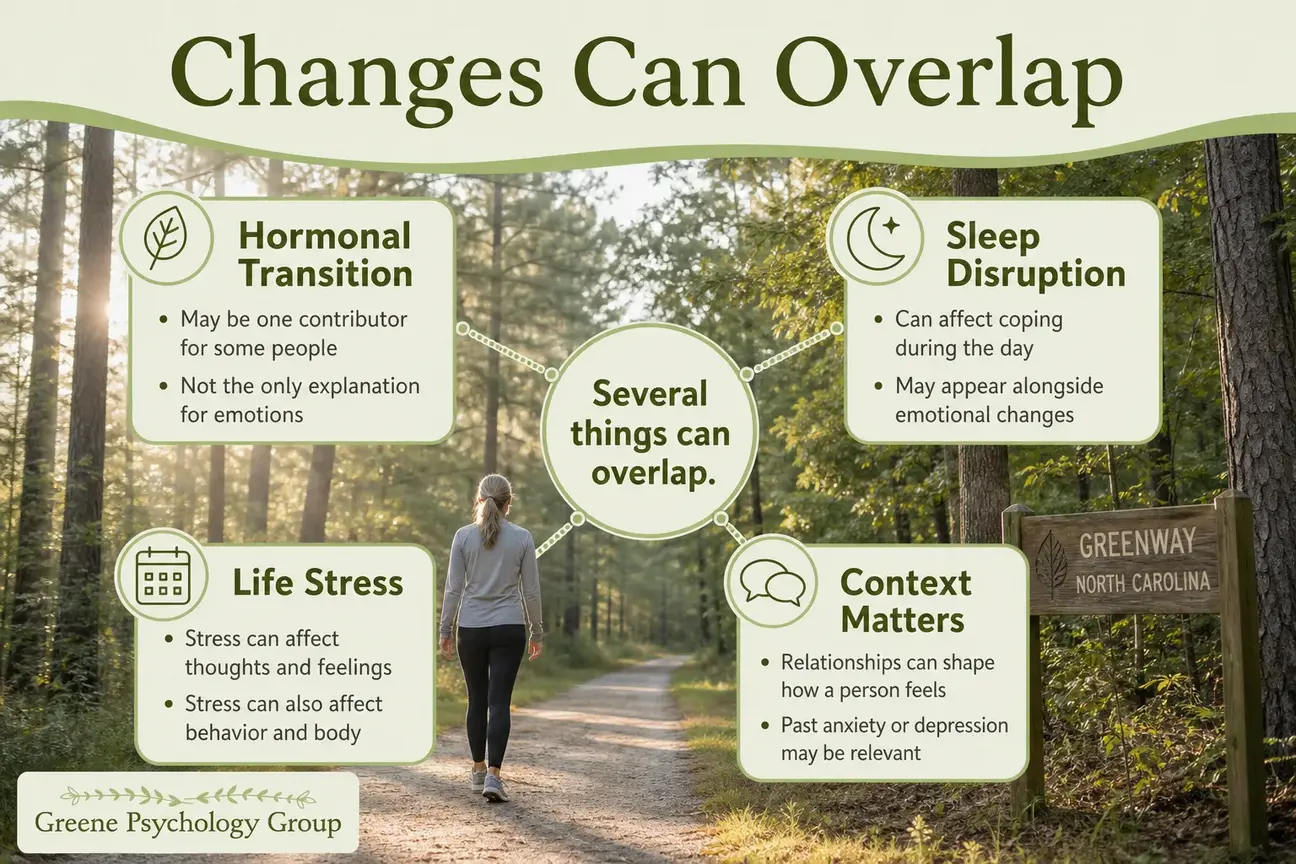
The search phrase hormonal changes anxiety reflects a real question: can body changes affect emotions? The careful answer is that hormonal transition may be one contributor for some people, but emotional symptoms are rarely understood well by looking at hormones alone. Sleep, physical discomfort, stress, previous anxiety or depression, relationships, and the meaning of the life transition can all shape how a person feels.
Stress can also affect the body and emotions in ways that resemble anxiety. The American Psychological Association describes stress as affecting thoughts, feelings, behavior, and the body. That matters during perimenopause because a person may be trying to interpret several signals at once: waking up during the night, feeling more reactive during the day, worrying about health, or becoming less tolerant of demands that used to feel manageable.
Sleep is one important bridge between physical and emotional experience. When sleep is interrupted, the next day may bring more worry, less patience, more sensitivity to conflict, or difficulty concentrating. Therapy cannot provide medical sleep treatment, but it can help identify the cycle between poor sleep, anxious thoughts, emotional reactivity, and coping habits.
Life stress may also become more visible during perimenopause. A person may realize that the load is too heavy, that saying yes has become automatic, or that managing others’ needs has left too little room for support. Sometimes the emotional changes that feel “out of nowhere” are also signals that long-standing stress patterns need attention.
Hormonal changes anxiety is therefore best understood as a question to explore, not a conclusion to make alone. A medical professional can assess physical contributors. A licensed therapist can help identify how stress, thoughts, emotions, relationships, and daily behavior are interacting.
It is also possible for hormonal changes anxiety concerns to bring up fear about the future. Some people worry that emotional changes will affect their relationships, work performance, parenting, or sense of self. Those concerns deserve compassion, and they can be discussed without assuming the worst or promising a simple answer.
4. What should I track before seeking help?
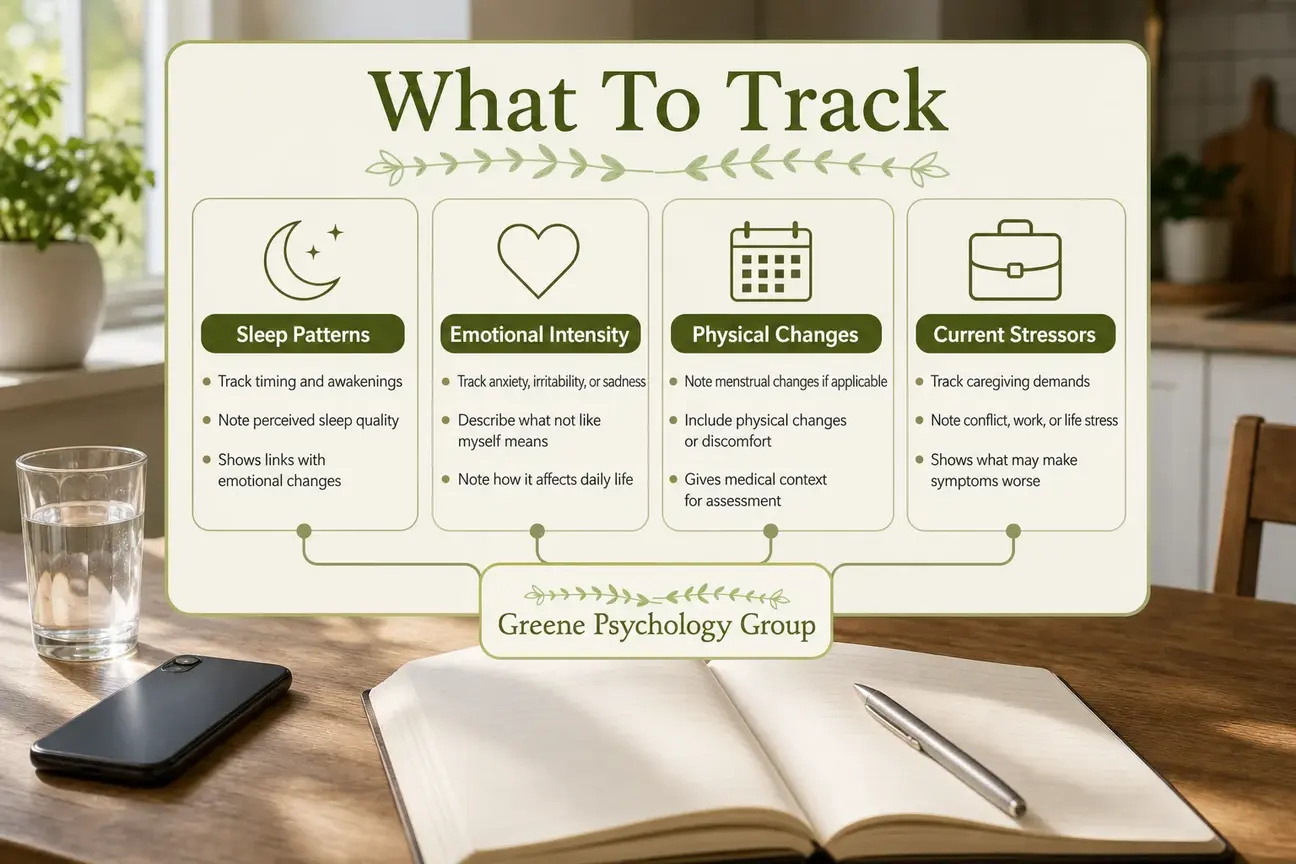
Tracking can make appointments more focused, especially when symptoms feel scattered. The goal is not to prove that perimenopause is the cause. The goal is to give a medical professional or therapist a clearer picture of timing, intensity, and impact.
| What to notice | Why it may help |
|---|---|
| Sleep timing, awakenings, and perceived sleep quality | Shows whether sleep disruption tends to appear before or alongside emotional changes |
| Anxiety, irritability, sadness, or emotional intensity | Helps describe what “anxious” or “not like myself” means in daily life |
| Menstrual or physical changes, if applicable | Gives a medical professional context for physical assessment |
| Stressors, caregiving demands, conflict, or work changes | Identifies situational patterns that may be increasing distress |
| Alcohol or caffeine patterns as observations | Helps describe habits without treating them as a diagnosis or treatment plan |
| Effects on work, relationships, self-care, or daily functioning | Clarifies whether additional support may be warranted |
| Questions for a clinician | Makes medical or therapy appointments more focused |
Try to keep tracking simple. A few notes in a calendar or phone can be enough. If tracking becomes another source of worry, it may be better to pause and discuss that with a professional. The purpose is to support care, not to monitor yourself perfectly.
This kind of tracking can also help with perimenopause mental health conversations in therapy. For example, patterns may show that irritability rises after several nights of poor sleep, that anxiety spikes before certain meetings, or that conflict with a partner becomes harder to repair when physical discomfort is high. Those observations can guide coping strategies without turning the tracker into a diagnostic tool.
Tracking may also clarify menopause anxiety symptoms that otherwise blend into the background. A brief note such as “woke at 3 a.m., worried most of the morning, avoided a difficult conversation” can be more useful than a long journal entry. Over time, small notes may reveal patterns that are hard to see in the middle of a stressful week.
5. When should I contact a medical professional?
It is reasonable to contact a medical professional when emotional or physical symptoms are new, persistent, worsening, difficult to explain, or interfering with daily life. This is especially important if sleep disruption, anxiety, sadness, irritability, or loss of enjoyment is becoming hard to manage, or if menstrual or physical changes raise questions.
You may also want medical guidance if a previous anxiety or depression pattern seems to be returning or changing. A medical professional can evaluate possible physical contributors, review health history, and discuss treatment options that are within their scope. If medication or hormone treatment is under consideration, those decisions belong with a prescriber.
Greene Psychology Group does not prescribe medication or provide medication management. Therapy can still be helpful alongside medical care because the two roles are different. Medical care can address physical symptoms, prescribing questions, and hormone-treatment decisions. Therapy can address coping, emotional regulation, stress, relationships, and adjustment.
Contacting a medical professional does not mean something is “wrong.” It simply means the symptoms deserve thoughtful attention. Many people benefit from having both medical and emotional support when a life transition affects sleep, mood, relationships, and daily functioning.
Medical care can also help when hormonal changes anxiety concerns are accompanied by physical symptoms that need evaluation. A therapist should not try to answer prescribing or hormone-treatment questions, but therapy can help organize concerns, reduce avoidance around appointments, and support coping while medical questions are being addressed.
6. How can therapy for perimenopause support coping and adjustment?
Therapy for perimenopause is not about treating hormones or replacing medical care. It is about supporting the emotional, behavioral, relational, and stress-related parts of the experience. If anxiety, irritability, or overwhelm is affecting life, therapy may help with understanding patterns and building more workable responses.
The National Institute of Mental Health describes psychotherapy as a range of treatments that can help people identify and change troubling emotions, thoughts, and behaviors. In the context of perimenopause-related distress, that might mean exploring how worry builds, how sleep disruption affects coping, how conflict escalates, or how self-criticism makes symptoms feel more frightening.
Therapy may support several parts of perimenopause mental health care:
- Coping with worry: noticing anxious thought patterns, reducing rumination, and practicing responses that fit personal goals
- Managing irritability: identifying early cues, slowing reactions, and repairing conversations when needed
- Reducing stress load: clarifying what is realistic to carry, where boundaries are needed, and what support may help
- Addressing sleep-related distress: working with worry and frustration around sleep without presenting therapy as medical sleep treatment
- Strengthening communication: discussing needs with partners, family members, or colleagues more clearly
- Navigating identity and transition: making space for grief, uncertainty, changing roles, or shifting priorities
- Coordinating questions: organizing concerns to bring to a medical professional, with permission when coordination is appropriate
For some clients, stress management therapy is the most natural starting point because the immediate concern is overload. For others, anxiety therapy may fit better when worry, panic-like sensations, avoidance, or rumination are central. If the concerns are broader, individual therapy can provide space to discuss anxiety, mood, relationships, and life transitions together.
Therapy for perimenopause should be collaborative. A therapist should not assume that every symptom is hormonal, psychological, or stress-related. Instead, therapy can help make sense of patterns, clarify what is in a person’s control, and identify when medical questions should be brought back to a prescriber or other medical professional.
Therapy for perimenopause may also include practical work around values, boundaries, and communication. A person might practice pausing before responding, preparing for a difficult conversation, or noticing the difference between a true urgent problem and an anxious urge to solve everything immediately. These skills do not erase physical symptoms, but they may reduce the emotional pileup around them.
7. What might therapy look like in practice?
A first therapy appointment often includes a discussion of what has been happening, what prompted the decision to reach out now, and what the client hopes will be different. Topics may include sleep, stress, relationships, work, health concerns, previous experiences with anxiety or depression, and what support has or has not helped before.
From there, therapy may focus on patterns. For example, the client and therapist might notice that worry increases when sleep is poor, that irritability appears when the client feels overextended, or that certain conversations lead to shutdown or escalation. These observations can guide coping skills and communication changes.
In practical terms, psychotherapy may include learning skills, reflecting on patterns, practicing new responses, and reviewing what is or is not helping over time. The work should be shaped around the client’s goals, clinical needs, and the therapist’s scope of practice.
Therapy should also include room to discuss fit. You can ask how the therapist approaches anxiety, stress, life transitions, menopause anxiety symptoms, and perimenopause-related concerns. You can ask how goals will be set, how progress will be discussed, and what happens if medical concerns become more prominent during therapy.
No therapist can promise a specific timeline or outcome. Progress may look different for each person. For one client, the goal may be fewer spirals of worry. For another, it may be better communication with a partner. For someone else, the work may center on boundaries, self-compassion, grief, or learning to pause before reacting.
Questions to ask about therapy fit
If you are considering therapy for perimenopause, it is not necessary to know exactly what kind of therapy you want before reaching out. It is enough to describe what is happening and ask whether the practice or therapist may be a fit. Helpful questions include:
- Do you work with adults experiencing anxiety, stress, sleep-related distress, irritability, or life transitions?
- How would therapy address both emotional symptoms and current life stress?
- What therapy approaches might be considered, and how would they be adapted to my goals?
- How will we discuss progress without treating symptom tracking as a diagnosis?
- What should I do if medical concerns come up during therapy?
- Is online therapy available if I am physically in North Carolina during the session?
- How are insurance benefits, out-of-network reimbursement, or self-pay arrangements handled?
These questions are especially useful when hormonal changes anxiety is part of what a person is trying to understand. A good therapy fit should leave room for both the body and the context of daily life. Therapy does not need to compete with medical care; it can support the emotional and relational parts of the same experience.
If relationship strain is part of what has become harder, relationship counseling may also be worth considering. Not every perimenopause-related concern requires relationship therapy, but communication, boundaries, and shared stress can become important parts of the picture.
Can therapy and medical care happen together?
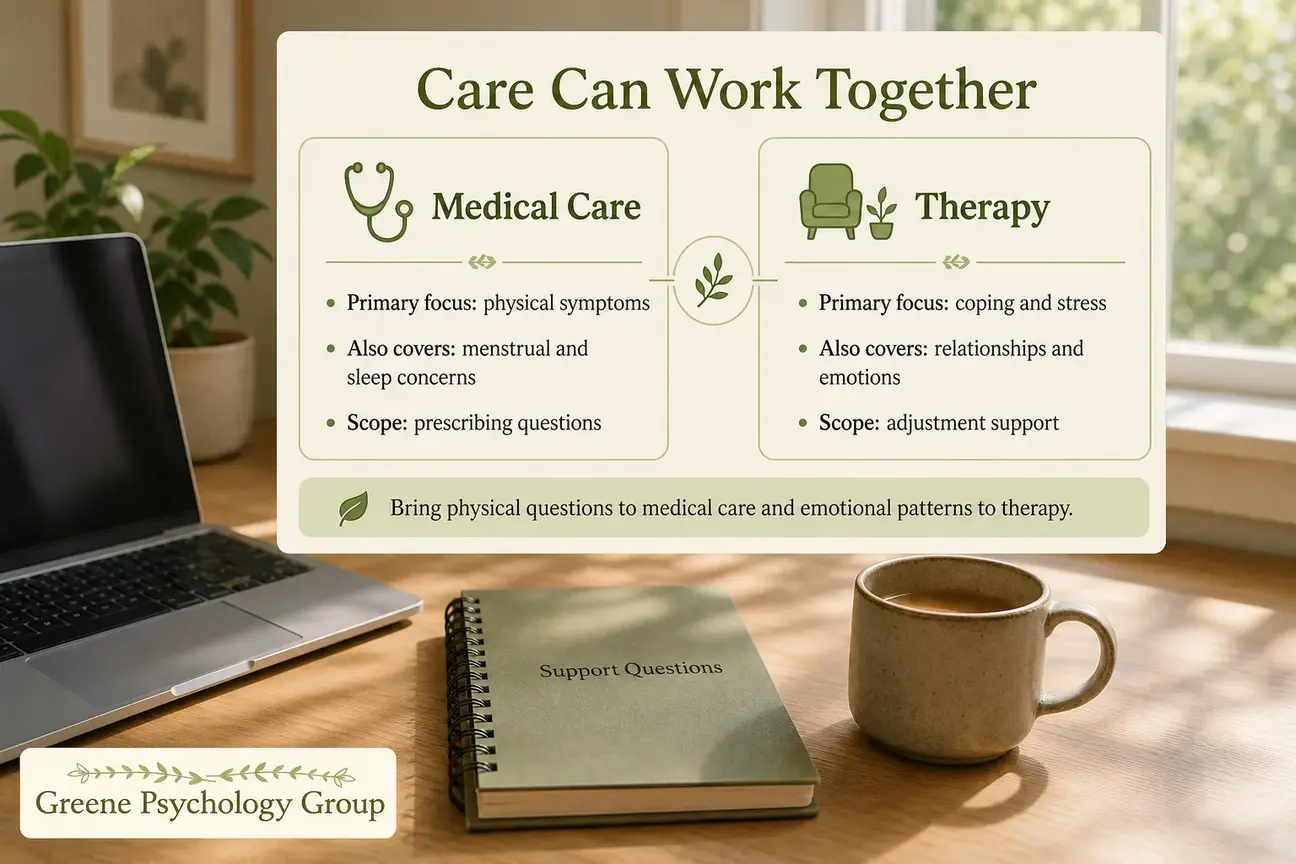
Yes. Therapy and medical care can happen at the same time because they address different needs. A medical professional can evaluate physical symptoms, menstrual changes, sleep concerns, and prescribing questions. A therapist can help with coping, stress, relationships, emotional regulation, and adjustment.
This distinction can reduce pressure to choose the “right” explanation too quickly. If possible menopause anxiety symptoms are showing up, physical questions can go to a medical professional and emotional patterns can be brought to a therapist. The information gathered in one setting may help shape clearer questions in the other.
With permission, a therapist may also help clarify what to ask a medical professional. That might include describing the timing of symptoms, noting sleep disruption, or naming concerns about mood, anxiety, or functioning. Therapy should not tell anyone what medication or hormone treatment to take. Those decisions belong with a prescriber.
It can also help to be honest if the process feels dismissive, confusing, or overwhelming. Therapy can provide a steady place to process those feelings, organize questions, and decide what next step feels manageable.
When therapy for perimenopause and medical care happen alongside each other, the work can become more organized. Medical appointments can focus on physical assessment and prescribing questions, while therapy can focus on coping, communication, stress patterns, and adjustment.
Practical options for starting support
Greene Psychology Group has offices in Raleigh and Asheville and offers online therapy in North Carolina for people physically located in the state during the session. If you are exploring support for anxiety, stress, emotional changes, or life transitions, you can contact Greene Psychology Group, call 919-205-5339, or email [email protected]. Because the site notes that phones may not be working properly, include email as an option.
When reaching out, share only contact details and a brief reason for the inquiry, such as anxiety, stress, irritability, sleep-related distress, perimenopause mental health concerns, or life-transition concerns. You can also mention whether an in-person or online format is preferred and include insurance information. The contact form and email are not encrypted, so avoid sending detailed health information through those channels.
For cost and coverage questions, review insurance and payment information. Greene Psychology Group is in-network with most Blue Cross Blue Shield and Aetna plans, out-of-network for most other plans, and accepts self-pay clients. Please verify benefits with both the insurer and the practice. Uninsured and self-pay clients receive a Good Faith Estimate under the No Surprises Act.
Where perimenopause anxiety fits in the bigger picture
If feeling unlike yourself, it can be tempting to search for one explanation. Sometimes that search brings relief. Other times, it creates more pressure: “Is it hormones? Is it stress? Is it anxiety? Is it my relationship? Is it my job?” A more compassionate answer may be that several things can be true at once.
Perimenopause anxiety can be a useful phrase when it helps name a concern and opens the door to support. It becomes less useful if it creates a sense of certainty about something that still needs assessment. Your experience deserves careful attention, not a rushed conclusion.
If tracking changes, talking with a medical professional, and considering therapy are on the table, that is not an overreaction. It is a way of gathering support for a transition that can affect the body, emotions, relationships, and daily life. Emotional support may not remove every symptom, but it may help a person feel less alone with the patterns they are trying to understand.
This article is for general education and isn't a substitute for diagnosis or treatment from a licensed professional. If you are in crisis, call or text 988 or call 911.
Greene Psychology Group is not a crisis service. For immediate danger, call 911 or go to the nearest emergency room. For a mental-health or suicidal crisis, call or text 988; SAMHSA provides information about the 988 Suicide and Crisis Lifeline.
Frequently Asked Questions
Can perimenopause cause anxiety?
Anxiety symptoms may occur during perimenopause, but it is usually too simple to say that perimenopause is the only cause. Hormonal transition, disrupted sleep, life stress, physical symptoms, and a previous anxiety or mood pattern may overlap. A medical professional can evaluate physical contributors, and a therapist can help with coping and emotional patterns.
What are common menopause anxiety symptoms?
People may notice worry, tension, irritability, sleep disruption, difficulty concentrating, or feeling overwhelmed. These experiences are not a diagnostic test. They can reflect several possible contributors, including stress, health concerns, sleep loss, anxiety, depression, or the adjustment demands of a life transition.
How can I tell whether anxiety is related to perimenopause or stress?
You may not be able to tell on your own, and the causes may overlap. Tracking sleep, physical changes, emotional intensity, stressors, and daily impact can support a clearer conversation with a medical professional or therapist. Tracking can support assessment, but it cannot diagnose the cause.
Should I see a doctor or therapist for perimenopause anxiety?
Consider a medical professional for physical symptoms, menstrual changes, sleep concerns, and medication or hormone-treatment questions. Consider therapy when anxiety, irritability, relationship strain, stress, or adjustment concerns are affecting daily life. Many people use both types of support because they serve different roles.
Can therapy help with perimenopause-related irritability and sleep disruption?
Therapy may help with emotional responses to poor sleep, stress, communication, coping skills, and adjustment. It should not be presented as medical treatment for hormonal changes or sleep disorders. If sleep disruption or physical symptoms are persistent or concerning, a medical professional can evaluate those concerns.
Does Greene Psychology Group prescribe medication or hormone treatment?
No. Greene Psychology Group does not prescribe medication or provide medication management. Medication and hormone-treatment decisions belong with a prescriber. Therapy can still support coping, stress management, relationships, emotional regulation, and adjustment while you work with medical professionals as needed.
What should I ask before starting therapy?
You can ask whether the therapist works with adults experiencing anxiety, stress, irritability, sleep-related distress, life transitions, or perimenopause-related concerns. You can also ask about therapy approaches, online or in-person format, confidentiality, communication between sessions, how progress is discussed, and how medical concerns are handled.
Can I use insurance for therapy?
Greene Psychology Group is in-network with most BCBS and Aetna plans, out-of-network for most other plans, and accepts self-pay clients. Coverage depends on your specific plan, so verify benefits with both your insurer and the practice. Uninsured and self-pay clients receive a Good Faith Estimate without quoting fees in advance.