

Help Teen Anxiety: 7 Practical, Safe Parent Moves
Quick answer: Parents can help teen anxiety by listening before advising, validating the teen’s experience without confirming every feared outcome, offering choices, and watching for changes in daily functioning. A parent does not need to diagnose a teenager to be helpful. If worry is persistent, intensifying, or interfering with school, sleep, friendships, activities, or self-care, a consultation with a licensed clinician may be appropriate.
It can be hard to know what to do when a teen seems anxious. Some teenagers shut down, some ask for repeated reassurance, some get irritable, and some appear “fine” while quietly avoiding more and more of life. A parent’s first job is not to find the perfect phrase or solve everything quickly. It is to stay steady enough that the teen does not feel alone with what is happening.
This article offers a practical, non-diagnostic framework for noticing teen anxiety signs, starting a conversation, offering teen anxiety support, and deciding when professional help may be worth exploring. It also covers therapy confidentiality for adolescents, parent involvement, and how to manage a parent’s own reaction when worry or frustration rises.
What might be ordinary stress, and what may warrant assessment?
Stress is part of adolescence. Teens may feel nervous before exams, tryouts, performances, social plans, family changes, or big decisions. A stressful week does not automatically mean a teen has an anxiety disorder. The more useful question is: Is the worry easing with support and time, or is it becoming persistent, intense, and limiting?
The National Institute of Mental Health notes that parents can watch for changes in mood, behavior, sleep, school performance, and relationships, and consider seeking help when concerns persist or interfere with daily life. This is a guide for noticing patterns, not a way to diagnose at home. NIMH child and adolescent mental health guidance emphasizes that mental-health concerns in young people should be understood in context.
Teen anxiety signs can overlap with many other experiences. A teenager who avoids school might be anxious, depressed, exhausted, overwhelmed by social conflict, struggling with attention, dealing with trauma reminders, coping with physical symptoms, or facing stressors they have not yet shared. A licensed clinician can assess the broader picture, including development, family context, school functioning, medical considerations, and the teen’s own perspective.
| More consistent with temporary stress | May warrant professional assessment |
|---|---|
| Linked to a specific event and gradually eases | Persists, intensifies, or repeatedly returns |
| Daily functioning remains mostly intact | Interferes with school, sleep, relationships, activities, or self-care |
| The teen can still use support and recover | Avoidance, distress, or family conflict is increasing |
| The teen is willing to talk or accept some support | The teen asks for help, shuts down, or the family feels stuck |
This table is a reflection tool, not a test. If a teen’s distress seems disproportionate to the situation, keeps returning, or narrows their life, it may be time to ask for professional input.
Teen anxiety signs parents may notice without turning it into a test
Parents often notice patterns before they know what to call them. Teen anxiety signs may show up as repeated worry, avoidance, irritability, reassurance-seeking, trouble sleeping, difficulty concentrating, physical complaints, or a sudden drop in participation. Some teens become more perfectionistic. Others stop turning in work, avoid friends, or spend more time in their room.
It is important to avoid using a symptom list as proof. Anxiety disorders involve fear, worry, or avoidance that can be excessive or difficult to control and can interfere with life, but only a qualified professional can assess whether a diagnosis fits. NIMH’s anxiety disorders overview describes anxiety disorders as involving more than temporary worry or fear.
Parents can track broad changes respectfully. Instead of monitoring every mood shift, notice patterns such as missed school, repeated requests to come home, difficulty sleeping, withdrawal from activities, increased conflict before leaving the house, or avoidance of ordinary responsibilities. This kind of observation can help a parent describe concerns to a pediatrician, school counselor, or therapist without making a teen feel watched.
When discussing teen anxiety signs with a teen, avoid labels at first. “I’ve noticed mornings have been harder lately” may feel less threatening than “Your anxiety is getting worse.” The goal is to open a door, not convince the teen that a parent’s interpretation is correct.
It can also help to notice what happens before and after the anxious moment. Do teen anxiety signs appear before school, social plans, tests, bedtime, practice, family transitions, or conflict? Patterns can guide a calmer conversation and help a clinician understand what support might fit.
Help teen anxiety with 7 practical, safe parent moves
A helpful parent response balances care with autonomy. Teens need to know a parent is paying attention, but they also need room to have their own thoughts, preferences, and pace. If support turns into constant checking, forced reassurance, or urgent problem-solving, the teen may feel less safe opening up.
One way to keep that balance is to ask, “Am I trying to understand, or am I trying to make my own discomfort stop?” This question can be especially useful when parenting anxious teens. A parent’s fear can quickly become a push for immediate answers, while a teen may need time to name what is happening.
1. Choose a calmer moment
Begin when no one is rushing, arguing, or visibly overwhelmed. A teen may be more able to listen when the conversation is not happening in the middle of a school refusal, bedtime conflict, or emotional spike. If the moment is already heated, focus first on lowering the temperature: fewer words, a quieter voice, and a short pause if needed.
2. Start with observation, not diagnosis
Try naming what you have noticed without deciding what it means. “I’ve noticed mornings have been harder lately” is usually easier to hear than “Your anxiety is out of control.” Observations can include sleep, school, routines, social withdrawal, or repeated distress, but they should not be presented as proof of a diagnosis.
3. Reflect before advising
Before offering a solution, repeat the heart of what the teen said. A brief reflection such as “You’re worried you’ll embarrass yourself if you go” can help the teen feel heard. Advice is sometimes useful, but it usually lands better after the teen believes the parent understands the concern.
4. Validate feelings without confirming feared predictions
Validation means communicating that the feeling makes sense from the teen’s point of view. It does not require agreeing that the feared outcome is likely. “That sounds overwhelming” is different from “You’re right, this will go badly.” This distinction helps parents stay compassionate without strengthening the fear.
5. Offer choices instead of taking over
Ask whether the teen wants listening, problem-solving, space, or help finding support. Choices can be small: talk now or later, walk or sit, text or speak, start with one task or another. When a teen has some say in the process, support may feel less like control.
6. Support routines and small next steps
Focus on manageable actions rather than a complete life overhaul. A parent might help simplify the morning, identify the next assignment, plan one conversation with a teacher, or choose one calming strategy the teen is willing to try. The goal is not to make anxiety disappear in one step, but to reduce overwhelm enough that movement is possible.
7. Consider professional support when functioning is affected
Therapy or another professional consultation may help when worry is persistent, impairing, or causing repeated family conflict. A parent does not need to have the “right” diagnosis before asking for guidance. A licensed clinician can help assess what is happening and what type of support may fit.
These moves are not a guarantee, and they will not fit every teen in the same way. They are meant to lower pressure and keep communication possible.
When parenting anxious teens, it is also worth noticing the difference between support and rescue. Support helps a teen face a manageable next step with backup. Rescue removes every uncomfortable situation so quickly that the teen may not get a chance to learn what they can handle with help.
Parenting anxious teens starts with listening and validation
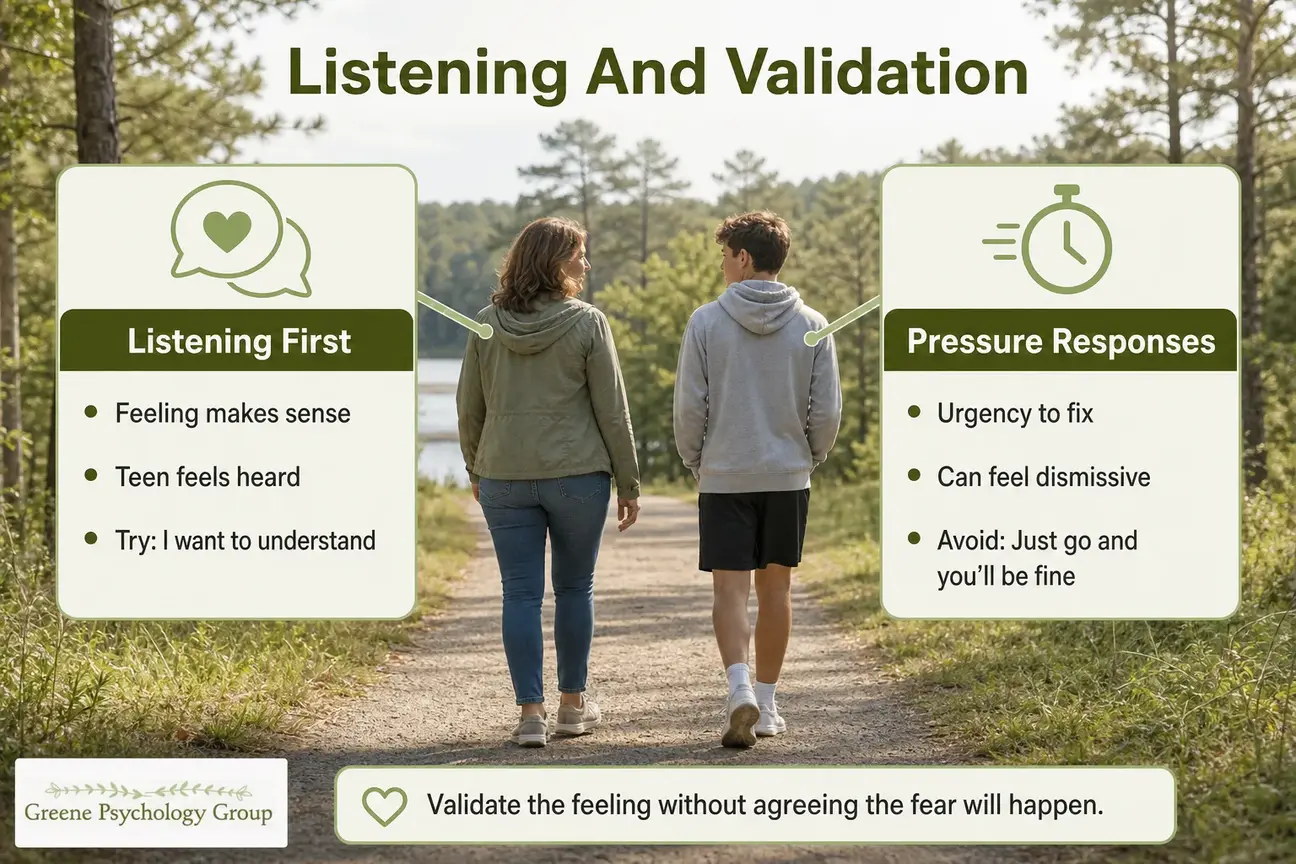
Parenting anxious teens often brings up understandable urgency. A parent may want to say, “There’s nothing to worry about,” “Everyone feels that way,” or “Just go and you’ll be fine.” Those statements usually come from love, but they can leave a teen feeling dismissed.
Validation does not mean agreeing that every feared outcome is likely. It means communicating that the feeling makes sense from the teen’s perspective. Try phrases such as:
- “That sounds really overwhelming.”
- “I can see why you would want to avoid that.”
- “I’m glad you told me, even if we don’t know the next step yet.”
- “I’m not here to lecture. I want to understand.”
- “Would listening, thinking through options, or finding someone else to talk with feel most useful?”
Validation can be paired with calm limits. If a teen avoids every stressful situation, the family may need support deciding what to hold steady and where to be flexible. Avoid forcing exposure exercises or demanding that a teen “just face it” without professional guidance, especially if distress is intense or there are other safety concerns.
Reassurance can also become a cycle. A teen may ask, “Are you sure I won’t fail?” or “Are you sure everyone isn’t mad at me?” A brief, warm response can help in the moment. But if reassurance is requested repeatedly and never lasts, it may be more useful to shift toward coping: “I’ve answered that, and I know the worry is still loud. What helped you ride it out last time?”
Parenting anxious teens may require repeating the same steady message many times: “I believe this feels hard, and I also believe we can take the next step carefully.” That combination of empathy and confidence can be more useful than arguing with the worry.
How to talk to anxious teen without escalating pressure
Many parents search for how to talk to anxious teen because they worry about saying the wrong thing. There is no perfect script, but a few principles help: be specific, be brief, be curious, and avoid turning the first conversation into an interrogation.
Start with an observation and care:
- “I’ve noticed you seem more worried lately, and I want to understand what it’s been like for you.”
- “Mornings have looked harder this month. I’m not mad. I’m wondering what’s making them so difficult.”
- “You do not need to explain everything right now. I want you to know I’m available.”
Then offer choices. Some teens talk better while walking, driving, texting, or doing something side by side. If the phrase talk to anxious teen is what brought you here, the deeper goal is not a flawless speech. The goal is a conversation that helps the teen feel less alone and a little more able to name what is happening.
Open-ended questions can reduce pressure:
- “What has felt hardest recently?”
- “When does the worry show up most?”
- “What do you notice in your body or thoughts when it happens?”
- “Is anything making school, sleep, friendships, or activities harder?”
- “What kind of support would feel useful from me?”
- “Would talking now, texting, taking a walk, or revisiting this later feel easier?”
- “Would talking with a counselor, pediatrician, or another trusted adult feel possible?”
These are conversation openers, not clinical assessment questions. If a teen gives short answers, try not to fill the silence too quickly. A calm “Thank you for telling me that much” can keep the door open.
It may take several tries to talk with an anxious teenager in a way that feels natural. If one conversation goes poorly, repair matters. A parent can say, “I pushed too hard earlier. I’m sorry. I still care, and I’ll try to listen better next time.”
Teen anxiety support at home: practical help that stays low-pressure
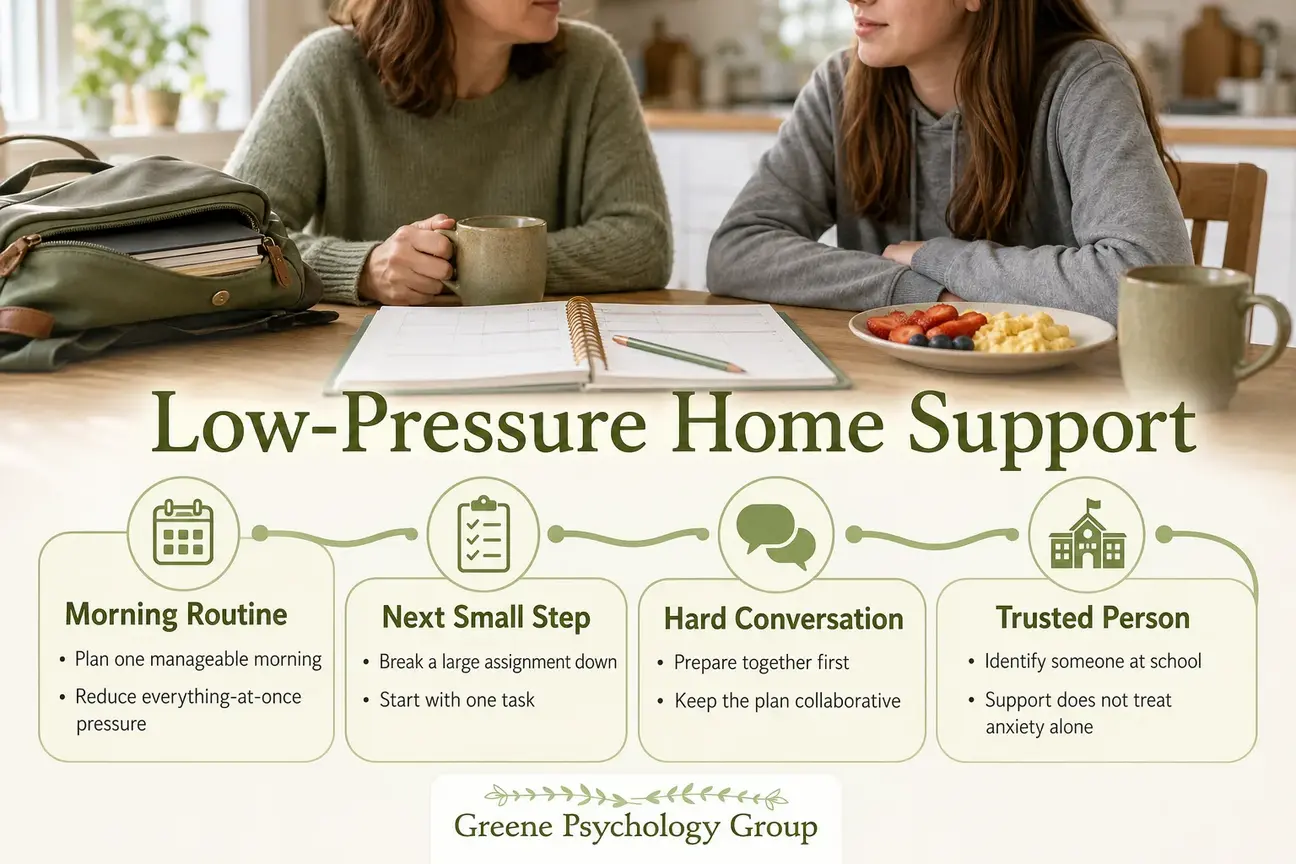
Teen anxiety support at home is usually most helpful when it is collaborative. Instead of announcing a new plan, ask what has helped before and what feels realistic now. Teens are more likely to participate when they have some ownership.
Low-pressure supports may include helping a teen plan a manageable morning routine, break a large assignment into the next small step, prepare for a difficult conversation, or identify a trusted person at school. These steps do not “treat” anxiety by themselves, but they can reduce the sense that everything must be handled at once.
Basic rhythms can also matter. Sleep, meals, movement, breaks from screens, and connection with trusted people can support general well-being. Present these as supports, not cures. A teen who feels blamed for being anxious may hear routine suggestions as criticism, so tone matters: “Would it help if we made tomorrow morning simpler?” often lands better than “You need a better schedule.”
Brief calming strategies may be useful if the teen is receptive. A parent might invite a teen to slow the exhale, name a few things in the room, step outside for a few minutes, or take a short break before returning to a task. Ask permission first. “Do you want to try something with me, or would that feel annoying right now?” respects autonomy.
As part of teen anxiety support, parents can also encourage continued participation in valued activities where feasible. That does not mean forcing a teen into situations they are not ready to handle. It means gently protecting the parts of life that matter to them while seeking guidance if avoidance keeps growing.
Effective teen anxiety support often sounds ordinary: fewer lectures, clearer expectations, predictable routines, and brief check-ins that do not turn every anxious moment into a long discussion. Small changes in the home environment can reduce pressure while a family decides whether more help is needed.
School, sleep, and daily-function changes to watch
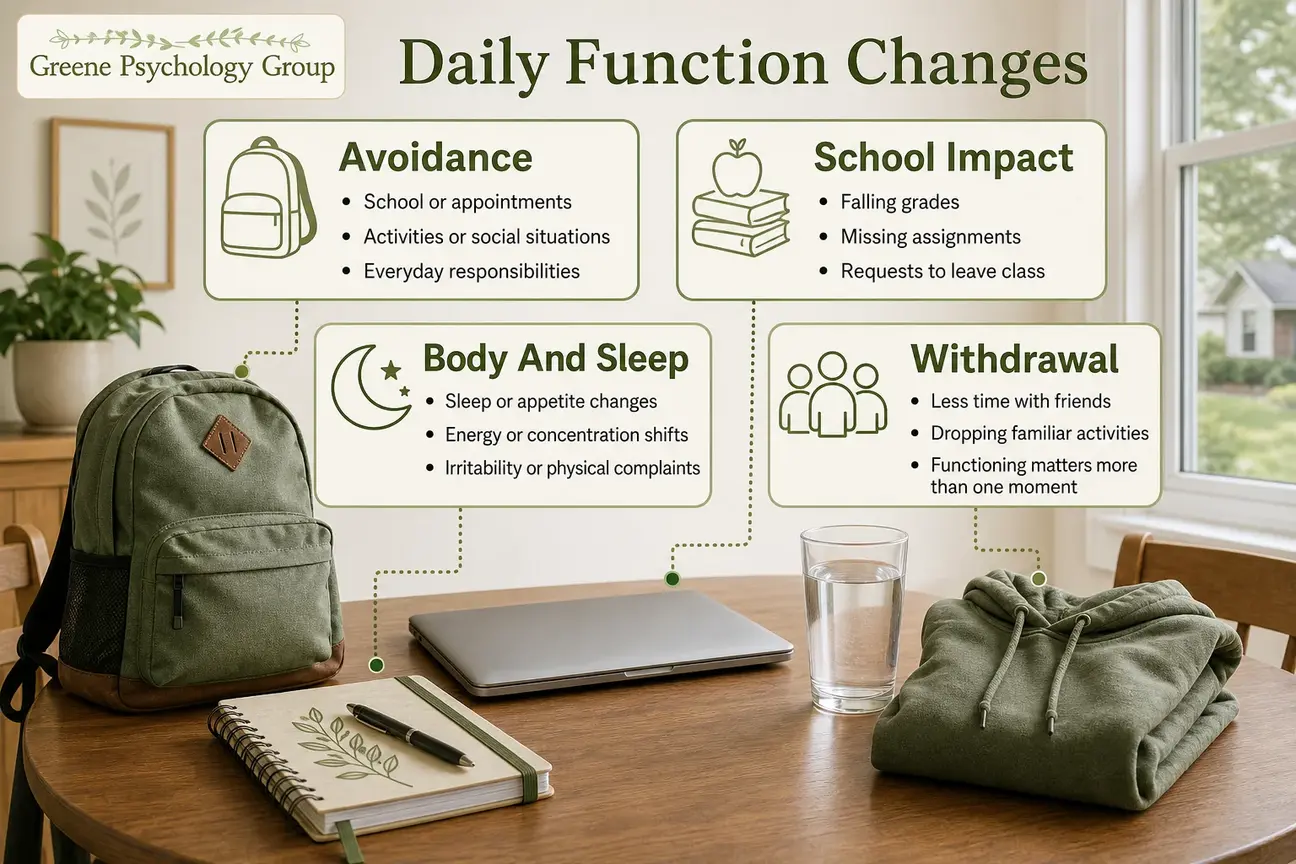
Functioning is often more informative than a single emotional moment. A teen may be worried and still functioning well with support. Another teen may say very little but gradually stop attending school, seeing friends, sleeping normally, or completing ordinary responsibilities.
Changes that may deserve attention include:
- New or increasing avoidance of school, appointments, activities, social situations, or everyday responsibilities.
- Falling grades, missing assignments, difficulty staying in class, or repeated requests to leave school.
- Noticeable changes in sleep, appetite, energy, concentration, irritability, or physical complaints.
- Withdrawal from friends or activities the teen previously valued.
- Increasing family conflict around reassurance, attendance, routines, or leaving home.
- Distress that does not ease as the situation changes or keeps returning in new forms.
When noting teen anxiety signs, keep records simple and respectful. A parent might jot down dates, patterns, and functional changes to share with a professional if needed. Avoid reading journals, searching devices, or monitoring every emotion unless there is an immediate safety concern and urgent help is needed.
School support can be practical rather than dramatic. If a teen is open to it, a parent might ask whether a school counselor, teacher, advisor, or administrator could help with a plan. Keep the teen involved in the conversation when possible, especially if they are worried about embarrassment or loss of control.
Parents can also watch for improvement. If routines stabilize, avoidance decreases, and a teen can talk more openly, that is useful information. If anxiety-related patterns continue to expand across settings, a professional assessment may help clarify what is driving the pattern.
When therapy or another professional consultation may help
Professional support may be appropriate when anxiety persists, keeps returning, or interferes with daily life. It may also help when parent-teen conversations repeatedly become conflictual, reassurance no longer helps, the teen asks for support, or the family wants guidance about communication and next steps.
Greene Psychology Group offers individual therapy for adolescents and adults, and parents looking for anxiety-related care can also learn more about anxiety therapy. Therapy does not require a parent to arrive with a diagnosis already figured out. An initial conversation typically explores what the teen and family noticed, what the teen wants help with, how functioning has changed, and how parents may be involved.
NIMH describes psychotherapy as a treatment in which people work with a trained mental-health professional to identify and change troubling emotions, thoughts, and behaviors. It also states that evidence-based psychotherapies have been shown to reduce symptoms of anxiety and other mental disorders, while the right approach depends on the person and situation. See NIMH’s psychotherapy overview for a general explanation of therapy.
Depending on the teen’s needs, therapy might focus on understanding worry patterns, building coping skills, practicing communication, reducing avoidance over time, or addressing related mood, stress, attention, trauma, or family concerns. Some families also benefit from family therapy when communication patterns, conflict, or shared stress are affecting the household. Family therapy is not required for every anxious teen, but it can be one option when the family system needs support.
For families considering logistics, Greene Psychology Group offers online therapy in North Carolina for people physically in the state during the session. Parents should ask the practice about adolescent fit, parent participation, consent, privacy, and whether in-person or online care is appropriate for their situation.
Questions to ask before scheduling
Before scheduling, it is reasonable to ask practical questions. Parents can ask what kinds of concerns the practice sees, how adolescent therapy begins, how parents are included, what communication methods are used, and how insurance is handled. Greene Psychology Group is in network with most BCBS and Aetna plans, out of network for most other plans, and accepts self-pay; families should verify benefits with both the insurer and the practice. Parents can review insurance and payment information without relying on any quoted fee here.
Uninsured and self-pay clients receive a Good Faith Estimate under the No Surprises Act. This estimate is provided without requiring families to rely on any fee quoted in this article.
To reach out, contact Greene Psychology Group, email [email protected], or call 919-205-5339. Because email and the contact form are unencrypted, share only contact details, a brief reason for reaching out, whether Raleigh, Asheville, or online sessions are preferred, and insurance information. Do not send detailed health information by email or the contact form.
What parents should ask about teen therapy confidentiality
Confidentiality can feel complicated for parents. A parent may want to know enough to keep a teen safe and support treatment, while the teen may need privacy to speak honestly. Rather than assuming how it works, ask the practice directly how consent, confidentiality, parent participation, communication, records, and safety concerns are handled for adolescent therapy.
In applicable health-care settings, HIPAA provides federal privacy protections for health information, and HHS explains HIPAA rights for individuals. At the same time, minor consent and parent access can depend on specific circumstances and practice policies. This article cannot provide legal advice or blanket rules. The practice’s intake paperwork should explain its own confidentiality limits and communication procedures.
Useful questions include:
- “What information is shared with parents?”
- “What remains private between the teen and therapist?”
- “How are safety concerns handled?”
- “How are treatment goals discussed with the family?”
- “How can parents support treatment without requiring the teen to report every detail?”
- “Who may contact the therapist, and what communication method should we use?”
- “How are records, scheduling, and billing communications handled?”
Confidentiality is not about excluding parents. It is often part of creating enough trust for a teen to speak openly. Parents can still play an important role by supporting attendance, practicing communication changes at home, and sharing relevant observations through the agreed-upon process.
Parenting anxious teens while managing your own reaction
Parenting anxious teens can activate a parent’s fear, guilt, anger, or urgency. A parent may wonder whether something was missed, whether school should change, whether to push harder, or whether backing off means not doing enough. Those reactions are human. They also need somewhere to go other than directly onto the teen.
Try pausing before responding when a parent’s own nervous system is escalating. Taking a breath, lowering the voice, or saying, “I want to respond well, so I’m going to take a minute,” can model regulation without making the teen responsible for calming the parent down.
It can help to separate safety from control. Safety means paying attention to risk, seeking help when needed, and maintaining reasonable boundaries. Control often looks like demanding every detail, repeatedly asking if the teen is okay, or making anxiety-related avoidance a moral issue. Teens often respond better when parents are calm, clear, and collaborative.
If the household is caught in repeated conflict, parent support or family sessions may be worth considering. The goal is not to blame parents or teens. It is to understand the pattern and create a plan that protects connection while still supporting daily responsibilities.
Parenting anxious teens is rarely about one perfect response. More often, it is a pattern of returning to calm, repairing missteps, and showing that anxiety can be discussed without shame or panic.
Teen anxiety support that respects autonomy
The most sustainable teen anxiety support usually includes both compassion and choice. A teen may not choose every responsibility, but they can often choose how to approach support: talking now or later, texting or speaking, starting with a parent or another adult, trying one small step, or asking for professional help.
Autonomy also means inviting the teen into the plan. Instead of “Here is what we’re doing,” try, “Here are a few options. Which one feels least overwhelming?” When a teen helps shape the next step, they may feel less trapped and more willing to participate.
Parents can also be honest about uncertainty. “I don’t know the perfect answer, but we can figure out the next step together” is often more comforting than a forced promise that everything will be fine. The goal is steady support, not perfect certainty.
When teen anxiety support respects autonomy, it does not abandon limits. A parent can be warm and still hold expectations around school, sleep, respectful communication, safety, and treatment follow-through. The difference is that expectations are discussed in a way that leaves room for collaboration.
When urgent help is needed
Keep crisis concerns separate from ordinary anxiety support. If a teen is in immediate danger, call 911 or go to the nearest emergency room. If there is a mental-health or suicidal crisis, call or text 988 or chat through the 988 Suicide & Crisis Lifeline.
If a teen discloses suicidal thoughts, immediate danger, or risk of harm, do not promise secrecy. Stay with the teen if it is safe to do so, involve a trusted adult or emergency support, and seek help promptly. Avoid asking for graphic details or trying to manage a crisis alone.
A steady next step for parents
A parent does not need to decide in one conversation whether a teen needs therapy. Start by listening, watching functioning, asking better questions, and reducing the pressure to solve everything immediately. If worry keeps narrowing a teen’s life or family conversations feel stuck, professional consultation may help clarify the next step.
The goal is not to remove every uncomfortable feeling from adolescence. It is to help the teen feel less alone, more understood, and better supported while the family decides whether additional help is needed. Parents who want to help a teen with anxiety can begin with calm presence, practical support, and a willingness to ask for guidance when the situation feels bigger than the family can manage on its own.
Parents may return to the same basics again and again: notice teen anxiety signs, listen before advising, use teen anxiety support that preserves autonomy, and ask for help when parenting anxious teens starts to feel beyond what the family can manage alone. If it feels hard to talk with an anxious teen, that does not mean the relationship is failing. It may simply mean the family needs a slower pace, a different format, or added support.
This article is for general education and isn't a substitute for diagnosis or treatment from a licensed professional. If you are in crisis, call or text 988 or call 911.
For immediate danger, call 911 or go to the nearest emergency room. For a mental-health or suicidal crisis, call or text 988.
Frequently Asked Questions
How can I help my teen with anxiety without making it worse?
Listen first, reflect what you heard, validate the emotional experience, and ask what kind of support would feel useful. Avoid minimizing, interrogating, or taking over every decision. If anxiety is persistent or affecting school, sleep, relationships, or daily life, consider consulting a licensed clinician.
What are common teen anxiety signs parents may notice?
Parents may notice broad changes such as repeated worry, avoidance, sleep changes, concentration problems, physical complaints, irritability, withdrawal, reassurance-seeking, or school difficulties. These signs are not a diagnostic test. A licensed clinician considers the full context before making any diagnosis.
What should I say when my teen refuses to talk?
Reduce pressure and leave the door open. A parent might say, “I won’t force you to talk right now, but I care and I’m available.” Offer another format, such as texting, walking, or talking with another trusted adult or counselor.
When should a parent seek therapy for an anxious teenager?
Therapy may be worth considering when worry persists, intensifies, repeatedly returns, or interferes with daily life. It may also help when the teen asks for support, school or sleep is affected, or parent-teen conversations keep becoming conflictual.
Can parents attend a teenager’s therapy sessions?
Parent involvement varies by teen, therapist, goals, and safety considerations. Parents should ask the practice how parent participation, updates, privacy, treatment goals, and safety concerns are handled before therapy begins.
What should I ask about confidentiality before teen therapy begins?
Ask what information is shared with parents, what remains private, how safety concerns are handled, how goals are discussed, and how parents can support treatment without requiring the teen to report every detail from sessions.
Can family therapy help when a teen has anxiety?
Family therapy may help when communication patterns, conflict, reassurance cycles, or shared stress are affecting the household. It is not necessary for every family, and a licensed clinician can help determine whether it fits the situation.
Is online therapy available for teens in North Carolina?
Greene Psychology Group offers online therapy for people physically in North Carolina during the session. Parents should ask the practice about adolescent availability, clinician fit, consent, privacy, and whether online or in-person care is appropriate.