
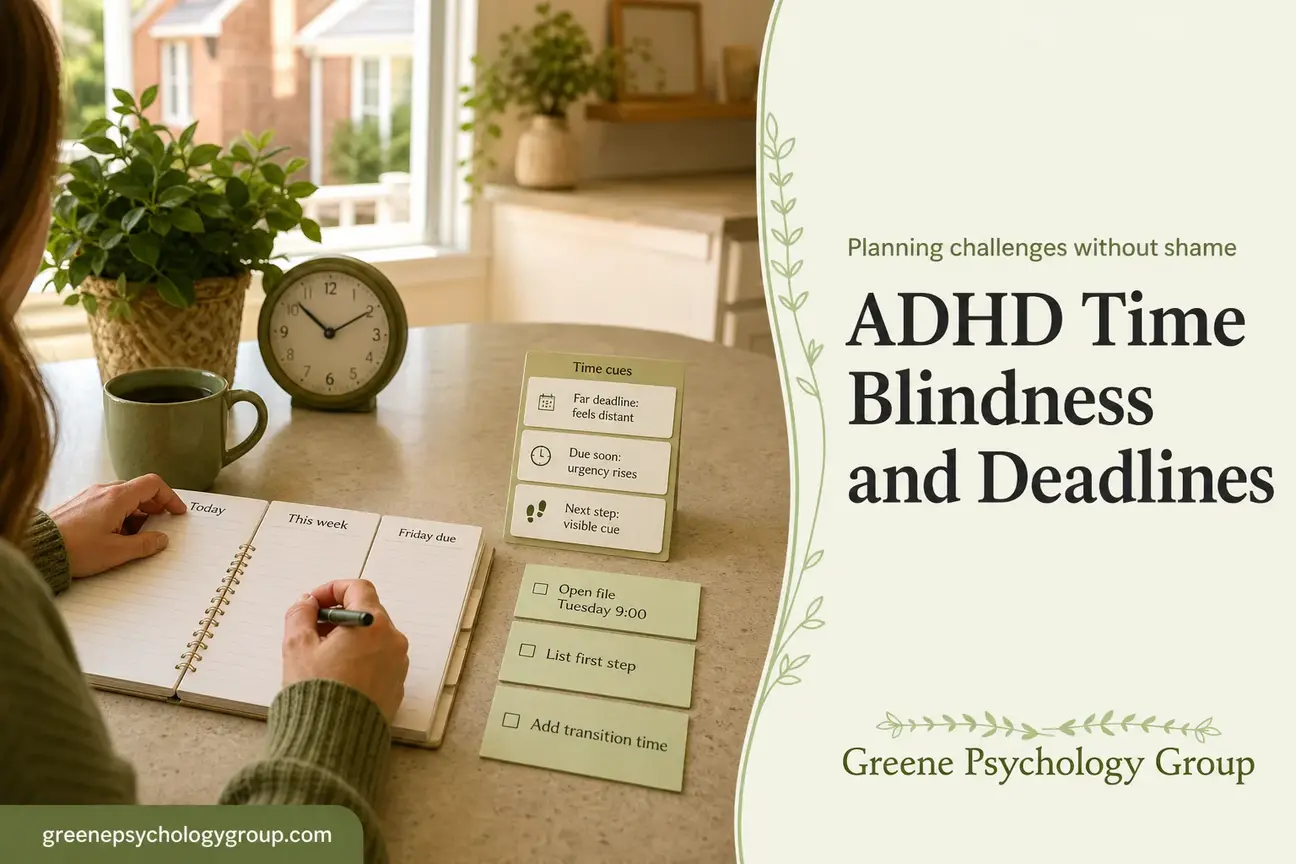
Adult ADHD and Time Blindness: Why Deadlines Feel Difficult
Adult ADHD and time blindness can feel confusing because the issue is not always a lack of effort. A person may fully intend to start early, care about the outcome, and still misjudge how long a task will take or feel unable to begin until the deadline is close. “Time blindness” is an informal phrase people use for difficulty sensing, estimating, monitoring, or acting on time; it is not a diagnosis, and deadline trouble alone does not prove ADHD.
Quick answer: ADHD can involve difficulties with attention, organization, planning, task completion, and follow-through. The NIMH ADHD topic page describes ADHD as a pattern of inattention, hyperactivity, and impulsivity that can interfere with functioning or development, and it includes organization strategies such as writing down reminders, prioritizing time-sensitive tasks, breaking large tasks into smaller steps, and taking short breaks. A licensed clinician can assess whether ADHD or another concern may be part of the pattern; medication questions belong with a qualified prescriber.
Adult ADHD and time blindness: what the phrase means
ADHD time blindness is not a formal medical diagnosis. It is a common, informal way to describe a lived experience: time may feel vague, uneven, hard to estimate, or hard to act on until there is strong urgency. For some adults, an appointment at 3:00 p.m. does not feel “real” until 2:45 p.m. For others, a project due next month stays mentally quiet until the week, day, or hour before it is due.
People often use this phrase when they notice patterns such as underestimating task length, losing track of time during an absorbing activity, forgetting transition time, or assuming that “I’ll do it later” will be easy to remember. Time may feel abundant when a deadline is far away and suddenly scarce when the deadline is near.
This can affect work, school, relationships, finances, household responsibilities, and self-confidence. An adult may miss a bill payment, arrive late despite trying to leave on time, delay a report, or feel surprised that a “small” errand took half a day. The frustration can be especially painful when other people interpret the pattern as careless or indifferent.
It is important to hold two ideas at once. First, time-related difficulty can be very real and disruptive. Second, not everyone who struggles with time has ADHD, and not everyone with ADHD experiences time in the same way. Stress, anxiety, depression, sleep problems, competing responsibilities, major life transitions, and ordinary differences in work style can also affect planning and follow-through.
How executive function time challenges show up with deadlines
Executive function time challenges often involve the mental skills that help a person plan, start, sequence, monitor, adjust, and finish tasks. Executive function is not the same thing as ADHD, but ADHD can involve executive-function difficulties. When those skills are strained, a deadline may be known intellectually but still fail to guide behavior in the moment.
In daily life, time-related difficulty can look like having the deadline written down but not knowing what to do first, starting too late because the task seemed smaller than it was, or losing momentum after an interruption. A person may care deeply about the outcome and still struggle to translate that care into an early, concrete action.
A deadline also requires several hidden steps. The person must notice the due date, estimate the total work, account for setup time, identify dependencies, start before urgency is intense, and return after distractions. If any one of those steps breaks down, the final outcome may look like procrastination even when the person has been mentally carrying the task for days or weeks.
Consider a clearly hypothetical example: someone intends to begin a presentation two weeks ahead of time. The task “make presentation” feels too broad, so they keep waiting for a clearer moment. A few days before the deadline, pressure rises, urgency finally makes the task feel concrete, and they work late to finish. The pattern may be exhausting, but it is not a character flaw.
Executive function time difficulties can also create a cycle. A person misses a deadline, feels shame, avoids looking at the task, receives a reminder, feels more pressure, and then tries to complete the work in a rushed state. Over time, the emotional burden around planning may become as difficult as the task itself.
Why ADHD deadlines can feel urgent only at the last minute
ADHD deadlines may feel especially difficult when the brain responds more strongly to immediacy, novelty, interest, or pressure than to abstract future importance. A project due in three weeks may matter a great deal, but if there is no immediate cue, consequence, or first step, it can remain mentally distant. When the due date is suddenly close, urgency supplies structure that was missing earlier.
This does not mean a person wanted to delay. It may mean the task did not become specific enough to start. “Write the proposal” is different from “open the document and list the three required sections.” “Clean the house” is different from “put dishes in the dishwasher.” “Handle taxes” is different from “find last year’s return.” The more abstract the task, the easier it may be to postpone.
ADHD deadlines can also be complicated by emotional factors. Worry about making mistakes, uncertainty about expectations, embarrassment about being behind, or frustration from past attempts can make a task feel heavier. The person may avoid the task not because it is unimportant, but because starting brings up discomfort.
Competing demands matter too. Work messages, family needs, chores, appointments, and digital notifications can constantly interrupt the fragile process of building momentum. A person may spend the whole day being busy and still not complete the most time-sensitive task. That experience can be discouraging, especially when others only see the missed deadline.
How ADHD planning breaks down before a task starts
ADHD planning is often described as a problem with follow-through, but many difficulties begin before the task truly starts. The first barrier may be turning a broad goal into a clear sequence. If the project has too many possible starting points, the mind may bounce between them without choosing one.
Planning also requires estimating the future. A person needs to guess how long something will take, predict interruptions, remember supplies, decide when to begin, and leave room for revisions. If estimates are consistently too optimistic, the schedule may not look unrealistic until the task is already behind.
Another common planning difficulty is treating the deadline as the only checkpoint. A final due date is usually too late to be the first time progress is evaluated. Large tasks often need earlier personal milestones: gathering materials, drafting, reviewing, asking questions, and submitting. Without these smaller markers, a project can remain invisible until the final date is close.
The following table shows how a time-related difficulty can be translated into a practical planning cue. These are not diagnostic signs; they are possible places to add support.
| Common time difficulty | What may be happening | Possible support |
|---|---|---|
| A task seems quick but takes much longer | Setup, transitions, interruptions, or review time were not counted | Compare expected and actual time, then add a buffer next time |
| A deadline feels distant until it is urgent | The final date is visible, but the next action is not | Create earlier checkpoints and define the first concrete step |
| The to-do list keeps being rewritten | The list may be too broad or not prioritized | Mark time-sensitive tasks and choose one next action |
| A meaningful project keeps being avoided | The task may feel unclear, emotionally loaded, or too large | Break it into smaller steps and ask for clarification when needed |
ADHD procrastination is not the same as not caring
ADHD procrastination can be misunderstood. From the outside, delay may look like laziness, defiance, or lack of motivation. From the inside, it may feel more like being stuck at the doorway of a task: the person knows the task matters, wants relief, and still cannot find a workable entry point.
Procrastination may happen when a task is too large, boring, emotionally charged, vague, repetitive, or uncertain. It can also occur when the person does not know what “done” means. Without a clear finish line, starting may feel risky because the task could expand indefinitely.
ADHD procrastination can also become tangled with perfectionism or self-criticism. If a person has often been told they are behind, careless, or not trying hard enough, a new task may carry old shame. Avoidance can temporarily reduce that discomfort, but it usually increases stress later.
It helps to replace moral language with problem-solving language. Instead of “Why can’t I just do this?” try asking, “What is unclear, too large, too hidden, or too emotionally loaded about this task?” That question does not excuse missed responsibilities, but it creates a more useful starting point.
Five practical ways to support adult ADHD time management
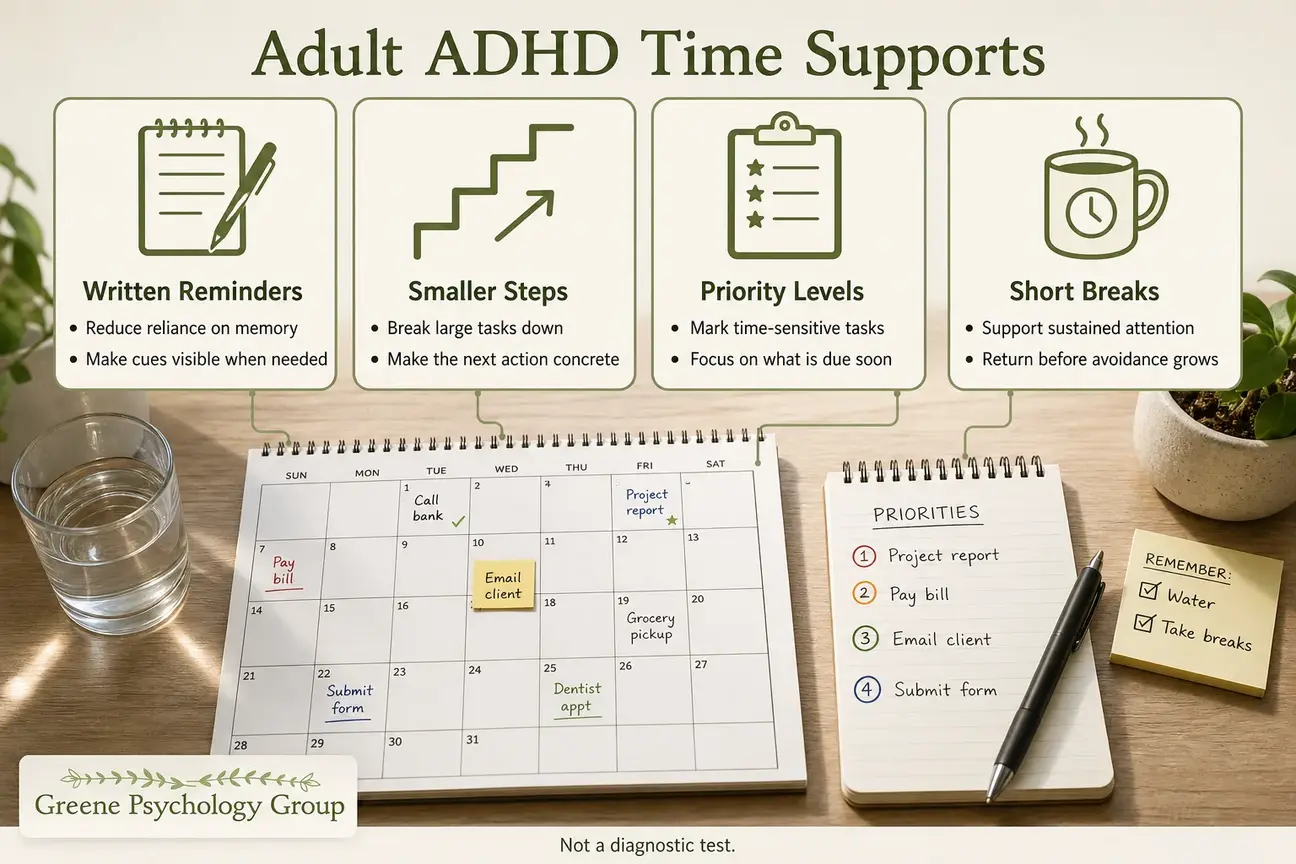
Adult ADHD time management strategies work best when they reduce reliance on an internal sense of time. The goal is not to become perfectly organized or to force a person into someone else’s system. The goal is to make time, steps, and priorities more visible so action can happen earlier and with less panic.
The NIMH ADHD page includes practical organization strategies for adults with ADHD, including writing down reminders, breaking large tasks into smaller steps, assigning priority levels to time-sensitive tasks, and taking short breaks during work. These strategies may help with organization and task completion, but they are not a diagnostic test and they do not promise a specific outcome.
1. Use external reminders for ADHD time blindness
External reminders are supports outside memory. They can include a calendar, alarm, written list, wall planner, sticky note, task manager, email flag, or a reminder attached to a specific routine. The format matters less than whether the cue will be visible at the moment it is needed.
For ADHD time blindness, reminders are more useful when they are tied to action. “Report due Friday” may not be enough. “Tuesday 9:00: open report file and write bullet outline” gives the future self a clearer starting point. A reminder that says what to do next can reduce the need to re-plan from scratch.
Try to keep deadlines in one primary place when possible. If appointments live in one app, work tasks in another, and personal deadlines in a third, the system may become another source of missed information. Some people do better with one main calendar plus a short daily list; others need a visible weekly board. The right system is the one that can be maintained.
It can also help to use multiple time cues for important transitions. For example, one reminder might signal “wrap up,” and another might signal “leave now.” This is especially useful when a task requires stopping one activity, gathering items, traveling, logging in, or preparing materials.
2. Prioritize time-sensitive tasks when ADHD deadlines compete
Prioritizing time-sensitive tasks means looking beyond what feels loudest. The most emotionally urgent task is not always the one with the closest deadline or highest consequence. A practical priority check can include three questions: What is due soon? What has a consequence if delayed? What needs to start now because it has multiple steps?
When ADHD deadlines compete, a written priority list can reduce mental spinning. Tasks might be marked as “today,” “this week,” “waiting on someone,” or “needs clarification.” If everything is labeled urgent, nothing is truly prioritized. A smaller set of time-sensitive tasks is easier to act on than a long list of equally important items.
It may help to separate “important” from “time-sensitive.” Calling the dentist, paying a bill, replying to a work question, and planning a long-term goal may all matter. But the task with a deadline, late fee, or dependency may need to come first today. This does not mean other tasks are unimportant; it means time has to be part of the decision.
For some adults, prioritizing also means asking for missing information earlier. If the deadline, expected format, next step, or decision-maker is unclear, the task may remain vague. Clarifying the task is often a legitimate first step, not a delay.
3. Break large projects into smaller ADHD planning steps
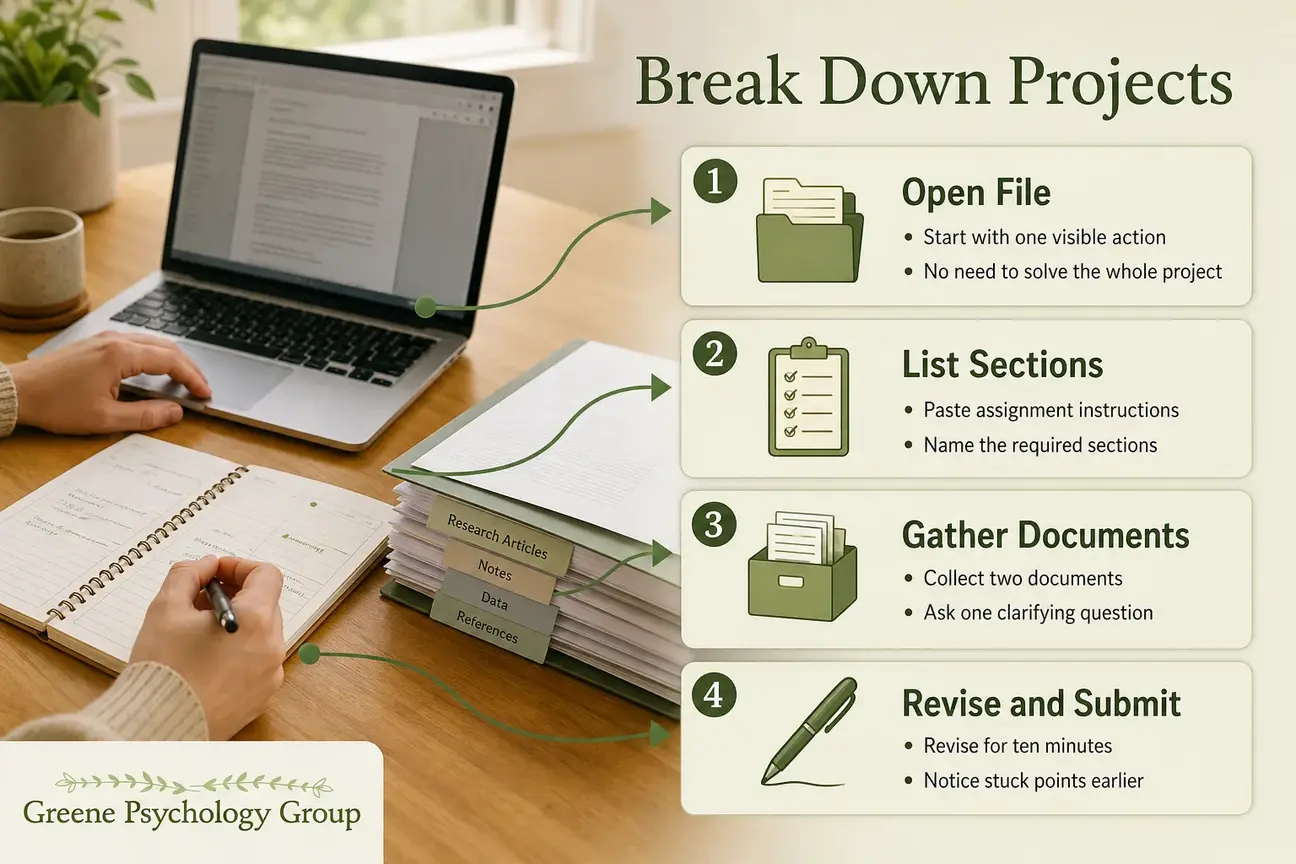
Large projects are hard to start because they ask the brain to hold too much at once. ADHD planning often improves when “finish the project” becomes a sequence of visible actions. The first step should be so specific that it can be done without solving the whole project.
For example, “complete the report” might become: open the file, paste the assignment instructions, list the required sections, gather two documents, draft the introduction, ask one clarifying question, revise for ten minutes, and submit. These steps are not magic; they simply reduce the mental load of starting.
Smaller steps make progress easier to see and give more chances to notice when a person is stuck before the final deadline arrives. This can be especially useful for adult tasks with several hidden parts, such as administrative forms, work reports, school assignments, home projects, or planning conversations.
Intermediate checkpoints can also make time more concrete. Instead of one final deadline, create dates for outlining, drafting, reviewing, and submitting. These checkpoints may be self-imposed, but they work best when they are visible and attached to a calendar, reminder, or accountability structure.
4. Take short breaks without turning them into avoidance
Breaks can support sustained attention when they are planned and brief. The key is that the break should support returning to the task, not become a new task that swallows the afternoon.
A helpful break might involve standing up, stretching, getting water, stepping away from the screen, or looking at the next step before pausing. It may be less helpful to begin an activity with no natural stopping point if returning is already difficult. The goal is to reset attention, not punish a person for needing a pause.
Some adults benefit from deciding the restart cue before the break begins. For example: “After I refill my water, I will return and write the next paragraph.” This keeps the task connected across the pause. Without a restart cue, the break may become another point where time disappears.
5. Track estimates to improve executive function time awareness
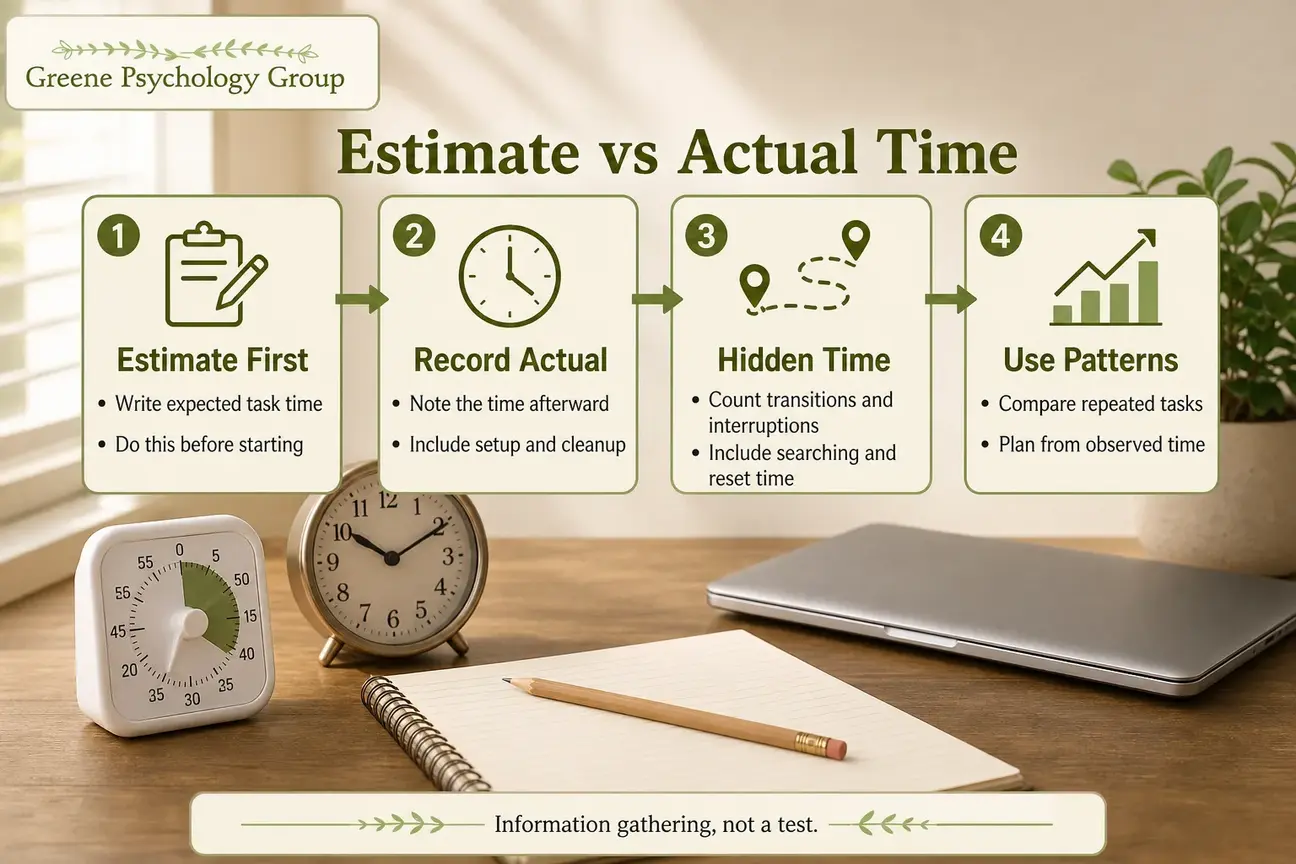
Tracking estimates can be a practical experiment. Before a task, write down how long it seems likely to take. Afterward, record the actual time. Include setup, transitions, interruptions, searching for information, emotional reset time, and cleanup. Over several tasks, patterns may become clearer.
This is not meant to create shame. It is information gathering. If a task is expected to take 20 minutes and usually takes 50, the problem may be the estimate, not the effort. Future planning can become more realistic when it is based on observed time rather than hope.
Executive function time awareness often improves when estimates are visible. A written record can help identify which tasks are consistently underestimated, which environments create interruptions, and which kinds of projects need more lead time. This can also make it easier to communicate about deadlines before a rushed situation develops.
Could it be ADHD, stress, anxiety, depression, or something else?
Missed deadlines, poor time estimates, and procrastination can happen for many reasons. ADHD is one possibility, but it is not the only one. Stress can crowd attention. Anxiety can make decisions feel risky. Depression can affect energy, motivation, and concentration. Sleep problems, health issues, caregiving demands, grief, work overload, or a poorly matched environment can also affect follow-through.
A licensed clinician looks at the broader pattern, not one symptom. Assessment may include when the difficulties began, whether they occur in more than one setting, how much they interfere with life, what helps, what makes them worse, and whether other concerns may better explain the pattern.
For adolescent or adult ADHD diagnosis, clinicians generally consider developmental history, including whether several symptoms were present before age 12. That point is clinician assessment context, not a self-test or a rule for diagnosing yourself. Many adults do not have a neat memory of childhood symptoms, and a clinician may gather a careful history rather than relying on a single recollection.
If time-management problems appeared suddenly during a specific stressful period, after a major life change, or alongside changes in mood, sleep, anxiety, or health, it is worth discussing those factors with a professional. That conversation can help separate a long-standing attention pattern from a newer stress response or another concern.
Some readers may also be exploring how adult ADHD symptoms can be missed or misunderstood in different life stages. Greene Psychology Group’s article on adult ADHD in women offers related education while still emphasizing that diagnosis comes from a licensed clinician.
How therapy can help with planning, shame, and follow-through
Therapy is not only about insight; it can also support practical change. When time-related problems have affected a person for years, they often bring shame, conflict, self-doubt, or avoidance. A therapist can help a client understand patterns, identify realistic supports, and address emotional barriers that make tasks harder to start.
The NIMH overview of psychotherapies describes psychotherapy as a way to help people identify and change troubling emotions, thoughts, and behaviors. For ADHD-related concerns, therapy may include building skills, noticing patterns, and addressing stress or self-criticism that interferes with follow-through.
At Greene Psychology Group, individual therapy may be a fit for adults or adolescents who want support with emotional stress, life demands, relationships, or patterns that interfere with daily functioning. This article does not imply that therapy is the right fit for everyone or that a specific approach will produce a particular result.
When ADHD-related concerns overlap with anxiety, low mood, stress, self-criticism, or relationship strain, mental health therapy can provide a space to sort through the whole picture. For some clients, cognitive behavioral therapy may be one useful approach because it focuses on patterns of thoughts, behaviors, and skills. A licensed clinician can discuss what seems clinically appropriate.
Medication questions should be directed to a qualified prescriber. Greene Psychology Group provides psychotherapy and does not provide medication prescribing or medication management. Therapy can support coping skills and behavior change, but it is not a substitute for medical guidance when someone has questions about medication.
When to consider professional support
It may be useful to seek support when time-management patterns repeatedly interfere with work, school, finances, relationships, self-care, or emotional well-being. Occasional lateness or procrastination is common. A repeated pattern that causes distress, conflict, missed opportunities, or significant functional problems may be worth discussing with a licensed clinician.
Support may also be helpful when strategies work briefly but are hard to sustain. Many adults have tried planners, apps, color-coded calendars, notebooks, or productivity systems. If the problem keeps returning, the issue may not be a lack of tools. It may be that the tools need to be simplified, personalized, or paired with emotional support and accountability.
Another sign to reach out is when shame becomes part of the pattern. Hiding missed deadlines, avoiding messages, feeling intense self-criticism, or assuming failure as a person can make the cycle harder to interrupt. Therapy may help a client approach the problem with more clarity and less blame.
Professional support does not mean ADHD is the only explanation. It means the pattern is being taken seriously enough to understand it. A clinician can help consider ADHD, stress, anxiety, depression, sleep, life circumstances, and other possible contributors without reducing the whole picture to one label.
Practical next steps for care in North Carolina
Greene Psychology Group offers psychotherapy for adults and adolescents, with offices in Raleigh and Asheville and online therapy in North Carolina for people physically located in the state during the session. If therapy for planning problems, ADHD-related concerns, stress, anxiety, or self-criticism feels worth exploring, a reader can contact Greene Psychology Group to ask about next steps.
When reaching out, share contact information, a brief reason for seeking support, whether in-person or online sessions are preferred, and insurance information. Please do not send detailed health information through the contact form or email, because they are unencrypted. The practice can be reached through the contact page, by calling 919-205-5339, or by emailing [email protected]; because the website notes phone issues, email may be useful to include.
If insurance is part of planning, Greene Psychology Group is in network with most BCBS and Aetna plans, and readers should verify benefits with both their insurer and the practice. The insurance and payment information page explains practical details without promising coverage. Self-pay clients receive a Good Faith Estimate under the No Surprises Act.
A gentler way to think about missed deadlines
Adult ADHD and time blindness are not about becoming perfectly productive. They are about understanding the gap between intention and follow-through, then adding supports that make time and next steps easier to see. For many people, the most useful shift is moving from “What is wrong with me?” to “What structure does this task need?”
If ADHD time blindness describes the experience, it may help to externalize time, prioritize what is truly time-sensitive, break large tasks into smaller steps, plan short breaks, and track estimates without self-criticism. These NIMH-supported organization strategies may make daily demands more manageable, but they do not replace a professional assessment when symptoms are persistent or impairing.
ADHD deadlines, ADHD planning, executive function time awareness, and ADHD procrastination can all feel less mysterious when the problem is approached with curiosity rather than shame. A licensed clinician can help a client understand what may be contributing and what type of support may fit the situation.
This article is for general education and isn't a substitute for diagnosis or treatment from a licensed professional. If you are in crisis, call or text 988 or call 911.
Greene Psychology Group is not a crisis service. For immediate danger, call 911 or go to the nearest emergency room. For a mental-health or suicidal crisis, call or text 988. SAMHSA explains 988 crisis support for people experiencing a mental-health or suicidal crisis.
Frequently Asked Questions
Is “time blindness” a diagnosis?
No. “Time blindness” is an informal phrase describing experiences such as difficulty estimating, monitoring, or acting on time. It is not a diagnosis, and the experience alone does not establish ADHD.
Can missed deadlines mean I have adult ADHD?
Missed deadlines can occur with ADHD, but they can also have other explanations. Poor time management, planning problems, disorganization, procrastination, and deadline difficulties may be part of an ADHD pattern, but a licensed clinician must assess the broader picture.
What strategies may help with ADHD-related deadlines?
NIMH-supported organization strategies include writing down reminders, using calendars or alarms, prioritizing time-sensitive tasks, breaking large projects into smaller steps, and taking short breaks during tasks that require sustained attention.
How does breaking a project into smaller steps help?
Breaking a project down turns a broad task into specific actions that are easier to start and monitor. It can also create earlier checkpoints, so the whole project is not guided by one final deadline.
Can therapy help with ADHD-related planning difficulties?
Therapy may help some adults understand patterns, reduce shame, address stress or anxiety around deadlines, and build practical organization skills. Whether therapy is appropriate depends on an individual assessment and the person’s goals.
Does Greene Psychology Group prescribe ADHD medication?
No. Greene Psychology Group provides psychotherapy and does not provide medication prescribing or medication management. Medication decisions belong with a qualified prescriber.
When should an adult seek professional support for missed deadlines?
Consider reaching out when planning, procrastination, or time-management difficulties repeatedly affect work, relationships, finances, self-care, school, or emotional well-being. A licensed clinician can help assess what may be contributing.