

Parent Role Teen Therapy: A Safe Parent Guide
Quick answer: The parent role teen therapy question usually has a balanced answer: parents often help with logistics, background information, safety concerns, and support at home, but they may not attend every session or receive every detail. A teen may need private time with a therapist to speak openly, while parents still remain important partners in care. Before therapy begins, ask the practice how consent, confidentiality, caregiver communication, safety procedures, and parent participation are handled.
It is understandable to feel unsure about where you fit once your teen starts counseling. Many parents want to help without hovering. Others worry that if they step back too far, they will miss something important. The goal is not to choose between total privacy and total parent control. A healthier starting point is to build a clear structure: what the teen can expect, what the parent can expect, and how everyone will respond if safety concerns come up.
Psychotherapy, sometimes called talk therapy, is described by the National Institute of Mental Health’s psychotherapy guidance as a variety of treatments that aim to help people identify and change troubling emotions, thoughts, and behaviors. With adolescents, that work often includes both the teen’s own relationship with the therapist and some thoughtful involvement from caregivers.
Why parents still matter after adolescent therapy starts
Once therapy begins, many parents wonder whether they should step back completely. In most situations, disappearing from the process is not the goal. Parents often notice changes that a therapist may not see directly: sleep habits, school stress, friend changes, irritability, withdrawal, family conflict, or difficulty following through on routines.
At the same time, teen therapy is not meant to become a weekly report to parents. Adolescence is a stage when young people are developing more independence, and many teens need a private space to talk honestly. If a teen believes every word will be repeated at home, they may become guarded, minimize concerns, or avoid talking about the issues that brought them to therapy.
A helpful parent stance is: I am involved enough to support safety and growth, but not so involved that I take over the therapy. That balance may shift over time. Early in therapy, a clinician may need more background from parents. Later, parent contact may become more occasional unless there are safety concerns, family issues, or practical questions to discuss.
The National Institute of Mental Health publication Children and Mental Health: Is This Just a Stage? encourages parents and caregivers to ask questions, share concerns, and understand how they can support treatment recommendations at home. That kind of involvement can be important, especially when parents communicate concerns thoughtfully and avoid pressuring the teen for private session content.
What teen therapy parent involvement may include
Teen therapy parent involvement can look different from one family to another. A parent’s role may be more active at the beginning, during periods of stress, or when family communication is part of the concern. It may be more limited when the main work is between the teen and therapist.
Possible forms of teen therapy parent involvement include:
- An initial parent conversation to share history, current concerns, and practical information.
- Brief parent check-ins when the clinician believes caregiver input would help.
- Joint parent-teen sessions to practice communication or clarify expectations.
- Referral into or discussion of family therapy when relationship patterns, conflict, transitions, or parenting stress are part of the concern.
- Education about coping skills, communication patterns, or ways to support the teen between sessions.
- Sharing observations about changes in mood, sleep, school functioning, friendships, behavior, or safety.
- Helping with scheduling, transportation, payment, technology, and privacy for sessions.
These are possibilities, not promises about every clinician or every treatment plan. Some teens benefit from regular caregiver participation. Others need parent contact to be more structured and limited so the individual therapy space remains useful.
Parents can also help by learning the language of the therapy process. If the clinician and teen are working on coping skills, values, communication, emotional regulation, or problem-solving, parents may be able to support practice at home without asking for private session details. For a broader overview, Greene Psychology Group has a helpful article on types of therapy.
Must parents attend every session?
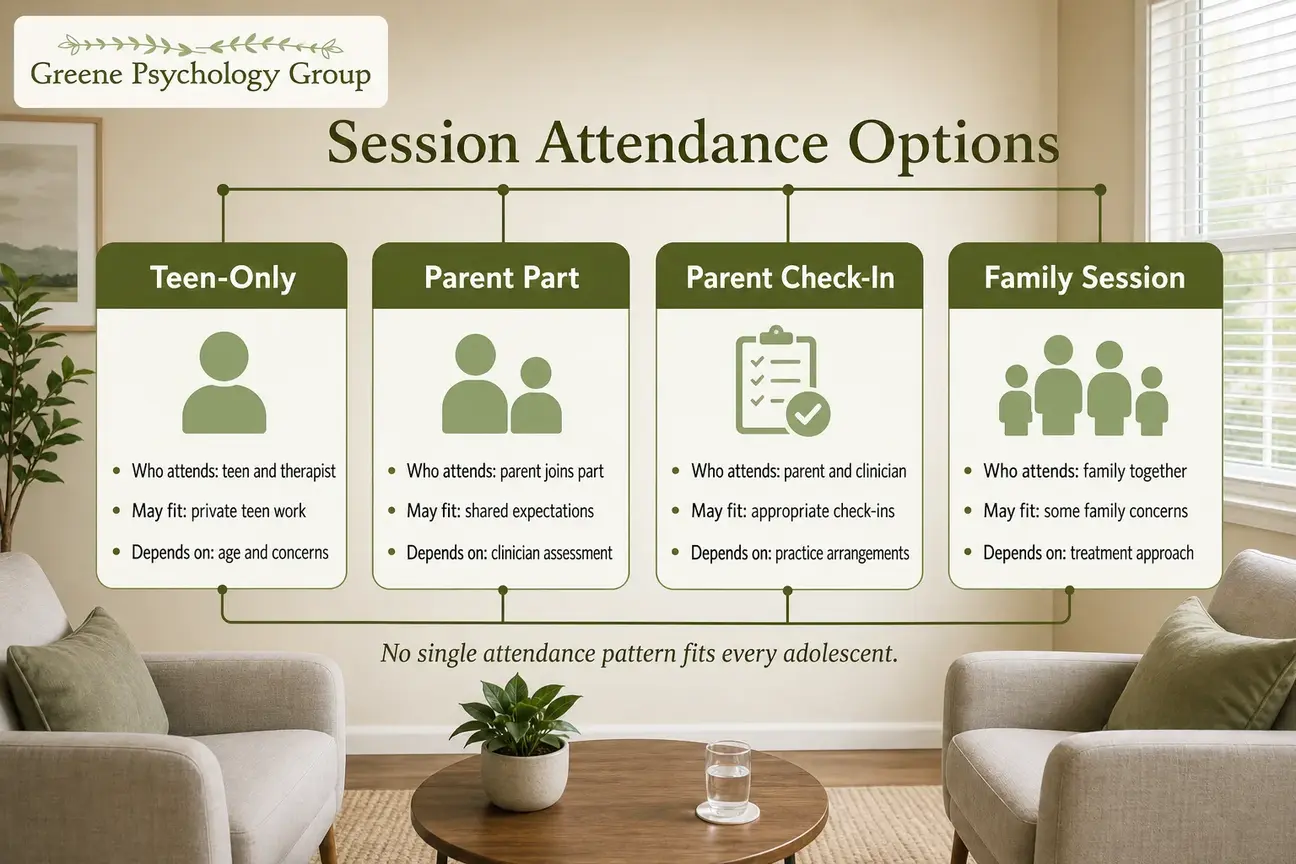
Not necessarily. There is no single attendance pattern that fits every adolescent. Some sessions may be teen-only. Some may include a parent for part of the appointment. Some may be parent-only check-ins when clinically appropriate. Some families may decide that family sessions are a better fit for certain concerns.
The right structure depends on factors such as the teen’s age, the presenting concerns, the treatment approach, the clinician’s assessment, and the arrangements made with the practice. A teen who is working on anxiety, low mood, grief, stress, identity questions, school pressure, or relationship concerns may need substantial private time. A family dealing with conflict, major transitions, communication breakdowns, or parenting strain may need more joint work.
It can help to ask before scheduling: “How do you usually involve parents in adolescent therapy?” and “When would you recommend a parent join a session?” These questions set expectations early and reduce confusion later.
If you are exploring individual therapy for a teen, it is reasonable to ask how the first appointment is structured, whether a parent is included at the beginning, and how ongoing communication is handled. Avoid assuming that being the parent means attending every appointment or receiving a full summary afterward.
Parent involvement therapy works best with clear expectations
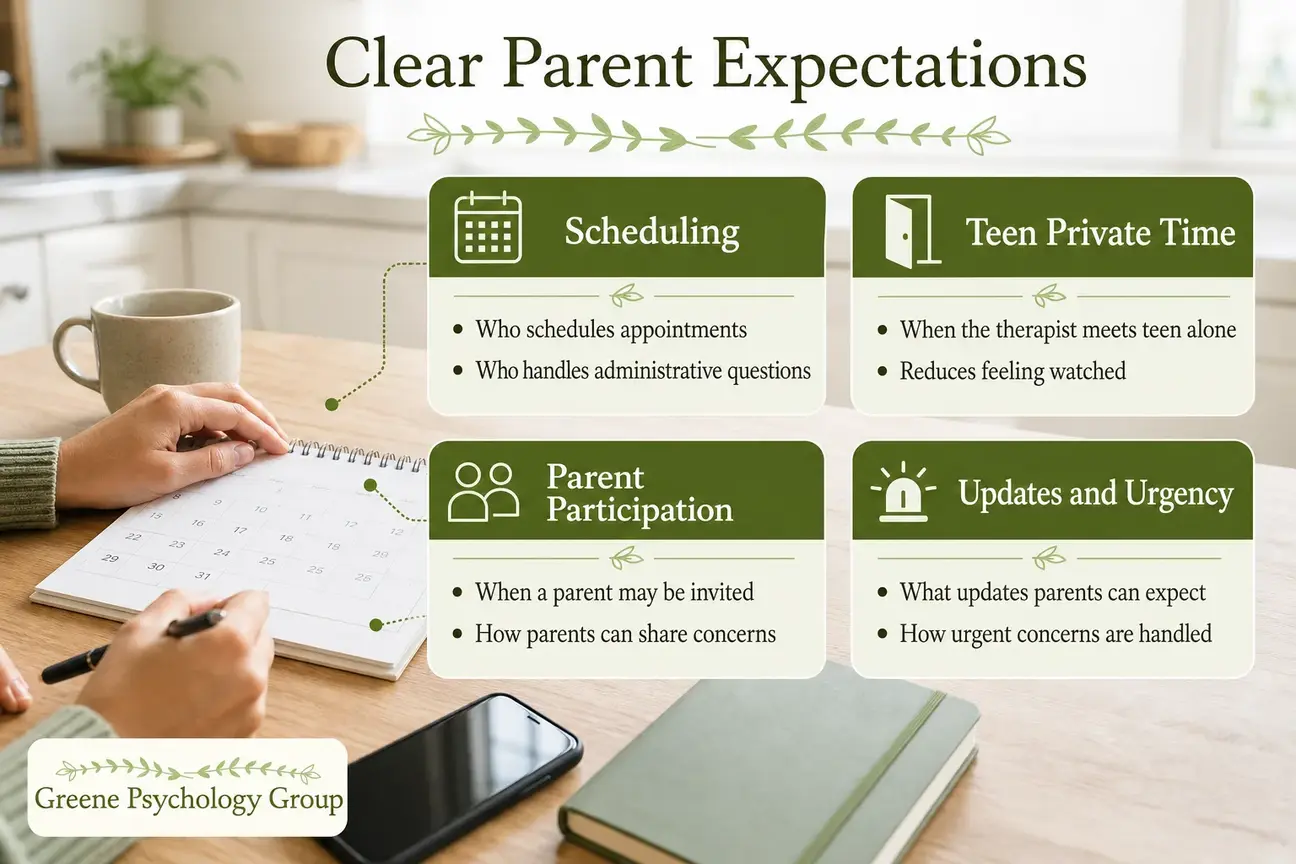
Parent involvement therapy is not about monitoring every word your teen says. It is about creating a clear, supportive system around the teen’s care. When expectations are vague, everyone can feel more anxious: parents may feel shut out, teens may feel watched, and clinicians may have to keep renegotiating boundaries.
A clearer caregiver-involvement structure often answers questions like:
- Who schedules appointments and handles administrative questions?
- When does the therapist meet with the teen alone?
- When might a parent be invited into the session?
- What kinds of updates can parents expect?
- How can parents share concerns without expecting private details in return?
- How are urgent concerns handled between appointments?
These questions do not need to be adversarial. They can be asked calmly: “We want our teen to have privacy, and we also want to understand our responsibilities. Can you explain how caregiver involvement works here?”
When expectations are discussed openly, the teen may feel less caught between the therapist and the parent. Parents may also feel less pressure to extract information after each session. Instead of asking, “What did you talk about?” a parent might ask, “Is there anything you want from me this week?” or “Would it help if I gave you space right now?”
Parent involvement therapy can also protect parents from trying to solve everything alone. A licensed clinician can help define what belongs in individual sessions, what belongs in parent communication, and what may need a family conversation.
Teen therapy boundaries protect both privacy and support
Teen therapy boundaries can feel uncomfortable at first, especially when parents are used to managing medical, school, and family decisions. In therapy, boundaries are not meant to exclude parents from care. They are meant to make the therapy relationship workable while still addressing safety and practical needs.
A useful way to think about teen therapy boundaries is to separate three kinds of information:
| Type of information | What parents can ask about | Why it matters |
|---|---|---|
| Routine session content | Ask how privacy is handled and what general updates may be shared. | Teens often need room to speak honestly without feeling every detail will be repeated. |
| Care coordination | Ask how parents can share observations and whether releases are needed for school, physicians, or other providers. | Coordination can help, but it should be handled through the practice’s procedures. |
| Safety concerns | Ask what happens if the clinician is worried about immediate danger or serious risk. | Safety procedures should be clarified separately from ordinary progress updates. |
The National Institute of Mental Health encourages people seeking therapy to ask whether meetings are confidential, how confidentiality is assured, and whether there are limits. For adolescent therapy, those questions are especially important. Parents should ask the practice how confidentiality works for teens, how policies are explained to the teen, and how caregiver questions are handled.
General health-information privacy is shaped by federal privacy protections, and the U.S. Department of Health and Human Services HIPAA information for individuals explains privacy rights in broad terms. However, this article is not legal advice and does not explain North Carolina minor-consent law. For your family’s situation, ask the practice directly how consent, confidentiality, releases of information, and parent communication apply.
Clear teen therapy boundaries can lower defensiveness. When a teen knows what is private, what may be shared in general terms, and what would require adult action for safety, therapy may feel less like surveillance and more like support.
How to support teen therapy without taking over
Many parents are relieved to learn that they do not have to become a co-therapist at home. To support teen therapy, focus on creating conditions that make treatment easier to use. That may mean helping your teen arrive on time, protecting privacy for sessions, reducing arguments immediately before or after appointments, or asking what kind of support feels acceptable.
Here are practical ways to support teen therapy while respecting the teen’s developing independence:
- Ask, “How can I support you?” rather than “What did you tell the therapist?”
- Keep scheduling, transportation, and technology as smooth as possible.
- Give the teen privacy before and after sessions unless they ask to talk.
- Notice effort without turning therapy into a performance review.
- Use calm, specific observations when communicating with the clinician.
- Avoid using therapy disclosures as punishment, leverage, or proof during conflict.
- Ask the clinician how parents can reinforce agreed-upon coping skills at home.
Support teen therapy by being steady, not intrusive. If your teen shares something from a session, listen without immediately correcting, interrogating, or turning it into a family meeting. A simple response such as “Thank you for telling me” can make future sharing more likely.
If your teen does not want to talk after therapy, that does not automatically mean therapy is not helping. Some teens need time to shift from a private session back into family life. Others may be emotionally tired. You can support teen therapy by offering food, quiet, a ride home, or a low-pressure check-in later.
What parents can share with the clinician
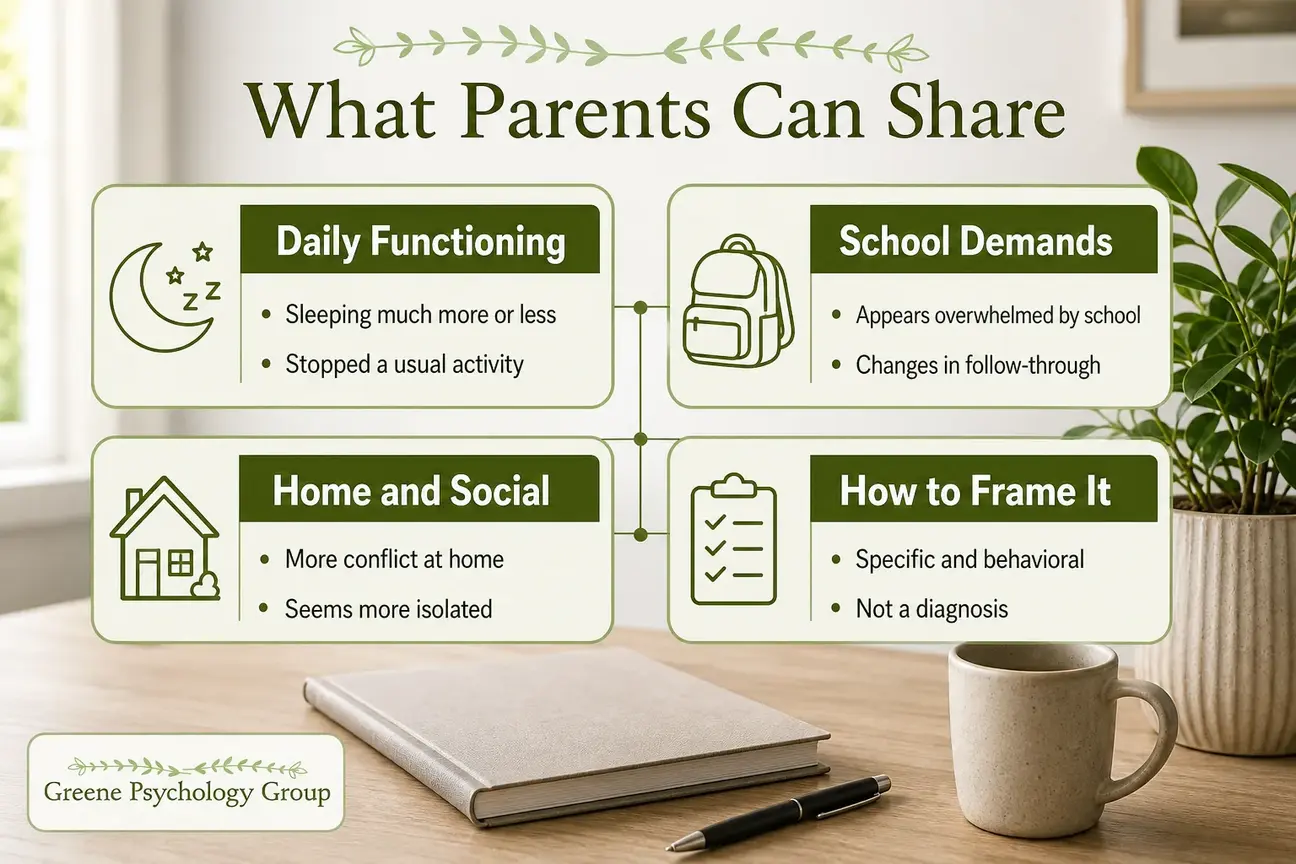
Parents sometimes assume there are only two options: say nothing, or demand a full update. There is a middle ground. You can ask the practice how to share relevant observations while still respecting the teen’s privacy.
Useful parent observations are usually specific and behavioral rather than interpretive. For example, you might share that your teen has stopped attending an activity they used to enjoy, is sleeping much more or less than usual, has had more conflict at home, seems more isolated, or appears overwhelmed by school demands. These observations are not a diagnosis. They are context a licensed clinician can consider.
Teen therapy parent involvement is often most useful when parents share patterns, not arguments. Instead of trying to prove a point, focus on what has changed, how often it happens, and what the family has already tried at home.
Before sending information, ask about the practice’s preferred communication process. Some practices may prefer a phone call, a scheduled parent consultation, a secure system for existing clients, or a brief administrative message. If email or a contact form is unencrypted, avoid sending detailed health information through those channels.
Questions to ask about confidentiality and consent
Confidentiality is often the most sensitive part of teen therapy parent involvement. Parents may feel responsible for their teen and want details. Teens may fear that anything they say will be reported at home. The best time to clarify expectations is before or at the start of treatment, not after a misunderstanding occurs.
Consider asking the practice:
- How do you explain confidentiality to adolescents and parents?
- What information is generally private between the teen and therapist?
- What kinds of routine updates can caregivers receive?
- Can parents share observations without receiving session details?
- Are parent-only check-ins or joint sessions ever used?
- How are releases of information handled for communication with schools, physicians, or other providers?
- What are the limits of confidentiality?
- How are safety concerns communicated to caregivers?
- How should parents ask administrative questions without sharing unnecessary private information?
These questions help everyone understand teen therapy boundaries. They also help your teen see that privacy is being discussed openly rather than negotiated behind their back.
Parents can also ask how parent involvement therapy is documented and scheduled. That question can clarify whether caregiver conversations happen during the teen’s appointment, in a separate parent consultation, or through another process the practice explains.
Safety conversations are different from routine updates
Safety-related communication deserves its own conversation. Routine therapy privacy is one issue; immediate danger or serious risk is another. Parents should ask how the practice handles urgent concerns, what would prompt caregiver contact, and what parents should do if they notice a sudden or serious change between sessions.
Helpful questions include:
- What should I do if my teen’s behavior changes suddenly?
- How should I communicate an urgent concern to the practice?
- What concerns would lead the clinician to contact a caregiver?
- What is the procedure outside scheduled appointments?
- Is the practice an emergency or crisis service?
Greene Psychology Group does not provide emergency or crisis services. If there is immediate danger, call 911 or go to the nearest emergency room. For a mental-health or suicidal crisis, call or text 988. SAMHSA describes 988 as a resource for people experiencing a mental-health or suicidal crisis.
Preparing for the first appointment
Parents can prepare without turning the first session into a courtroom presentation. A short, factual list is often more useful than a long argument about who is right. Write down the main concerns, when they began, and what has changed in daily functioning.
You might note changes in sleep, appetite, school attendance, academic stress, friendships, family conflict, activities, mood, or behavior. Keep the language observational: “stopped going to soccer practice,” “more tearful in the evenings,” or “argues more when asked about homework.” Avoid labeling your teen or presenting your list as a self-diagnosis.
Ask your teen what they want the therapist to understand. They may not tell you everything, and that is okay. Even a brief answer can help you avoid speaking over them. You might say, “I have a few concerns I want to share, but I also want the therapist to hear what matters to you.”
Before the first visit, it can help to write down your questions about teen therapy parent involvement, privacy, and safety communication. Bringing those questions calmly can help everyone start with clearer expectations.
If the appointment is online, ask about privacy, technology, and location requirements. Greene Psychology Group offers online therapy in North Carolina for people physically in North Carolina during the session. Parents can ask how teletherapy works for teens, how privacy is protected, and what to do if the connection fails.
When family therapy may be worth discussing
Individual therapy focuses primarily on the teen’s own concerns, coping skills, emotions, thoughts, and behavior patterns. Family therapy may be worth discussing when the concern is closely tied to communication, conflict, transitions, parenting stress, grief, separation or divorce adjustments, blended family changes, or repeated misunderstandings at home.
Family therapy is not a statement that anyone is to blame. It is a way to look at interaction patterns and practice different ways of communicating. Sometimes, a teen’s individual therapy and family sessions can work alongside each other. Other times, the clinician may recommend focusing on one format first.
Parents can ask, “Would family therapy be useful in our situation?” and “How would it differ from my teen’s individual sessions?” Those questions help clarify whether the focus is the teen’s private work, the family relationship, or both.
In some families, structured parent check-ins may be enough for a specific concern. In others, family therapy may offer a more direct way to work on patterns that show up at home. A licensed clinician can help explain which format may fit the concern being discussed.
What if your teen does not want you involved?
It can be painful to hear, “I don’t want you involved.” Try to listen for what may be underneath the statement. Your teen may want privacy, fear judgment, worry about getting in trouble, or feel that adult conversations about therapy will become arguments. Resistance to parent involvement does not always mean a teen is hiding something dangerous.
You can respond with curiosity: “I hear that you want privacy. What kind of involvement would feel okay?” The answer may be narrow at first. A teen might tolerate a parent handling scheduling, joining the first few minutes, or receiving general updates, but not discussing session details. The clinician can help define what is clinically appropriate and what the practice requires.
At the same time, parents do not have to ignore serious concerns. If you notice safety-related changes, ask the practice how to share them. You can respect teen therapy boundaries while still taking safety seriously.
Support teen therapy by avoiding a power struggle immediately before or after sessions. If the teen feels therapy leads to interrogation, they may become less willing to attend. If the teen experiences you as calm and respectful, they may become more open to carefully chosen family participation over time.
How parent role teen therapy conversations can reduce conflict
A clear parent role teen therapy conversation can reduce conflict because it replaces guessing with agreed-upon expectations. Parents can stop wondering whether they are “supposed” to ask for updates. Teens can stop fearing that every disclosure will become a household discussion. Clinicians can explain what information they can share, what they cannot promise, and how safety concerns are handled.
This conversation may include the teen whenever appropriate. Hearing the same explanation together can be reassuring. The parent does not have to secretly negotiate access, and the teen does not have to imagine that private conversations are happening behind closed doors.
It can also help to revisit expectations as therapy progresses. A plan that worked at the first appointment may need adjustment during a school transition, family change, safety concern, or new stressor. Parent involvement therapy can be flexible without becoming intrusive.
When expectations are revisited, use the same basic questions: what does the teen need privately, what do parents need to know for support and safety, and how should information move between sessions? That rhythm can keep boundaries clear even when family stress changes.
Practical ways to support teen therapy between sessions
Between-session support does not have to be complicated. Often, the most helpful parent actions are steady and ordinary. Keep routines predictable where possible. Reduce avoidable conflict around appointment times. Ask before giving advice. Notice small efforts. Offer choices when appropriate.
If the clinician suggests a communication strategy or coping skill for home practice, ask how you can support it without policing it. For example, rather than saying, “Did you do your therapy homework?” you might ask, “Would a reminder help, or would you rather manage it yourself?”
Support teen therapy by separating your anxiety from your teen’s process. It is natural to want rapid reassurance that therapy is “working,” but pressure for visible progress can make the teen feel evaluated. Instead, look for broader signs of engagement: willingness to attend, more language for feelings, small attempts to communicate, or increased ability to ask for space.
If things seem unchanged or more difficult for a while, ask the clinician how parent communication should occur. Do not assume that a difficult week means therapy has failed. Also do not ignore serious concerns. The point is to communicate through the right channel and with the right level of urgency.
Support teen therapy with calm consistency. That may sound simple, but it can be difficult when parents are worried. If you find yourself pushing for details after every appointment, pause and return to the plan you clarified with the clinician.
Starting teen therapy with Greene Psychology Group
Greene Psychology Group offers individual psychotherapy for adolescents and adults, with offices in Raleigh and Asheville and online therapy for people physically in North Carolina during the session. Parents can ask about adolescent therapy, caregiver participation, confidentiality procedures, safety communication, and whether in-person or online sessions fit their situation.
To ask about scheduling, you can contact Greene Psychology Group, call 919-205-5339, or email [email protected]. Because the contact form and email are unencrypted, share only contact details and a brief reason for reaching out, not detailed health information. It may help to mention whether you prefer Raleigh, Asheville, or online sessions, and what insurance you plan to use.
Greene Psychology Group is in network with most BCBS and Aetna plans, while out-of-network and self-pay arrangements may also be available. Families should verify benefits with their insurer and the practice. You can review insurance and payment information and, if you are self-pay or uninsured, ask about the Good Faith Estimate. Do not assume coverage, cost, or clinician availability until you confirm directly.
A steady parent role can help without taking over
The parent role teen therapy process is usually most helpful when it is calm, clear, and flexible. Parents can provide context, logistics, safety awareness, and support at home. Teens can have meaningful privacy. Clinicians can help define what information is shared, when family participation is useful, and how concerns should be communicated.
You do not have to get every detail to be supportive. You also do not have to stay silent when safety, functioning, or family communication needs attention. The best next step is often a straightforward question to the practice: “How do you involve parents while respecting teen confidentiality?”
When families treat caregiver participation as a shared structure rather than a tug-of-war, it becomes easier to respect teen therapy boundaries and support teen therapy at home. Parent involvement therapy is most useful when it protects privacy, keeps safety visible, and helps the teen feel supported rather than managed.
This article is for general education and isn't a substitute for diagnosis or treatment from a licensed professional. If you are in crisis, call or text 988 or call 911.
For immediate danger, call 911 or go to the nearest emergency room. For a mental-health or suicidal crisis, call or text 988.
Frequently Asked Questions
Do parents attend every teen therapy session?
Not necessarily. The arrangement may include teen-only sessions, parent check-ins, joint sessions, or family therapy, depending on the teen’s needs and the clinician’s approach. Ask the practice how caregiver participation is handled before therapy begins.
Will a therapist tell parents everything discussed in therapy?
Parents should ask the practice how adolescent confidentiality works, what routine updates may be provided, and what limits apply. It is not safe to assume that parents will receive every detail or that no information can ever be shared.
How can a parent help if a teen does not want to talk about therapy?
Offer practical support without demanding a session summary. Parents can ask what kind of help feels useful, support scheduling and privacy, and share important observations with the clinician through the practice’s preferred communication process.
Can parents participate in family therapy?
Possibly. Family therapy may be appropriate when family relationships, communication, conflict, or transitions are part of the concern. Ask the practice whether family therapy fits the situation and how it would differ from the teen’s individual sessions.
What should a parent ask about safety?
Ask how the practice handles urgent concerns, what information would prompt caregiver contact, how parents should report a serious change, and what to do outside scheduled sessions. For immediate danger, call 911 or go to the nearest emergency room. For a mental-health or suicidal crisis, call or text 988.
Can a parent provide information to the therapist without asking for session details?
Parents should ask the practice how it accepts caregiver observations and how those communications are handled. A parent can request guidance about sharing relevant information while respecting the teen’s privacy.
What should parents ask before starting online teen therapy?
Ask how privacy is protected during the session, what to do if the connection fails, how safety concerns are handled, and whether the teen must be physically in North Carolina during the appointment.