

If you are the parent of a teenager in Raleigh, you have probably asked yourself a version of the same question at least a dozen times: Is this normal adolescence, or is something actually wrong?
Your once‑talkative child now answers every question with a grunt. Their grades have dropped. They spend hours alone in their room. They seem sad, irritable, or anxious – but when you ask, they snap, "I'm fine."
Here is the truth that no parenting book tells you: distinguishing normal adolescent moodiness from a treatable mental health condition is genuinely difficult – even for trained clinicians. The brain undergoes massive rewiring during the teenage years. Hormones fluctuate. Social pressure intensifies. Some withdrawal and irritability are expected.
But there is a line. And crossing that line without intervention can have lifelong consequences.
Greene Psychology Group has helped hundreds of Raleigh families navigate this exact uncertainty. This guide is not designed to make you paranoid. It is designed to give you a clear, evidence‑based framework for recognizing when your teen needs professional help, how to talk to them about it without pushing them away, and what effective adolescent therapy in Raleigh NC actually looks like.
Part 1: Normal Adolescence vs. Something More Serious – A Practical Framework
The single most common question we hear at Greene Psychology Group is: How do I know if this is just a phase?
The answer lies not in any single behavior, but in three dimensions: duration, intensity, and impairment.
The Three Dimensions of Assessment
| Dimension | Normal Adolescence | Possible Disorder (Seek Evaluation) |
|---|---|---|
| Duration | Moodiness lasts hours or a couple of days. Usually resolves with sleep, distraction, or positive interaction. | Symptoms persist for more than two weeks without significant break. |
| Intensity | Irritability, sadness, or worry that is noticeable but does not prevent functioning. | Extreme emotional reactions (rage, uncontrollable crying, panic attacks). Talking about death, dying, or worthlessness. |
| Impairment | Still attending school, seeing friends (even if less frequently), maintaining basic hygiene and sleep. | Grades drop significantly. Withdrawal from all friends and activities. Refusing school. Major changes in eating or sleeping. Self‑harm (cutting, burning). |
The Most Important Red Flags
Any change in functioning that lasts more than two weeks requires close attention. Key indicators include:
- A previously B student who is now failing.
- A social teenager who now has zero friends.
- An athlete who quits the team and stops exercising.
Research from Duke University's Center for Child and Family Policy found that parents who used this "duration, intensity, impairment" framework were 3x more accurate in identifying when professional help was needed – and 60% less likely to seek unnecessary treatment for normal adolescent development.
Part 2: The Most Common Mental Health Conditions in Raleigh Teens
Before you can decide whether your teen needs adolescent therapy in Raleigh NC, it helps to know what you are looking for. These are the conditions we treat most often at Greene Psychology Group.
Anxiety Disorders (Most Common)
Prevalence: ~32% of adolescents will meet criteria for an anxiety disorder by age 18.
Signs: Excessive worry about school, social situations, health, or the future. Physical symptoms (headaches, stomachaches, nausea before school). Avoidance of specific situations (refusing to go to school, skipping parties, not eating in front of others). Reassurance seeking ("Do you think I looked weird? Do you think they hate me?").
Most treatable: CBT with exposure therapy has a 70–80% response rate.
Depressive Disorders
Prevalence: ~13% of adolescents (1 in 8) will experience a major depressive episode.
Signs: Persistent sadness or irritability (not just crying – anger is a common depression symptom in teens). Loss of interest in activities they used to love. Sleep changes (insomnia or sleeping all day). Appetite changes. Withdrawal from family and friends. Talking about feeling worthless, hopeless, or trapped. Suicidal thoughts or self‑harm requires immediate evaluation.
Warning: Teen depression often looks like defiance, not sadness. If your teen is suddenly oppositional, angry, or isolative, do not assume it is "just being a teenager."
Attention‑Deficit/Hyperactivity Disorder (ADHD)
Prevalence: ~9% of adolescents.
Signs: Chronic difficulty sustaining attention, organizing tasks, following through on instructions. Easily distracted. Forgetful (loses homework, misses appointments). May be hyperactive (fidgeting, unable to sit still) or inattentive without hyperactivity (daydreaming, slow processing).
Nuance: Many teens with undiagnosed ADHD develop anxiety or depression secondary to academic and social failure.
Self‑Harm and Suicidal Ideation
Prevalence: ~17% of adolescents report having self‑harmed at least once.
Signs: Unexplained cuts or burns on arms, legs, or torso. Wearing long sleeves in warm weather. Finding razors, lighters, or sharp objects in their room. Talking about feeling "numb" or wanting to "feel something."
Critical: Self‑harm is not always suicidal. But it is always a sign of severe emotional distress that requires professional evaluation.
At Greene Psychology Group, we offer adolescent therapy using evidence‑based approaches including CBT, DBT skills, and family therapy. We also provide anxiety therapy and CBT specifically tailored for teens.
Part 3: How to Talk to Your Teen About Therapy – Without Pushing Them Away
This is the second most common question we hear: My teen needs help, but they refuse to go. What do I do?
The answer depends on how you approach the conversation. Most parents lead with concern – which is natural – but concern can sound like criticism to a teenager.
What Does NOT Work
Accusation: "You have a problem and you need to see someone."
Threat: "If you don't go to therapy, I'm taking your phone."
Pathologizing: "Something is wrong with you. You need to be fixed."
Ambush: Surprising them with a therapist without warning.
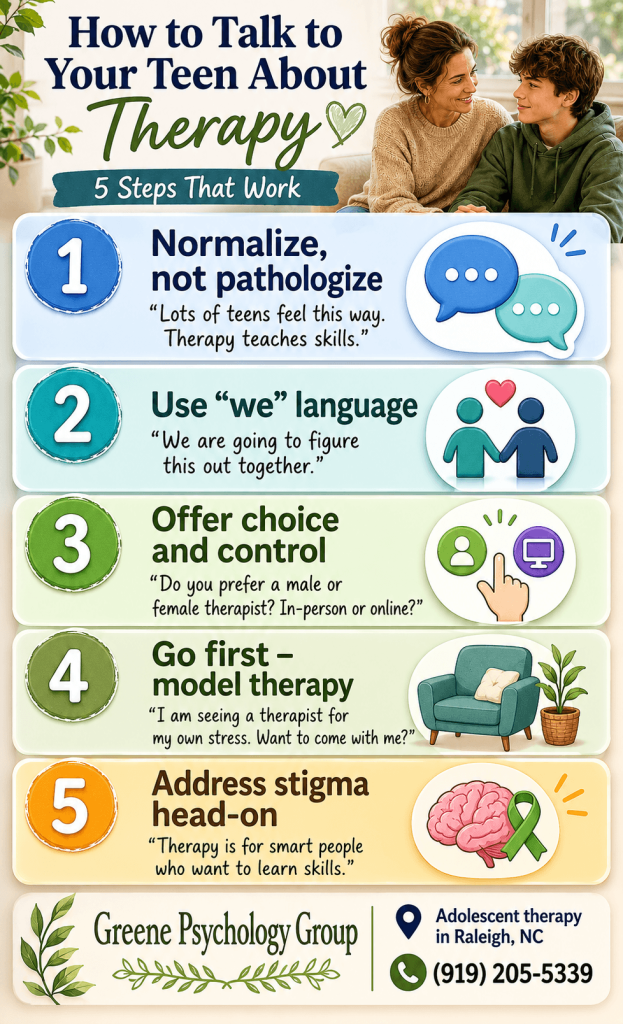
What DOES Work (Evidence‑Based from UNC Chapel Hill's School of Social Work)
Step 1: Normalize, Don't Pathologize
Instead of: "You are so anxious all the time. It's not normal."
Try: "Lots of teens feel this way. Therapy is like tutoring for your brain – it teaches skills that make things easier."
Step 2: Use "We" Language
Instead of: "You need help."
Try: "We are going to figure this out together. I want to understand what you are going through. Let's talk to someone who knows how to help both of us understand."
Step 3: Offer Choice and Control
Instead of: "You are going to therapy on Tuesday at 4 PM."
Try: "Would you prefer a therapist who is a man or a woman? Do you want to try in‑person or online? You can interview the therapist first and decide if they are a good fit."
Step 4: Go First (Model the Behavior)
Instead of: Sending them alone.
Try: "I have been feeling stressed too. I am going to see a therapist to work on my own stuff. Would you be willing to come with me for the first session? We can sit together."
Step 5: Address the Stigma Head‑On
Many teens refuse therapy because they fear being labeled "crazy" or "weak." Say: "Therapy is not for broken people. It is for smart people who want to learn skills. Every athlete has a coach. You are the athlete, and the therapist is your mental coach."
What If They Still Refuse?
If your teen is not in immediate danger (no suicidality, self‑harm, or psychosis), you have options:
Go to therapy yourself. A family therapist can teach you strategies to change the home environment, which often changes the teen's behavior.
Try school‑based counseling. Many Wake County public schools have mental health counselors. The lower barrier (it is "at school," not "a therapist's office") can reduce resistance.
Use a "warm handoff." Ask your pediatrician or a trusted adult (aunt, coach, clergy) to recommend therapy. Sometimes the message lands better from someone who is not a parent.
If your teen is in immediate danger (talking about suicide, self‑harming, refusing to eat for days), do not wait for consent. Call Alliance Health Mobile Crisis at (800) 510-9132 or 988. Parental authority overrides refusal in life‑threatening situations.
Part 4: What Effective Adolescent Therapy Looks Like
If you are searching for adolescent therapy in Raleigh NC, you should know what quality care looks like. Not all therapy for teens is the same.
Developmentally Appropriate Therapy for Teens
Effective adolescent therapy differs from adult therapy in several key ways:
| Adult Therapy | Adolescent Therapy |
|---|---|
| Primarily one‑on‑one | Often includes parent check‑ins (separate or joint) |
| Relies on verbal insight | Uses concrete tools, worksheets, metaphors, technology |
| Focuses on past and present | Balances present skills with future planning |
| Expects homework compliance | Builds in rewards, reminders, and parent support for homework |
| Assumes autonomy | Builds autonomy gradually within safe boundaries |
Evidence‑Based Modalities for Teens
CBT for Adolescents
CBT is the gold standard for teen anxiety and depression. Adaptations include:
Shorter sessions (30–45 minutes for younger teens)
More visual aids (thought bubbles, worksheets)
Behavioral activation (scheduling fun activities to combat withdrawal)
Exposure therapy (facing fears step‑by‑step, with parent support)
DBT for Adolescents (DBT‑A)
Dialectical Behavior Therapy is adapted for teens who struggle with intense emotions, self‑harm, or suicidal behavior. DBT‑A includes:
Individual therapy plus a multi‑family skills group (teens and parents learn together)
Skills: mindfulness, distress tolerance, emotion regulation, interpersonal effectiveness
24/7 phone coaching for crisis moments (therapist available by phone)
Family Therapy
Often essential when family conflict is driving or maintaining the teen's symptoms. Family therapy focuses on:
Communication patterns (who speaks, who interrupts, who withdraws)
Boundary setting (clear rules, consistent consequences)
Repairing trust after rupture (lying, secrecy, betrayal)
Motivational Interviewing (MI)
For resistant teens who do not see a problem, MI uses gentle, non‑confrontational questions to build internal motivation for change.
At Greene Psychology Group, we offer family therapy and CBT for teens, as well as anxiety therapy and mindfulness therapy appropriate for adolescents.
Part 5: The Role of Parents in Teen Therapy
Many parents ask: Should I be involved? How much? Will my teen still talk to the therapist if I am there?
The answer depends on the teen's age, the presenting problem, and the therapist's style. But here is a general framework.
Level of Parent Involvement by Phase
Phase 1 – Intake and Assessment (First 1–3 sessions)
Parent role: High. You will meet with the therapist alone (or with your teen) to provide history, concerns, and context.
What you share: Developmental milestones, family mental health history, school reports, any prior treatment.
Phase 2 – Active Treatment (Ongoing, typically 12–20 weeks)
Parent role: Moderate. The therapist will usually meet with your teen alone for 30–40 minutes, then meet with you (alone or with teen) for 10–15 minutes to share observations, coordinate skills practice, and address concerns.
What you should NOT do: Demand to know everything your teen said. Therapists maintain confidentiality but will share safety concerns and broad themes.
Phase 3 – Crisis or Safety Concern
Parent role: Full involvement. The therapist is legally required to inform you if your teen discloses suicidal ideation with plan, self‑harm with injury, or intent to harm others.
Phase 4 – Termination and Relapse Prevention
Parent role: Collaborative. You and your teen (and therapist) create a written plan for what to do if symptoms return.
What Parents Should Never Do
Cancel therapy as punishment ("You are grounded, so no session this week.")
Use therapy content against your teen ("Your therapist said you need to control your anger, so stop yelling at me.")
Bribe your teen to attend ("I'll give you $50 if you go to therapy.") This undermines intrinsic motivation.
Research from Columbia University Department of Psychiatry found that parent involvement (specifically, attending parent check‑ins and practicing skills at home) improved teen outcomes by 40% compared to teen‑only therapy.
If your teen needs help urgently or you want additional support beyond therapy, these Wake County resources are available.
Crisis and Urgent Care
Alliance Health Mobile Crisis: (800) 510-9132 – 24/7, free, sends a crisis team to your home or school.
988 Suicide & Crisis Lifeline: Call or text 988 – teen‑friendly, confidential.
WakeMed Pediatric Psychiatric Emergency Department: 3000 New Bern Ave, Raleigh – for teens in immediate crisis (ages 5–17).
School‑Based Mental Health (Wake County Public Schools)
WCPSS Student Services: Each high school and middle school has a school psychologist, counselor, and social worker. Start with your school's student services office.
Mental Health Support Teams (MHST): Some WCPSS schools have embedded therapists from local agencies (Alliance Health, Monarch, etc.).
Outpatient Therapy (Greene Psychology Group)
We offer in‑person and online therapy for adolescents aged 14 and older. Parent check‑ins are standard. We accept most major insurance. Contact us at (919) 205-5339.
Intensive Outpatient Programs (IOP) for Teens
For teens who need more than weekly therapy but not hospitalization:
Holly Hill Hospital – Adolescent IOP
SouthLight Healthcare – Youth IOP
Greene Psychology Group – We will refer you if IOP is appropriate; we do not offer IOP for adolescents at this time.
Part 7: Putting It All Together – Three Teen Archetypes
Archetype A: The Anxious Overachiever
Presentation: 15‑year‑old, straight‑A student, suddenly having panic attacks before tests. Refuses to go to school on exam days. Complains of stomachaches.
Bottleneck: Performance anxiety with avoidance behavior.
Treatment map: Intake (parent and teen) → 12 weeks of CBT with exposure (mock tests, timed practice) → Parent learns to stop reassurance ("You'll be fine") and instead coach relaxation → Teen returns to school → Maintenance: 3 booster sessions before final exams.
Archetype B: The Withdrawn Depressed Teen
Presentation: 16‑year‑old, previously social, now spends all time in room. Grades dropped from Bs to Ds. Stopped playing soccer. Parents found cuts on forearm.
Bottleneck: Major depression with self‑harm (non‑suicidal).
Treatment map: Immediate safety assessment (no suicide plan) → DBT‑A (24 weeks, individual + parent skills group) → Family therapy to address conflict around screen time and curfew → Self‑harm cessation (typically by week 8–10) → Return to sports and social activities.
Archetype C: The Defiant ADHD Teen
Presentation: 14‑year‑old, constant arguments about homework, losing assignments, talking back to teachers. Parents have tried grounding, phone removal – nothing works.
Bottleneck: Undiagnosed ADHD with secondary oppositional behavior.
Treatment map: Psychological testing (referral) to confirm diagnosis → Medication evaluation (psychiatrist) → CBT for executive function (organization, planning, time management) → Parent training in behavior management (consistent rewards, natural consequences) → Academic accommodations (504 plan at school).
Part 8: When to Seek Help Immediately – Do Not Wait
Some situations require emergency intervention, not a "wait and see" approach. If your teen exhibits any of the following, seek help today:
Talking about suicide ("I want to die," "Everyone would be better off without me")
Giving away prized possessions (clothes, electronics, sports gear)
Writing a will or goodbye notes (digital or physical)
Self‑harm with bleeding (cuts that require medical attention)
Not eating for >48 hours or significant weight loss
Not sleeping for >72 hours (mania risk)
Running away from home repeatedly
Threatening violence toward others with a weapon or detailed plan
What to do: Call 988 (Suicide & Crisis Lifeline) or Alliance Health Mobile Crisis at (800) 510-9132. For immediate life‑threatening danger, call 911 and state: "This is a mental health crisis. Please send CIT officers."
FAQs
Therapy can be effective from age 4 (play therapy) through adulthood. Greene Psychology Group sees adolescents aged 14 and older for individual therapy. For younger children, we provide referrals.
Use the framework: duration (more than 2 weeks), intensity (extreme emotions or risk behaviors), and impairment (grades, friendships, functioning). Any change in functioning lasting >2 weeks warrants an evaluation.
For non‑urgent concerns, cooperation improves outcomes. Use the motivational strategies in Part 3. For urgent safety concerns (suicide, self‑harm, psychosis), you can bring them to an ER or call mobile crisis.
Therapist‑teen communication is confidential, with exceptions: safety concerns (suicide, self‑harm, abuse, harm to others). The therapist will share general themes (e.g., "anxiety about tests") but not specific disclosures unless safety is at risk.
Rarely. In some cases, uncovering trauma or increasing awareness of anxiety can temporarily increase distress. A skilled therapist will pace treatment and provide coping skills before deep exploration.
For mild to moderate anxiety or depression, 12–20 sessions is typical. For self‑harm or suicidal behavior, DBT‑A often requires 24 weeks. Some teens need only 6–8 sessions for specific phobias.
Yes, most plans cover mental health treatment for minors. Greene Psychology Group accepts Blue Cross NC, Cigna, UnitedHealthcare, Aetna, MedCost, CBHA, NC State Health Plan, Medicare, and TriCare.
That is common. A skilled adolescent therapist will not force conversation. They may play games, draw, use worksheets, or simply sit in silence. Many resistant teens open up after 3–4 sessions.
Yes. Greene Psychology Group offers online therapy for teens. Research shows online CBT is equally effective for adolescent anxiety and depression.
School counselors focus on academic and social functioning within the school setting. They cannot provide ongoing treatment for mental health disorders. A licensed therapist (LCSW, LPC, LMFT, psychologist) provides diagnosis and evidence‑based treatment.
Look for licensed providers who list specific training in adolescent CBT, DBT, or family therapy. Ask: "Do you involve parents? Do you use exposure therapy for anxiety? Do you track progress with questionnaires?"
Greene Psychology Group can refer you to a child and adolescent psychiatrist in Raleigh. Many teens benefit from medication (e.g., SSRI for anxiety/depression) plus therapy. Start with therapy; medication is added if insufficient response.
Sources
Harvard Medical School – Adolescent brain development and mental health
Duke University Center for Child and Family Policy – Parenting and teen mental health
UNC Chapel Hill School of Social Work – Talking to teens about therapy
Johns Hopkins Bloomberg School of Public Health – Adolescent anxiety prevalence
Columbia University Department of Psychiatry – Parent involvement in teen therapy
Stanford University Department of Psychiatry – DBT for adolescents
National Institute of Mental Health (NIMH) – Child and adolescent mental health
If you are worried about your teenager's mental health – even if you are not sure whether it is "serious enough" – trust your instincts.
We offer adolescent therapy with parent check‑ins, evidence‑based approaches, and flexible scheduling (evenings available). Same‑week appointments are available for urgent concerns.
Contact Greene Psychology Group today: