
Adult ADHD therapy: What counseling can help with
Adult ADHD therapy may help when daily life has become harder because of unfinished tasks, organization-related stress, procrastination, intense self-criticism, emotional reactions, relationship strain, or anxiety and depression that seem tangled with attention concerns. Counseling is not a shortcut to a diagnosis, psychological testing, medication management, or ADHD coaching. It is a place to understand patterns, practice skills, and work on the emotional and relationship effects of ADHD with a licensed clinician.
Quick answer
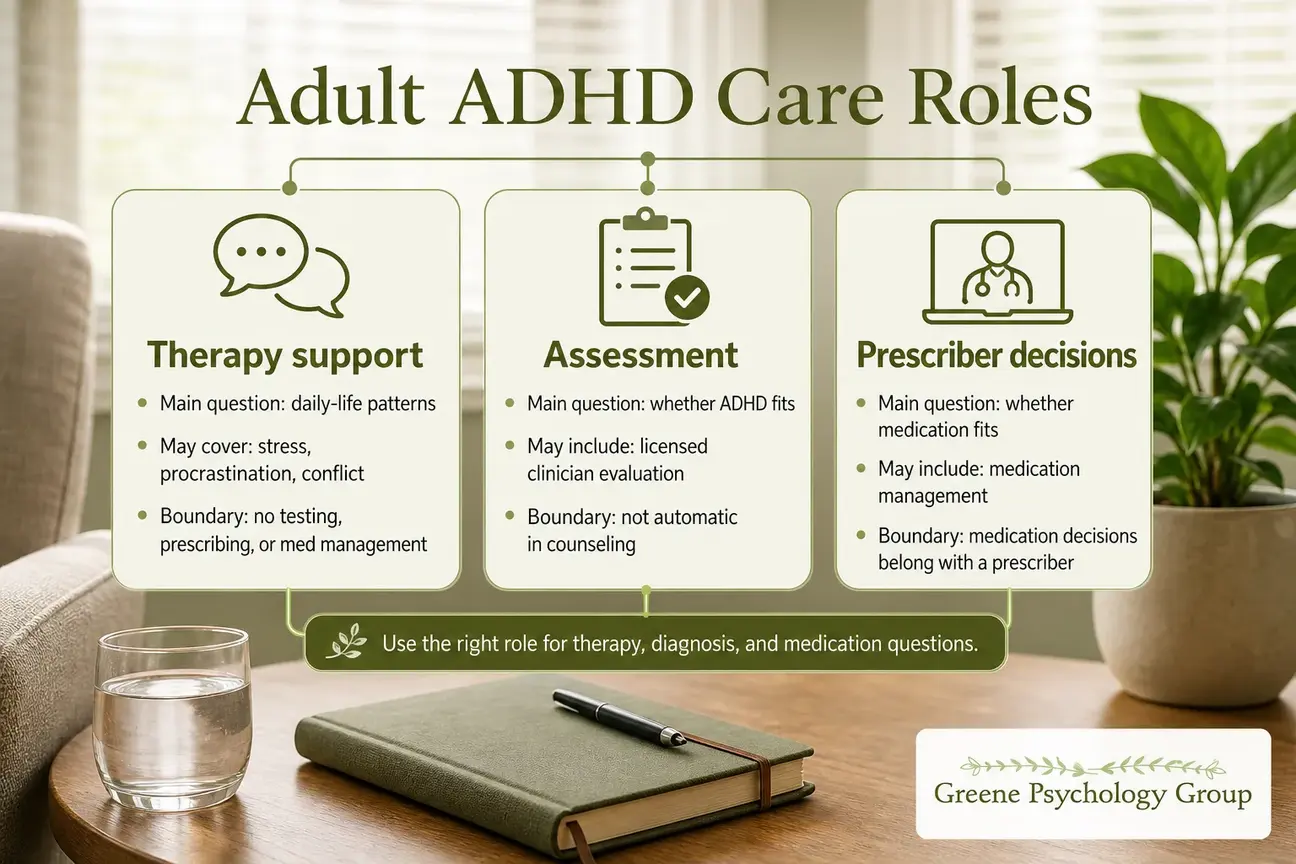
Adult ADHD therapy can support the emotional, behavioral, and relational parts of living with ADHD, including stress around responsibilities, procrastination, self-criticism, conflict, and ADHD emotional regulation. It does not automatically provide an ADHD diagnosis, psychological testing, medication management, or coaching. A licensed clinician assesses diagnosis, and medication decisions belong with a prescriber.
What adult ADHD therapy can and cannot do
Psychotherapy is a broad term for treatment that helps people notice and work with thoughts, emotions, behaviors, relationships, and daily functioning. The National Institute of Mental Health describes psychotherapy as a treatment that can help people identify and change troubling emotions, thoughts, and behaviors, with goals that can include symptom relief, daily functioning, and quality of life.
For adults with ADHD, counseling may be one part of a broader care plan. The NIMH ADHD overview describes psychotherapy, including behavioral therapy and cognitive behavioral therapy, as approaches that can help some people cope with daily challenges, gain confidence, and manage behavior patterns. That does not mean therapy is the only option, the right fit for every person, or a replacement for medical care.
It can help to separate several services that are often discussed together:
| Need | What it generally involves | Important boundary |
|---|---|---|
| Psychotherapy | Work on emotions, behaviors, relationships, coping skills, self-criticism, stress, and functioning | Greene Psychology Group provides individual psychotherapy for adults and adolescents |
| ADHD diagnosis | A clinical assessment of symptoms, history, impairment, and other possible explanations | Do not assume therapy automatically includes a formal ADHD evaluation |
| Psychological or neuropsychological testing | Standardized testing when clinically indicated or requested | Testing availability is not verified as a current Greene Psychology Group service |
| Medication management | A prescriber evaluates, prescribes, adjusts, and monitors medication | Greene Psychology Group does not provide medication prescribing or medication management |
| ADHD coaching | Practical goal-setting, accountability, and structure-focused support | Coaching is distinct from psychotherapy and should not be assumed to be offered |
This distinction matters because many adults arrive in counseling with a mix of questions: “Is this ADHD?” “Why do I keep avoiding tasks?” “Why do small conflicts feel so big?” “Should I ask someone about medication?” Therapy can help organize those questions without pretending that one service answers all of them.
ADHD counseling for organization-related stress
ADHD counseling may help when organization problems have become emotionally loaded. Some adults are not only dealing with a messy desk, a late bill, or an unfinished project. They are also carrying dread, embarrassment, arguments, or a sense that they are always behind. Therapy can make room for both parts: the practical problem and the emotional weight around it.
In counseling, a therapist may help a client look at what usually happens before a task falls apart. Is the task too large to start? Does the client avoid it because it has led to criticism in the past? Is there uncertainty about the first step? Are reminders helpful, or do they trigger shame and resistance? These questions are not a diagnosis by themselves; they are a way to understand patterns.
Cognitive behavioral therapy may include practical work with attention, organization, and task completion. NIMH describes CBT for ADHD as helping a person become aware of attention and concentration challenges and work on skills related to focus, organization, and completing daily tasks. One example is breaking larger tasks into smaller steps.
That kind of skill-building is not about moralizing disorganization. It is not “try harder” in a therapy voice. It is a collaborative process of asking, “What is realistic for this person, in this life, with these responsibilities and these stressors?” ADHD coping skills are more likely to be usable when they fit the person’s actual routines, not an idealized version of how life “should” work.
Therapy may also help clients notice when organization strategies become too complicated. A system that requires constant upkeep may fail quickly for someone who is already overwhelmed. ADHD coping skills often need to be simple, visible, repeatable, and forgiving enough to restart after an off day.
Why people search for ADHD therapy adults: procrastination patterns
When someone searches for “ADHD therapy adults,” they may be looking for help with something that has been misunderstood as laziness. Procrastination can involve avoidance, fear, discouragement, or task-related emotion. A person may fully understand that a task matters and still find themselves delaying it. By the time they come to therapy, they may have already tried planners, apps, reminders, and motivational advice, only to feel more frustrated.
Therapy can explore what procrastination is doing for the person in the short term. It may provide relief from a task that feels confusing, boring, emotionally risky, or too large. It may protect the person from the possibility of doing something imperfectly. It may also be reinforced by past experiences where urgency was the only thing that created enough pressure to act.
In ADHD counseling, procrastination work may include identifying the thought that appears right before avoidance. Some common patterns include “I need to do this perfectly,” “I already messed it up,” “It will take forever,” or “If I start, I will have to face how behind I am.” Therapy can help a person test those thoughts and practice smaller, more workable next actions.
ADHD coping skills for procrastination are often behavioral and emotional at the same time. A therapist might help a client define a first step that is small enough to begin, plan a realistic stopping point, or build in a recovery plan if the task does not go smoothly. The goal is not to promise constant productivity. The goal is to reduce avoidance loops and build more flexible responses.
For some people, anxiety, perfectionism, depression, grief, burnout, or relationship stress also contributes to delay. That is one reason assessment matters. A licensed clinician can help clarify whether ADHD, another concern, or more than one concern may be involved.
ADHD emotional regulation without shame
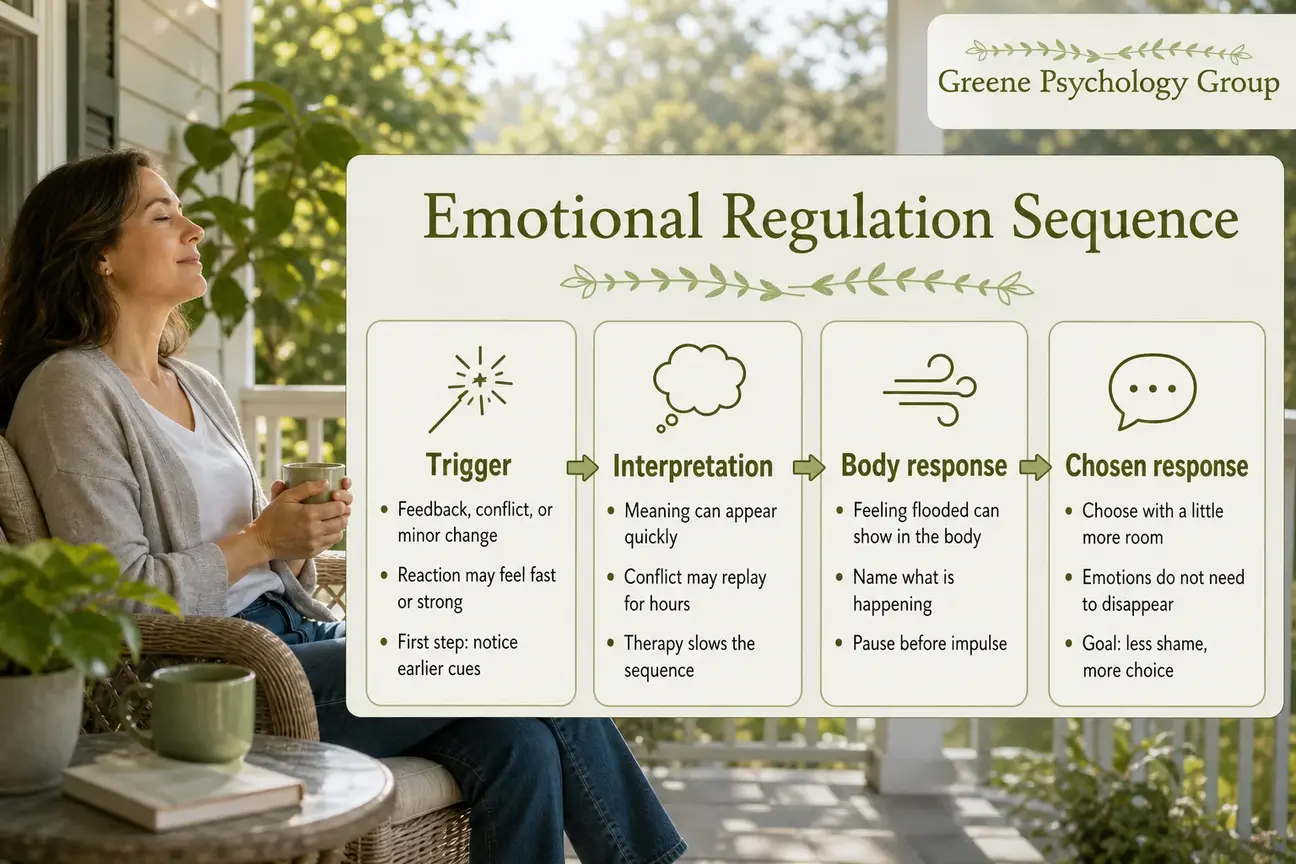
ADHD emotional regulation is a common reason adults consider therapy, especially when reactions feel faster, stronger, or harder to interrupt than they want. This might show up as snapping in a conversation, shutting down after feedback, feeling flooded by a minor change, or replaying a conflict for hours. These patterns can be painful even when the person cares deeply about the people around them.
Psychotherapy can help clients slow down the sequence between trigger, interpretation, body response, impulse, and action. That does not mean emotions become easy or disappear. It means the person may learn to notice earlier cues, name what is happening, and choose a response with a little more room.
ADHD emotional regulation work may include recognizing situations that reliably raise stress, such as transitions, criticism, competing demands, or feeling rushed. It may also include practicing repair after a difficult interaction. Repair can be an important skill because many adults with ADHD feel intense regret after reacting in a way that does not match their values.
ADHD counseling can also help separate accountability from shame. A person can take responsibility for an action without turning that action into a global statement about their character. That distinction matters in therapy because shame often leads to hiding, defensiveness, or giving up, while accountability can lead to learning and repair.
Sometimes emotional regulation concerns are connected to anxiety, depression, anger, trauma-related stress, sleep disruption, or major life transitions. Counseling can help sort through those layers and identify whether additional care or coordination with another professional may be appropriate.
How counseling can soften self-criticism
Many adults who pursue therapy for ADHD-related concerns are not only asking how to manage tasks. They are asking how to live with years of feeling inconsistent, misunderstood, or disappointed in themselves. Repeated missed deadlines, lost items, unfinished projects, or conflict can become a harsh inner story: “I always fail,” “I am unreliable,” or “Everyone else can handle this.”
Therapy may help a client examine those thoughts without excusing harmful behavior or pretending consequences do not matter. A balanced therapeutic approach can hold two truths at once: patterns may need to change, and shame is not usually an effective long-term strategy for change.
ADHD coping skills in this area may include noticing self-attacking language, identifying what emotion is underneath it, and practicing a more accurate response. For example, “I missed that deadline, so I need a repair plan” is different from “I ruin everything.” The first statement leaves room for action. The second often leads to avoidance or despair.
Self-criticism can also be intensified by depression. The NIMH depression information page describes depression as affecting mood, thoughts, sleep, appetite, and daily activities. When low mood, loss of interest, or hopelessness is present, it is important not to assume that every difficulty is simply an ADHD problem.
This is where mental-health assessment matters. A licensed clinician can ask about mood, anxiety, sleep, stress, life changes, safety, and functioning. The goal is not to label every experience. The goal is to understand what is contributing to distress and what kind of support may fit.
Relationship strain when ADHD is part of the picture
Relationship stress is another common reason adults seek therapy. ADHD-related patterns may affect relationships through missed commitments, uneven household responsibilities, repeated reminders, interruptions, impulsive comments, difficulty following through, or withdrawal after conflict. Partners, family members, and close friends may interpret these patterns in ways that become painful for everyone involved.
In individual therapy, the focus is usually on the client’s own patterns and choices. That may include noticing defensiveness, practicing clearer communication, planning for predictable responsibilities, or learning how to repair after a missed commitment. ADHD emotional regulation work can be especially relevant when conflict escalates quickly.
Therapy may also help a client prepare for conversations that have become repetitive or tense. Instead of entering the conversation with “I always mess this up” or “They are just criticizing me,” the client may practice naming the issue, acknowledging impact, and asking for a specific structure that supports follow-through.
Sometimes relationship or family work may be useful when more than one person wants help with interaction patterns. Greene Psychology Group has a service page for relationship counseling, but readers should ask the practice about fit, format, and clinician availability rather than assuming a specific service or clinician is appropriate for every situation.
ADHD counseling should not frame one person as the entire problem in a relationship. It can help identify the client’s responsibilities while also recognizing that relationships involve patterns between people. The aim is usually clearer communication, less blame, and more workable agreements.
Anxiety, depression, and concentration concerns
ADHD, anxiety, and depression can overlap in daily life. Trouble concentrating, low motivation, irritability, sleep changes, avoidance, and reduced functioning can have more than one possible explanation. An adult may have ADHD, another concern, or more than one concern at the same time. That is why a thoughtful assessment is more useful than trying to self-diagnose from a symptom list.
In therapy, a licensed clinician may ask when the concerns began, whether they appear across settings, what makes them better or worse, and how mood, worry, sleep, stress, health, relationships, work, or school demands affect functioning. These questions help clarify whether counseling should focus mainly on coping with ADHD-related patterns, anxiety, depression, life stress, or a combination.
Mental health therapy may be especially relevant when attention concerns are tied to broader emotional distress. For example, a person may seek ADHD counseling because they cannot finish tasks, then discover that grief, chronic stress, depression, or anxiety is also affecting energy and concentration. Therapy can help sort those threads without making premature assumptions.
A search such as “ADHD therapy adults” may point to a broad need rather than a narrow skills program. Some people need help with the emotional consequences of years of feeling behind. Others need support around current life demands. Others need a space to discuss whether a formal evaluation, medical consultation, or coordination with another provider would be helpful.
How adult ADHD is assessed
A diagnosis of ADHD comes from a qualified health care provider or licensed clinician conducting a thorough evaluation. The CDC information on ADHD in adults describes adult ADHD as requiring careful evaluation because symptoms can resemble or overlap with other conditions and life stressors. Assessment may include clinical interviews, symptom checklists, rating scales, history, and information about functioning across settings.
A clinician may ask about childhood patterns, school experiences, work history, relationships, daily responsibilities, sleep, mood, anxiety, substance use, medical concerns, and current stress. The purpose is to understand the whole picture, not to reduce a person to one label. Symptoms that resemble ADHD may have different causes, and more than one concern can be present.
Psychotherapy can sometimes begin while diagnostic questions are still being clarified. For example, a person might work on procrastination, self-criticism, communication, or ADHD coping skills while also deciding whether to pursue a formal evaluation elsewhere. However, it is important to ask directly what a practice or clinician provides. Do not assume that starting therapy means comprehensive ADHD testing is included.
Greene Psychology Group provides psychotherapy for adults and adolescents, but this article does not represent that the practice offers formal ADHD evaluations, psychological testing, or neuropsychological testing. If evaluation is a main goal, readers should ask what type of assessment is available and whether another referral may be needed.
What CBT may look like in counseling
CBT is one therapy approach that may fit some adults with ADHD-related concerns. It often focuses on the links among thoughts, emotions, behaviors, and patterns of avoidance or follow-through. In ADHD counseling, CBT may be used to identify unhelpful thought patterns, create manageable behavior experiments, and practice skills that support task completion.
For example, a client might bring in a recurring difficulty such as avoiding email, delaying paperwork, or becoming overwhelmed by a multi-step project. The therapist and client may break the situation down: What triggers avoidance? What thought appears? What emotion follows? What does the person do next? What happens afterward? From there, they may test a smaller next step.
ADHD coping skills in CBT may include breaking tasks into smaller actions, using reminders more strategically, planning transitions, practicing realistic self-talk, and building restart routines after interruptions. These skills do not assure that tasks will always be completed. They are tools that may help a person respond more intentionally.
CBT may also address self-criticism and ADHD emotional regulation. If a person interprets one mistake as proof that they are incapable, that thought may increase avoidance. If a person can name the mistake, repair what can be repaired, and choose a next step, the situation may become more workable.
CBT is not the only psychotherapy approach, and it is not the right fit for everyone. Some clients may benefit from other forms of therapy, or from a combination of therapy, medical care, accommodations, coaching, or practical supports. A licensed clinician can help discuss fit and limits.
Medication questions belong with a prescriber
Many adults wonder whether medication should be part of ADHD care. Therapy is an appropriate place to talk about feelings, questions, worries, or past experiences related to treatment decisions, but medication decisions themselves belong with a prescriber. That includes whether medication is appropriate, what medication to use, how to monitor it, and whether any changes are needed.
Greene Psychology Group does not provide medication prescribing or medication management. A therapist may, with appropriate consent, coordinate with other providers as part of broader care. The therapist’s role is not to tell a client to start, stop, or change medication.
For medication questions, speak with a qualified prescriber. Do not change or stop medication based on an article. When already working with a prescriber, it can be useful to share what is showing up in daily life, including benefits, concerns, side effects, sleep, mood, and functioning, so the prescriber has accurate information.
Online and in-person options for counseling
The choice between in-person and online therapy depends on privacy, technology, scheduling logistics, clinical fit, and personal preference. Some adults prefer the structure of traveling to an office. Others find that teletherapy reduces barriers and makes it easier to attend consistently. Neither format should be described as automatically better for everyone.
Greene Psychology Group has offices in Raleigh and Asheville and offers online therapy in North Carolina for people physically located in the state during the session. If therapy is under consideration, it is appropriate to ask about format, fit, and what to expect before scheduling.
For adults considering ADHD-focused counseling, the practical details may be especially important. A private space, a reliable device, calendar reminders, and a plan for paperwork can make starting therapy feel less overwhelming. These are not clinical requirements for every person, but they are useful planning questions.
ADHD coping skills you might start discussing in therapy
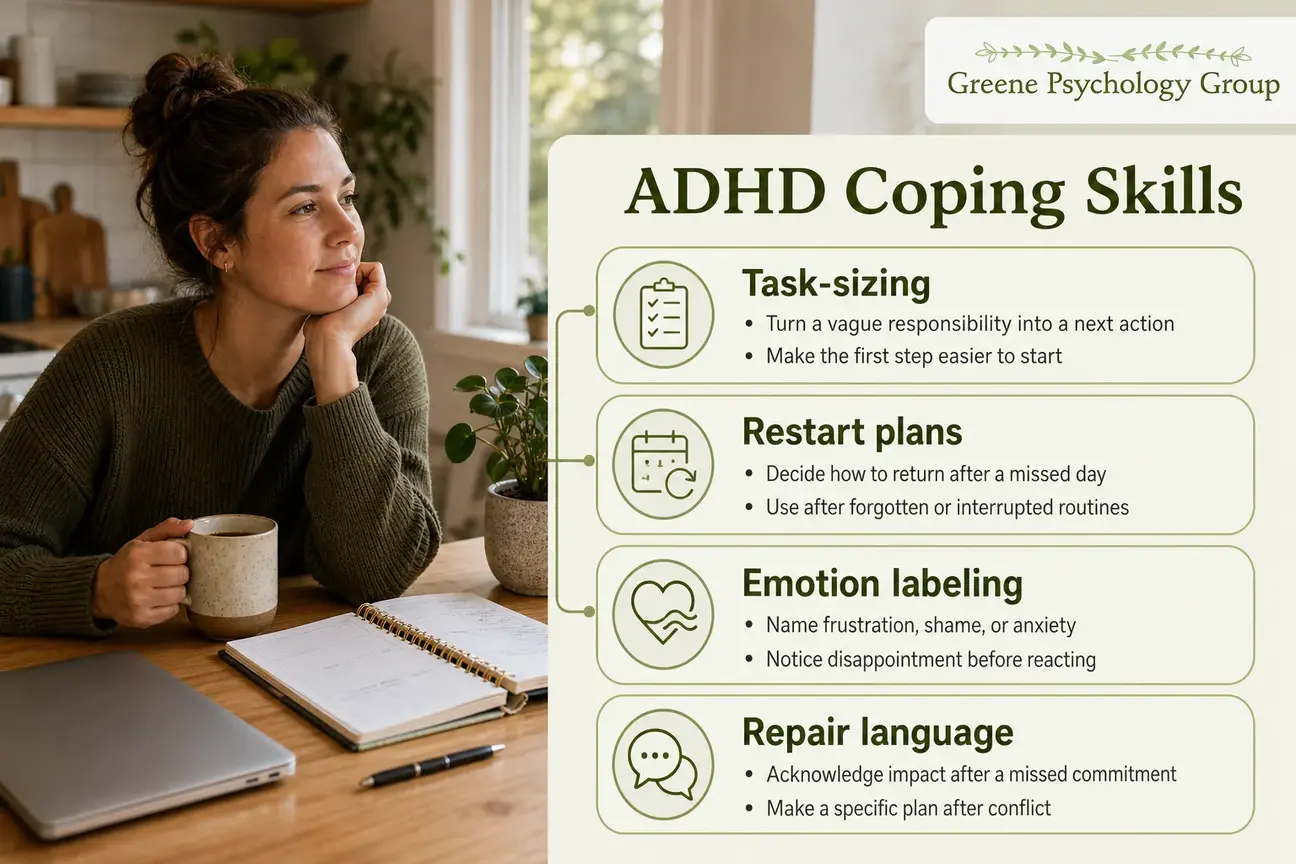
ADHD coping skills are most useful when they are realistic, compassionate, and connected to the problem a person actually wants to change. Therapy is not simply a list of tips. Still, some skill areas often become part of counseling when attention, organization, procrastination, or emotional regulation are part of the concern.
- Task-sizing: turning a vague responsibility into a next action that can be started.
- Restart plans: deciding ahead of time how to return after a missed day, forgotten task, or interrupted routine.
- Emotion labeling: naming frustration, shame, anxiety, or disappointment before reacting.
- Repair language: practicing how to acknowledge impact and make a specific plan after a mistake.
- Environmental supports: adjusting reminders, visibility, or routines so they are easier to use.
- Self-talk shifts: replacing global self-criticism with accurate, action-oriented language.
These ADHD coping skills are not a substitute for diagnosis, medical care, or accommodations when those are needed. They are examples of what counseling may help a person practice. In therapy, the client and therapist can also look at what has not worked and why, rather than assuming the client simply lacked motivation.
ADHD emotional regulation skills may be woven into each of these areas. For instance, a restart plan is not only practical; it also helps reduce the shame spiral that can follow a missed task. Repair language is not only relational; it also helps slow the urge to withdraw or become defensive.
When counseling may be worth considering
The following are reflection prompts, not a diagnostic test. Therapy may be worth considering if ADHD-related patterns, attention concerns, or emotional distress are interfering with work, school, relationships, parenting, household responsibilities, or daily routines. It may also be worth considering if self-criticism, anxiety, depression, or conflict is becoming harder to interrupt.
Some adults reach out because they want help understanding patterns before deciding whether to pursue an evaluation. Others already have a diagnosis and want support with daily functioning, relationships, or emotional distress. Others are unsure whether ADHD is involved at all but know that their current strategies are not enough.
ADHD counseling may be a good conversation to start when the concern is not just “I need a better planner,” but “I need help understanding why I keep getting stuck and how to respond differently.” Therapy for adult ADHD concerns can include both practical work and deeper emotional work, depending on the person’s needs and the clinician’s assessment.
How to take the next step with Greene Psychology Group
If counseling feels like a possible next step, contact Greene Psychology Group, email [email protected], or call 919-205-5339. Because the website notes that phones may not be working properly, it may be helpful to use email as well. Share only contact information, a brief reason for reaching out, whether Raleigh, Asheville, or online sessions are preferred, and insurance information. Do not send detailed health information through the contact form or email because they are unencrypted.
The practice is in network with most BCBS and Aetna plans, accepts out-of-network and self-pay clients, and provides payment information for reimbursement when applicable. Readers should verify benefits with both their insurer and the practice. Uninsured and self-pay clients receive a Good Faith Estimate under the No Surprises Act. The practice’s insurance and payment information page can also help with general coverage questions before reaching out.
When contacting the practice, it is reasonable to ask what services are available, whether the concerns sound like a fit for psychotherapy, and whether another type of evaluation or provider might also be appropriate. Asking these questions does not commit anyone to a particular treatment path.
A final note on safety and scope
Adult ADHD therapy can be one form of support for patterns that affect daily life, emotions, and relationships, but it is not emergency care and does not replace diagnosis or treatment from an appropriate licensed professional. Greene Psychology Group does not provide crisis care, emergency services, medication prescribing, medication management, inpatient treatment, residential treatment, or intensive outpatient programming.
This article is for general education and isn't a substitute for diagnosis or treatment from a licensed professional. If you are in crisis, call or text 988 or call 911.
For immediate danger, call 911 or go to the nearest emergency room. For a mental-health or suicidal crisis, call or text 988 or use the 988 Lifeline.
Frequently Asked Questions
Can therapy diagnose adult ADHD?
A licensed clinician or qualified health care provider assesses diagnosis through a thorough evaluation. Therapy and diagnosis are related, but they are not always the same service. If diagnosis or formal assessment is the main goal, ask the practice what type of ADHD assessment is available and whether another referral may be needed.
What can adult ADHD therapy help with?
It may help with daily challenges, organization-related stress, procrastination patterns, emotional responses, self-criticism, relationship strain, and co-occurring anxiety or depression. Therapy can also help a person practice ADHD coping skills and understand patterns that make daily functioning harder.
Is ADHD counseling the same as ADHD coaching?
No. ADHD counseling is psychotherapy that addresses emotional, behavioral, relational, and mental-health concerns. Coaching generally focuses more on practical goals, structure, and accountability. Coaching should not be assumed to be offered by a psychotherapy practice unless the practice confirms it.
Does a therapist prescribe ADHD medication?
No. Medication decisions belong with a prescriber. Greene Psychology Group does not provide medication prescribing or medication management. A therapist may discuss feelings or questions about treatment and may coordinate with another provider with appropriate consent.
Can CBT help adults with ADHD?
CBT may help some adults notice attention and concentration patterns, work on organization, break tasks into smaller steps, and address avoidance or self-critical thoughts. It is one option to discuss with a licensed clinician, not an assured fit for every person.
Can therapy help when anxiety or depression occurs with ADHD?
It may. A licensed clinician can assess whether ADHD, anxiety, depression, another concern, or more than one condition may be affecting concentration, motivation, mood, or relationships. Therapy may address emotional and functional effects, while medication questions belong with a prescriber.
Is online ADHD therapy available for adults in North Carolina?
Greene Psychology Group offers online therapy for people physically located in North Carolina during the session. If online care is under consideration, ask about privacy, technology, clinical fit, and whether teletherapy or in-person sessions make the most sense for the situation.