

If you are reading this, you may already know the exhausting reality of living with anger that feels out of control. Maybe you have snapped at a partner over something small, only to feel immediate shame. Maybe you have yelled at your children and watched their faces crumple. Maybe you have felt your blood pressure spike in traffic, in meetings, or in conversations that should have been routine. Maybe you have broken things, slammed doors, or said words you cannot take back.
And afterward, the guilt settles in. Why did I react like that? Why can't I just stay calm? What is wrong with me?
Here is the truth that anger tries to hide from you: anger is not the enemy. It is a signal. Anger is a high‑energy alarm that protects what matters – your boundaries, your values, your sense of fairness. It is not a moral failing. It is a biological response that, when understood and channeled, can actually serve you.
But when anger becomes frequent, intense, or out of proportion to the trigger, it stops protecting you and starts controlling you. It strains relationships, derails careers, damages your health, and leaves you feeling drained and ashamed.
Greene Psychology Group offers evidence‑based anger management therapy in Raleigh, NC, using Cognitive Behavioral Therapy (CBT), mindfulness, and skills‑based approaches. This guide is a complete, research‑backed overview: what anger actually is, how it escalates, the most effective treatments, and how to find the right help.
Part 1: What Anger Actually Is – Beyond the Stereotypes
Most people think anger is "bad." They try to suppress it, ignore it, or shame themselves for feeling it. But anger is a normal, universal human emotion. The problem is not anger itself – it is how we express it.
Anger vs. Aggression – A Critical Distinction
| Anger | Aggression |
|---|---|
| An internal state: thoughts, feelings, and physiological activation (heat, muscle tension, fast breathing) | Behavior: verbal (shouting, insults) or physical (slamming doors, throwing objects, hitting) |
| A signal that something is wrong | An action that can harm others or yourself |
| Can be managed and channeled | Often leads to regret and damaged relationships |
The therapy target is both: you learn to notice anger earlier, downshift your body's arousal, and choose behaviors that align with your goals and values.
How Anger Manifests – The Three Layers
1. Cognitive (Thoughts)
"They did this on purpose."
"I'm being disrespected."
"This is unfair."
"They always do this."
"I can't let them get away with this."
2. Physiological (Body)
Muscle tension (jaw, shoulders, fists)
Rapid heart rate
Shallow, quick breathing
Heat or flushing
Adrenaline surge
3. Behavioral (Actions)
Yelling or raising voice
Slamming doors or objects
Throwing or breaking things
Physical aggression
Withdrawal or silent treatment
Research from Harvard Medical School has shown that anger activates the amygdala (the brain's fear and threat center) and the sympathetic nervous system (the fight‑or‑flight response). Anger is a biological alarm – not a character flaw.
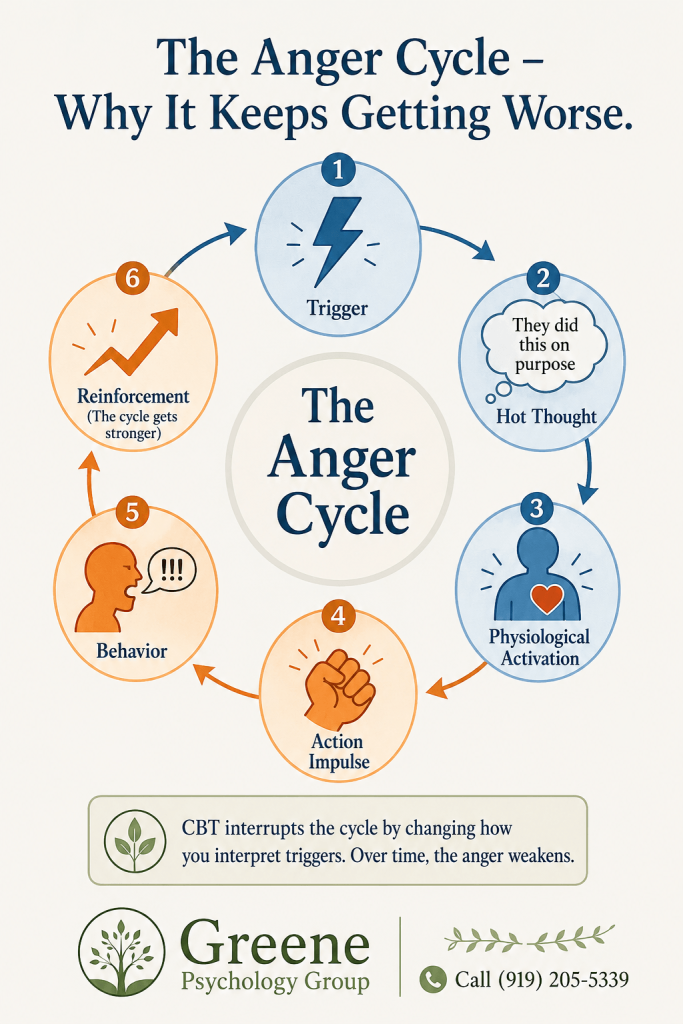
Part 2: The Anger Cycle – Why It Keeps Getting Worse
Anger often escalates when three ingredients stack up: a trigger, a catastrophic appraisal, and an action impulse. Understanding this cycle is the first step to breaking free.
The Cycle
Trigger: Something happens – a perceived disrespect, an unfair situation, a blocked goal, a criticism.
Appraisal: You interpret the trigger through a lens of threat. "They did this on purpose." "I'm being cornered." "This is completely unfair."
Physiological Activation: Your body responds: adrenaline surges, heart rate increases, muscles tense.
Action Impulse: You feel the urge to lash out, shut down, or escape.
Behavior: You act on the impulse – yelling, slamming, withdrawing, or worse.
Reinforcement: The behavior provides temporary relief (the adrenaline drops), but the pattern is reinforced. The next time you encounter a similar trigger, your response is faster and stronger.
The Role of "Hot Thoughts"
Anger is fueled by "hot thoughts" – quick, absolute, often catastrophic interpretations of events. Common hot thoughts include:
| Hot Thought | More Balanced Alternative |
|---|---|
| "They did this on purpose to hurt me." | "They may not have realized how this would affect me." |
| "This is completely unfair." | "This is frustrating, but fairness isn't always immediate." |
| "I can't let them get away with this." | "I can address this without escalating." |
| "They always do this." | "This has happened before, but not always." |
| "I'm being disrespected." | "I feel disrespected. That doesn't mean it was intentional." |
The goal is not forced positivity. The goal is a more accurate read of the situation so your actions fit the reality, not your hot‑headed interpretation.
Part 3: Anger Management Therapy – What Works
Anger management therapy does not aim to erase anger. It aims to help you regain choice so you can respond effectively in the moments that matter.
Cognitive Behavioral Therapy (CBT) for Anger
CBT is the most researched and effective approach for anger management. A 2024 review published in Cureus evaluated CBT interventions for anger and aggression, confirming their effectiveness across diverse populations. Studies show CBT for anger management leads to significant improvements in anger control and reduction in aggressive behaviors.
Key components of CBT for anger:
1. Cognitive Restructuring
You learn to identify "hot thoughts" – quick, absolute interpretations ("always," "never," "on purpose") – and test them against fuller evidence. Techniques include thought records and evidence‑for/against exercises.
2. Behavioral Tools
Avoidance is instant relief with long‑term costs. Therapy uses graded exposures – small, repeatable steps toward tough tasks or conversations – so your brain relearns that challenge is not catastrophe. You also learn competing responses (deliberately slower voice, relaxed hands) to interrupt the urge to escalate.
3. Physiological Downshifts
Brief routines – paced breathing, progressive muscle release, posture resets – help you exit the "red zone," especially in the first 60–120 seconds after a trigger. Relaxation is not the cure; it is the runway that lets other skills take off.
4. Mindfulness as a Stabilizer
Mindfulness trains attention to present‑moment signals without immediately fighting or fleeing them. As an adjunct to CBT, it helps you notice anger earlier, label sensations, and choose on purpose.
5. Assertive Communication & Problem‑Solving
Anger often spikes because needs are not stated clearly or limits are not enforced until too late. You rehearse assertive scripts (clear + respectful), conflict planning, and a simple problem‑solving loop (define, brainstorm, choose, test, review). These are learnable – and they reduce the need for volume.
At Greene Psychology Group, we offer CBT for anger management, mindfulness therapy, and anxiety therapy.
Part 4: What an Anger Management Session Looks Like
If you are new to anger therapy, you might feel nervous. Will you be judged? Will you have to admit to things you are ashamed of?
Typical Session Structure (50 minutes)
| Time | Activity |
|---|---|
| 0–10 min | Check‑in: "How was your week? Any anger episodes? Any successes?" |
| 10–30 min | Active work: Identifying hot thoughts, practicing a physiological downshift, rehearsing an assertive script |
| 30–40 min | Processing: "What did you notice? What triggered the anger? What could you do differently next time?" |
| 40–45 min | Planning: "What skill will you practice between now and next session?" |
| 45–50 min | Homework assignment: Specific, graded practice (e.g., "Practice the breathing technique when you feel your jaw tighten"). |
What You Will NOT Experience
Judgment: Your therapist has worked with many people who struggle with anger. They understand the shame and the struggle.
Forced positivity: You will not be told to "just calm down" or "look on the bright side." You will learn skills that actually work.
Shaming: Anger is a normal emotion. The goal is not to eliminate it, but to channel it constructively.
The Role of Homework
Anger management is a skill, not a passive treatment. Between‑session practice is essential. Your therapist will give you specific, graded assignments – practicing breathing techniques, completing thought records, or rehearsing assertive scripts.
Part 5: The Five Skill Domains of Anger Management
The Five Skill Domains of Anger Management
At Greene Psychology Group, anger management therapy is built on five core skill domains.
1. Cognitive Tools: Accurate Thinking Under Pressure
You learn to spot hot thoughts – quick, absolute interpretations – and test them against fuller evidence.
Techniques:
Thought records: Write down the trigger, the hot thought, the evidence for and against, and a more balanced alternative.
Evidence‑for/against exercises: "What is the evidence that this person acted intentionally to hurt me? What is the evidence that they didn't?"
2. Behavioral Tools: Approach Beats Avoidance
Avoidance is instant relief with long‑term costs. You learn to approach difficult situations in small, repeatable steps.
Techniques:
Graded exposures: Small, repeatable steps toward tough tasks or conversations.
Competing responses: Deliberately slower voice, relaxed hands, open posture – to interrupt the urge to escalate.
3. Physiological Downshifts You Will Actually Use
Brief routines that help you exit the "red zone."
Techniques:
Paced breathing: Inhale for 4 counts, hold for 4, exhale for 6.
Progressive muscle release: Tense and release muscle groups.
Posture resets: Unclench your jaw, drop your shoulders, uncross your arms.
4. Mindfulness as a Stabilizer
Mindfulness trains attention to present‑moment signals without immediately fighting or fleeing them.
Techniques:
Body scans: Notice where anger lives in your body (tight chest, clenched jaw).
Labeling: "I notice anger arising. I notice the urge to yell."
Pause practice: Before responding, take one conscious breath.
5. Assertive Communication & Problem‑Solving
Anger often spikes because needs are not stated clearly or limits are not enforced until too late.
Techniques:
Assertive scripts: Clear + respectful statements (e.g., "I feel frustrated when... I need...").
Conflict planning: Anticipate difficult conversations and rehearse responses.
Problem‑solving loop: Define the problem, brainstorm solutions, choose one, test it, review
Part 6: Anger in Specific Populations
Anger in Children and Adolescents
Children and teens often express anger differently than adults. They may have tantrums, act out, or withdraw. Anger in adolescents is often a mask for anxiety, depression, or trauma.
Treatment: CBT adapted for younger ages. Parent involvement is essential. Family therapy may be recommended if family dynamics are contributing to the anger.
At Greene Psychology Group, we offer family therapy and individual therapy for adolescents.
Anger in the Workplace
Workplace anger can be costly – damaging relationships, derailing careers, and creating a toxic environment.
Treatment: CBT for anger, communication skills training, and stress management.
Anger in Romantic Relationships
Anger in relationships often follows a cycle: criticism → defensiveness → contempt → stonewalling (Gottman's Four Horsemen). Anger management therapy can break this cycle.
Treatment: Individual anger management + couples counseling. At Greene Psychology Group, we offer couples counseling.
Anger with Comorbid Conditions
Anger rarely travels alone. Common comorbidities include:
Depression: Anger is often a symptom of depression, especially in men.
Anxiety: Chronic anxiety can lower your threshold for anger.
Trauma / PTSD: Anger is a common symptom of trauma.
Substance Use: Alcohol and drugs lower impulse control.
Treatment: Treat the most impairing condition first. Anger management skills can be integrated into treatment for depression, anxiety, or trauma.
Part 7: How to Find an Anger Management Therapist in Raleigh – What to Look For
Not all therapists are trained in anger management. Finding the right therapist is essential.
What to Look For
Specialized training in CBT for anger: Ask: "Do you use CBT for anger management? What training do you have?"
Experience: Treating anger requires specific skills. Look for therapists who list anger management as a specialty.
Skills‑based approach: Anger management is about learning skills, not just "talking about your feelings."
Homework: Anger management requires between‑session practice. If a therapist does not assign homework, they are probably not doing evidence‑based anger work.
Questions to Ask Before Booking
Do you use CBT or other evidence‑based approaches for anger management?
What is your training in anger management? How many patients have you treated?
Do you teach specific skills (cognitive restructuring, physiological downshifts, communication)?
Do you assign between‑session homework?
What is your approach to anger in [your specific context – e.g., relationships, workplace, parenting]?
Red Flags
"Anger is always bad and you need to eliminate it" (anger is a normal emotion)
"We'll just talk about your childhood" (talk therapy alone is not sufficient for anger management)
"I can fix your anger in 6 sessions" (unrealistic)
No license or using a coaching credential only
At Greene Psychology Group, our therapists are licensed and trained in evidence‑based approaches including CBT for anger management. Contact us for a consultation.
Part 8: Putting It All Together – Three Anger Archetypes
Archetype A: The Explosive Parent
Presentation: 38‑year‑old, loving parent who loses control when children misbehave. Yells, slams doors, then feels intense guilt. Children have started to withdraw. Partner is worried.
Bottleneck: Anger triggered by perceived disrespect and powerlessness.
Treatment map: 12 sessions of CBT for anger → Identify hot thoughts: "They are doing this on purpose to defy me" → Practice physiological downshifts (paced breathing) → Rehearse assertive parenting scripts → At 12 weeks, reports "I still get frustrated, but I don't explode. My kids are less scared of me."
Archetype B: The Workplace Reactor
Presentation: 45‑year‑old, high‑performing professional with a reputation for being "difficult." Has been passed over for promotions. Colleagues avoid him. He feels misunderstood and undervalued.
Bottleneck: Anger triggered by perceived disrespect and unfairness.
Treatment map: 16 sessions of CBT for anger → Cognitive restructuring: "Not every disagreement is a personal attack" → Communication skills: assertive scripts for difficult conversations → Problem‑solving: addressing workplace conflicts constructively → At 16 weeks, reports "I still feel frustrated, but I can express it without damaging relationships."
Archetype C: The Internalized Anger
Presentation: 32‑year‑old, feels intense anger but never expresses it. Suppresses anger until it turns into depression, physical symptoms (headaches, stomach pain), or passive‑aggressive behavior. Feels like a "pressure cooker."
Bottleneck: Anger turned inward with poor emotional expression.
Treatment map: 12 sessions of CBT + mindfulness → Learn to notice anger signals earlier → Practice assertive expression (not aggressive) → Body‑based work (mindfulness, breathing) → At 12 weeks, reports "I don't feel so tense all the time. I can say 'I'm angry' without exploding or collapsing."
Anger does not have to control your life. Evidence‑based anger management therapy in Raleigh, NC, using CBT, mindfulness, and skills‑based approaches, can help you regain choice and protect what matters. Call Greene Psychology Group at (919) 205-5339 or schedule an appointment online. We offer anger management therapy, evening appointments, and free insurance verification. Same‑week availability for new clients.
FAQs
Anger management therapy is a structured, evidence‑based approach that helps you understand your anger, identify triggers, and develop skills to respond constructively – not suppress or eliminate anger.
Yes. Anger is a normal, universal human emotion. It is a signal that something is wrong – a boundary crossed, a value violated, a need unmet.
Anger is an internal state (thoughts, feelings, physiological arousal). Aggression is behavior (yelling, slamming, hitting). Therapy targets both.
Cognitive Behavioral Therapy (CBT) is the most researched and effective approach for anger management.
You will learn cognitive restructuring (changing hot thoughts), physiological downshifts (breathing, relaxation), assertive communication, problem‑solving, and mindfulness.
Most patients see significant improvement in 12–16 sessions. Some need more, depending on severity and complexity.
Yes. Many people seek anger management for workplace issues – difficult colleagues, high‑pressure environments, or a reputation for being "difficult."
Yes. Many parents seek anger management to respond to their children with patience and consistency, rather than reactivity.
Yes, in most cases. Anger management is typically covered when delivered by a licensed mental health professional. Greene Psychology Group accepts major insurance plans.
Yes. Research shows that CBT for anger can be effectively delivered via telehealth. Greene Psychology Group offers online therapy.
Many people have both. CBT can be adapted for both conditions. Treating anger often improves depression, and vice versa.
Look for a licensed therapist with specialized training in CBT for anger. Ask about their experience and approach. Greene Psychology Group offers evidence‑based anger management – call (919) 205-5339.