

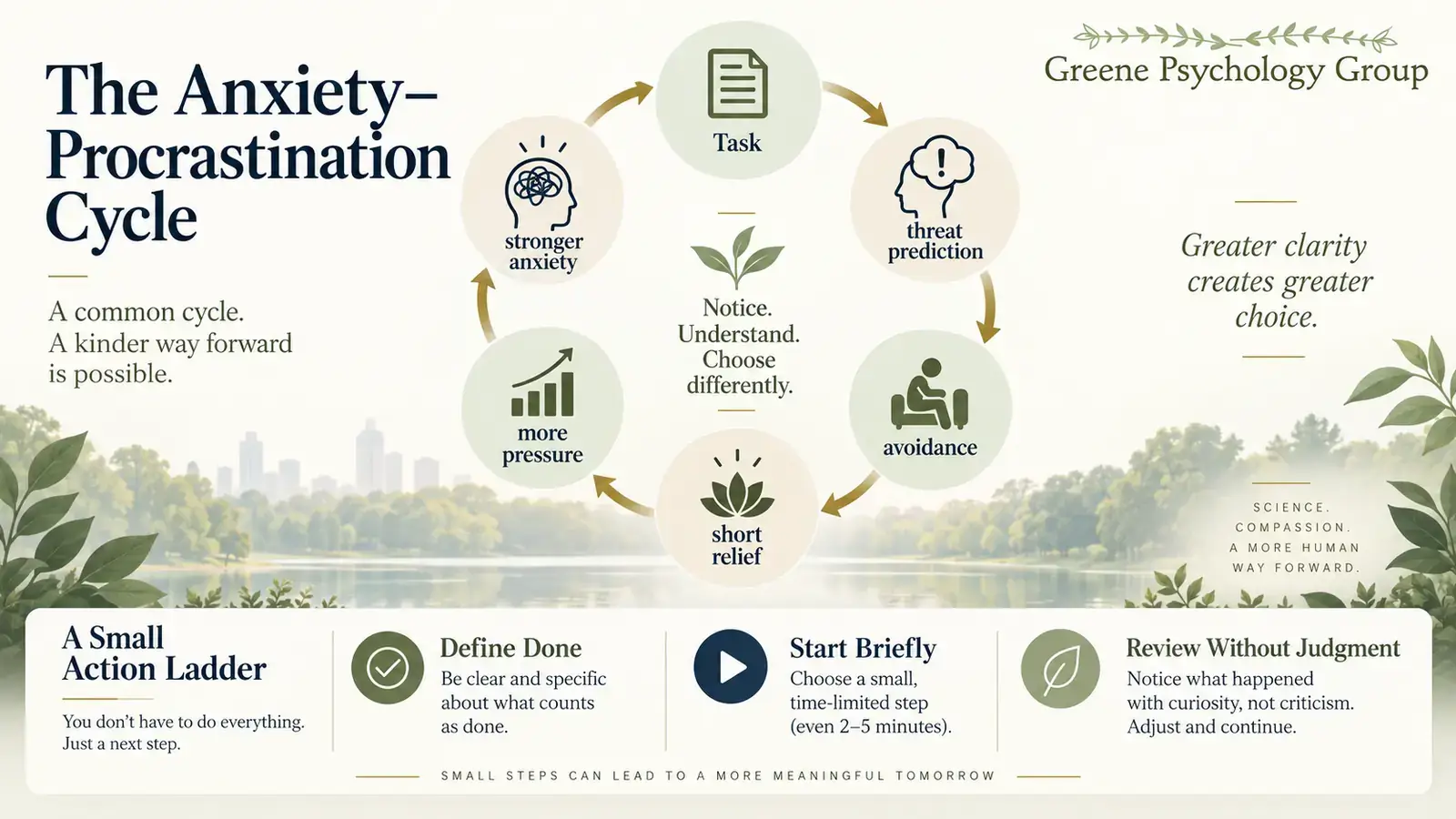
Anxiety and procrastination can form a frustrating cycle. A task feels uncertain, difficult, important, or open to judgment. Anxiety rises. Avoiding the task brings immediate relief, but the deadline, consequences, and self-criticism grow. When you return to it, the task feels even more threatening than before.
This pattern is not always laziness or poor time management. Procrastination can function as a short-term attempt to regulate uncomfortable emotions. Understanding that function makes it possible to choose strategies that address both the task and the distress attached to it.
Quick answer
Anxiety can contribute to procrastination when a task triggers fear of failure, uncertainty, perfectionism, overwhelm, or anticipated discomfort. Avoidance lowers distress briefly, which teaches the brain to avoid again. Breaking the cycle usually involves defining a small finish line, starting with a brief action, tolerating some discomfort, and reviewing the result without shame. Persistent patterns may benefit from therapy and an assessment for other contributing concerns.
What Are Anxiety and Procrastination?
Procrastination generally means unnecessarily delaying an intended action despite expecting the delay to create negative consequences. It is different from consciously reprioritizing a task, waiting for needed information, or taking restorative rest.
Anxiety involves apprehension, worry, physical activation, or anticipation of threat. When a task becomes associated with failure, embarrassment, conflict, uncertainty, boredom, or overwhelm, postponing it can temporarily reduce those feelings. That immediate emotional reward helps explain why someone may procrastinate even while genuinely wanting to begin.
Neither procrastination nor occasional anxiety automatically indicates a mental health disorder. The pattern of anxiety and procrastination deserves attention when it becomes persistent, causes significant distress, or interferes with work, education, finances, relationships, health, or basic responsibilities.
How the Anxiety-Procrastination Cycle Works
- Task: A report, application, conversation, appointment, bill, or household responsibility requires action.
- Threat prediction: The mind anticipates failure, criticism, confusion, discomfort, or an impossible amount of effort.
- Avoidance: You scroll, research excessively, organize unrelated items, wait for motivation, or choose an easier task.
- Short relief: Anxiety falls because the threatening task is temporarily out of focus.
- More pressure: Time shrinks, consequences increase, and self-criticism grows.
- Stronger anxiety: The task now carries the original discomfort plus urgency and shame, making another round of avoidance more likely.
Why Anxiety Can Make Tasks Harder to Start
Fear of failure or criticism
If performance feels tied to worth, starting creates a chance to discover that the result may not be perfect. Delay protects against that possibility for a little longer.
Perfectionism
Perfectionism can make the acceptable finish line unclear or unrealistic. “Write the first paragraph” becomes “produce something impressive with no errors,” which dramatically raises the emotional cost of beginning.
Uncertainty and unclear tasks
Vague tasks require many hidden decisions. “Handle the project” does not reveal the first action, expected outcome, or available time. Anxiety fills those gaps with threatening predictions.
Overwhelm and emotional exhaustion
When several responsibilities compete for limited attention, choosing where to begin can feel impossible. Avoidance may reflect depleted capacity rather than a lack of caring.
Fear of success or increased expectations
Completing something may lead to visibility, more responsibility, change, or pressure to repeat the performance. The threat is sometimes what might happen after success, not only failure.
Common Signs of Anxiety-Driven Procrastination
- waiting to feel confident, calm, motivated, or fully prepared before starting;
- researching, planning, or organizing far beyond what the task requires;
- doing low-priority tasks to avoid one emotionally loaded responsibility;
- repeatedly rewriting, checking, or delaying submission;
- avoiding emails, calls, bills, appointments, or difficult conversations;
- feeling temporary relief followed by guilt, dread, or panic;
- completing tasks only when deadline pressure becomes stronger than anxiety;
- criticizing yourself as lazy while continuing to feel unable to begin.
Procrastination vs. Rest, Prioritization, and Strategic Delay
| Pattern | What it involves | Likely result |
|---|---|---|
| Rest | Intentional recovery with a plan to resume | Greater capacity or steadier attention |
| Prioritization | Choosing a more important task based on real constraints | Resources align with current goals |
| Strategic delay | Waiting for information, timing, or resources | Delay improves the decision or outcome |
| Procrastination | Unnecessary delay despite expected costs | More pressure, distress, or lost opportunity |
A Small Action Ladder
When the entire task feels threatening, reduce the size of the commitment without pretending the larger responsibility does not exist. This approach can weaken the connection between anxiety and procrastination by creating a manageable point of entry.
- Define done. Describe a specific, observable finish line. Replace “work on presentation” with “draft three slide headings.”
- Start briefly. Choose a two-to-five-minute action: open the file, write one sentence, locate one document, or make one call.
- Review without judgment. Notice what happened. Did anxiety rise, settle, or remain? What made the step easier or harder? Adjust the next step rather than using the result to attack yourself.
7 Ways to Break the Anxiety and Procrastination Cycle
- Name the emotion. Identify whether the task brings fear, shame, boredom, resentment, confusion, or overwhelm. Different barriers need different responses.
- Make the first action visible. Use a verb and an object: open the portal, find the invoice, write the subject line.
- Lower the starting standard. Permit a rough draft, incomplete outline, or imperfect first attempt. Quality can improve after something exists.
- Use a short time container. Work for ten minutes, then decide whether to continue. The goal is starting, not tricking yourself into hours of work.
- Remove one source of friction. Close extra tabs, place materials nearby, silence notifications, or ask for clarification.
- Expect discomfort. Starting may not immediately feel better. Success means taking a useful step while anxiety is present.
- Respond with curiosity. Replace “What is wrong with me?” with “What made this task threatening, and what support would help?”
Applying These Strategies at Work or School
At work or school, anxiety and procrastination may intensify when expectations are unclear or deadlines feel distant. Break assignments into deliverables with separate dates rather than treating one distant deadline as the entire plan. Clarify ambiguous expectations early. Use accountability for structure, not punishment: tell someone what action you will complete and when you will check back.
If perfectionism is central, define the quality level the task actually requires. Not every email needs the care of a legal document, and not every draft needs to demonstrate your full ability. Match effort to purpose.
When a pattern may involve a documented condition, a clinician or appropriate workplace or educational office can explain whether evaluation or accommodations should be considered. A blog cannot determine eligibility.
When Something Other Than Anxiety May Contribute
Similar delays can arise from different causes. Depression may reduce energy, interest, and hope. ADHD or other executive-function difficulties may affect task initiation, working memory, time awareness, and organization. Burnout can reduce cognitive and emotional capacity. Sleep problems, substance use, medication effects, pain, and medical conditions may also interfere.
The distinction matters because an anxiety strategy may not address untreated depression, unclear priorities, an inaccessible environment, or a medical problem. An individualized assessment considers when the pattern began, where it occurs, what improves it, and what other symptoms are present.
The Role of Shame and Self-Criticism
After delaying, many people try to motivate themselves with harsh labels: lazy, irresponsible, weak, or incapable. This may create a burst of urgency, but it also makes the next encounter with the task more painful. The task no longer represents only work; it becomes evidence in a trial about personal worth.
Self-compassion does not mean pretending that consequences do not matter. It means acknowledging the missed action clearly while responding in a way that supports repair: “I avoided this because I felt overwhelmed. The delay created a problem. What is the smallest responsible step I can take now?”
When possible, separate accountability from humiliation. Name the impact, contact anyone affected, revise the plan, and identify the barrier that needs attention. Curiosity produces more useful information than repeated self-attack.
Common Myths About Procrastination
“I work best under pressure.”
Pressure may create enough urgency to overpower avoidance, but that does not mean it produces your best work. Last-minute completion can hide the cost in sleep, stress, flexibility, and the ability to respond when something unexpected happens.
“I need a perfect system before I begin.”
A new planner or productivity method can help, but searching for the ideal system can become another form of avoidance. Use the simplest structure that makes the next action clear, then improve it from experience.
“If the first step is small, it does not count.”
Small steps matter when they reduce ambiguity and create contact with the task. Opening a document is not the final goal, but it changes the situation from imagined work to observable work and makes the next choice easier.
“I should be able to fix this through willpower.”
Willpower varies with sleep, stress, health, environment, and emotional load. Sustainable change usually relies on clear actions, supportive conditions, realistic expectations, and repeated practice—not continuous force.
How Therapy Can Help
Therapy can help identify what maintains anxiety and procrastination rather than relying on generic productivity advice. Cognitive behavioral therapy may examine catastrophic predictions, all-or-nothing standards, and avoidance behaviors. Behavioral experiments allow a person to test what happens when they begin imperfectly, submit work without excessive checking, or tolerate uncertainty.
Acceptance-based approaches may help a person act according to values without waiting for anxiety to disappear. Self-compassion can reduce the shame that often drives further avoidance. Treatment may also address perfectionism, attention difficulties, depression, trauma, sleep, relationship patterns, or other relevant concerns.
Progress with anxiety and procrastination may look like beginning sooner, reducing rituals, recovering from setbacks faster, completing more meaningful tasks, and making decisions with less dependence on urgency.
When to Seek Professional Support
Consider professional support when procrastination repeatedly threatens employment, education, finances, relationships, health, or daily functioning; when anxiety is persistent or severe; or when self-help efforts do not produce meaningful change. Seek assessment if the pattern occurs alongside substantial mood changes, substance use, panic, attention problems, sleep disruption, or loss of interest.
Urgent support: If you may harm yourself or another person, cannot stay safe, or face an immediate emergency, call 911 or go to the nearest emergency department. In the United States, call or text 988 for the Suicide & Crisis Lifeline.
Therapy for Anxiety and Procrastination in Raleigh, NC
Greene Psychology Group provides therapy for adults experiencing anxiety and procrastination, perfectionism, avoidance, stress, and related concerns. Care should begin with understanding the pattern and your goals rather than assuming that every delay has the same cause.
You can learn more about anxiety therapy in Raleigh, explore the relationship between perfectionism and imposter syndrome, or review online therapy options.
Take one practical next step
Contact Greene Psychology Group to ask about current availability and therapy options.
Contact Us Call 919-205-5339Frequently Asked Questions
1. Why does anxiety make me procrastinate?
A task may trigger fear, uncertainty, shame, perfectionism, or overwhelm. Avoiding it lowers discomfort briefly, reinforcing the urge to delay the next time anxiety appears.
2. Is procrastination a sign of laziness?
Not necessarily. Procrastination may involve emotion regulation, unclear tasks, exhaustion, executive-function difficulties, depression, anxiety, or environmental barriers. The cause should be understood before applying a solution.
3. How is procrastination different from resting?
Rest is intentional recovery and usually includes a plan to resume. Procrastination is unnecessary delay despite expecting negative consequences, often accompanied by short relief and later distress.
4. Can perfectionism cause procrastination?
Yes. Unrealistic standards can make starting feel risky and finishing feel impossible. Defining a realistic standard and permitting an imperfect first attempt may reduce this barrier.
5. Can ADHD look like anxiety-driven procrastination?
Yes. ADHD and anxiety can both affect task initiation, and they can occur together. An assessment considers attention, organization, development, anxiety, mood, sleep, health, and functioning across settings.
6. What is the smallest useful step?
Choose an observable action that takes only a few minutes, such as opening the document, writing one heading, finding one record, or drafting an email subject line.
7. Should I wait until I feel motivated?
Motivation often follows action rather than preceding it. A brief, clearly defined start can create information and momentum even when motivation is low.
8. How does CBT help with procrastination?
CBT may help identify anxious predictions, test perfectionistic beliefs, reduce avoidance, break tasks into workable actions, and build more flexible responses to discomfort.
9. When should I seek therapy?
Consider therapy when the pattern is persistent, distressing, or interfering with work, education, health, finances, relationships, or daily responsibilities.
10. Can online therapy help with anxiety and procrastination?
Online therapy may be appropriate for many non-emergency concerns when privacy, technology, location, and clinical needs support it. A provider can help determine whether remote or in-person care is a better fit.
Sources and Further Reading
- APA Dictionary of Psychology: Procrastination
- National Institute of Mental Health: Anxiety Disorders
- American Psychological Association: Cognitive Behavioral Therapy
- PubMed: Psychological Treatments for Procrastination
This article is for educational purposes only and is not a substitute for diagnosis, treatment, or individualized advice from a qualified healthcare professional.