

If you are reading this, you may have already achieved a great deal in your life – perhaps a successful career, a loving family, or meaningful accomplishments – yet still feel like a fraud. Maybe you have been praised for your work, but you dismiss it as luck. Maybe you are convinced that any day now, someone will discover that you do not actually know what you are doing. Maybe you set impossibly high standards for yourself and then beat yourself up when you fall short – even though you are already performing at a level that would be impressive for anyone else.
Here is the truth that perfectionism and imposter syndrome try to hide from you: you are not alone, and you are not a fraud.
Perfectionism and imposter syndrome are not signs of inadequacy. They are patterns of thinking that many high‑achieving people develop – often as a way to cope with anxiety, fear of failure, or early experiences of not feeling "good enough." But these patterns, left unchecked, can lead to burnout, depression, anxiety, and a life spent chasing an unattainable ideal.
Greene Psychology Group in Raleigh, NC, offers evidence‑based therapy for perfectionism and imposter syndrome, using Cognitive Behavioral Therapy (CBT), Acceptance and Commitment Therapy (ACT), and mindfulness‑based approaches. This guide is a complete, research‑backed overview: what perfectionism and imposter syndrome actually are, how they develop, the impact on mental health, how therapy can help, and how to break the cycle.
Part 1: What Is Perfectionism – Beyond High Standards
Most people think perfectionism is just "having high standards." But there is a critical difference between healthy striving and perfectionism.
| Healthy Striving | Perfectionism |
|---|---|
| Setting challenging but realistic goals | Setting unattainable goals |
| Taking pride in your work | Never feeling satisfied |
| Learning from mistakes | Being devastated by mistakes |
| Motivated by growth | Motivated by fear of failure |
| Flexible and adaptable | Rigid and all‑or‑nothing |
The Three Dimensions of Perfectionism
Research from Stanford University has identified three dimensions of perfectionism:
1. Self‑Oriented Perfectionism
You hold yourself to impossibly high standards. You are your own harshest critic. You feel that nothing you do is ever "good enough."
2. Other‑Oriented Perfectionism
You hold others to impossibly high standards. You are critical of others' work and often disappointed by their performance.
3. Socially Prescribed Perfectionism
You believe that others expect you to be perfect. You feel immense pressure to meet others' expectations – and you are convinced that you are failing.
Socially prescribed perfectionism is the most strongly associated with depression, anxiety, and burnout.
The Perfectionism Paradox
Perfectionists often perform at a high level – but at a great cost. They are more likely to experience:
-
Burnout: Working harder than anyone else, but never feeling satisfied
-
Procrastination: Avoiding tasks because they feel overwhelming or impossible to do "perfectly"
-
Depression: Chronic feelings of inadequacy and disappointment
-
Anxiety: Constant fear of making mistakes or being judged
-
Relationship difficulties: Holding others to impossible standards
Part 2: What Is Imposter Syndrome – The Feeling of Being a Fraud
Imposter syndrome is a psychological pattern in which you doubt your accomplishments and have a persistent, internalized fear of being exposed as a "fraud." Despite external evidence of your competence, you remain convinced that you do not deserve your success.
The Signs of Imposter Syndrome
-
You attribute success to luck: "I just got lucky," "They were being nice," "Anyone could have done this."
-
You fear being "found out": You are convinced that eventually, people will realize you do not actually know what you are doing.
-
You discount praise: When people compliment you, you dismiss it. "They don't really know me," "They are just being polite."
-
You set impossibly high standards: You feel that anything less than perfect is a failure.
-
You avoid challenges: You avoid new opportunities because you fear you will not be able to handle them.
-
You overwork: You work harder than necessary to "prove" yourself – but the feeling never goes away.
The Imposter Syndrome Cycle
-
The Challenge: A new task, a promotion, a project, an opportunity
-
Anxiety: You feel anxious about the challenge. "I'm not qualified for this."
-
Over‑preparation or Procrastination: You either over‑prepare (working twice as hard as necessary) or procrastinate (avoiding the task because it feels overwhelming).
-
The Outcome: You succeed (because you are actually competent).
-
Internalization: Instead of attributing success to your abilities, you attribute it to luck, timing, or hard work.
-
Reinforcement: The cycle repeats. You never internalize your success, and the fear of being "found out" persists.
Who Experiences Imposter Syndrome?
Imposter syndrome is common among high‑achieving individuals, particularly:
-
Women and people of color, who may face additional societal pressures and stereotypes
-
First‑generation students and professionals
-
People in competitive fields (academia, medicine, law, technology)
-
Perfectionists (imposter syndrome and perfectionism often go hand in hand)
Research from Harvard Medical School has shown that imposter syndrome is associated with increased anxiety, depression, and burnout.
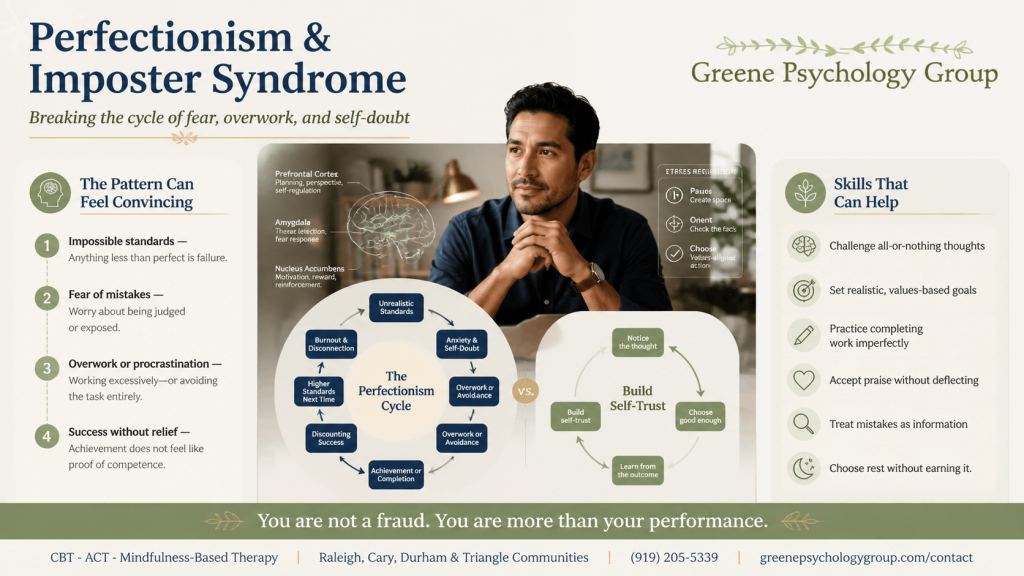
Part 3: The Perfectionism‑Imposter Syndrome Cycle – Why It Keeps You Stuck
Perfectionism and imposter syndrome often feed each other in a destructive cycle.
The Cycle
-
Perfectionism: You set impossibly high standards
-
Anxiety: You fear you will not meet those standards
-
Over‑work: You work excessively to try to meet the standards
-
Temporary relief: You succeed – but you do not feel it is "enough"
-
Imposter Syndrome: You dismiss your success as luck or external factors
-
Reinforcement: You set even higher standards to prove yourself
-
Burnout: You become exhausted and demoralized
The Role of "All‑or‑Nothing" Thinking
Perfectionism and imposter syndrome are fueled by "all‑or‑nothing" thinking – a cognitive distortion where you see things in black‑and‑white terms.
| All‑or‑Nothing Thought | More Balanced Alternative |
|---|---|
| "If I make a mistake, I am a failure." | "Everyone makes mistakes. Mistakes are part of learning." |
| "If I don't get an A, I have failed." | "A B is still a good grade. I can learn from my mistakes." |
| "I have to be perfect or people will think I'm incompetent." | "People respect me for who I am, not for being perfect." |
| "If I'm not the best, I'm nothing." | "I can be good without being the best." |
Part 4: Evidence‑Based Treatments for Perfectionism and Imposter Syndrome
Cognitive Behavioral Therapy (CBT)
CBT is one of the most effective therapies for perfectionism and imposter syndrome. It targets the negative thoughts and behaviors that keep you stuck.
How CBT works:
1. Cognitive Restructuring
You learn to identify and challenge the unhelpful thoughts that drive perfectionism and imposter syndrome. "I must be perfect" becomes "I can do my best, and that is enough."
2. Behavioral Experiments
You test your anxious predictions in real life. "If I submit this report with one small mistake, everyone will think I'm incompetent." You submit it. No one notices. The prediction is disconfirmed, and the anxiety weakens.
3. Exposure Therapy
You gradually face feared situations – submitting work that is not perfect, accepting praise without deflecting, taking on new challenges.
Acceptance and Commitment Therapy (ACT)
ACT is particularly helpful for perfectionism because it helps you accept uncertainty while moving toward what matters to you.
Core ACT skills:
-
Acceptance: Making room for difficult emotions (anxiety, fear of failure) without trying to push them away
-
Cognitive Defusion: Watching your thoughts as mental events, not facts. "I am having the thought that I'm a fraud" is different from "I am a fraud."
-
Values Clarification: Identifying what truly matters to you – not what you should care about
-
Committed Action: Taking small, purposeful steps toward your values, even when you are afraid
Mindfulness‑Based Therapy
Mindfulness helps you notice your thoughts without getting caught up in them. It helps you tolerate discomfort without reacting.
At Greene Psychology Group, we offer CBT, mindfulness therapy, and individual therapy for perfectionism and imposter syndrome.
Part 5: What a Therapy Session for Perfectionism Looks Like
If you are new to therapy for perfectionism, you might wonder what happens in a session.
Typical Session Structure (50 minutes)
| Time | Activity |
|---|---|
| 0–10 min | Check‑in: "How has your week been? Any perfectionist thoughts? Any successes?" |
| 10–30 min | Active work: Identifying and challenging a perfectionist thought, or planning a behavioral experiment |
| 30–40 min | Processing: "What did you learn? What was the hardest part? What surprised you?" |
| 40–45 min | Planning: "What will you practice between now and next session?" |
| 45–50 min | Homework assignment: Specific, achievable actions |
What You Will NOT Experience
-
Judgment: Your therapist has worked with many people who struggle with perfectionism. They understand.
-
Pressure: You set the pace. You decide what to explore and when.
-
Empty reassurances: You will learn practical skills, not just "feel better" platitudes.
Part 6: Practical Strategies for Breaking the Cycle – What You Can Do Today
1. Challenge All‑or‑Nothing Thinking
When you notice yourself thinking in extremes, ask:
-
What is the evidence for and against this thought?
-
Is there a middle ground?
-
What would I say to a friend who thought this?
2. Practice Imperfection
Deliberately do something imperfectly:
-
Send an email without re‑reading it three times
-
Submit a report with one small typo
-
Wear something slightly mismatched
-
Share an idea that is not fully formed
3. Accept Compliments
When someone praises you, resist the urge to deflect. Try:
-
Instead of: "It was nothing, anyone could have done it."
-
Try: "Thank you, that means a lot."
4. Reframe Mistakes as Learning
When you make a mistake, ask:
-
What can I learn from this?
-
What would I do differently next time?
-
How can I be kind to myself right now?
5. Set Realistic Goals
-
Instead of: "I must be the best"
-
Try: "I will do my best and learn from the process"
6. Limit Comparison
Social media and comparison are toxic for perfectionists. Limit your exposure to comparison traps.
7. Practice Self‑Compassion
-
Instead of: "I should have done better."
-
Try: "I did my best, and that is enough."
Part 7: When to Seek Professional Help – The Warning Signs
If perfectionism or imposter syndrome is interfering with your ability to function, it is time to seek professional help.
Red Flags
-
Burnout: You are exhausted, overwhelmed, and unable to find joy in your work
-
Procrastination: You avoid tasks because they feel overwhelming or impossible to do "perfectly"
-
Depression: Chronic feelings of inadequacy, hopelessness, or worthlessness
-
Anxiety: Constant fear of making mistakes or being judged
-
Relationship difficulties: Holding others to impossible standards or withdrawing from relationships
-
Physical symptoms: Headaches, muscle tension, sleep disturbances, gastrointestinal issues
-
Avoidance: Turning down opportunities because you fear you will not be able to handle them
What to Do
-
Talk to someone you trust. You are not alone.
-
Seek professional help. Contact Greene Psychology Group at (919) 205-5339 or schedule an appointment.
-
In a crisis: Call 988 or Alliance Health Mobile Crisis at (800) 510-9132.
Part 8: Putting It All Together – Three Perfectionism Archetypes
Archetype A: The Overworked Professional
-
Presentation: 34‑year‑old, successful in career but constantly exhausted. Works 60‑hour weeks. Has not taken a vacation in 2 years. Feels like a fraud.
-
Bottleneck: Perfectionism and imposter syndrome with burnout.
-
Treatment map: 12 weeks of CBT → Identify beliefs: "If I'm not working, I'm failing" → Behavioral experiment: take a 3‑day weekend without checking email → At 12 weeks, reports "I still have perfectionist thoughts, but I can challenge them."
Archetype B: The Self‑Critical Student
-
Presentation: 22‑year‑old, straight‑A student, terrified of graduating. Feels like everyone is smarter. Has panic attacks before exams.
-
Bottleneck: Perfectionism with performance anxiety.
-
Treatment map: 12 weeks of CBT → Challenging beliefs: "If I get a B, I'm a failure" → Exposure: submit an assignment without re‑reading it 5 times → At 12 weeks, reports "I still want to do well, but I don't panic anymore."
Archetype C: The High‑Achieving Parent
-
Presentation: 42‑year‑old, working parent, feels like a failure at work and at home. Convinced everyone else is doing better. Exhausted and depressed.
-
Bottleneck: Perfectionism with burnout and depression.
-
Treatment map: 12 weeks of CBT + ACT → Values clarification: what matters most? → Acceptance: making room for imperfection → Committed action: choosing what to focus on and letting go of the rest → At 12 weeks, reports "I'm not perfect, but I'm more present."
The information provided in this blog is for educational and informational purposes only and is not intended as medical advice, diagnosis, or treatment. It does not create a therapist-patient relationship between you and Greene Psychology Group. Always seek the advice of a qualified mental health professional or physician with any questions you may have regarding a mental health condition. If you are in crisis or experiencing a medical emergency, please call 911 immediately or contact the 988 Suicide & Crisis Lifeline. For non-emergency mental health support, call Greene Psychology Group at (919) 205-5339 or visit our website to schedule an appointment.
FAQs
Healthy striving is about setting challenging but realistic goals and learning from mistakes. Perfectionism is about setting unattainable goals and being devastated by mistakes.
Imposter syndrome is a psychological pattern where you doubt your accomplishments and fear being exposed as a "fraud," despite evidence of your competence.
Both often develop from early experiences (critical parents, high expectations), personality traits (anxiety, conscientiousness), and societal pressures.
Yes. Both are associated with increased anxiety, depression, burnout, and relationship difficulties.
Cognitive Behavioral Therapy (CBT) and Acceptance and Commitment Therapy (ACT) are both highly effective.
Most people see significant improvement in 12–16 sessions. Some need longer.
Yes. Greene Psychology Group offers online therapy for perfectionism, anxiety, and depression.
A behavioral experiment is a technique where you test your anxious predictions in real life. For example, submitting work with a small mistake to see if anyone notices.
ACT is a therapy that helps you accept difficult emotions while taking committed action toward your values. It is particularly helpful for perfectionism.
Look for a licensed therapist with training in CBT or ACT. Greene Psychology Group offers evidence‑based therapy for perfectionism and imposter syndrome – call (919) 205-5339.
Some people argue that perfectionism drives success, but the cost – anxiety, depression, burnout – often outweighs the benefits.
Start by noticing your perfectionist thoughts. Awareness is the first step. Then, practice challenging them.
Sources
-
Stanford University Department of Psychology – Dimensions of perfectionism
-
UNC Chapel Hill School of Social Work – Imposter syndrome interventions
-
Duke University Department of Psychiatry – CBT for perfectionism
-
Johns Hopkins Bloomberg School of Public Health – Imposter syndrome research
-
National Institute of Mental Health (NIMH) – Anxiety and perfectionism
Perfectionism and imposter syndrome are not signs of inadequacy – they are patterns of thinking that can be changed. Evidence‑based therapy in Raleigh, NC, using CBT and ACT, can help you break the cycle, build confidence, and live a more balanced life. Call Greene Psychology Group at (919) 205-5339 or schedule an appointment online. We offer individual therapy, evening appointments, and free insurance verification. Same‑week availability for new clients.