
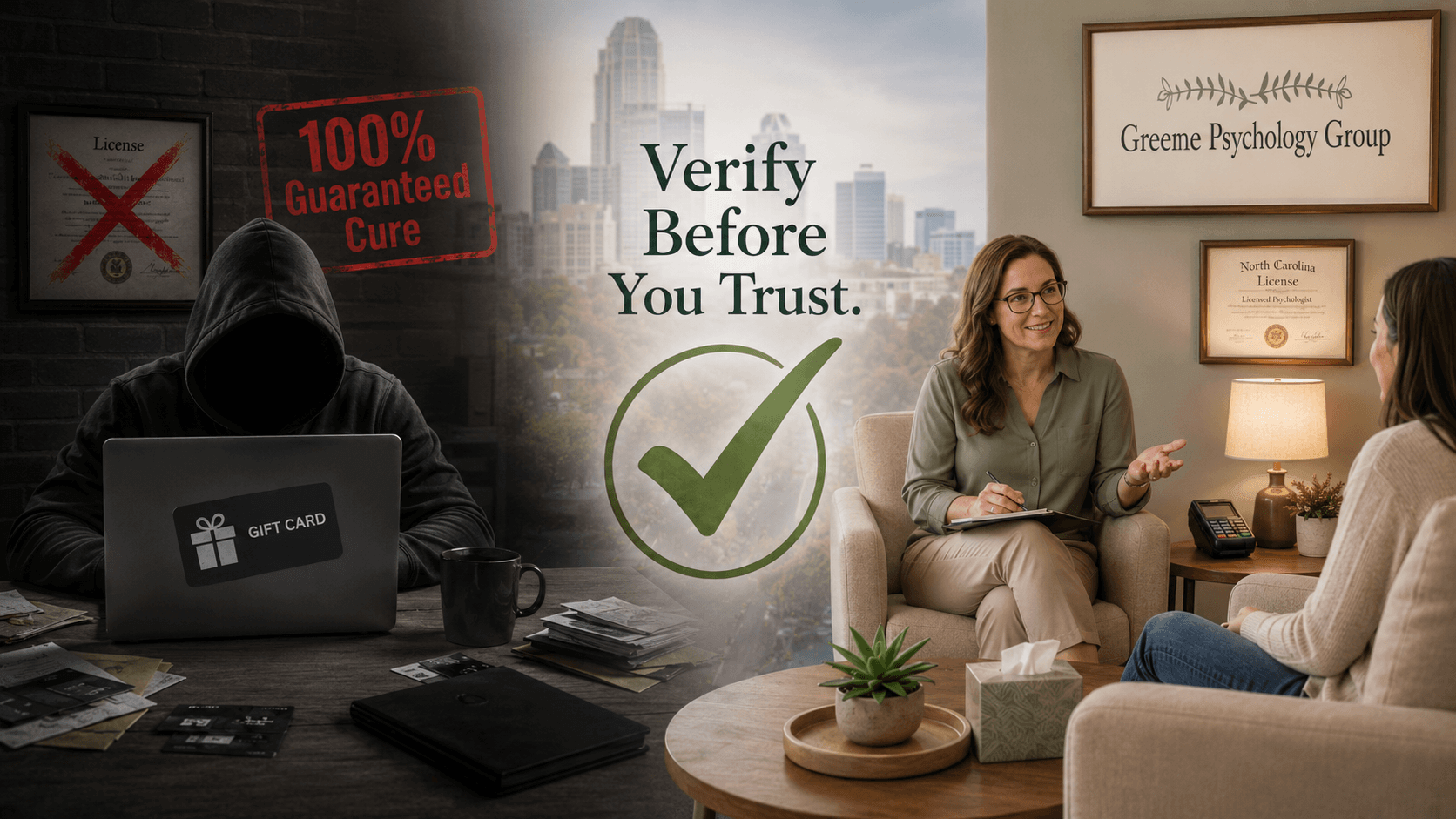
How to Avoid Mental Health Scams in Raleigh, NC: Red Flags and Safe Practices
If you are searching for a therapist right now, you are probably already feeling vulnerable. Maybe you have been struggling with anxiety for months. Maybe your teenager is withdrawing from everything they used to love. Maybe you just need someone to talk to who actually understands.
That vulnerability is exactly what scammers exploit.
The demand for mental health services in Raleigh has exploded over the past five years. Waitlists are long. Insurance is confusing. And into that gap have stepped hundreds of unlicensed "coaches," "healers," "consultants," and outright fraudsters who advertise therapy but deliver nothing of value – or worse, cause active harm.
Greene Psychology Group has treated clients who lost thousands of dollars to fake therapists. We have seen the shame and confusion that follows. This guide is not designed to scare you away from seeking help. It is designed to arm you with the specific, actionable tools you need to avoid mental health scams in Raleigh NC – including how to verify licenses, which payment methods are safe, and what legitimate therapy should actually look like.
Part 1: The Landscape of Mental Health Fraud in North Carolina
Before we talk about red flags, let us look at the actual problem.
The North Carolina Psychology Board receives approximately 200–300 consumer complaints each year. About 15% involve unlicensed practice – someone claiming to be a psychologist who has no license at all. Another 25% involve misrepresentation (e.g., a life coach advertising "therapy for anxiety"). The remaining complaints involve billing fraud, unethical dual relationships, and abandonment.
But these are just the complaints that get filed. The North Carolina Attorney General's Office estimates that for every formal complaint, at least five to ten people never report because they feel embarrassed or unsure of the process.
Who is most at risk?
People searching for low‑cost therapy (30–30–50 sessions are often too good to be true)
People seeking specific niche treatments (EMDR, trauma therapy, autism evaluations) where demand exceeds supply
People who prefer online therapy and do not verify where the "therapist" is licensed
People in crisis who cannot wait for a legitimate appointment
Learning how to avoid mental health scams in Raleigh NC is not about paranoia. It is about having a simple, repeatable verification process that takes less than five minutes.
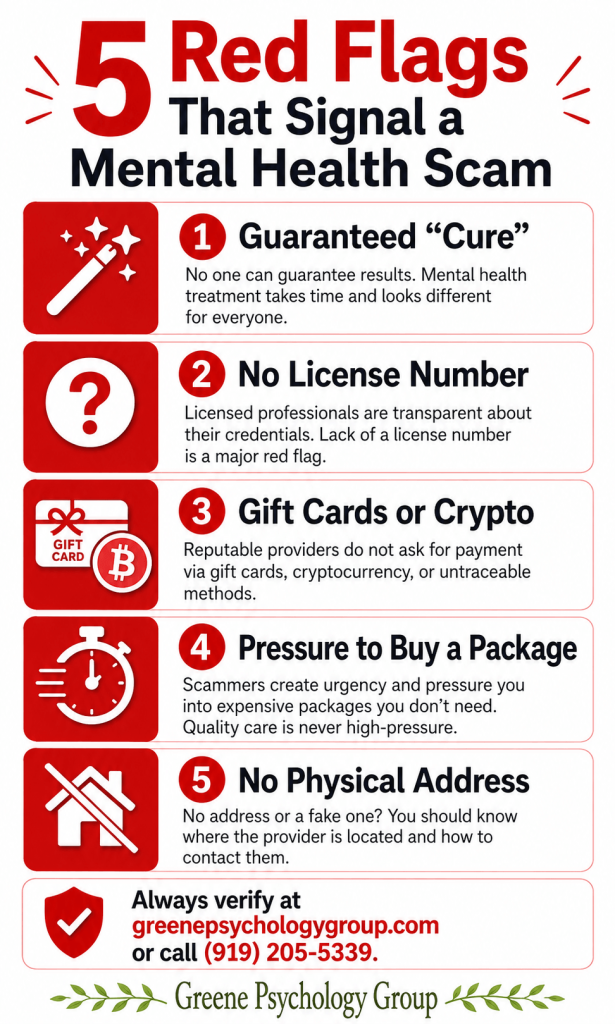
Part 2: Five Red Flags That Should Stop You Immediately
These are not subtle. If you see any of these, walk away – even if everything else feels right.
Red Flag #1: Guarantees of "Cures" or Specific Outcomes
Legitimate mental health professionals never promise to "cure" depression in six sessions or guarantee that you will "never feel anxious again." Therapy is uncertain. Outcomes vary by individual. Anyone who promises otherwise is either delusional or lying.
What a legitimate therapist says: "Research shows that CBT helps about 60–75% of people with your condition. We will track your progress every few sessions, and if you are not improving, we will adjust the approach."
What a scammer says: "I have a 98% success rate. You will be anxiety‑free in 8 weeks."
Red Flag #2: No Verifiable License Number
In North Carolina, every psychologist, clinical social worker, and professional counselor has a license number that is publicly searchable. If a provider cannot or will not give you their license number before the first session, that is a hard stop.
What to ask: "What is your license number, and under which board are you licensed?"
What to do next: Search the North Carolina Psychology Board verification portal or the NC Social Work Certification and Licensure Board. If nothing comes up, do not schedule.
Red Flag #3: Requests for Cash, Gift Cards, or Cryptocurrency
Legitimate therapists accept credit cards, checks, HSA/FSA cards, or insurance. They do not ask for Venmo to a personal account, CashApp, gift cards, or cryptocurrency.
Why this matters: Gift cards and cryptocurrency are untraceable. Once you send the money, it is gone. No legitimate healthcare provider would risk their license by demanding payment in Target gift cards.
Red Flag #4: Pressure to Sign Long‑Term Contracts Before an Assessment
Some legitimate providers offer package pricing (e.g., 10 sessions for a discounted rate). However, no ethical therapist will pressure you into a 20‑session contract before your first appointment.
Scam script: "Our program is 12 weeks, non‑refundable, $3,500 upfront. You need to decide today because our slots fill fast."
Legitimate script: "Let's do one session. If we are a good fit, we can talk about ongoing scheduling. You pay per session."
Red Flag #5: No Physical Address or Telehealth‑Only with No NC Location
Under North Carolina law, a therapist providing telehealth to someone in Raleigh must be licensed in North Carolina. But many out‑of‑state scammers claim to be "licensed nationally" (which does not exist) or refuse to provide a physical address.
What to check: The therapist's website should have a physical address – either their office or their home address if it is a solo practice. If there is no address and they are "100% online only" with no ties to North Carolina, be very skeptical.
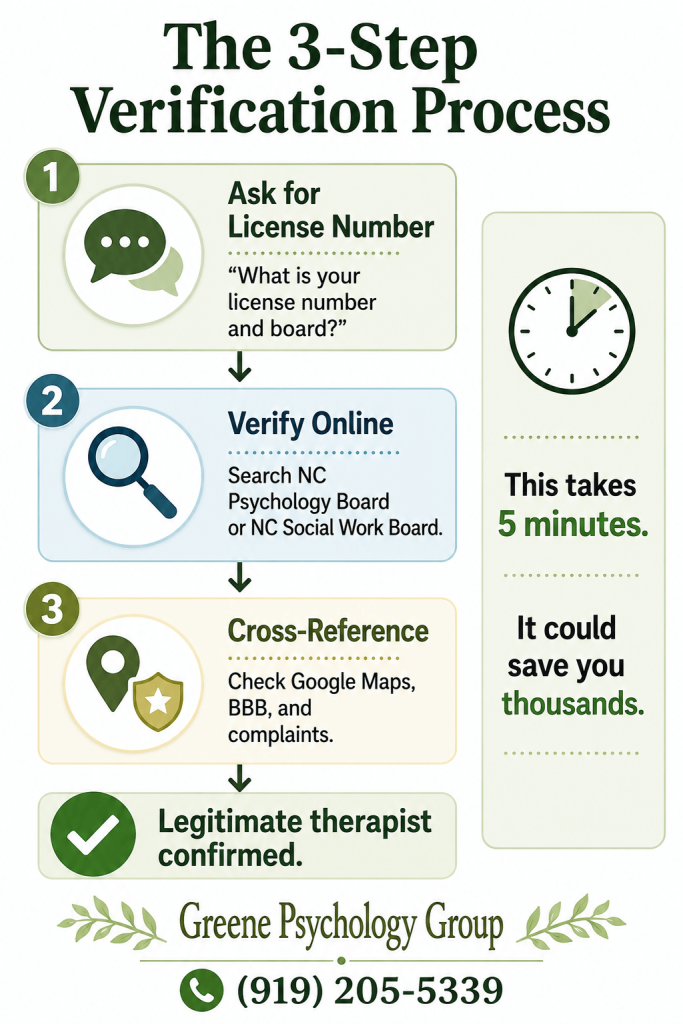
Part 3: The Three‑Step Verification Process (Takes 5 Minutes)
Learning how to avoid mental health scams in Raleigh NC comes down to a simple, repeatable process. Do this before your first session.
Step 1: Ask for the License Number and Board
Send this exact message: "Before we schedule, could you please provide your license number and the name of the board that issued it? I would like to verify your credentials. Thank you for understanding."
Legitimate response: They provide the number and board immediately, without defensiveness.
Suspicious response: "I don't give that out until after the first session." "I'm a 'certified life coach' – we don't have licenses." "I'm licensed in another country." Any of these = stop.
Step 2: Verify Online
Go to the North Carolina Psychology Board for psychologists (PhD, PsyD) or the NC Social Work Certification and Licensure Board for LCSW, LPC, LMFT.
Enter the license number. You should see:
Full name matching the provider
License status (Active, not Expired or Revoked)
Any disciplinary actions
If the license is active but has disciplinary actions, read them. Minor administrative issues are common. But if you see patient harm, fraud, or boundary violations, find someone else.
Step 3: Cross‑Reference with Google Maps and Better Business Bureau
Search the provider's address on Google Maps. Does it exist? Is it a real office or a virtual mailbox?
Search "[Provider Name] complaints" or "[Provider Name] scam."
Check the Better Business Bureau for any patterns.
If you find nothing, that is neutral. Many legitimate solo practitioners have no online complaints. But if you find multiple people reporting the same problem, believe them.
Part 4: The Difference Between Licensed Therapists and Unlicensed "Coaches"
One of the most common ways people accidentally engage with unqualified providers is through the life coach industry. Life coaching is not regulated in North Carolina. Anyone can call themselves a life coach – no training, no ethics board, no license to revoke.
Licensed Therapist vs. Life Coach
| Factor | Licensed Therapist (LCSW, LPC, LMFT, Psychologist) | Life Coach (unregulated) |
|---|---|---|
| Education | Master's or doctoral degree from accredited program | None required |
| Supervised hours | 3,000+ before independent license | None |
| Can diagnose? | Yes | No |
| Can treat mental illness? | Yes (depression, anxiety, PTSD, etc.) | No (legally cannot) |
| Ethics board | Yes (can lose license) | No |
| Insurance accepted | Often yes | No |
| Confidentiality laws | Yes (HIPAA) | No |
Here is the nuance: Some life coaches are ethical and helpful for non‑clinical issues (career coaching, fitness motivation, relationship advice for healthy couples). The problem is when life coaches advertise treatment for depression, anxiety, trauma, or other diagnosable conditions. That is illegal in North Carolina – and it is dangerous.
How to Tell the Difference in Advertising
Pay close attention to the specific terminology used in marketing materials:
- Therapy language: "Treat anxiety," "heal trauma," "diagnose depression," "evidence‑based."
- Coaching language: "Achieve goals," "find clarity," "improve performance," "accountability."
The Golden Rule: If you see therapy language from someone who is not licensed, run.
Part 5: Common Scams Specific to Raleigh
The "Free Consultation" Upsell Scam
You respond to an ad for a "free 15‑minute consultation." The "therapist" spends 45 minutes on the phone (unethical) diagnosing you with multiple conditions and then pressures you to buy a 3,000–3,000–5,000 "package" before you hang up.
How to avoid it: Legitimate consultations last 10–15 minutes and focus on logistics (fees, availability, general approach) – not diagnosis. If they diagnose you before ever meeting in person, that is a violation of ethics codes.
The Insurance Billing Scam
A "therapist" says they accept insurance. You attend sessions. Then you receive a bill for thousands of dollars because they "forgot" to tell you they were out‑of‑network – or they never submitted claims at all.
How to avoid it: Before your first session, call your insurance company directly and ask: "Is [Provider Name] in‑network? What is my copay?" Do not rely on the provider's front desk.
The "Sliding Scale" That Never Materializes
A provider advertises a sliding scale. After several sessions, they bill you the full rate and claim you "did not qualify."
How to avoid it: Get the sliding scale terms in writing before your first session. Ask: "What income documentation do you need? What is the reduced rate at my income level? Can you send me a written fee agreement?"
The Out‑of‑State Telehealth Loophole
A provider in Florida or California offers "therapy" to Raleigh residents. They are not licensed in North Carolina. When something goes wrong, you have no recourse – the NC Psychology Board cannot discipline someone with no NC license.
How to avoid it: Confirm that the provider is licensed in North Carolina. You can look this up yourself. If they are not, find someone who is. Greene Psychology Group's therapists are all licensed in NC.
Part 6: What Legitimate Therapy Should Look Like
To help you avoid mental health scams in Raleigh, NC, it helps to know what the real thing looks like.
Standard Elements of Professional Mental Health Care
| Element | What You Should See |
|---|---|
| First contact | Clear information about fees, insurance, cancellation policy, and license number. |
| Informed consent | Written document explaining confidentiality, its limits, and your rights. |
| Diagnosis | After an assessment (usually 1–3 sessions), a clear diagnostic impression or rule‑out. |
| Treatment plan | Specific goals (e.g., "reduce panic attacks from 3x/week to 1x/week in 12 sessions"). |
| Progress monitoring | Regular check‑ins on symptoms (e.g., PHQ‑9 for depression every 4‑6 weeks). |
| Billing | Clear receipts, superbills, or insurance claims submitted within days. |
| Termination | Planned ending with relapse prevention, not ghosting. |
Red Flag Warning: If your provider does not offer informed consent, cannot name their treatment approach, and does not track progress – they may not be a scam, but they are probably not providing evidence‑based care.
Part 7: How Greene Psychology Group Protects You
Greene Psychology Group has served Raleigh for over a decade. We are transparent about who we are and what we do.
Licensed: Every therapist holds an active, verifiable NC license (PhD, PsyD, LCSW, LPC, LMFT).
Transparent fees: $175 for individual therapy. We verify insurance before you pay.
Informed consent: You will sign a document explaining confidentiality, limits, and your rights.
Evidence‑based: We use CBT, EMDR, DBT, and other research‑supported approaches.
Physical location: 901 Paverstone Drive, Raleigh, NC 27615. You can visit us.
Telehealth: We offer online therapy, but only for clients located in North Carolina – because we are licensed here.
Internal resources to learn more:
What to Do If You Have Been Scammed
If you believe you have already been harmed by an unlicensed or fraudulent mental health provider in North Carolina:
Stop all contact and do not send more money.
File a complaint with the North Carolina Psychology Board (if they claimed to be a psychologist) or the NC Attorney General's Office.
File a complaint with the Federal Trade Commission (FTC) at ReportFraud.ftc.gov.
Contact your bank or credit card company to dispute charges.
Find a legitimate therapist – you still need support, and the shame of being scammed should not stop you from getting real help. Call Greene Psychology Group at (919) 205-5339. We will not judge you.
FAQs
Always verify the therapist's license number through the NC Psychology Board before your first session. Never pay with gift cards or cryptocurrency.
No. Use only platforms that explicitly state they use HIPAA‑compliant, encrypted video. Verify that the therapist is licensed in North Carolina.
Guarantees of a "cure" or pressure to buy an expensive package before an assessment.
No. Life coaches cannot diagnose or treat mental health conditions. They are not licensed or regulated.
Visit the NC Psychology Board's license verification portal or the NC Social Work Board's portal. Search by name or license number.
Do not proceed. That is a major red flag. Find a different provider.
Yes, we accept Blue Cross NC, Cigna, UnitedHealthcare, Aetna, MedCost, CBHA, NC State Health Plan, Medicare, and TriCare.
Look for a physical address, license numbers for each provider, verifiable clinician profiles, and clear fee information.
Yes, credit cards offer fraud protection. Never pay with gift cards, CashApp, Venmo (personal), or cryptocurrency.
There is no national license for mental health providers. Each state has its own board. This is almost certainly a scam.
Yes. File a complaint with the NC Psychology Board, the NC Attorney General's Office, and the FTC.
The terms overlap. Both require licenses in North Carolina. The key is the license, not the title. Always verify the license number.
Sources
-
Duke University Department of Psychiatry – Telehealth Ethics and Fraud Prevention
-
UNC Chapel Hill School of Social Work – Consumer Protection in Mental Health
-
Johns Hopkins Bloomberg School of Public Health – Mental Health Fraud Patterns
-
Stanford University Department of Psychiatry – Differentiating Coaching from Therapy
-
North Carolina Psychology Board – License Verification Portal
Do not let the fear of scams stop you from getting the help you need. Learning how to avoid mental health scams in Raleigh, NC is simple when you know the verification steps.
If you are ready to work with a legitimate, licensed, evidence‑based practice, we are here to help. We will verify your insurance for free before you pay anything.
Connect with Greene Psychology Group: