

You have been telling yourself the same story for months. It is not that bad. I can handle it. It will pass. Other people have it worse.
Maybe you are sleeping four hours a night, or twelve. Maybe you have cancelled plans with friends so many times they have stopped inviting you. Maybe your work performance has slipped, and you are terrified someone will notice. Maybe you have started drinking more just to quiet your mind at the end of the day.
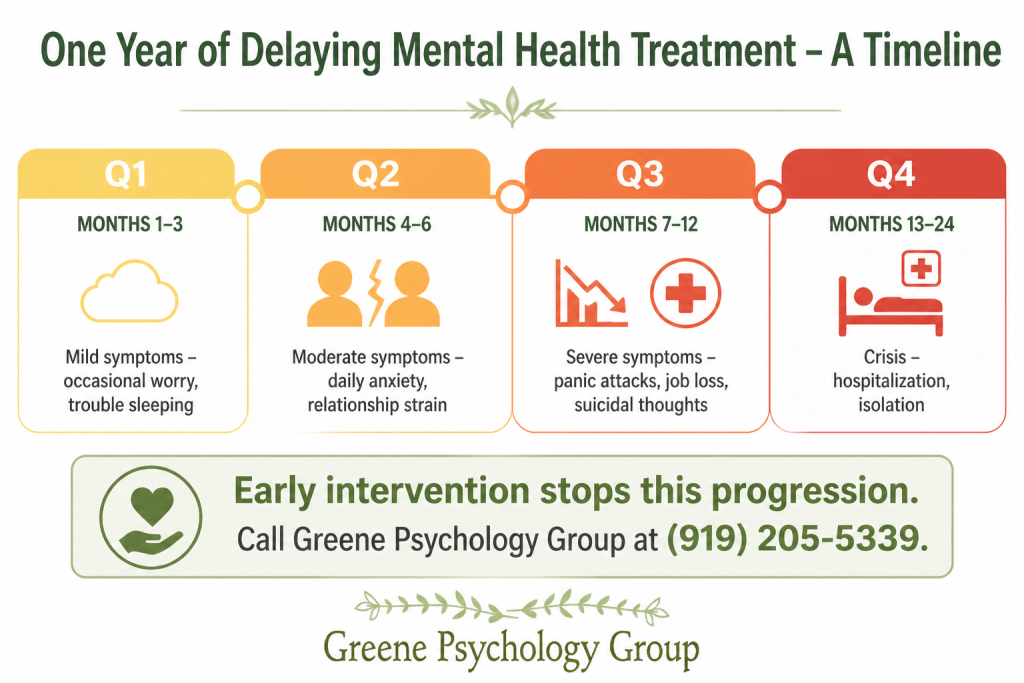
Here is the truth that no one tells you: mental illness is progressive. Without treatment, most conditions do not stay the same. They get worse. And the consequences of delaying mental health treatment are not abstract – they are measurable, predictable, and often severe.
Greene Psychology Group has worked with hundreds of Raleigh residents who wish they had started therapy months or years earlier. This guide is not written to scare you. It is written to give you an honest, evidence‑based picture of what happens when anxiety, depression, trauma, or other conditions go untreated – and why today is the best day to make the call.
Part 1: The Progressive Nature of Untreated Mental Illness
The single most important thing to understand about the consequences of delaying mental health treatment is that mental illness almost never stays static. Without intervention, the brain’s neural pathways reinforce the very patterns that cause suffering.
How Untreated Anxiety Escalates
| Timeline | Typical Progression |
|---|---|
| Months 1–3 | Occasional worry, muscle tension, trouble falling asleep. Still functioning at work and socially. |
| Months 4–6 | Daily anxiety. Physical symptoms: racing heart, sweating, gastrointestinal distress. Starting to avoid certain situations (crowds, meetings, driving). |
| Months 7–12 | Panic attacks begin. Avoidance spreads to more situations. May stop driving on highways, attending social events, or going to the office. |
| Year 2+ | Agoraphobia possible. Unable to leave home without extreme distress. Job loss. Isolation. Secondary depression. |
How Untreated Depression Progresses
| Timeline | Typical Progression |
|---|---|
| Months 1–3 | Low mood, loss of interest in hobbies. Still getting out of bed and going to work, but everything feels harder. |
| Months 4–6 | Sleep disturbances (insomnia or hypersomnia). Appetite changes (eating too little or too much). Fatigue. Difficulty concentrating. |
| Months 7–12 | Feelings of worthlessness or guilt. Thoughts of death or suicide. Withdrawal from all social contact. May stop showering, eating regularly, or leaving home. |
| Year 2+ | Chronic depression. High risk of suicide. Physical health deterioration (heart disease, diabetes, chronic pain). |
Research from Harvard Medical School’s Department of Psychiatry followed 1,500 patients with untreated major depression over two years. At the 24‑month mark, only 12% had improved without treatment. 43% had worsened significantly, and 8% had made at least one suicide attempt.
Part 2: The Physical Health Consequences – Your Body Pays the Price
One of the most overlooked consequences of delaying mental health treatment is the toll on physical health. The mind and body are not separate. Chronic anxiety and depression cause measurable damage to every organ system.
Cardiovascular Disease
Chronic anxiety and depression increase inflammation and cortisol levels. A 2017 meta‑analysis in Circulation found that untreated depression doubles the risk of heart attack and increases the risk of stroke by 60%. The more severe the depression, the higher the risk.
Weakened Immune System
Chronic stress suppresses immune function. People with untreated anxiety are 30–50% more likely to catch common infections (colds, flu, COVID‑19) and take longer to recover from surgery or injury.
Sleep Disorders
Insomnia and hypersomnia are core symptoms of both anxiety and depression. But untreated mental illness also causes sleep apnea, restless leg syndrome, and circadian rhythm disorders. Poor sleep then worsens the mental illness – a vicious cycle that research from Duke University’s Sleep Medicine Program shows is best interrupted by treating the underlying mood disorder first.
Substance Use Disorders
Up to 50% of people with untreated mental illness self‑medicate with alcohol, cannabis, or prescription drugs. What starts as "a drink to take the edge off" can become a full‑blown substance use disorder within 12–18 months. Then you are treating two conditions instead of one.
Chronic Pain
Depression and anxiety lower pain tolerance and increase pain perception. People with untreated depression are three times more likely to develop chronic back pain, migraines, or fibromyalgia – even without an organic cause.
At Greene Psychology Group, we address both mental and physical wellness through evidence‑based approaches like Cognitive Behavioral Therapy (CBT), which has been shown to reduce pain interference and improve immune function.
Part 3: The Social and Relational Consequences – What It Costs Your Relationships
The consequences of delaying mental health treatment are not only internal. They ripple outward to everyone who loves you.
Relationship Breakdown
Untreated mental illness strains every relationship. Partners of people with untreated depression report feeling exhausted, resentful, and lonely. A 2020 study from Johns Hopkins Bloomberg School of Public Health found that divorce rates were 2.7 times higher in couples where one partner had untreated depression compared to couples where the depressed partner was in treatment.
Parenting and Child Development
Children of parents with untreated mental illness are at higher risk for anxiety, depression, and behavioral problems – even when the children have no genetic vulnerability. This is not about blame. It is about the well‑documented impact of parental stress, irritability, and withdrawal on child development.
Social Isolation
As symptoms worsen, people with untreated mental illness withdraw from friends, hobbies, and community. Loneliness then exacerbates the mental illness. A 2021 study from UNC Chapel Hill found that social isolation was the strongest predictor of depression worsening over time – stronger than income, health status, or age.
For families already feeling these strains, Greene Psychology Group offers family therapy to repair communication and rebuild trust, as well as couples counseling for partners struggling to stay connected.
Part 4: The Economic Consequences – The High Cost of Doing Nothing
Many people delay treatment because of cost concerns. But the financial consequences of delaying mental health treatment are almost always higher than the cost of therapy itself.
| Scenario | Cost of Early Treatment | Cost of Delayed Treatment |
|---|---|---|
| Generalized anxiety | 12–16 CBT sessions ($2,100–$2,800) | ER visits for panic attacks, missed work, lost productivity: $8,000–$15,000+ |
| Major depression | 16–20 therapy sessions ($2,800–$3,500) | Hospitalization, disability leave, medication non‑adherence: $20,000–$50,000+ |
| Panic disorder | 8–12 CBT sessions ($1,400–$2,100) | Repeated ER visits, cardiac workups, missed work: $10,000–$25,000+ |
| PTSD | 12–16 EMDR or CPT sessions ($2,100–$2,800) | Job loss, disability, substance use treatment: $30,000–$100,000+ |
The Productivity Cost
The World Health Organization estimates that depression and anxiety cost the global economy $1 trillion annually in lost productivity. For an individual, that means:
Increased absenteeism (calling in sick)
Presenteeism (being at work but unable to function)
Increased errors and accidents
Lower performance reviews and missed promotions
A 2019 study from Harvard Medical School found that employees who received CBT for depression had a 35% reduction in lost productive time within six months – saving employers an average of $4,000 per employee per year.
The Insurance Reality
Most insurance plans cover mental health treatment at the same level as medical treatment (thanks to the Mental Health Parity and Addiction Equity Act). Greene Psychology Group accepts Blue Cross NC, Cigna, UnitedHealthcare, Aetna, MedCost, CBHA, NC State Health Plan, Medicare, and TriCare. Contact us for a free insurance verification before your first session.
Part 5: The Crisis Point – Hospitalization and Involuntary Commitment
The most severe consequence of delaying mental health treatment is psychiatric hospitalization – and sometimes involuntary commitment under North Carolina law.
What Crisis Care Looks Like in Wake County
Emergency room evaluation at WakeMed Raleigh or Holly Hill Hospital (4–12 hours)
Inpatient psychiatric stay (average 5–10 days, can be longer)
Discharge planning (often to an Intensive Outpatient Program)
Ongoing therapy and medication management
The Trauma of Crisis Care
Even when hospitalization is necessary, it is often traumatic. Patients describe feeling:
Loss of autonomy (locked units, no personal belongings)
Fear (being surrounded by strangers in distress)
Shame (being involuntarily committed by family or police)
North Carolina involuntary commitment law (NC GS 122C-261) allows a physician or law enforcement to hold a person for up to 24 hours for evaluation if they pose a danger to themselves or others. A magistrate can order a 72‑hour hold. A judge can order longer inpatient treatment.
These laws exist to save lives. But they are also a direct result of delayed treatment. Most patients who end up involuntarily committed have been symptomatic for months or years before the crisis point.
How Early Treatment Prevents Hospitalization
Research from Columbia University Department of Psychiatry followed 2,000 patients with recurrent major depression. Those who started therapy within 4 weeks of symptom onset had a 78% lower risk of hospitalization over the next two years compared to those who waited more than 6 months.
Part 6: The Cognitive Consequences – Brain Shrinkage and Memory Loss
This is the consequence that surprises most people. Untreated mental illness actually changes the structure of the brain.
Hippocampal Atrophy
Multiple longitudinal MRI studies have shown that untreated depression is associated with shrinkage of the hippocampus – the brain region responsible for memory and emotion regulation. A 2019 meta‑analysis from Stanford University found that each year of untreated depression was associated with approximately 2–3% reduction in hippocampal volume.
The good news? Successful treatment (CBT, medication, or both) can reverse some of this damage. The same study found that patients who achieved remission showed hippocampal regrowth within 12 months.
Executive Dysfunction
Untreated anxiety and depression impair executive function: working memory, cognitive flexibility, and inhibitory control. Patients describe it as "brain fog" – forgetting appointments, losing their train of thought mid‑sentence, struggling to make simple decisions.
These cognitive symptoms are often the first to improve with CBT. At Greene Psychology Group, our anxiety therapy specifically targets cognitive symptoms using attention training and metacognitive techniques.
Part 7: Why People Delay – And Why Those Reasons Are Misguided
Let me address the most common reasons people give for delaying treatment – and why the research suggests these reasons do not hold up.
"I can handle it myself."
Mental illness is not a character flaw. You would not treat a broken leg yourself. The same applies to your brain. Studies show that people who try to "tough it out" for more than 3 months are unlikely to improve without professional help.
"I don't have time."
Therapy takes 50 minutes per week. The time lost to untreated mental illness (sick days, reduced productivity, sleep loss, relationship repair) is far greater. A 2022 study from Duke University found that people who delayed therapy spent an average of 8 hours per week in "mental health related lost time" – 8 hours. Therapy would take 1 hour.
"I'm afraid of what people will think."
Mental health treatment is as normal as going to the gym for your brain. Over 40 million US adults receive therapy annually. The stigma is fading. And the cost of caring about stigma is your wellbeing.
"It's too expensive."
The average cost of untreated depression in lost wages alone is 5,000–5,000–10,000 per year. Therapy costs far less. And many therapists, including Greene Psychology Group, offer sliding scales and work with insurance.
"I tried therapy before and it didn't work."
Not all therapy is the same. Different therapists, different modalities, different timing can produce completely different outcomes. If you had a bad experience with CBT, try EMDR. If individual therapy did not work, try group or family therapy. If one therapist was not a good fit, try another.
Part 8: The Good News – It Is Never Too Late
The consequences of delaying mental health treatment are real, but they are not permanent. Even people who have been symptomatic for years can experience significant improvement.
Evidence for Late‑Stage Treatment
A 2021 study in JAMA Psychiatry followed 800 patients who had been depressed for an average of 12 years. After 16 weeks of CBT, 58% achieved remission. After 12 months of maintenance treatment, 72% remained well.
The brain is plastic. Neural pathways can be reshaped. Avoidance patterns can be unlearned. Relationships can be repaired.
What Recovery Looks Like
Weeks 1–4: Sleep often improves first. Then energy. You may notice you are less irritable.
Weeks 5–8: Anxiety or depression symptoms begin to lift. You might attend a social event without dread.
Weeks 9–12: Cognitive symptoms (brain fog, forgetfulness) improve. You feel more like yourself.
Months 4–6: Relapse prevention skills are in place. You have a plan for setbacks.
Months 6–12: Maintenance phase. Fewer symptoms, greater resilience, better relationships.
Why Greene Psychology Group Is Here to Help
We have seen the consequences of delaying mental health treatment up close. We have also seen the transformation that happens when someone finally makes the call.
Greene Psychology Group offers:
Cognitive Behavioral Therapy (CBT) for depression and anxiety
Online therapy for flexibility
Family therapy to repair strained relationships
We accept most major insurance plans. We verify your benefits for free. We offer appointments within 1–2 weeks, often sooner for urgent concerns.
You have already taken the hardest step: recognizing that delaying treatment has consequences. Now take the next step. Call Greene Psychology Group at (919) 205-5339 or schedule an appointment online.
Same‑week availability for new clients. We will verify your insurance for free. Your future self will thank you.
FAQs
Worsening symptoms, relationship breakdown, job loss, substance use, physical health deterioration, and increased risk of suicide.
Yes. Chronic anxiety increases risk of heart disease, high blood pressure, weakened immune function, and chronic pain.
If you have had symptoms for more than 4 weeks (especially sleep disturbance, appetite change, or suicidal thoughts), do not wait longer. Seek evaluation.
Yes. Each year of untreated depression is associated with longer time to remission and higher relapse rates. However, recovery is still possible even after years of symptoms.
A single psychiatric hospitalization can exceed 30,000.Lostproductivityaverages30,000.Lostproductivityaverages5,000–$10,000 per year. Routine therapy costs far less.
Yes. Untreated childhood anxiety or depression increases risk of academic failure, social isolation, and adult mental illness. Early intervention is especially important for young people.
If your symptoms interfere with daily functioning (work, school, relationships, sleep, eating), you deserve treatment. There is no minimum severity threshold.
For moderate symptoms, yes. For severe symptoms (suicidality, psychosis, mania), in‑person crisis care is needed first. After stabilization, online therapy is appropriate.
It is never too late. Studies show that even people with 10+ years of depression respond well to CBT and other evidence‑based treatments.
Yes. Different therapists, different modalities, and different timing produce different outcomes. Ask about trying a different approach (e.g., EMDR instead of CBT, or group instead of individual).
Untreated depression is associated with hippocampal shrinkage, but this is reversible with successful treatment. The brain is plastic and can heal.
Sources
Harvard Medical School – Long‑term outcomes of untreated depression
Duke University Department of Psychiatry – Sleep and mental health
Johns Hopkins Bloomberg School of Public Health – Depression and divorce
UNC Chapel Hill School of Social Work – Social isolation and depression
Columbia University Department of Psychiatry – Hospitalization prevention
Stanford University Department of Psychiatry – Hippocampal atrophy in depression
National Institute of Mental Health (NIMH) – The importance of early intervention