

Couples Counseling in Raleigh, NC: Signs You Need Help, How It Works, and What to Expect
If you are reading this, chances are your relationship is not where you want it to be. Maybe you and your partner argue about the same things over and over – money, sex, parenting, chores – with no resolution. Maybe you have stopped arguing altogether, replaced by a cold, silent distance. Maybe you feel more like roommates than romantic partners. Maybe one of you has mentioned separation, or infidelity has shattered the trust you once took for granted.
Here is the truth that no one tells you: most couples wait too long to seek help. By the time they walk into a therapist's office, they have been unhappy for an average of six years. The patterns are deeply entrenched. The resentment is thick. The hope is thin.
But here is the other truth: couples counseling works – when you get the right help at the right time. Research shows that approximately 70–75% of couples who complete evidence‑based couples therapy report significant improvement in relationship satisfaction. Even couples considering divorce often find a path back to connection.
Greene Psychology Group offers couples counseling in Raleigh, NC, using evidence‑based approaches including Emotionally Focused Therapy (EFT) and Integrative Behavioral Couple Therapy (IBCT). This guide is a complete, research‑backed overview: how to know if you need help, what therapy actually looks like, how long it takes, and how to choose the right therapist.
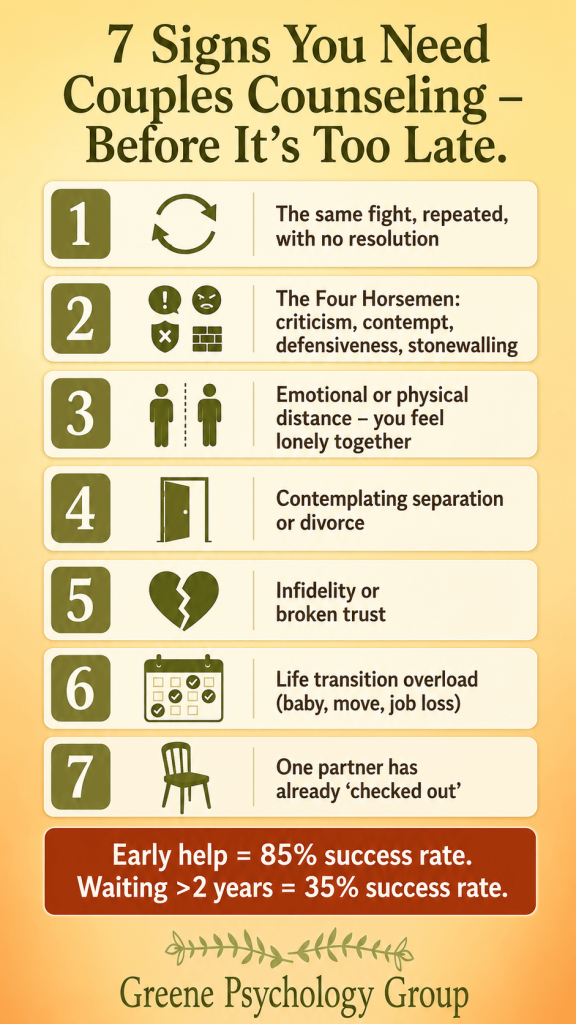
Part 1: The Seven Signs That You Need Couples Counseling – Not Later, Now
Many couples dismiss early warning signs as "normal rough patches." Some are. But research from Johns Hopkins Bloomberg School of Public Health has identified specific predictors of relationship distress and divorce. If you recognize any of these, do not wait.7 Warning Signs That Your Relationship Needs Professional Help:
Sign #1: The Same Fight, Repeated, with No Resolution
You have had the same argument about the same topic (money, sex, in‑laws, screen time) at least 10 times. Neither of you gives ground. The fight ends with withdrawal, yelling, or silent treatment – never repair.
Why it matters: Repeated, unresolved conflict creates contempt, the single strongest predictor of divorce according to research by Dr. John Gottman at the University of Washington.
Sign #2: The Four Horsemen (Gottman's Predictors of Divorce)
Dr. John Gottman's research, conducted at the University of Washington and cited by Harvard Medical School, identified four communication patterns that predict divorce with over 90% accuracy. If you hear any of these regularly, your relationship is in the danger zone:
| Horseman | What It Sounds Like |
|---|---|
| Criticism (not complaint) | "You never help around here. You are so lazy." (vs. "I'm frustrated that the dishes are still out.") |
| Contempt (sarcasm, name‑calling, eye‑rolling) | "You are such a child. Grow up." |
| Defensiveness | "It's not my fault. You are the one who..." |
| Stonewalling (withdrawal, silent treatment) | The partner checks their phone, walks away, or goes silent for hours. |
Sign #3: Emotional or Physical Distance
You no longer share inside jokes. You do not know what is happening in your partner's inner world (fears, hopes, dreams). Sex has declined significantly – not just in frequency, but in affection. You feel lonely in the same room.
Sign #4: Contemplating Separation or Divorce
If you have seriously discussed separation, consulted a lawyer, or secretly searched apartments, you need couples counseling now. Many couples who divorce regret not trying therapy first.
Sign #5: Infidelity or Broken Trust
An affair, emotional betrayal, financial secret, or addiction can shatter trust. Recovery is possible – but not without professional help.
The Data: Research from Duke University Department of Psychiatry shows that couples who complete affair‑focused couples therapy have a 60–70% chance of staying together and rebuilding trust.
Sign #6: Life Transition Overload
Major life transitions – having a baby, moving, job loss, retirement, children leaving home – are relationship stressors. If you have experienced two or more major transitions in the past 12 months, your relationship is at elevated risk.
Sign #7: One Partner Has Already "Checked Out"
If one partner has stopped trying – no more arguments, no more bids for connection – that is often worse than fighting. It signals hopelessness. Do not wait.
Timing Matters: The Window of Success
A study from UNC Chapel Hill found that couples who started therapy within 3 months of recognizing these signs had an 85% success rate. Conversely, those who waited more than 2 years had only a 35% success rate.
Part 2: How Couples Counseling Works – The Two Evidence‑Based Approaches
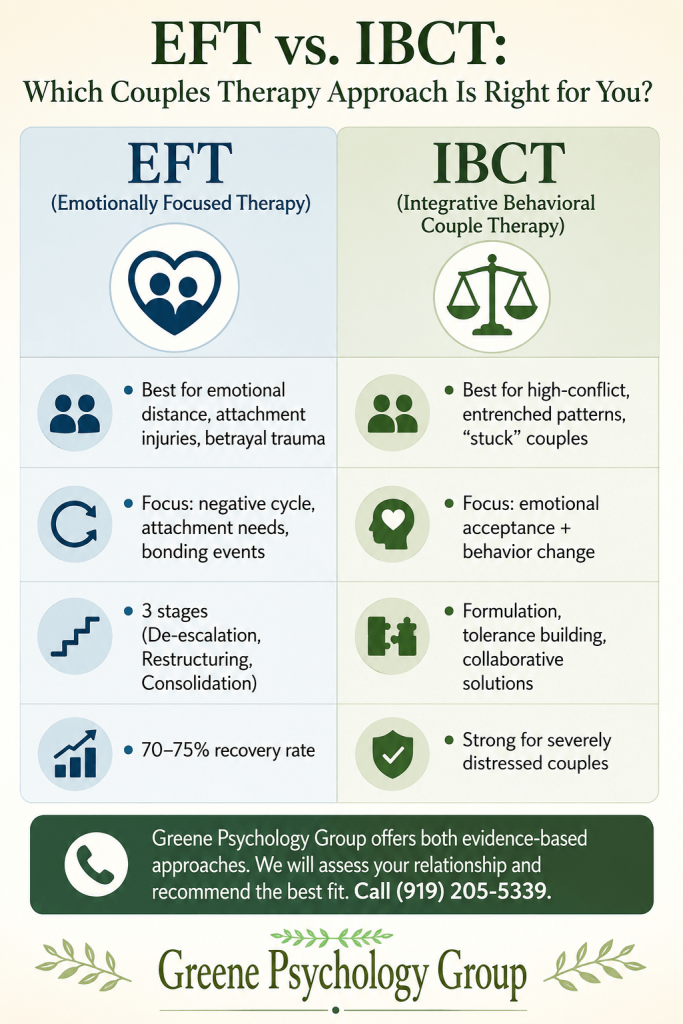
Not all couples therapy is the same. At Greene Psychology Group, we use two evidence‑based approaches with the strongest research support: Emotionally Focused Therapy (EFT) and Integrative Behavioral Couple Therapy (IBCT) .
Emotionally Focused Therapy (EFT) – Gold Standard for Attachment
Developed by Dr. Sue Johnson, EFT is based on attachment theory. The core idea: relationship distress is not about poor communication skills; it is about emotional disconnection and insecure attachment. When you feel threatened or rejected, your nervous system goes into fight, flight, or freeze – which looks like criticism, withdrawal, or stonewalling.
How EFT works (three stages, nine steps):
Stage 1: De‑escalation (4–6 sessions)
Identify negative cycles (e.g., "I pursue, you withdraw")
Access underlying attachment emotions (fear, shame, sadness beneath anger)
Reframe the problem as the cycle, not the partner
Stage 2: Restructuring (6–10 sessions)
Withdrawer re‑engages (expresses needs, fears, longings)
Pursuer softens (expresses vulnerability instead of criticism)
Create new bonding events (emotional engagement and repair)
Stage 3: Consolidation (2–4 sessions)
Practice new patterns
Plan for future conflicts
Celebrate changes
Evidence: EFT has been tested in over 30 clinical trials. It shows a 70–75% recovery rate (moving from distressed to non‑distressed) and 90% improvement rate. Gains are maintained at 2‑year follow‑up.
Integrative Behavioral Couple Therapy (IBCT) – For Deeply Entrenched Conflict
Developed by Dr. Andrew Christensen and Dr. Neil Jacobson, IBCT is ideal for couples who have tried "communication skills training" and found it superficial. IBCT focuses on emotional acceptance alongside behavior change.
How IBCT works:
Formulation: Understanding the "why" behind each partner's behavior (e.g., "She nags because she fears abandonment; he withdraws because he fears engulfment")
Tolerance building: Learning to sit with differences without fighting
Collaborative problem‑solving: For issues that can be changed
Acceptance strategies: For issues that cannot be changed (e.g., personality differences)
Evidence: IBCT has been tested in multiple randomized trials. It outperforms traditional behavioral couples therapy (TBCT) for severely distressed couples and shows continued improvement after treatment ends.
Which Approach Is Right for You?
| Presenting Problem | Likely Best Fit |
|---|---|
| Emotional distance, feeling unloved, attachment injuries | EFT |
| One affair, one partner wants to leave | EFT (with affair‑adapted protocol) |
| Constant arguing about the same topics, but still engaged | IBCT |
| One partner wants "communication skills," the other is resistant | IBCT (acceptance first) |
| Trauma history (individual) affecting relationship | EFT (with trauma‑informed adaptations) |
At Greene Psychology Group, we offer couples counseling in Raleigh using both EFT and IBCT. We will assess your relationship and recommend the best fit.
Part 3: What a Couples Counseling Session Actually Looks Like
Many first‑time couples are nervous. They worry the therapist will take sides, blame one person, or turn the session into a courtroom. Here is the reality.
The First Session (90 minutes)
First 30 minutes – Both partners together
Your therapist explains confidentiality, limits, and the process.
Each partner briefly shares why they are seeking help.
Your therapist sets ground rules: no interrupting, no blaming, no cross‑talk.
Next 30 minutes – Partner A alone (or with partner B in the waiting room)
Your therapist asks about your individual history, family background, previous relationships, and individual mental health.
They also ask what you need from your partner and what you are willing to change.
Next 30 minutes – Partner B alone
Same process.
Last 15 minutes – Both partners together
Your therapist shares initial impressions (no diagnosis, just themes).
You set goals together (e.g., "Reduce fighting from 5x/week to 1x/week").
You schedule the next session.
Subsequent Sessions (50 or 75 minutes)
A typical 50‑minute couples session looks like this:
| Time | Activity |
|---|---|
| 0–5 min | Check‑in: "How was your week? Any major conflicts?" |
| 5–40 min | Active work: identifying the cycle, accessing emotions, practicing new communication, processing a recent fight |
| 40–45 min | Summarize insights: "What did you learn today about yourself, your partner, or the cycle?" |
| 45–50 min | Assign practice: "Between sessions, try this one new behavior." |
What Your Therapist Will NOT Do
Take sides – The problem is the cycle, not the person.
Blame – Both partners contribute to the dynamic.
Keep secrets – With rare exceptions (safety concerns), everything is shared.
Tell you to stay together or separate – That decision is yours.
Part 4: How Long Does Couples Counseling Take? Realistic Timelines
One of the most common questions we hear is: How many sessions will we need?
The answer depends on several critical factors: the severity of distress, the duration of the problem, the presence of individual mental health issues (such as depression, trauma, or substance use), and both partners' willingness to practice new skills between sessions.
Estimated Duration of Couples Therapy
| Your Situation | Typical Number of Sessions |
|---|---|
| Mild distress: Early intervention, highly motivated couple. | 8–12 sessions |
| Moderate distress: Entrenched communication patterns, recovering from an affair (where both want to stay). | 12–20 sessions |
| Severe distress: Multiple betrayals, individual trauma/mental illness, or one partner has "one foot out the door." | 20–30+ sessions (often 6–12 months) |
| Discernment counseling: The couple has already decided to separate, but wants to process the transition. | 1–5 sessions |
Important Reality Check: Most couples wait far too long to seek help. If you are reading this and recognizing these patterns in your relationship, you are likely in the moderate to severe category. Do not expect a "quick fix." However, do not let the timeline discourage you – the alternatives (separation, divorce, or years of chronic emotional misery) are far more costly.
The Clinical Evidence: Research from the Columbia University Department of Psychiatry found that couples who completed 12–20 sessions of Emotionally Focused Therapy (EFT) achieved a 70% recovery rate, defined as moving completely from distressed to non‑distressed on standardized relationship measures.
Part 5: What If Only One Partner Wants to Come?
This is extremely common. One partner (usually the one reading this article) is motivated. The other says: "We don't need therapy. You're the problem. It's a waste of money."
Here is what works:
Step 1: Do not demand, invite. Instead of "You have to come with me," try: "I am struggling in our relationship. I am going to see a therapist to work on my part. I would love it if you joined me, even for one session."
Step 2: Go alone. Individual therapy can help you clarify your own needs, set boundaries, and change your part of the dynamic. Often, when one partner changes, the other responds differently.
Step 3: Use a "trial session." Many reluctant partners agree to one session if you frame it as a consultation, not a commitment. "Let's just go once. If you hate it, we don't have to go back."
Step 4: Address the fear directly. Reluctant partners often fear being blamed, humiliated, or forced to change. Say: "I don't want a therapist to blame you. I want help understanding us."
What if they still refuse? Then you have data: your partner is unwilling to work on the relationship. That information should guide your decisions about whether to stay.
At Greene Psychology Group, we offer individual therapy for people in conflicted relationships – sometimes called "individual couples therapy" – to help you decide what to do next.
Part 6: Common Myths About Couples Counseling – Debunked
Fear and misinformation often prevent couples from seeking help when they need it most. Here is what the science and clinical practice actually show:
| Myth | The Reality |
|---|---|
| "The therapist will take my partner's side." | A skilled couples therapist remains strictly neutral. In evidence-based care, the enemy is the negative relationship cycle itself, not either individual partner. |
| "Therapy will make things worse before they get better." | Sometimes, surface-level tension increases temporarily as old wounds are opened, but you will quickly learn actionable stabilization skills to manage this distress safely. |
| "We should try to fix it on our own first." | You have likely been trying to fix it for months or years. Professional intervention provides the objective framework needed to accelerate genuine healing. |
| "Couples therapy is only for people who are about to divorce." | No. The absolute best time to start therapy is when you first notice the warning signs, not when you are already standing at the edge of the brink. |
| "We don't have the money." | The financial and emotional cost of a divorce (legal fees, setting up two separate households, asset division) is far higher than the investment in therapy. |
| "We don't have time." | Couples therapy requires just 50–75 minutes per week. The cumulative hours a couple loses to chronic conflict, withdrawal, and rumination is far greater. |
Research from Stanford University's Department of Psychology shows that couples who hold these myths delay treatment by an average of 3.5 years – and have significantly worse outcomes when they finally seek help.
Part 7: When Couples Counseling Is Not Enough – Adjuncts and Alternatives
Sometimes couples counseling needs to be supplemented with other services.
Individual Therapy for One or Both Partners
If one partner has untreated depression, anxiety, trauma, or substance use, couples therapy will be less effective. Address individual mental health first (or concurrently). Greene Psychology Group offers individual therapy, anxiety therapy, and EMDR for trauma.
Discernment Counseling (For Couples on the Brink)
If one partner is leaning toward divorce and the other wants to stay, traditional couples counseling often fails. Discernment counseling is a brief (1–5 session) intervention that helps couples decide, with clarity, whether to:
Pursue divorce
Commit to 6 months of intensive couples therapy
Stay married but make no changes (not recommended)
Separation with a Contract
Sometimes a temporary, structured separation (with clear rules about dating, finances, and communication) reduces pressure and allows each partner to assess what they truly want.
Intensive Couples Retreats
Some couples benefit from 2–3 day intensive retreats (e.g., EFT intensives) that compress months of therapy into a weekend. Greene Psychology Group can provide referrals.
Part 8: How to Choose a Couples Therapist in Raleigh
Not all therapists are trained in couples work. Individual therapy skills do not automatically translate to couples therapy.
What to Look For
Specific training in EFT, IBCT, or Gottman Method (not just "I see couples")
Licensed mental health professional (LCSW, LPC, LMFT, Psychologist) in North Carolina
Experience with your specific issue (affair recovery, parenting conflicts, sexual issues)
Transparent fees and policies (cancellation, after‑hours contact, etc.)
Questions to Ask Before Booking
What couples therapy models do you use? How many hours of training do you have in each?
Do you meet with partners individually? If so, when and how often?
What is your success rate? How do you define success?
Do you offer a free phone consultation so we can both speak with you?
Red Flags
"I never meet with partners individually" (can miss important safety issues like domestic violence)
"I can fix your relationship in 6 sessions guaranteed" (unrealistic)
No license or using a coaching credential only
At Greene Psychology Group, our couples therapists have advanced training in EFT and/or IBCT. Contact us for a free 15‑minute phone consultation with both partners.
Part 9: Putting It All Together – Three Couple Archetypes
Archetype A: The New Parents
Presentation: 32‑year‑olds, first baby is 8 months old. Haven't had sex since before birth. Constant fighting about chores, sleep deprivation, and in‑laws. Both exhausted. Love each other but feel like strangers.
Bottleneck: Life transition overload + communication breakdown.
Treatment map: Intake (90 min) → 6 sessions of EFT focusing on attachment (both feel abandoned: mom feels unsupported, dad feels rejected) → 4 sessions of problem‑solving (schedules, division of labor) → Discharge with booster at 6 months.
Archetype B: The Post‑Affair Couple
Presentation: 45‑year‑olds, married 18 years. Husband had a 6‑month emotional and physical affair with a coworker. Wife found out 2 months ago. Both devastated but want to try. Wife has nightmares and hypervigilance. Husband is remorseful but defensive.
Bottleneck: Betrayal trauma and shattered trust.
Treatment map: Immediate safety (affair must be over, no contact) → 3 sessions of individual assessment for each partner → 16 sessions of EFT with affair‑adapted protocol (Stage 1: contain the trauma; Stage 2: rebuild trust; Stage 3: create new shared narrative) → Additional 6 sessions if needed → Discharge with monthly check‑ins for 6 months.
Archetype C: The Empty Nesters
Presentation: 58‑year‑olds, last child left for college 3 months ago. Realized they have nothing to talk about. Decades of conflict avoidance. Considering divorce for the first time.
Bottleneck: Chronic disconnection with no practice in vulnerability.
Treatment map: Intake → 4 sessions of IBCT focusing on acceptance of differences (they have different interests, energy levels, social needs) → 8 sessions of EFT to access underlying fears (abandonment, irrelevance, mortality) → 4 sessions of creating shared rituals (weekly date, shared hobby) → Discharge or continue as maintenance.
Your relationship does not have to stay stuck. Couples counseling in Raleigh, NC, can help you break the cycle, rebuild trust, and find each other again. Call Greene Psychology Group at (919) 205-5339 or schedule an appointment online. We offer evening appointments and a free 15‑minute phone consultation for both partners. Do not wait six more years.
FAQs
If you recognize any of the seven signs in Part 1 (repeated unresolved fights, the Four Horsemen, emotional distance, contemplating separation, infidelity, life transition overload, or one partner checked out), you need help.
No. If there is ongoing domestic violence (physical abuse), untreated addiction, or one partner has already decided irrevocably to leave, counseling may not help. But for most distressed relationships, it significantly improves satisfaction.
8–12 sessions for mild distress, 12–20 for moderate, 20–30+ for severe or complex cases.
No. A skilled couples therapist is neutral. The problem is the cycle, not either partner.
Go alone. Individual therapy can help you change your part of the dynamic. See Part 5 for more strategies.
Sometimes. Many plans cover "marriage counseling" if a diagnosed mental health condition (e.g., adjustment disorder) is present. Call your insurer to verify.
EFT focuses on attachment and emotional bonding. Gottman focuses on communication skills and conflict management. Both are evidence‑based. Greene Psychology Group primarily uses EFT and IBCT.
Yes. Research shows online couples therapy is as effective as in‑person for most couples. Greene Psychology Group offers online therapy for couples.
Consider discernment counseling first (1–5 sessions) to ensure you are making a clear, regret‑free decision.
Yes, with a therapist trained in affair‑focused EFT or similar. Success rates are 60–70% for couples who complete treatment.
Your therapist will assess your relationship and recommend. In general, EFT is better for emotional distance and attachment injuries; IBCT is better for deeply entrenched, high‑conflict couples.
Treat the individual condition first (or concurrently). Couples therapy is less effective when one partner is actively symptomatic. Greene Psychology Group offers individual and couples therapy.
Sources
Duke University Department of Psychiatry – Affair recovery outcomes
UNC Chapel Hill School of Social Work – Timing of couples therapy
Johns Hopkins Bloomberg School of Public Health – Predictors of divorce
Columbia University Department of Psychiatry – EFT outcome studies
Stanford University Department of Psychology – Myths about couples therapy