

EMDR Therapy for Trauma in Raleigh, NC: How It Works, What to Expect, and Who It Helps
If you have experienced a traumatic event – a car accident, an assault, military combat, childhood abuse, or even a painful medical procedure – you know that the memory does not simply "fade with time." It stays. It intrudes. It shows up as nightmares, flashbacks, panic attacks, or an overwhelming urge to avoid anything that reminds you of what happened.
For years, the standard advice was to "talk it out." But for many trauma survivors, talking about the event makes things worse, not better. They re‑experience the trauma without resolution. They feel retraumatized.
There is a better way.
Eye Movement Desensitization and Reprocessing (EMDR) is one of the most rigorously researched treatments for post‑traumatic stress disorder (PTSD) and trauma‑related conditions. Endorsed by the World Health Organization, the American Psychological Association, and the Department of Veterans Affairs, EMDR has helped millions of people process traumatic memories so they no longer cause debilitating distress.
Greene Psychology Group offers EMDR therapy in Raleigh, NC, delivered by trained clinicians. This guide is a complete, evidence‑based overview of EMDR: how it works (including the theory and the research), what a session actually looks like, who it helps, and how to know if it is right for you or a loved one.
Part 1: What Is EMDR – A Clear Definition
EMDR was developed in the late 1980s by psychologist Dr. Francine Shapiro. She discovered that lateral eye movements (back and forth) seemed to reduce the intensity of disturbing memories. Over the following decades, EMDR evolved into a structured, eight‑phase protocol that is now used worldwide.
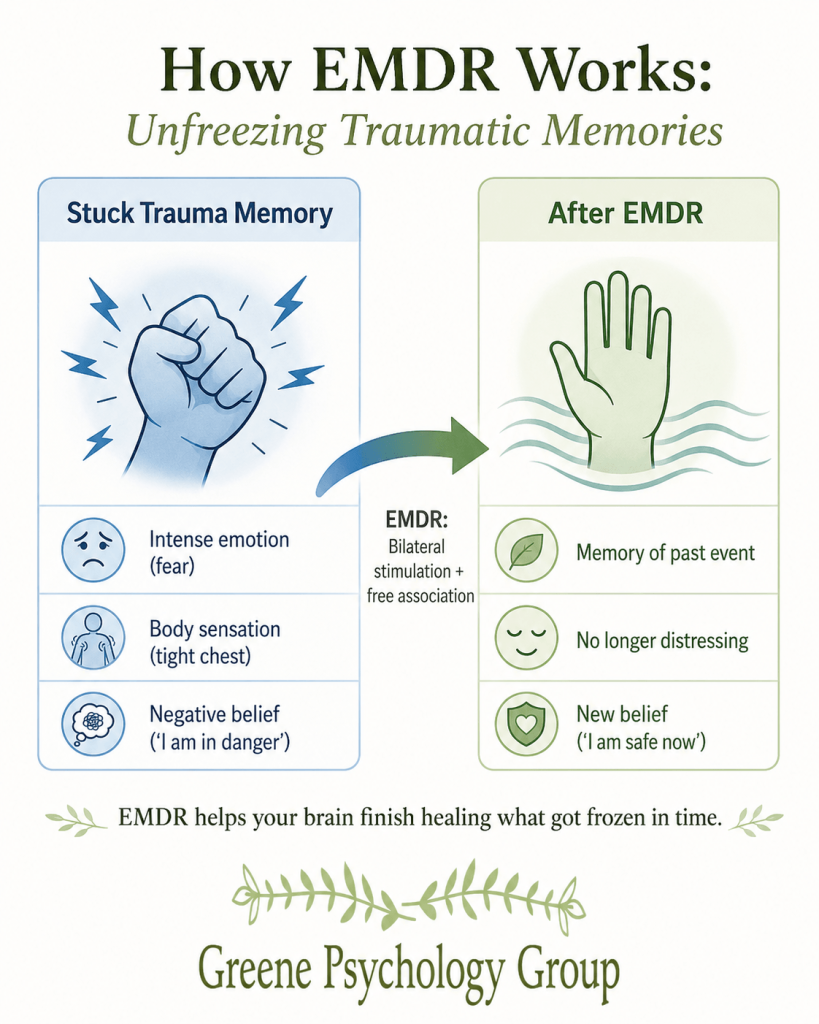
The core idea: Trauma memories are stored differently than ordinary memories. A normal memory fades over time and becomes integrated into your life story. A trauma memory is "frozen in time" – it retains the same intense emotions, physical sensations, and beliefs that were present during the event. When something triggers that memory, you do not just remember what happened; you relive it.
EMDR helps "unfreeze" those memories. Using bilateral stimulation (eye movements, taps, or tones), EMDR activates the brain's natural information‑processing system, allowing the traumatic memory to be integrated and stored properly – so it becomes a memory of something that happened in the past, not something that is happening now.
Metaphor: Think of trauma memory as a wound that never healed. EMDR is like cleaning out the debris and allowing the wound to close properly. The scar may remain, but the pain stops.
Part 2: The Research – Why EMDR Is Considered Evidence‑Based
EMDR is not alternative medicine. It is a first‑line, evidence‑based treatment for PTSD, recognized by every major health organization.
Key Research Findings
World Health Organization (WHO): Recommends EMDR and CBT with a trauma focus as the only two treatments for PTSD in adults and children.
American Psychological Association (APA): Strongly recommends EMDR for PTSD.
Department of Veterans Affairs / Department of Defense: EMDR is among the highest‑rated treatments for PTSD in clinical practice guidelines.
Meta‑Analysis Data
A 2018 meta‑analysis in European Journal of Psychotraumatology reviewed 26 randomized controlled trials comparing EMDR to other treatments (CBT, medication, waitlist). Results:
EMDR was superior to waitlist and non‑trauma‑focused treatments (large effect size, d = 1.0+).
EMDR was equivalent to trauma‑focused CBT (both highly effective).
EMDR had lower dropout rates than trauma‑focused CBT (patients found EMDR less distressing).
Research from Harvard Medical School's Department of Psychiatry found that EMDR produced significant reductions in PTSD symptoms in an average of 8–12 sessions – faster than most other trauma treatments.
At Greene Psychology Group, we offer EMDR therapy as a core service for trauma, as well as CBT for those who prefer a different approach.
Part 3: The Eight Phases of EMDR – What Happens in Treatment
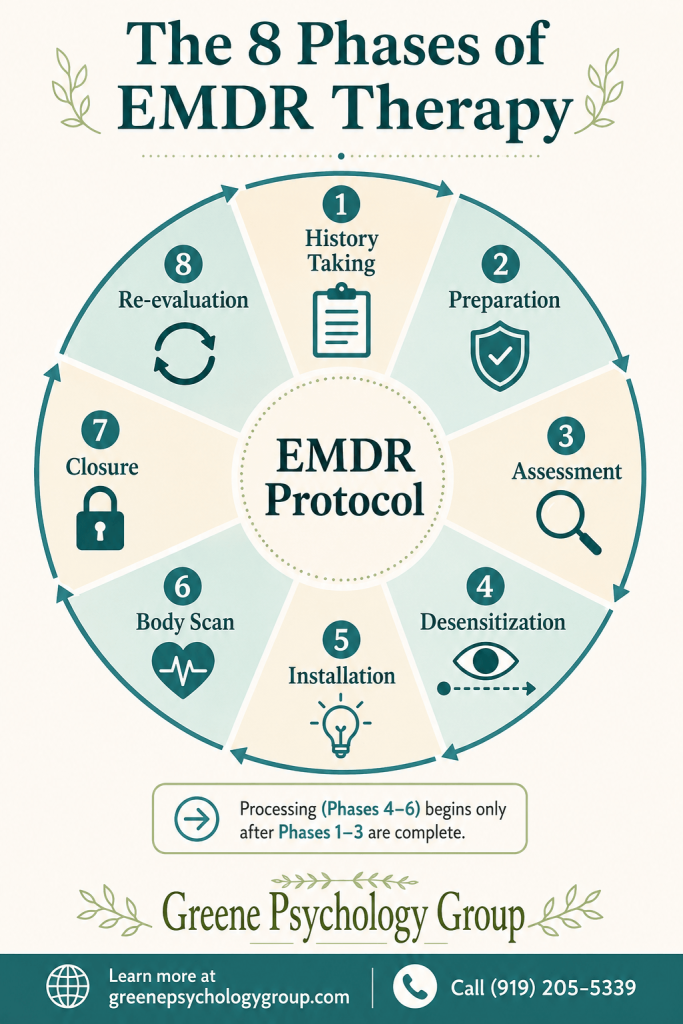
EMDR is not a single technique. It is a comprehensive, eight‑phase protocol. Understanding these phases helps you know what to expect and why EMDR is not just "moving your eyes while thinking about something bad."
Phase 1: History Taking and Treatment Planning
Your EMDR therapist will take a detailed history – not just of the trauma, but of your life before and after. They will identify:
- The target traumatic memory (or memories) to process.
- Current triggers (situations that bring back the trauma).
- Your resources (people, skills, strengths that help you cope).
- Any contraindications (active psychosis, severe substance use, certain medical conditions).
Estimated Time: 1–3 sessions.
Phase 2: Preparation (Resourcing)
Before any memory processing begins, your therapist teaches you stabilization skills. This is essential. Processing trauma can be intense, and you need tools to manage distress between sessions.
Skills you will learn:
- Safe/Calm Place: A guided imagery exercise where you visualize a place where you feel completely safe and in control. You learn to "go there" when distress rises.
- Container Exercise: A visualization where you put disturbing thoughts or images into a locked container to set aside until the next session.
- Grounding techniques: Physical anchors (feeling your feet on the floor, touching a textured object) to bring you back to the present moment if you become overwhelmed.
Important: Your therapist will not start processing until you have these skills. If you have complex trauma (multiple, repeated traumas over years), this phase may take several sessions.
Estimated Time: 1–4 sessions.
Phase 3: Assessment
For the target memory, your therapist will ask you to identify specific components:
- The image that represents the worst part of the memory.
- The negative cognition: A negative belief about yourself connected to the memory (e.g., "I am in danger," "I am powerless," "It was my fault," "I am dirty").
- The positive cognition: What you would rather believe (e.g., "I am safe now," "I am in control," "I did what I had to do to survive").
- Emotions and body sensations (e.g., fear in the chest, tension in shoulders).
- Validity of Cognition (VOC) scale: How true does the positive cognition feel right now? (1 = completely false, 7 = completely true).
- Subjective Units of Disturbance (SUD) scale: How disturbing is the memory right now? (0 = no disturbance, 10 = worst possible).
Estimated Time: Part of the first processing session.
Phase 4: Desensitization – The Core Processing
This is what most people think of as "doing EMDR." While holding the target memory in mind, you follow your therapist's finger (or a moving dot on a screen, or vibrating tappers in your hands, or alternating tones in headphones) with your eyes. After each set of bilateral stimulation (about 30–60 seconds), your therapist will ask: "What came up?"
You might report:
- A shift in the image: The image becomes less vivid or farther away.
- A change in emotion: Fear turns to anger, then sadness, and eventually calm.
- A new thought or memory: Internal associations expand (e.g., "I just remembered my grandmother's house").
- A body sensation: Physical release (e.g., "The knot in my stomach is loosening").
Your therapist does not direct you; you are the one who has the inner wisdom. The bilateral stimulation helps your brain continue processing on its own. Processing continues until your SUD score drops to 0 or 1.
Estimated Time: Most processing sessions are 60–90 minutes. A single target memory typically takes 1–3 sessions to fully process.
Phase 5: Installation
Once the memory is no longer disturbing, your therapist will ask you to hold the positive cognition (e.g., "I am safe now") while continuing bilateral stimulation. The goal is to strengthen the positive belief so it feels true at a core level (VOC score of 6 or 7).
Estimated Time: 5–15 minutes.
Phase 6: Body Scan
Your therapist will ask you to hold the original memory and the positive cognition in mind, then mentally scan your body from head to toe. If you notice any residual tension, discomfort, or "stuckness," those sensations are processed with additional bilateral stimulation until the body scan feels completely clear.
Estimated Time: 5–10 minutes.
Phase 7: Closure
At the end of each processing session, your therapist will guide you back to a calm state. If processing is not complete, you will practice the Safe/Calm Place and Container exercises to leave the session feeling stable – not flooded.
You will be given specific between‑session instructions: keep a log of any dreams, memories, or emotions that come up, note new insights, and use your grounding skills if distress rises.
Estimated Time: 10–15 minutes.
Phase 8: Re‑evaluation
At the beginning of the next session, your therapist will evaluate your progress: "How have you been since our last session? Have any new memories or feelings emerged?" If the target memory remains fully processed (SUD = 0, VOC = 7), you move to the next target. If some disturbance has returned, you process it further.
Estimated Time: Part of the next session's opening.
Part 4: What EMDR Feels Like – A Patient's Perspective
Many people ask: Will I be hypnotized? Will I lose control? Will I have to describe every detail of my trauma?
No to all three. You remain fully awake, aware, and in control. You can stop the process at any time by raising your hand or opening your eyes. You do not have to describe the trauma in detail if you do not want to. Your therapist only needs to know the image, the negative belief, and the body sensations – not a full narrative.
Common Experiences During Processing
Some sessions feel intense: You may cry, feel anger, or experience strong physical sensations. This is normal and part of the healing. Your therapist will help you regulate.
Some sessions feel boring: Nothing much seems to happen. You might feel sleepy or distracted. That is also normal. Processing continues beneath the surface.
Between sessions, you may have vivid dreams or new memories surface. This is a sign that your brain is continuing to process. Bring these to the next session.
Temporary increase in distress: Sometimes symptoms worsen briefly before they improve. This is similar to how a physical wound might hurt more as it heals. If distress becomes unmanageable, contact your therapist immediately.
What EMDR Is Not
Not hypnosis: You are not in an altered state. You are fully conscious.
Not a memory recovery technique: EMDR does not "uncover" repressed memories. It works with memories you already have.
Not a quick fix for everything: EMDR is effective for trauma, but it may take multiple sessions. Single‑session "trauma clearing" claims are not supported by research.
Research from Stanford University's Department of Psychiatry used fMRI to study the brain during EMDR. They found that after successful EMDR, the amygdala (fear center) showed reduced activation to trauma reminders, and the prefrontal cortex (rational thinking) showed increased activation – evidence that the brain literally reorganized.
Part 5: Who Can Benefit from EMDR – And Who Should Not
EMDR is primarily indicated for PTSD and trauma‑related conditions. However, research has also shown benefits for other disorders when trauma is a contributing factor.
Indications for EMDR Therapy
Strong Evidence (Multiple Randomized Controlled Trials)
- PTSD: Single‑event trauma such as assault, accidents, natural disasters, combat, or medical trauma.
- Complex PTSD: Repeated, prolonged trauma, especially in childhood (though this often requires more sessions and a slower pace).
- Trauma‑related conditions: Depression and anxiety secondary to traumatic events.
Emerging Evidence (Smaller Studies or Clinical Consensus)
- Panic disorder: When panic attacks are triggered by trauma reminders.
- Phobias: When the phobia originated from a specific traumatic experience.
- Complicated grief: When loss is traumatic, such as a sudden or violent death.
- Chronic pain: When physical pain is linked to trauma.
Who Should Not Do EMDR?
Absolute Contraindications
- Active psychosis: Hallucinations or delusions (EMDR can worsen these symptoms).
- Severe substance use disorder: Active withdrawal requires medical stabilization first.
- Unstable Dissociative Identity Disorder (DID): Requires specialized, longer‑phase treatment before any processing.
- Certain seizure disorders: Photosensitive epilepsy (eye movements could trigger seizures; however, auditory tones or tactile tappers can be used instead).
Relative Contraindications (Proceed with Caution)
- Severe dissociative symptoms: Feeling disconnected from the body or reality (requires an extended preparation phase).
- Active suicidal ideation with a plan: Crisis stabilization is necessary before trauma processing.
- Recent traumatic event (last 3 months): Crisis intervention and support come first; EMDR is best implemented after the acute phase.
Note: If you have any of these conditions, a skilled EMDR therapist will modify the protocol or refer you to a different treatment first.At Greene Psychology Group, we offer a free consultation to determine if EMDR is appropriate for you. Call (919) 205-5339.
Part 6: EMDR vs. Trauma‑Focused CBT – How to Choose
Both EMDR and trauma‑focused CBT (TF‑CBT) are first‑line treatments for PTSD. Here is how to decide which approach fits your needs.
EMDR vs. Trauma‑Focused CBT (TF‑CBT)
| Factor | EMDR | Trauma‑Focused CBT (TF‑CBT) |
|---|---|---|
| Core mechanism | Bilateral stimulation + free association | Exposure + cognitive restructuring |
| Need to describe trauma in detail | Minimal (image, belief, body sensation) | Yes (narrative often required) |
| Between‑session "homework" | Keep a log, practice grounding | Practice exposures, read the narrative |
| Emotional intensity during sessions | Moderate to high | High (exposure is intentionally distressing) |
| Dropout rate in research | Lower (~15%) | Higher (~25%) |
| Number of sessions (single‑event) | 8–12 sessions (average) | 12–16 sessions (average) |
| Best for | Patients who do not want to describe trauma; those who found talk therapy retraumatizing. | Patients who prefer a structured, verbal, and logical approach. |
The bottom line: Both work. The choice is about patient preference and fit. Some patients prefer EMDR because it feels less "invasive." Others prefer TF‑CBT because they want to understand and talk through the trauma. Greene Psychology Group offers both EMDR and CBT. We will help you choose based on your history, preferences, and goals.
Part 7: What to Look for in an EMDR Therapist in Raleigh
EMDR is a specialized skill. Not every therapist who claims to do EMDR is properly trained.
Minimum Qualifications for EMDR Therapists
When searching for a provider, ensure they meet the following baseline requirements:
- State Licensure: Must be a licensed mental health professional (LCSW, LPC, LMFT, or Psychologist) in North Carolina.
- Approved Training: Completed basic EMDR training (40–50 hours, including supervised practice) from an EMDRIA‑approved provider.
- Ongoing Consultation: EMDRIA requires 10+ hours of consultation with an approved consultant for full certification.
Red Flags to Watch Out For
Be cautious if a practitioner exhibits any of the following behavior or claims:
- "I can clear your trauma in one session." (Trauma processing takes time and proper pacing).
- They have no professional mental health license or operate under a coaching credential only.
- They cannot name the eight phases of the protocol or have never heard of EMDRIA.
- They skip Phase 2 (resourcing/stabilization) and attempt to jump straight into memory processing.
How to Verify a Therapist's EMDR Credentials
Do not hesitate to ask any prospective EMDR therapist these direct questions:
- "Are you trained in EMDR? Where did you complete your training and how many hours did it involve?"
- "Are you EMDRIA‑certified or actively working toward your certification?"
- "Do you utilize the full 8‑phase protocol? Do you consistently practice resourcing before memory processing?"
- "How many trauma clients have you successfully treated using EMDR?"
At Greene Psychology Group, our EMDR therapists are fully licensed, EMDRIA‑trained, and strictly follow the comprehensive 8‑phase protocol to ensure your safety and progress.
Raleigh‑Specific Resources for Trauma and EMDR
If you are seeking EMDR or trauma treatment in Raleigh, here are additional resources.
Crisis and Urgent Trauma Support
Alliance Health Mobile Crisis: (800) 510-9132 – 24/7, free, for immediate emotional distress.
988 Suicide & Crisis Lifeline: Call or text 988 – confidential, trauma‑informed.
InterAct of Wake County: (919) 828-7501 – 24/7 crisis line for domestic violence and sexual assault survivors.
Outpatient EMDR Providers (Beyond Greene Psychology Group)
EMDRIA Find a Therapist directory: Search by zip code (27601) and "EMDR."
The Healing Place of Raleigh – Low‑cost trauma therapy.
Monarch Behavioral Health – EMDR available at some locations.
Support Groups for Trauma Survivors
NAMI Wake County: Family support groups (not trauma‑specific, but helpful)
InterAct Support Groups: For survivors of domestic violence and sexual assault.
Part 9: Putting It All Together – Three Trauma Archetypes
Archetype A: Single‑Event Accident Trauma
Presentation: 35‑year‑old, in a car accident 18 months ago. Now avoids driving on highways, has nightmares of the crash, and feels intense anxiety when in a car.
Bottleneck: PTSD from single traumatic event.
Treatment map: Intake → Phase 2 resourcing (2 sessions) → Phase 3–6 processing of the accident memory (3–4 sessions) → Body scan and closure → Re‑evaluation → Driving exposure as homework → Discharge at 8 sessions.
Archetype B: Childhood Abuse Survivor (Complex PTSD)
Presentation: 42‑year‑old, history of emotional and physical abuse from age 5–15. Chronic shame, difficulty trusting others, frequent panic attacks, and feeling "numb" or disconnected.
Bottleneck: Complex PTSD (repeated, prolonged trauma).
Treatment map: Extended Phase 2 (8–10 sessions of resourcing and stabilization) → Processing of earliest memory (4–6 sessions) → Then processing of subsequent memories in chronological order (12–20 sessions total) → Phase 8 re‑evaluation every few sessions → Total treatment often 6–12 months.
Archetype C: Medical Trauma
Presentation: 28‑year‑old, had a traumatic childbirth experience (emergency C‑section, hemorrhage, baby in NICU). Now avoids gynecological exams, has flashbacks during sex, and feels intense rage when seeing pregnant women.
Bottleneck: PTSD with triggers specific to medical settings.
Treatment map: Intake → Phase 2 (resourcing includes Safe Place related to her body) → Processing of childbirth memory (3–4 sessions) → Processing of trigger memories (e.g., first time seeing baby in NICU) → Gradual exposure to gynecological exams (with permission) → Discharge at 10 sessions.
If you are living with the weight of trauma, you do not have to carry it alone. EMDR therapy in Raleigh, NC, can help you process painful memories so they no longer control your life. Call Greene Psychology Group at (919) 205-5339 or schedule an appointment online to speak with one of our EMDR‑trained clinicians. We offer in‑person and online therapy (some EMDR protocols can be adapted for telehealth). Same‑week availability for urgent concerns.
FAQs
EMDR (Eye Movement Desensitization and Reprocessing) is an evidence‑based treatment that uses bilateral stimulation (eye movements, taps, or tones) to help the brain reprocess traumatic memories so they no longer cause intense distress.
Yes. The World Health Organization, American Psychological Association, and VA/DoD all recommend EMDR as a first‑line treatment for PTSD.
Yes, but complex childhood trauma often requires more preparation (Phase 2) and more sessions. A skilled EMDR therapist will pace the treatment appropriately.
For a single‑event trauma, most patients need 8–12 sessions. For complex trauma (repeated abuse), treatment may take 6–12 months.
No. You only need to identify an image, a negative belief, and body sensations. You do not have to tell the full story.
No. You remain fully awake and in control. You can stop the process at any time by raising your hand or opening your eyes.
Yes, many EMDR protocols can be adapted for telehealth using visual moving dots or auditory tones. Greene Psychology Group offers online EMDR for eligible patients.
Yes, most insurance plans cover EMDR as a treatment for PTSD and other trauma‑related conditions. Greene Psychology Group accepts Blue Cross NC, Cigna, UnitedHealthcare, Aetna, and others.
That is why Phase 2 (resourcing) is essential. Your therapist will teach you grounding skills before any processing begins. If dissociation occurs during processing, your therapist will stop and help you return to the present.
Temporarily, some patients experience a brief increase in distress or vivid dreams. This is part of processing. If distress becomes unmanageable, your therapist will adjust the protocol.
Yes, EMDR is effective and safe for children with trauma. The protocol is adapted using simpler language, drawings, and age‑appropriate bilateral stimulation.
Look for a licensed mental health professional with EMDRIA‑approved basic training. Ask about their experience with your type of trauma. Greene Psychology Group employs EMDR‑trained clinicians – call (919) 205-5339.
Sources
Duke University Department of Psychiatry – Trauma treatment outcomes
UNC Chapel Hill School of Social Work – Complex PTSD and EMDR
Johns Hopkins Bloomberg School of Public Health – PTSD treatment guidelines
Stanford University Department of Psychiatry – fMRI studies of EMDR
Columbia University Department of Psychiatry – EMDR vs. CBT meta‑analysis