

Encourage Someone Therapy Without Pressure: 7 Practical Ways
Quick answer: If you are trying to encourage someone therapy without pressure, start by sharing what you’ve noticed, explaining why you care, and inviting the person to consider support. Use nonjudgmental language, listen for concerns, and offer practical help without taking over. An adult can say no; respecting that choice is part of keeping the relationship safe and honest. If there is immediate danger or a mental-health crisis, use emergency or crisis resources rather than treating it as an ordinary conversation about counseling.
It is painful to watch a partner, parent, adult child, sibling, friend, or teen struggle and feel unsure how to help. You may notice withdrawal, irritability, disrupted routines, conflict, grief, stress, or a sense that daily life has become harder. It is understandable to want to talk about therapy, and it is also understandable to worry that the conversation could sound critical or controlling.
This guide offers a respectful framework. It is not a script that can make someone agree to counseling. Instead, it focuses on how to support a loved one while protecting their dignity, privacy, and choice. It also explains how to respond when someone seems therapy resistant, when family therapy support may fit, and when safety concerns require crisis resources instead of persuasion.
Encourage someone therapy without pressure: the 7 practical ways
When people ask how to encourage someone therapy without pressure, the most helpful starting point is a mindset shift: your goal is not to win an argument. Your goal is to open a door. Therapy is a collaborative process, and collaboration begins before the first appointment, when the person still has a choice about whether, when, and how to seek help.
1. Choose a calm, private time
Do not raise therapy for the first time during an argument, in front of others, or as a reaction to embarrassment. A private setting gives the person more room to hear concern without also managing an audience. If the topic feels sensitive, ask permission first: “Is now an okay time to talk about something I’ve noticed?”
2. Describe observations, not diagnoses
Talk about what you have noticed rather than labeling what might be happening. “You seem more withdrawn lately” is usually safer than “You are depressed.” A licensed clinician can assess mental-health concerns; a loved one can describe changes and express care.
3. Use care-based language
Lead with the relationship. Say, “I care about you,” “I miss talking with you,” or “I do not want you to carry this alone.” Avoid using therapy as proof that something is wrong with the person. The goal is to communicate support, not judgment.
4. Ask, then listen
Give the person room to explain what therapy means to them and why they may hesitate. Listening does not mean agreeing with every concern. It means you are trying to understand what is in the way before offering ideas or information.
5. Offer practical help only with permission
Finding basic information, transportation, or insurance details can help, but only if the person wants that support. Ask first: “Would it be useful if I helped look at options, or would you rather handle that privately?” This keeps support from becoming control.
6. Respect privacy
Encouragement should not become monitoring, reading messages, demanding session details, or expecting a report after every appointment. If someone chooses therapy, they still deserve privacy around what they discuss with a therapist.
7. Leave the door open
If the answer is no, stay connected and revisit the topic only when there is a real reason and enough trust. A respectful conversation can plant a seed without requiring immediate agreement. Sometimes preserving trust is the most helpful thing you can do.
These seven ways apply differently depending on the relationship. A spouse may focus on relationship strain. An adult child may focus on concern for a parent’s daily functioning. A caregiver may need to name burnout and boundaries. A parent of an adolescent may need to ask the practice specific questions about consent, confidentiality, and parent involvement rather than assuming how those issues work.
What does encouragement mean, and where does pressure begin?
Encouragement means offering an option with respect. Pressure means trying to remove the person’s choice. The difference often shows up in tone, timing, and follow-through. “I wonder whether therapy could give you more support” lands differently than “Go to therapy or else.”
It is also possible to care deeply and still overstep. Searching for therapists on someone’s behalf, repeatedly bringing it up, scheduling an appointment without their agreement, or insisting on knowing what happens in sessions can make the person feel managed instead of supported. Even when the concern is real, feeling cornered can make someone less open to help.
That does not mean you must ignore behavior that affects daily life. It is reasonable to set honest boundaries about safety, finances, caregiving, parenting, substance use in the home, or how people in the household speak to one another. A boundary is about what you will do or not do. It is different from trying to control whether another adult attends therapy.
For example, “I am not willing to continue this conversation while we are yelling” is a boundary. “See a therapist by Friday or I will decide this relationship does not matter to you” is more likely to feel coercive. The first protects the relationship. The second tries to force a treatment decision through fear.
If the goal is to support a loved one, the tone should communicate care, not a verdict. If the goal is to talk about therapy, the invitation should leave room for questions and hesitation. That does not weaken the message; it often makes the conversation safer.
When is a good time to talk about therapy?
The moment you choose can shape the whole conversation. A calm, private time gives the person more room to hear concern without also managing embarrassment, defensiveness, or an audience. If possible, avoid starting when either person is exhausted, intoxicated, rushing out the door, or already in conflict.
A simple permission-based opener can help: “Is now an okay time to talk about something I’ve noticed?” If the person says no, ask when a better time might be. This small step communicates that the conversation is not an ambush.
When you talk about therapy, keep the first conversation short enough for the person to respond. Many supporters try to say everything at once because they have been holding worry for a long time. That can be overwhelming. A first conversation might only need to name the concern, express care, and ask whether the person would be willing to consider support.
There are exceptions. If someone may be in immediate danger, do not wait for the perfect conversation. Safety takes priority over timing. Ordinary encouragement is not the right tool for an emergency.
How to support a loved one without diagnosing them
One of the safest ways to support a loved one is to stay close to observable facts. You can describe changes in sleep, appetite, routines, school, work, conflict, withdrawal, caregiving strain, or daily responsibilities without declaring what condition the person has. A licensed clinician can assess mental-health concerns; family members should not turn observations into a diagnosis.
Try this four-part structure:
- What was noticed: “I’ve noticed that you’ve been pulling away from things that usually matter to you.”
- Why it concerns you: “I miss you, and I am worried this has been heavy to carry alone.”
- What support is being offered: “If therapy ever feels worth exploring, I could help find basic information.”
- The person’s choice: “I know it is your decision. I wanted to say it because I care.”
Here is a hypothetical communication example, not a clinical assessment: “I’ve noticed you’ve been sleeping poorly and pulling away from things you usually enjoy. I care about you, and I wonder whether talking with a therapist could give you some support. What do you think?”
Notice what is missing. There is no amateur diagnosis, no threat, no “everyone is worried,” and no claim that therapy will solve everything. The focus is care, observation, and invitation.
This approach can be especially useful when you want to support a loved one who is sensitive to criticism. People are more likely to stay engaged when they do not feel reduced to a label. You can be honest about concern without making the other person feel studied or judged.
It can also help to separate support from responsibility. To support a loved one does not mean becoming the therapist, the crisis line, the monitor, or the person who fixes every problem. It means staying connected, being honest, offering reasonable help, and knowing when professional support or urgent resources are needed.
How to talk about therapy in words that feel respectful
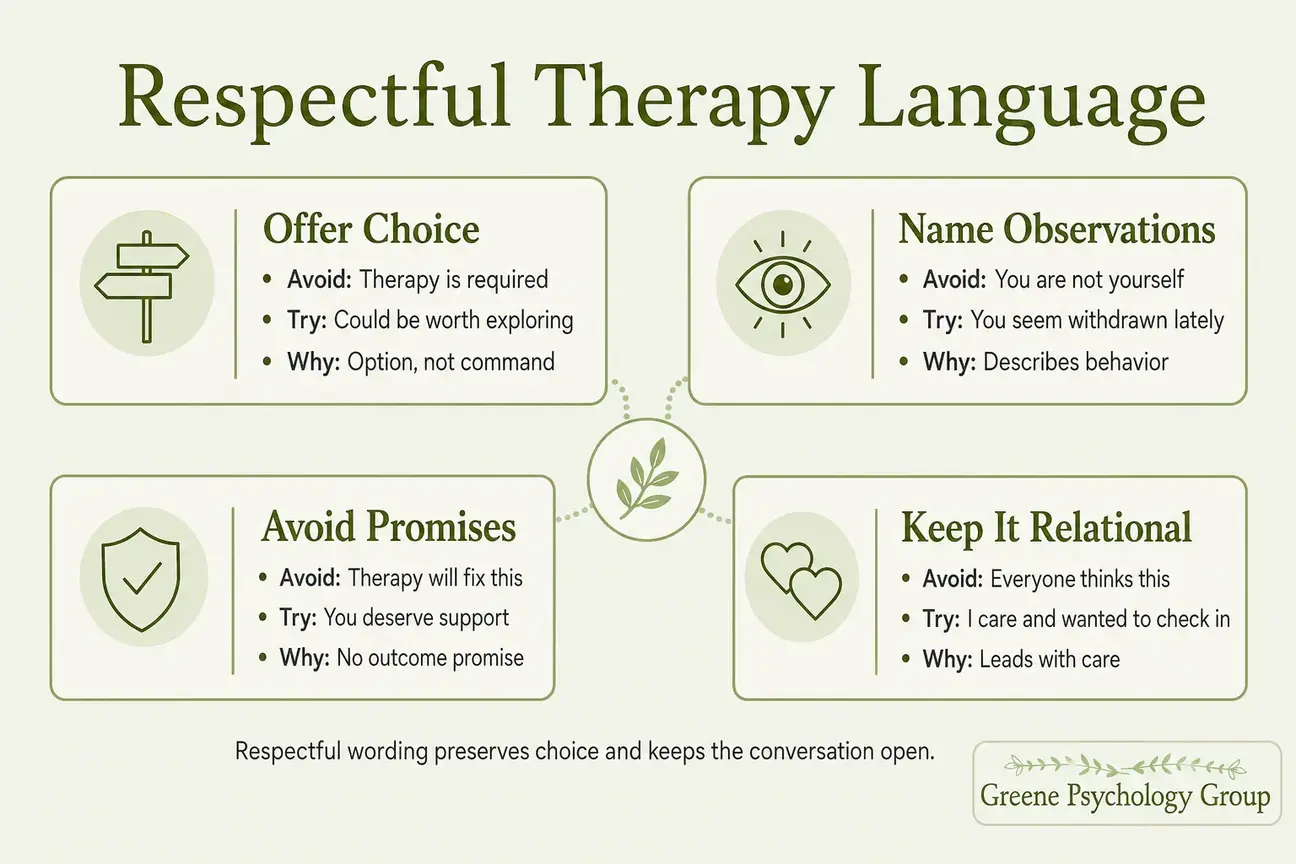
The words you choose matter. Some phrases invite conversation; others can sound like a verdict. When you talk about therapy, use language that preserves choice and avoids certainty that no one can promise.
| Instead of saying | Try saying | Why it may land better |
|---|---|---|
| “Therapy is required.” | “I wonder if therapy could be worth exploring.” | It offers an option rather than a command. |
| “You are not yourself.” | “I’ve noticed you seem more withdrawn lately.” | It describes behavior without defining the person. |
| “Therapy will fix this.” | “You deserve support with this.” | It avoids promising an outcome. |
| “Everyone thinks there is a problem.” | “I care about you, and I wanted to check in.” | It keeps the conversation relational rather than shaming. |
| “If this family mattered, therapy would happen.” | “I want us to find healthier ways to handle this.” | It names the shared impact without using love as leverage. |
It can also help to connect therapy to the person’s own goals. Someone who rejects the phrase “mental health” may still want better sleep, less conflict, more patience with a child, help with grief, or a place to think through a life transition. The goal is not to force the person to adopt your explanation. The goal is to ask what kind of support would feel acceptable.
If the person is open to learning more but not ready to schedule, suggest reading about individual therapy or writing down questions for a first appointment. For some people, the unknown is a large part of the reluctance. A low-pressure way to talk about therapy is to focus on information first, not commitment.
Another way to talk about therapy is to ask what would make the idea feel safer. The answer might be privacy, cost, format, therapist fit, or simply more time. Listening to the answer can show respect, especially if the person expects to be argued with.
How should you respond when someone is therapy resistant?
The phrase therapy resistant can sound blaming, so it is usually better to think in terms of reluctance, fear, or uncertainty. A person who seems therapy resistant may have reasons that make sense from their perspective. Listening does not mean agreeing with every reason; it means trying to understand what is in the way.
When someone is therapy resistant, the first response should usually be curiosity rather than a counterargument. “What worries you most about it?” is often more useful than “That reason does not make sense.” If the person feels heard, the conversation may stay open longer.
Privacy concerns
Some people worry that therapy means their family will know everything they say. You can respond by encouraging them to ask a therapist how confidentiality works, what information is shared, and what limits apply. Do not promise a specific answer on the therapist’s behalf, and do not pressure the person to disclose session content.
Stigma or embarrassment
If someone says therapy is “for other people,” arguing may harden the position. A gentler response is, “I hear that this feels uncomfortable. I see therapy as one form of support, not a judgment about who you are.” When someone is therapy resistant because of stigma, calm normalization is often more helpful than debate.
Cost or insurance worries
Money concerns are practical, not excuses. If the person wants help, offer to look at general insurance and payment information together. Greene Psychology Group is in-network with most Blue Cross Blue Shield and Aetna plans, and people should verify benefits with both their insurer and the practice. Out-of-network and self-pay arrangements are accepted, and uninsured or self-pay clients receive a Good Faith Estimate.
Time, transportation, or format concerns
Some people are not opposed to therapy in principle; they cannot imagine fitting it into life. If they want help thinking through logistics, compare in-person and online options. Greene Psychology Group offers online therapy in North Carolina for people physically in the state at the time of the session, as well as office-based care in its listed office locations. The person seeking care should still choose the format that feels appropriate and available for them.
Previous negative experiences
A poor prior experience can make someone understandably cautious. Avoid minimizing it. You might say, “I’m sorry that happened. I can understand why that would make this hard to consider.” If they are open to it, suggest that one difficult fit does not define every therapist, while being careful not to promise that the next experience will feel better.
Fear of being judged
Some people imagine therapy as being scolded or analyzed. It may help to explain that a first contact can be used to ask basic questions. The National Institute of Mental Health describes psychotherapy as treatment through conversation with a mental-health professional and notes that different therapy approaches may be used depending on a person’s needs. That does not mean every approach fits every person; it does mean therapy is broader than a single stereotype.
Not being ready
If someone says they are not ready, respect that and leave the option open. “I hear you. I won’t keep pushing. If help looking at options ever sounds useful, I’m here.” For a person who is therapy resistant, that kind of response may preserve trust better than another round of persuasion.
It is also possible for someone to be therapy resistant today and more open later. A respectful conversation can plant a seed without demanding immediate agreement. That is often the most realistic goal.
How can you offer practical help without taking control?
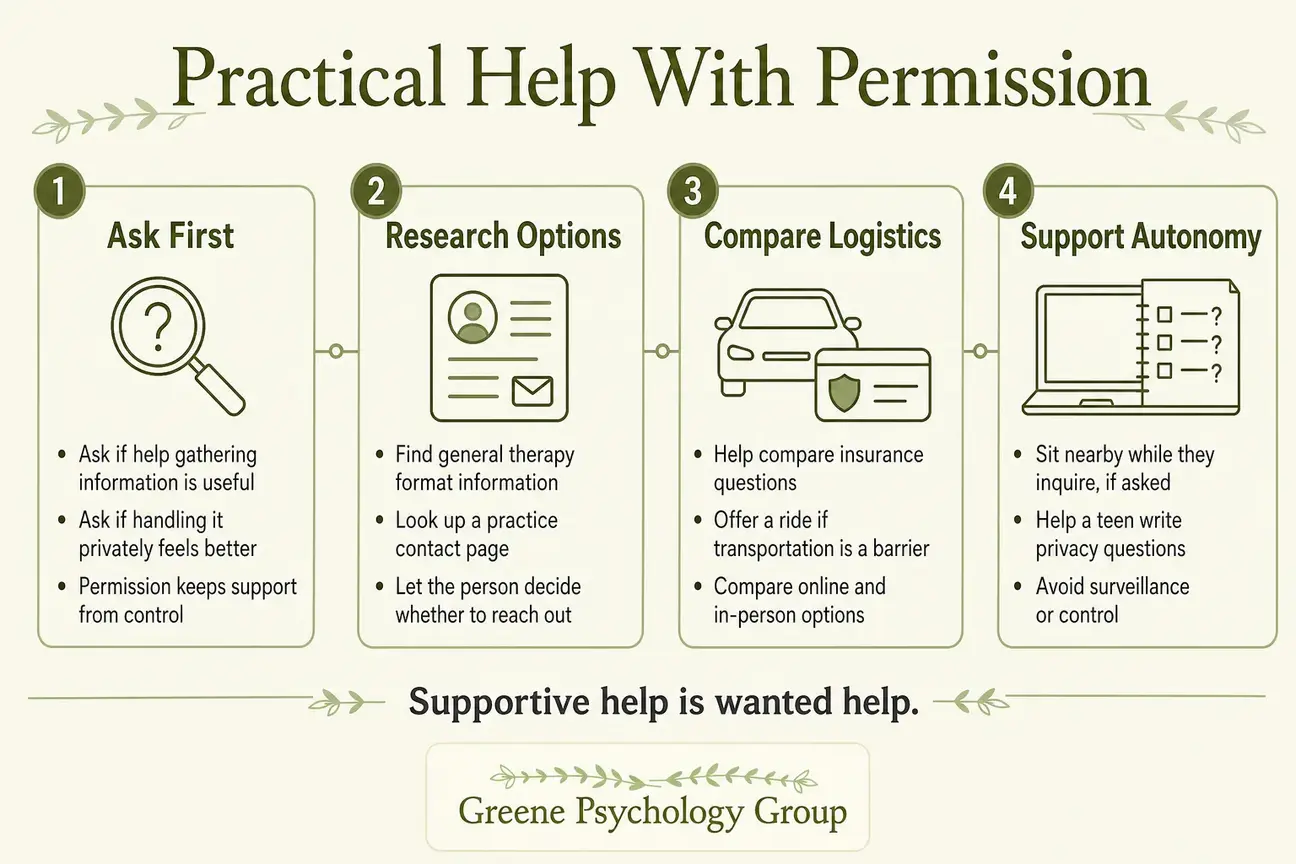
Practical help can be meaningful when it is wanted. It can also cross a line when it becomes surveillance or control. Before helping, ask: “Would it be useful if I helped gather information, or would handling it privately feel better?”
Supportive options might include:
- Finding general information about therapy formats.
- Looking up a practice’s contact page while the person decides whether to reach out.
- Helping compare insurance questions the person wants to ask.
- Offering a ride, if transportation is a barrier and the person wants help.
- Sitting nearby while the person sends an inquiry, if they ask for that support.
- Helping a teen write down questions they want to ask about privacy and parent involvement.
Less supportive behaviors include impersonating the person, demanding appointment details, reading emails or portal messages, insisting on attending sessions, or expecting a report after each appointment. Those actions may come from worry, but they can undermine trust.
If someone wants to contact Greene Psychology Group, encourage them to share only contact details and a brief reason for reaching out through the contact form or email, not detailed health information. The practice’s contact form and email are not the right place for private clinical detail. More specific information can be discussed through the practice’s intake process.
This is another place where it helps to support a loved one without taking ownership away. The person may appreciate help gathering information and still want control over what is sent, when it is sent, and whether an appointment is requested.
What should you do if the person says no?
A no is not always the end of the story, but it should end the immediate push. Arguing right away often teaches the person that therapy conversations are unsafe. A steadier response is: “I respect that. I brought it up because I care, and I’m here if support feels useful later.”
After that, return to ordinary connection. Eat dinner together. Send the normal text. Ask about the day. If every interaction becomes a treatment conversation, the relationship can start to feel like a project rather than a source of support.
You can still set boundaries. If the person’s behavior affects the household, caregiving responsibilities, finances, emotional safety, or children, it may be necessary to name what is and is not possible. Boundaries are not punishments. They are clear statements about limits.
For example, a caregiver might say, “I can help with appointments and errands on certain days, but I also need time to rest.” A partner might say, “I want to keep talking, but I am going to pause this conversation if we start yelling.” An adult child might say, “I can help gather resources, but I cannot be your only support.”
If the situation is weighing heavily on you, your own support matters too. You may benefit from a therapist, trusted friends, caregiver resources, or relationship counseling. Supporters are allowed to seek help even if the person they are worried about declines.
When family therapy support may fit the concern
Family therapy support may be worth considering when the main concern involves communication, recurring conflict, parenting stress, caregiving strain, or relationship patterns. It should be framed as shared support, not as a way to identify one person as “the problem.”
A less blaming way to raise family therapy support might be: “I wonder if it would help for us to talk with someone together about how we keep getting stuck.” This is different from, “Go so the therapist can tell you what is wrong.”
The American Psychological Association describes psychotherapy as a collaborative process that may involve individuals, couples, families, or groups. In that qualified sense, family psychotherapy can help people talk through concerns together and may be particularly helpful when the concern is relational rather than only individual.
At Greene Psychology Group, family therapy and relationship counseling are confirmed services. That does not mean family therapy support is right for every situation or every person. It may be one option when more than one person wants help understanding patterns, improving communication, or making decisions about how to relate differently.
Sometimes individual care is the better starting place. Sometimes relationship or family sessions are considered later. Sometimes both are discussed. The appropriate format depends on the concerns, the participants, and the clinician’s assessment. If the person is open to counseling but unsure where to begin, ask the practice what type of first appointment makes sense.
Family therapy support can also help supporters clarify their role. A loved one may not need someone else to solve the problem; they may need family members to show up differently, listen more clearly, or stop participating in a repeated pattern. That kind of work requires humility from everyone involved.
It is important not to use family therapy support as a threat. “We need help communicating” is different from “A therapist will prove my point.” Shared counseling works best when the goal is understanding and change, not winning.
How should parents talk with an adolescent about therapy?
Parents often carry a special kind of worry. Changes in mood, school, sleep, friendships, conflict, motivation, or stress can raise questions about when to bring up counseling. Start with curiosity and specific observations rather than conclusions. “I’ve noticed you seem more overwhelmed after school lately” is usually more approachable than “Your mental health is being ignored.”
The National Institute of Mental Health’s child and adolescent mental health information encourages young people to talk to a parent, school counselor, or health care provider when they need help, and points families toward resources for starting those conversations. For parents, this supports an approach that invites communication rather than using therapy as a punishment.
You might say: “Everything does not need to be decided today. Would learning what therapy is like and asking questions about privacy feel okay?” This gives the teen some room to participate instead of feeling sent away to be corrected.
Offer choices where choices are available. A teen may not control every practical detail, but they may be able to share whether they would prefer to ask questions first, whether parent involvement feels stressful, or what they hope would be different. If appropriate, parents can also read about what to expect in your first session so the first contact feels less mysterious.
Do not promise a teenager total privacy, and do not threaten that the therapist will tell a parent everything. Instead, ask the practice directly:
- Who participates in the first contact and intake?
- What information may be shared with a parent or guardian?
- What information is private?
- How are safety concerns handled?
- How does the practice explain consent and confidentiality before treatment begins?
- How can parents be supportive without taking over?
These are questions for the practice, not legal conclusions. Parents and teens should ask Greene Psychology Group how consent, confidentiality, parent involvement, and safety-related communication are handled for adolescent therapy.
Parents can also talk about therapy as one possible support, not a consequence. A teen who feels blamed may become more guarded. A teen who hears, “We want more support around this,” may have more room to ask questions.
How can family members support someone after therapy begins?
When someone agrees to therapy, it can be tempting to feel relieved and then immediately ask for details. Try to resist making therapy another place where the person has to manage someone else’s anxiety. A better first question is, “How would support around this feel most helpful?”
Some people want reminders or transportation. Some want privacy. Some want to talk generally about what they are learning without sharing session details. Some do not want therapy discussed unless they bring it up. Respecting those preferences can help the person feel ownership of their care.
Do not treat therapy as proof that the person is now “better” or as a deadline for change. Therapy may involve learning, reflection, skills practice, emotional work, and decisions over time. It is not a switch that someone flips to become easier for everyone else.
If relationship patterns are part of the concern, ask whether family or relationship sessions are something the person and clinician want to consider. Do not assume. Family therapy support is most respectful when it is collaborative and when the goals are clear to everyone participating.
You can also support a loved one by paying attention to your own behavior. Are questions being asked because the person wants support, or because reassurance feels needed? Is privacy being respected, or is progress being monitored? Is encouragement helping, or are responsibilities being taken over? These questions can help keep support from becoming control.
It may also help to keep everyday connection alive. Therapy does not need to become the only topic. Shared meals, ordinary texts, walks, errands, humor, and quiet presence can all communicate care without turning every interaction into a check-in.
How can someone contact Greene Psychology Group?
If the person is open to learning more, they can contact Greene Psychology Group through the contact page. A brief inquiry can include a short reason for reaching out, whether they prefer Raleigh, Asheville, or online sessions, and insurance information. Because the contact form and email are not appropriate for detailed health information, keep the message brief and save private clinical details for the intake process.
Greene Psychology Group lists both phone and email contact options: 919-205-5339 and [email protected]. Because phone functioning can vary, using phone and email together may be helpful. Do not imply urgency in an ordinary appointment request if the situation is actually a crisis.
The practice is in-network with most Blue Cross Blue Shield and Aetna plans. People should verify benefits with both their insurer and the practice before assuming coverage. Out-of-network and self-pay arrangements are accepted, and uninsured or self-pay clients receive a Good Faith Estimate. No one should send detailed personal health information through the contact form or email.
If the goal is to support a loved one, it may be best to share the contact information and then step back. The person can decide whether to reach out, what to say, and what kind of appointment to request.
When is this more than an ordinary conversation about therapy?
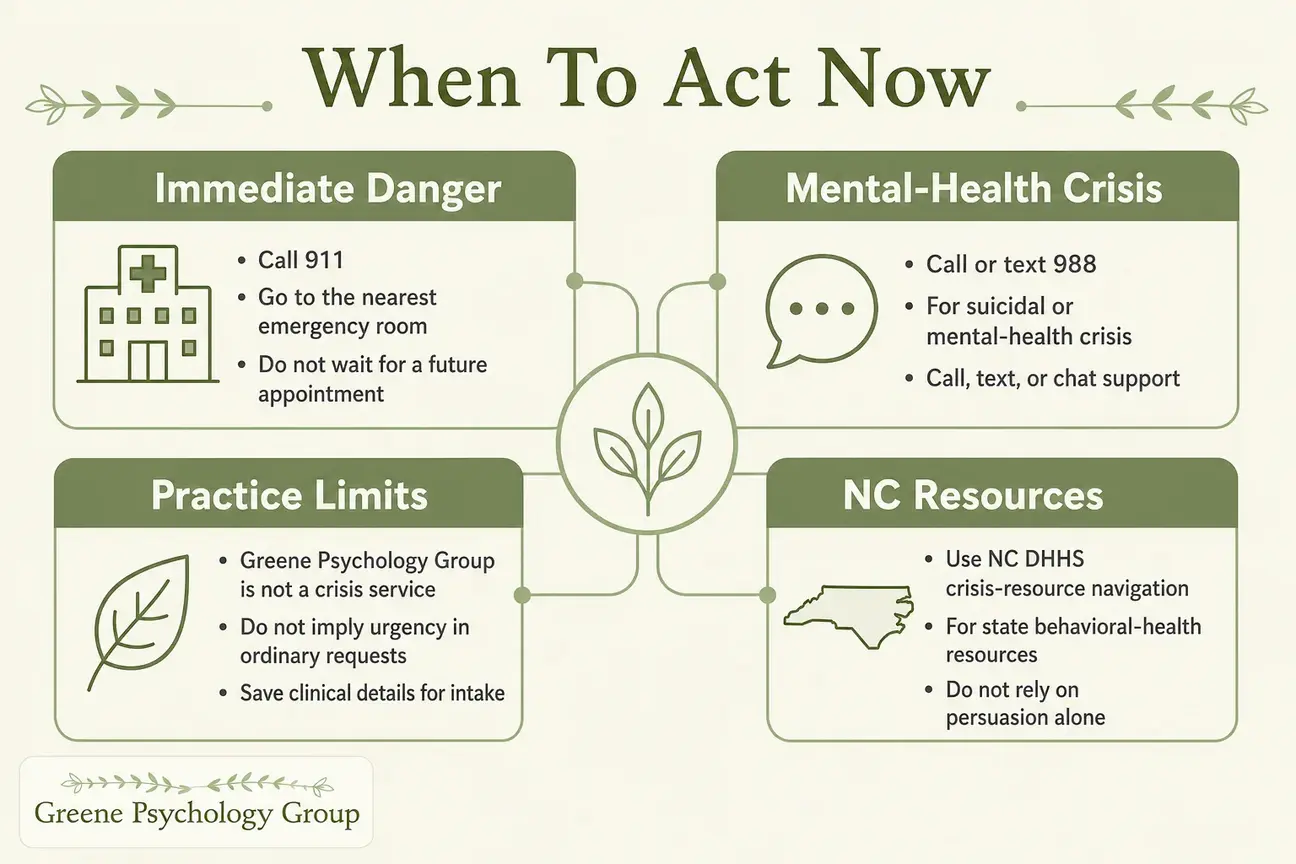
Some situations should not wait for a future therapy appointment. If someone is in immediate danger, call 911 or go to the nearest emergency room. If there is a mental-health or suicidal crisis, call or text 988. Greene Psychology Group is not a crisis service.
The Substance Abuse and Mental Health Services Administration explains 988 as a way to call, text, or chat for support during suicidal, mental-health, or substance-use-related crisis. North Carolina residents can also use the NC DHHS Division of Mental Health, Developmental Disabilities and Substance Use Services page for state behavioral-health and crisis-resource navigation.
Try not to handle crisis concerns by persuasion alone. A therapy conversation is appropriate when there is time, privacy, and enough stability to talk. Crisis response is different: it is about immediate safety and connection to urgent support.
If a conversation shifts from “Should we talk about therapy?” to “Is someone safe right now?” pause the ordinary discussion. Focus on immediate support, emergency care when needed, and crisis resources.
A final word on care, choice, and boundaries
It takes courage to raise therapy with someone you love. It also takes restraint. The most respectful way to encourage someone to try therapy is to stay grounded in care, speak from observation, listen to reluctance, offer help without taking control, and accept that the person may need time.
If you are the supporter, your wellbeing matters too. Compassion does not require becoming the only source of stability. It is possible to leave the door open without abandoning personal boundaries. It is possible to keep caring even when the person is not ready for the kind of help you hoped they would accept.
To talk about therapy with respect is to make room for choice. To support a loved one well is to offer steadiness without control. When someone is therapy resistant, patience and boundaries can protect the relationship. When the concern involves the whole household, family therapy support may be one option to consider.
This article is for general education and isn't a substitute for diagnosis or treatment from a licensed professional. If you are in crisis, call or text 988 or call 911.
For immediate danger, call 911 or go to the nearest emergency room. For a mental-health or suicidal crisis, call or text 988.
Frequently Asked Questions
How do you encourage someone to try therapy without making them defensive?
Use observations, concern, and an invitation rather than a diagnosis or demand. For example, name what was noticed, say why it matters, and ask whether they would consider talking with someone. Keep the person’s choice at the center.
What should you say when a loved one refuses therapy?
Acknowledge the decision and avoid arguing in the moment. You might say, “I respect that. I brought it up because I care, and I’m here if support feels useful later.” If safety becomes urgent, shift to crisis or emergency support rather than continuing a debate.
Can you make an adult family member go to therapy?
In ordinary outpatient situations, family members can express concern, offer options, and set their own boundaries, but they should not take over an adult’s private treatment decisions. A willing, collaborative start is generally more respectful than coercion.
How can you support someone who is therapy resistant?
Ask what is behind the reluctance. Common concerns include privacy, cost, scheduling, stigma, fear of judgment, or a previous difficult therapy experience. Offer practical help only with permission and avoid promising that therapy will produce a specific outcome.
Should I suggest family therapy or individual therapy?
It depends on the concern and what the person is willing to consider. Individual therapy focuses on the client’s own concerns, while family or relationship counseling may fit when communication, conflict, caregiving, parenting, or relationship patterns are central.
What should parents ask about therapy for a teenager?
Parents should ask the practice who participates in intake, how consent and confidentiality are explained, what may be shared with a parent or guardian, how safety concerns are handled, and how parents can support therapy without taking over.
When should I call 988 instead of continuing the conversation?
Call or text 988 for a mental-health or suicidal crisis or significant emotional distress. If someone is in immediate danger, call 911 or go to the nearest emergency room. Do not rely on a future therapy appointment for urgent safety needs.
Sources
- American Psychological Association: Understanding psychotherapy
- National Institute of Mental Health: Psychotherapies
- National Institute of Mental Health: Child and Adolescent Mental Health
- Substance Abuse and Mental Health Services Administration: 988 Suicide and Crisis Lifeline
- NC DHHS: Division of Mental Health, Developmental Disabilities and Substance Use Services