

First Therapy Session in NC: 7 Practical Basics to Expect
Quick answer: A first therapy session is usually a calm, structured conversation about what brought you in, what you hope will change, and what support might fit. You can expect a therapy intake process, new client forms, confidentiality basics, and space for your own therapy questions. There is no need to explain everything perfectly, and you can let the therapist know if you feel nervous, unsure where to start, or need a slower pace.
Many people feel a mix of relief and anxiety before starting therapy. You may be ready to talk, but still wonder: Will I be judged? What if I cry? What if I do not know what my goals are yet? Those are normal concerns. The first appointment is not a test. It is a starting point for understanding what has been happening, what feels hard right now, and what kind of working relationship may help you feel safe enough to talk honestly over time.
Greene Psychology Group offers individual therapy for adults and adolescents, and this guide explains the first appointment in plain language. Exact details can vary by therapist, practice policies, and the type of care you are seeking, but the broad purpose is usually the same: to begin building trust, gather relevant background, discuss privacy and paperwork, and decide together what therapy might focus on next.
Quick map of what the first appointment usually covers
It may help to think of the first visit as a beginning conversation rather than a full answer. The therapist is learning about you, and you are also learning whether the therapist’s style, pace, and approach feel workable. The American Psychological Association describes psychotherapy as a collaborative process that can involve talking about thoughts, feelings, behaviors, and goals. That collaborative tone often starts in the first meeting.
A first appointment may include:
- Reviewing intake paperwork, consent forms, payment or insurance details, and privacy information.
- Talking about why you are seeking therapy now, even if the answer is not fully clear yet.
- Discussing current stressors, symptoms, relationships, family context, work or school concerns, health background, or past therapy experience when relevant.
- Learning confidentiality basics, including how the practice explains privacy and its limits in intake paperwork.
- Beginning to identify goals, priorities, or patterns you want to understand.
- Leaving time for therapy questions, including what future sessions may feel like.
The therapist may not cover every topic in one appointment. In many cases, understanding someone’s full situation takes more than one conversation. If you leave with a few follow-up questions, that does not mean the session went badly. It often means the work has started.
7 first therapy session basics to expect
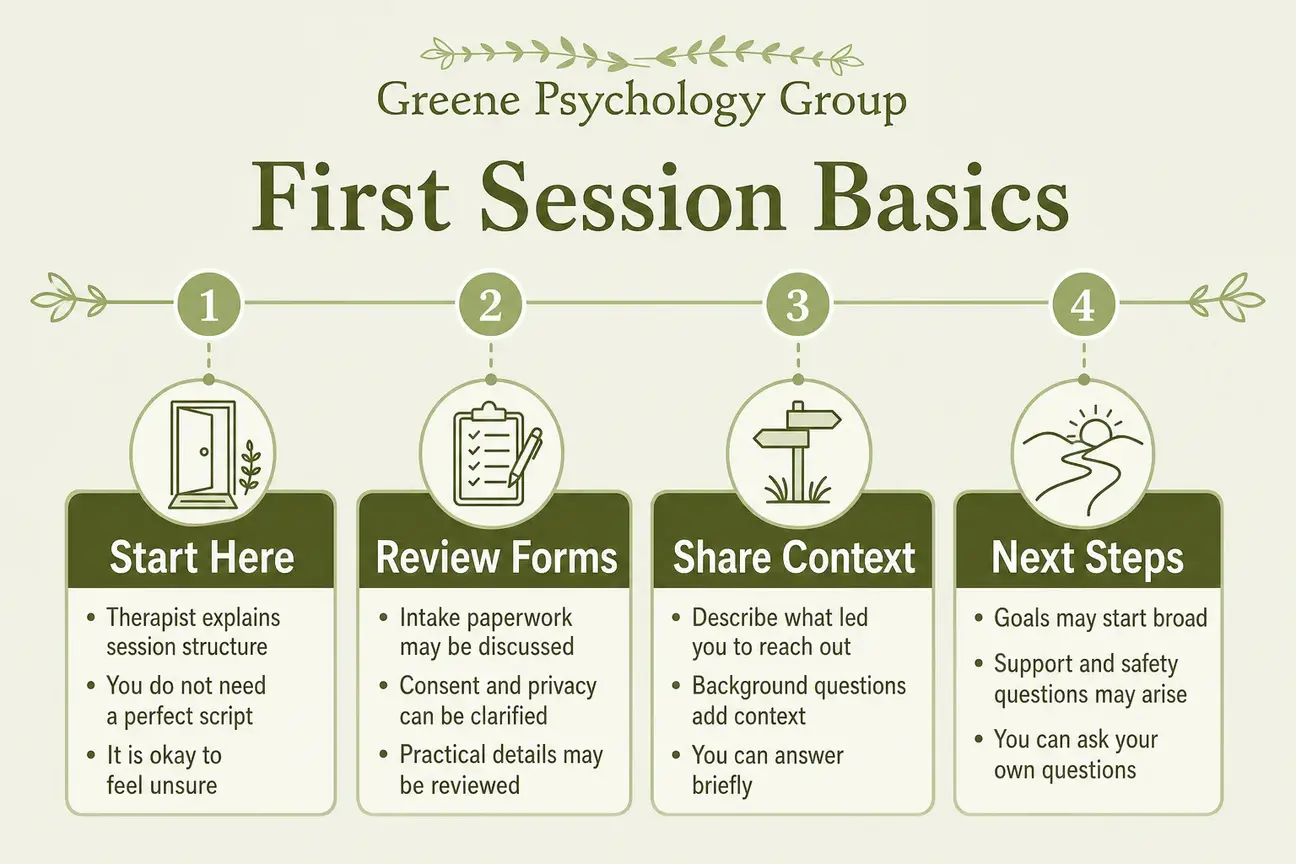
Although every therapist has a slightly different style, most first appointments include several predictable parts. Seeing the structure ahead of time can make the unknown feel less intimidating. These basics are not meant to pressure you to prepare a perfect script. They are simply a preview.
1. A welcome and orientation
The therapist may begin by explaining how the session will be structured, how long you will meet, and what topics are commonly covered first. This opening can also include a brief reminder that you do not have to know exactly where to begin. If you feel anxious, blank, or unsure, you can say that directly.
2. Paperwork review
The first meeting may include questions about new client forms, consent documents, privacy practices, and practical information. If a form was confusing or you signed something quickly, it is appropriate to ask for clarification. Paperwork is part of informed care, not a formality you are expected to understand without explanation.
3. Your reason for reaching out
You can describe what has been going on in your own words. Some people begin with a recent event. Others start with a pattern that has been building for months or years. A polished explanation is not required. “I am overwhelmed and not sure what else to do” is enough to begin.
4. Background and context
The therapist may ask about relationships, work, school, family, coping, health, past therapy, or recent changes. These questions help place current concerns in context. You can answer briefly, ask why a question matters, or let the therapist know if a topic feels too difficult to discuss right away.
5. Safety and support questions
Therapists often ask about distress, risk, support systems, and whether a different level of help is needed. These questions can feel direct, but they are part of responsible care. They help the therapist understand whether outpatient therapy is appropriate or whether another resource may be needed.
6. Goals and next steps
You may talk about what therapy could help with and what feels most important first. Goals can be specific, such as coping with panic or improving communication, or broad, such as understanding why life feels unmanageable. Goals can also change as therapy continues.
7. Your questions
The first meeting is also your chance to ask about approach, confidentiality, frequency, insurance, online care, and what to expect after intake. If you are unsure how to answer a therapist’s question, it is okay to say, “I do not know yet,” or “I need a minute to think.”
Therapy intake: why the first conversation is different from later sessions
A therapy intake is the information-gathering part of beginning care. It helps the therapist understand what is bringing you in, what has helped or not helped before, and whether outpatient therapy seems appropriate for your needs. The intake process can feel more structured than later sessions because the therapist is gathering a broad picture.
During therapy intake, you may be asked about present concerns and relevant history. That might include anxiety, depression, stress, grief, trauma history, attention concerns, relationship strain, parenting stress, major life changes, or other experiences that affect daily life. A licensed clinician may ask follow-up questions to understand patterns, severity, timing, and context. This is not about labeling you based on one conversation. Diagnosis, when appropriate, comes from a licensed clinician’s assessment, not from a checklist completed alone.
For some clients, therapy intake feels like telling a long story. For others, it feels like answering small questions because the bigger story is hard to organize. You can tell the therapist if structure would help, if a question feels hard to answer, or if starting with the present feels easier than beginning with the past.
A therapist may also ask what made you decide to schedule now. Sometimes the answer is a recent conflict, panic, burnout, grief, a relationship strain, school stress for a teen, or a sense that old coping strategies no longer work well. Sometimes there is no single event. Therapy intake can help connect the dots gradually.
Because therapy intake is broader than later sessions, you may not leave with a complete plan after one appointment. Instead, you may leave with an initial shared understanding: what you are hoping for, what needs more assessment, and what the next few sessions may explore.
New client forms and what they are usually for
New client forms are part of starting therapy because they help a practice gather practical, clinical, privacy, and consent information before or during the first appointment. Greene Psychology Group has a page for new client forms, and clients may be asked to complete practice-specific documents as part of the intake process.
While exact paperwork varies, new client forms often ask for basic identifying information, contact details, emergency contact information, insurance or payment information, current concerns, relevant medical or mental-health history, and consent to treatment. There may also be documents describing privacy practices, communication policies, and financial responsibilities.
It is reasonable to read new client forms carefully and bring questions to the first appointment. If something is unclear, you can ask what a form means before signing. You can also ask how records are handled, what information is shared with insurance when insurance is used, and how the practice explains confidentiality basics in its own intake paperwork.
If you are a parent seeking therapy for a teen, new client forms may include parent or guardian information and policies related to adolescent care. Parents and teens should ask the practice directly about consent, participation, and confidentiality for teens. It is better to ask early than to assume how information will be shared.
New client forms can feel formal, but they serve a practical purpose: they make sure therapy begins with shared expectations. They also give the therapist information that may be hard to gather fully in a single conversation. If forms ask about difficult topics, you can still discuss how much detail feels manageable in session.
Confidentiality basics without legal overwhelm
Confidentiality basics are usually discussed near the beginning of therapy because privacy is central to feeling safe enough to talk. In general, therapy is private health care, and therapists are expected to protect client information according to applicable laws, ethics, and practice policies. The U.S. Department of Health and Human Services explains HIPAA privacy rights for individuals, including rights related to protected health information.
At the same time, confidentiality is not unlimited. The practice’s own confidentiality limits and privacy practices are explained in intake paperwork. A therapist can review those policies with you and answer questions about what they mean in everyday terms. This article is not legal advice, and it cannot tell you how privacy rules apply to every situation. It can, however, reassure you that asking privacy questions is normal and appropriate.
Confidentiality basics may include how records are kept, how the practice communicates with clients, what happens when insurance is billed, and when information might need to be shared under law or policy. If you are using insurance, you can ask what information is typically submitted for claims. If you are attending with a partner, family member, or teen, you can ask how privacy works in that therapy format.
It is also wise to think about privacy before the appointment. For online sessions, choose a private location where conversations are not likely to be overheard. For in-person sessions, consider whether time after the appointment would help before returning to work, school pickup, or family responsibilities. Privacy is not only paperwork; it is also the practical space around the session.
If hesitation comes from uncertainty about privacy, say that first. A simple statement like, “Before I talk about this, can you explain how confidentiality works?” is completely appropriate.
Therapy questions your therapist may ask you
Therapy questions are not meant to interrogate you. They help the therapist understand your experience in context. Some questions may be practical, while others may invite reflection. You can answer briefly, ask for clarification, or say that you are not ready to discuss something yet.
Common therapy questions may include:
- What made you decide to reach out now?
- What has been feeling hardest recently?
- How are these concerns affecting sleep, work, school, relationships, parenting, or daily routines?
- Has therapy been part of your life before? If so, what felt helpful or unhelpful?
- What helps you cope when things feel difficult?
- Who is supportive in your life right now?
- Are there patterns you notice in thoughts, emotions, behavior, or relationships?
- What would you like to be different, even in a small way?
Some therapy questions may focus on safety, distress, or whether a level of support beyond outpatient therapy is needed. These questions can feel direct, but they are part of responsible care. Answering them honestly helps the therapist understand how to support you and whether another resource is needed.
Therapy questions may also depend on why you are coming in. Someone seeking support for panic may be asked different follow-ups than someone grieving a loss, trying to navigate a relationship, or parenting a teen. A person coming for stress may talk about workload, boundaries, and physical tension. A person coming for depression may talk about mood, energy, interest, sleep, and daily functioning. None of these questions by themselves diagnose you; they are pieces of a larger clinical picture.
You can also bring your own therapy questions. Many people want to know: How active will the therapist be? Will there be homework? What if I cry? What if I disagree with something? How will we know whether therapy is helping? What happens if it does not feel like a good fit? These are useful questions, not rude ones.
How goals are discussed when you are not sure what is needed
Not everyone enters therapy with a clear goal. Some people know exactly what they want to work on: fewer panic episodes, less conflict, more confidence setting boundaries, support through grief, or better coping with work stress. Others only know that they feel stuck, overwhelmed, numb, irritable, or unlike themselves.
In a first appointment, goal-setting may begin with broad language. You might say, “I want to understand why I keep shutting down,” or “I want to stop avoiding difficult conversations,” or “I want to feel less controlled by anxiety.” The therapist may help translate those concerns into practical goals over time.
Goals can also change. A person may begin therapy because of stress at work and later realize that perfectionism, grief, family roles, or relationship patterns are part of the picture. A teen may start therapy because of school stress, while parents may later learn that sleep, social pressure, or emotion regulation also need attention. Therapy intake helps identify the first focus, but it does not lock anyone into one topic forever.
A therapist may ask what would make therapy feel worthwhile. That does not mean promising a result or a timeline. It means naming what matters to you. For one person, progress might mean responding to conflict with more clarity. For another, it might mean understanding depression symptoms and asking for support earlier. For someone else, it might mean learning coping skills that make daily stress more manageable.
It is okay if the first goal is simply, “I want a place to talk and figure out what is going on.” That is a valid starting point.
What to bring and what to think about before the appointment

You do not need to prepare extensively for therapy to be useful. Still, a little reflection can make the first appointment feel less overwhelming. If writing things down helps, consider bringing a short note. If writing increases pressure, skip it.
Helpful things to bring or consider include:
- A brief description of what led you to schedule.
- Any new client forms requested by the practice, if they were not submitted already.
- Your insurance card or relevant payment information, if applicable.
- A list of current health providers or past therapy experiences, if they seem relevant.
- Questions about confidentiality basics, insurance, scheduling, or therapist approach.
- A few examples of situations that have been difficult recently.
- For online sessions, a private space, stable internet connection, and a charged device.
If you are supporting someone else, such as a partner, family member, or teen, it can help to ask what they want from the appointment rather than preparing a full explanation on their behalf. For adolescents, parents can share concerns, but therapy also needs room for the teen’s perspective. Ask the practice how parent involvement is handled.
You may also want to think about pacing. Some people share a lot in the first session and feel relieved. Others share a little and need time. Neither approach is wrong. If becoming emotional is a worry, bring water, tissues, or a grounding object. If returning to work afterward, consider leaving a small buffer when possible.
Before the appointment, try not to judge whether the concern is “serious enough.” Therapy can be appropriate for many concerns, including anxiety, depression, stress, relationship difficulty, grief, life transitions, parenting strain, trauma history, identity questions, and feeling stuck. A licensed clinician can help assess what kind of support fits.
Choosing an office visit or online therapy in the state

Some people feel most comfortable meeting face-to-face; others prefer the convenience or privacy of teletherapy. Greene Psychology Group has offices in Raleigh and Asheville and offers online therapy in North Carolina for people who are physically in the state at the time of the session. Online therapy is not the right fit for every situation, but it can be a practical option for many clients.
When deciding between in-person and online care, consider privacy, schedule, transportation, comfort with technology, and whether a quiet place to talk is available. The HHS telehealth patient guidance notes practical preparation steps such as checking technology and finding a private place for the visit. You can also ask whether certain concerns, preferences, or clinical needs make one format more appropriate than another. A first appointment can include this discussion.
| Consideration | In-person therapy | Online therapy |
|---|---|---|
| Privacy | A dedicated therapy office is available, but travel time before and after may matter. | A private location is needed so others cannot overhear. |
| Logistics | Works well if travel is manageable and being in the room feels preferable. | May fit better when transportation, distance, or scheduling make office visits harder. |
| Comfort | Some people feel more grounded in a physical office. | Some people feel more comfortable starting from a familiar space. |
| Technology | Less dependent on internet connection or device setup. | Requires a device, internet access, and a plan for interruptions. |
If you are unsure, you can ask during scheduling what options are available and what the first online or in-person appointment requires. Avoid assuming that every clinician, location, or format is available for every situation; ask the practice directly.
Insurance, payment, and Good Faith Estimate basics
Practical questions matter. Cost, insurance, and paperwork can affect whether therapy feels accessible. Greene Psychology Group is in network with most BCBS and Aetna plans. Clients should verify benefits with their insurer and the practice, because coverage, deductibles, copays, and plan rules can vary. Out-of-network and self-pay arrangements may also be options, and you can review insurance and payment information before scheduling.
If you are uninsured or self-pay, you may receive information about a Good Faith Estimate. This article does not quote fees or promise coverage. The safest step is to ask the practice and your insurer for current details that apply to your situation.
Insurance may also intersect with privacy. When insurance is used, certain information may be involved in billing or claims. If that concerns you, bring it up during intake. You can ask what information is generally required and how the practice handles privacy and billing communication.
For the first appointment, bring your insurance information if you plan to use insurance. If plan acceptance is unclear, ask before the first visit when possible. If using out-of-network benefits, ask your insurer what documentation is needed for reimbursement.
How to contact the practice without oversharing by email or form
When you first reach out, keep the message brief. You do not need to send a full mental-health history through a contact form or email. Because the practice’s contact form and email are unencrypted, share only basic contact details and a short reason for reaching out.
A simple message might include:
- Your name and preferred way to be contacted.
- Whether you are seeking adult therapy, adolescent therapy, or support for a relationship or family concern.
- A brief reason, such as anxiety, depression, stress, grief, life transition, parenting concern, or relationship strain.
- Whether an office visit or online sessions would be preferred.
- Your insurance plan name, if you want the practice to help check fit with its billing process.
You can contact Greene Psychology Group, call 919-205-5339, or email [email protected]. Because phone service may not always work properly, include email as an option. Do not include detailed health information in an email or contact form; save sensitive details for the appropriate intake process or appointment.
This low-detail first message is enough to start. You can say, “I am looking for therapy for anxiety and stress, prefer online if available, and have Aetna,” or “I am a parent seeking therapy for my teen and would like to understand confidentiality and scheduling.” The details can come later in a safer setting.
Understanding clinician licenses and fit
It is reasonable to ask about a therapist’s license, training, and general approach. At Greene Psychology Group, clinicians may include a licensed psychologist, licensed clinical mental health counselors, licensed clinical social workers, and licensed clinical social worker associates. Each clinician works within the scope of their license, supervision status when applicable, training, and role in the practice.
A licensed psychologist has doctoral-level training and a psychology license. In the state, psychologist licensure is overseen by the North Carolina Psychology Board. A licensed clinical mental health counselor, or LCMHC, is licensed to provide mental-health counseling services within the scope of that license; LCMHC licensure information is provided by the North Carolina Board for Licensed Clinical Mental Health Counselors.
An LCSW is a licensed clinical social worker. In general terms, this license indicates that the clinician has met requirements to provide clinical social work services independently within the scope of the license. An LCSWA is a licensed clinical social worker associate. In general terms, an associate license indicates that the clinician is practicing clinical social work while completing supervised experience or supervision requirements toward full clinical licensure. Because social work licensing details can change and depend on current board rules, ask the practice or the clinician directly if you have questions about a specific provider’s supervision status or scope.
Fit is not only credentials. It also includes whether you feel respected, whether the therapist explains things clearly, whether the pace feels tolerable, and whether the therapist’s approach matches your concerns. Some therapists are more structured and skills-focused; others are more exploratory, relational, or insight-oriented. Many integrate more than one approach.
If instant comfort is absent in the first appointment, that does not automatically mean therapy cannot work. Trust often takes time. At the same time, you are allowed to notice whether you feel dismissed, rushed, or unable to ask questions. Therapy should make room for feedback.
Therapy questions to ask before you leave the first appointment
Near the end of the first session, you may be thinking about what comes next. If the therapist does not answer all of these automatically, you can ask. Bringing therapy questions can help you leave with a clearer sense of direction.
Consider asking:
- What do you see as the first priorities based on what I shared?
- What kind of therapy approach might you use, and why?
- How will we discuss goals and progress?
- What should I do if I feel stuck or unsure between sessions?
- How do you handle confidentiality basics, records, and communication?
- What should I know about scheduling, cancellations, insurance, or payment policies?
- If this does not feel like the right fit, how should I bring that up?
These therapy questions are not about evaluating the therapist as if taking notes in an interview. They are about informed participation. Therapy is more effective when clients can ask, clarify, and collaborate rather than silently wonder what is happening.
If you are starting therapy after a long period of trying to manage alone, it may feel strange to ask for what is needed. Start small. “Can we slow down?” “Can you explain that?” “Can we talk about goals next time?” Those are all useful ways to participate in the process.
What if you feel nervous, blank, or emotional?
Feeling nervous before the first appointment is common. Some people rehearse what they will say and then go blank. Some cry sooner than expected. Some laugh when they feel uncomfortable. Some feel detached or overly practical because that is how they cope. A therapist is used to people arriving with different emotional styles.
If you go blank, say so. The therapist can ask smaller questions or help you start with the present moment. If tears come, apologizing is not necessary. If embarrassment shows up, naming that can help too. Therapy does not require anyone to perform calmness.
You also do not need to share everything at once. If there are painful experiences, trauma, grief, family conflict, self-harm history, or other sensitive topics, the first appointment may simply identify that those topics exist. Detailed trauma processing or exposure work should not be something anyone tries to do alone after reading an article. Those conversations need appropriate clinical support and pacing.
It can be helpful to plan gentle time after the appointment. That might mean a short walk, quiet drive, cup of tea, or a few minutes before returning messages. First sessions can bring relief, but they can also stir up feelings. Give yourself permission not to analyze the whole appointment immediately.
When the first appointment suggests a different level of care
Outpatient therapy can be helpful for many concerns, but it is not the right level of care for every situation. During intake, a therapist may ask about safety, crisis concerns, substance use, eating patterns, psychosis symptoms, severe functional impairment, or other issues that might require additional or more intensive support. These questions are part of responsible assessment.
If a therapist believes another level of care may be more appropriate, that does not mean anything was done wrong. It means the current needs may require support that is more immediate, specialized, or intensive than weekly outpatient therapy can provide. Greene Psychology Group does not provide emergency or crisis services, medication prescribing, inpatient care, residential treatment, or intensive outpatient programs.
If medication questions come up, a therapist may suggest discussing them with a prescriber. Therapy practices that do not prescribe medication can still coordinate with other providers when appropriate and with proper consent, but medication decisions belong with qualified prescribing professionals.
If safety feels uncertain before a scheduled appointment, do not wait for a therapy intake. Use crisis resources or emergency care as needed. Therapy can be part of support, but it is not a substitute for immediate help in a crisis.
A calm way to prepare before you schedule
If you are still deciding whether to start therapy, try narrowing preparation to three simple tasks. First, write one sentence about why therapy is under consideration now. Second, write two or three therapy questions that need answers. Third, gather practical details such as insurance information, preferred format, and any new client forms requested by the practice.
You can also read about what to expect in your first session and review practice information before reaching out. If anxiety makes scheduling difficult, keep the message short rather than trying to explain everything. The purpose of the first contact is not to tell a whole story; it is to open the door to the intake process.
If you decide to reach out, you can request an appointment through the practice’s contact page, call 919-205-5339, or email [email protected]. Share a brief reason for seeking therapy, whether an office or online appointment is preferred, and insurance information if relevant. Please avoid sending detailed health information through email or the form.
Final thoughts on your first therapy session
Your first therapy session is a beginning, not a final verdict on your story, your symptoms, or your future. You can arrive uncertain, emotional, skeptical, hopeful, or all of those at once. The early work is to understand what brings you in, review therapy intake information, discuss new client forms, cover confidentiality basics, and make room for your therapy questions.
It is okay if trust takes time. It is okay if goals are still forming. It is okay if the first appointment mostly helps you understand the next step. Starting therapy is often less about having the right words and more about being willing to begin a conversation in a setting designed for care, privacy, and collaboration.
This article is for general education and isn't a substitute for diagnosis or treatment from a licensed professional. If you are in crisis, call or text 988 or call 911.
Greene Psychology Group is not a crisis service. For immediate danger, call 911 or go to the nearest emergency room. For a mental-health or suicidal crisis, call or text 988.
Frequently Asked Questions
What happens at the first therapy appointment?
The first appointment usually includes intake paperwork, a discussion of what brought you to therapy, questions about relevant history and current stressors, a review of confidentiality, and an initial conversation about goals. It is also a chance for you to ask questions and get a sense of whether the therapist’s style feels like a workable fit.
Do I have to tell my therapist everything in the first session?
No. You can share at a pace that feels manageable. It is helpful to be honest about your main concerns, but every painful detail does not need to come out right away. You can tell the therapist when a topic feels important but too difficult to discuss fully in the first appointment.
What paperwork should I expect before therapy starts?
Paperwork often includes contact information, consent to treatment, privacy information, insurance or payment details, and questions about your concerns and history. Exact forms vary by practice. If a form is unclear, you can ask about it before signing or discuss it during the intake appointment.
Is the first therapy session confidential?
Therapy is generally private health care, and confidentiality should be explained early. There are limits to confidentiality under law and practice policy, and those limits should be described in intake paperwork. If you are unsure what is private, ask the therapist before sharing details that feel especially sensitive.
What should I bring to my first therapy session?
Bring any requested forms, insurance information if you plan to use insurance, and a few notes about what led you to schedule if that feels helpful. You may also want to bring questions about the therapist’s approach, privacy, online or in-person options, and what happens after intake.
How do I choose between online and in-person therapy?
Consider privacy, transportation, comfort with technology, schedule, and whether a quiet place to talk is available. Online therapy can be convenient, but it requires private space and appropriate technology. In-person therapy may feel more grounding for some people. Ask the practice what options are available for your situation.
What should I say when I contact the practice?
Keep the first message brief. Share your name, contact information, a short reason for reaching out, whether office or online sessions are preferred, and insurance information if relevant. Avoid sending detailed health information through email or the contact form; save sensitive details for intake paperwork or the appointment.