

If you are reading this, you have likely experienced a loss that has turned your world upside down. Maybe you lost a spouse, a parent, a child, or a dear friend. Maybe the loss was sudden – a heart attack, an accident, a suicide – leaving you in a state of shock. Maybe it was expected – a long illness, a slow decline – yet the grief is still overwhelming. Maybe your loss is not a death at all: a divorce, a miscarriage, a job loss, a diagnosis that changed everything.
Here is the truth that no one tells you: grief does not follow a straight line. It does not have a timeline. It does not care about your to‑do list, your job, or your family's expectations. It shows up when it wants, in ways you do not expect – as tears, as anger, as numbness, as physical pain, as a sudden wave that knocks you to your knees in the grocery store.
And here is another truth: you are not supposed to do this alone.
Greene Psychology Group offers grief and loss therapy in Raleigh, NC, using evidence‑based approaches including Complicated Grief Therapy (CGT), Cognitive Behavioral Therapy (CBT), and meaning‑centered approaches. This guide is a complete, research‑backed overview: what normal grief looks like (and what is not normal), the different types of grief, how therapy can help, and how to find the right support for your unique journey.
Part 1: What Is Grief – And What Is "Normal" Grief?
Grief is the natural, multifaceted response to loss. It affects every dimension of your being: emotional, cognitive, physical, behavioral, social, and spiritual.
The Emotional Experience of Grief
Grief is not just sadness. It is a complex tapestry of emotions that can include:
| Emotion | What It Feels Like |
|---|---|
| Sadness | Deep sorrow, crying, a heaviness in the chest |
| Anger | Rage at the person who died, at God, at the doctors, at yourself, at the world |
| Guilt | "I should have done more," "I should have been there," "I should have said..." |
| Anxiety | Fear of the future, fear of losing someone else, fear of your own mortality |
| Numbness | Feeling empty, disconnected, unable to feel anything at all |
| Relief | If the person suffered, relief that they are no longer in pain – often accompanied by guilt for feeling relief |
| Yearning | A powerful longing to see the person, hear their voice, feel their touch |
All of these are normal. There is no "right" way to grieve.
The Physical Experience of Grief
Grief is not just in your mind. It lives in your body:
Fatigue and exhaustion
Sleep disturbances (insomnia or sleeping too much)
Appetite changes (eating too little or too much)
Physical pain (headaches, chest tightness, stomachaches)
Weakened immune system (getting sick more often)
Brain fog (difficulty concentrating, forgetfulness)
Research from Harvard Medical School's Department of Psychiatry has shown that grief activates the same brain regions as physical pain. Grief hurts – literally.
The Cognitive Experience of Grief
Your thinking changes during grief:
Difficulty concentrating
Preoccupation with the person who died (thinking about them constantly)
Intrusive memories or images
Questioning your beliefs (about life, death, meaning, God)
Difficulty making decisions
The Social Experience of Grief
Grief affects your relationships:
Withdrawing from friends and family
Feeling misunderstood by people who have not experienced loss
Strain on your marriage or partnership (grieving differently)
Feeling isolated, even in a crowd
How Long Does "Normal" Grief Last?
There is no fixed timeline. However, research from Columbia University Department of Psychiatry suggests that for most people, the intensity of grief gradually decreases over 6–12 months. By 12–18 months, most people have integrated the loss into their lives – meaning they can think about the person without being overwhelmed by pain.
Important: "Integration" does not mean "getting over it." It means learning to live with the loss. The person remains important. You still miss them. But the pain is no longer all‑consuming.
Part 2: The Five Stages of Grief – And Why They Are Misunderstood
You have probably heard of the "five stages of grief" – denial, anger, bargaining, depression, acceptance – developed by Dr. Elisabeth Kübler‑Ross in 1969.
Here is what most people do not know: the five stages were originally developed for people who were dying, not for people who were grieving. Kübler‑Ross herself later said she regretted how the stages were applied to grief.
The Reality of Grief
Grief is not linear. You do not move smoothly from denial to anger to bargaining to depression to acceptance. You bounce around. You might feel acceptance one day and anger the next.
You can experience multiple stages at the same time.
Some people never experience certain stages – and that is normal.
The stages are descriptive, not prescriptive. They describe what some people experience; they do not tell you what you should experience.
A More Useful Framework: The Dual Process Model
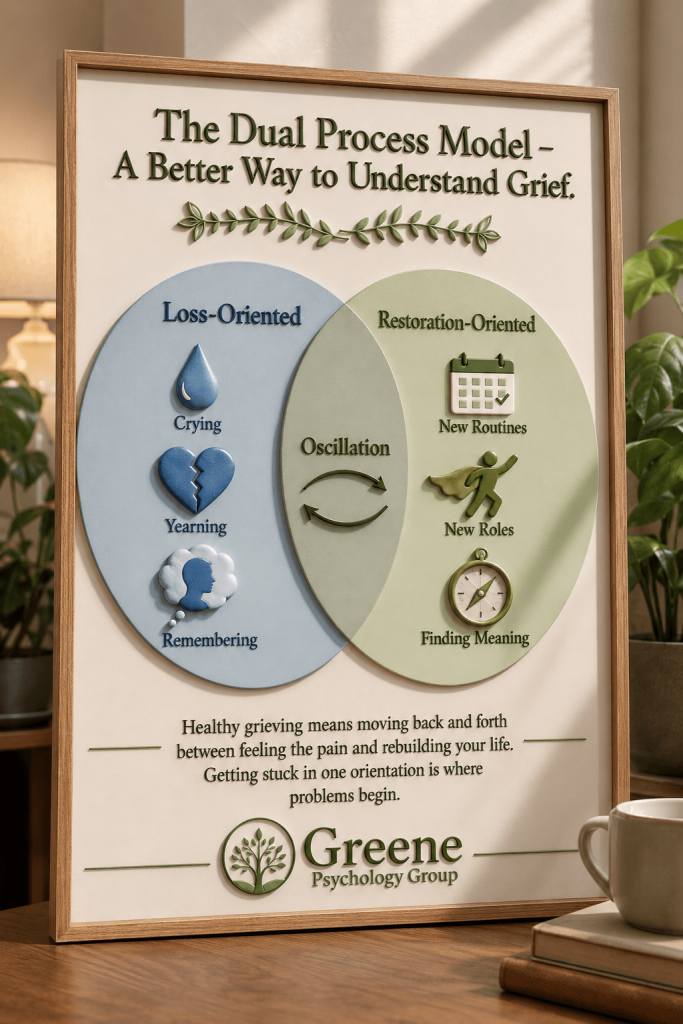
Developed by Stroebe and Schut, the Dual Process Model is more accurate and more helpful. It describes grief as a dynamic oscillation between two orientations:
| Orientation | What It Involves |
|---|---|
| Loss‑Oriented | Focusing on the loss itself: crying, yearning, remembering, feeling the pain |
| Restoration‑Oriented | Focusing on rebuilding your life: making new routines, taking on new roles, finding new meaning |
Healthy grieving involves oscillating between both. You spend some time in the pain of loss, and some time in the work of rebuilding. You are not "stuck" in one orientation. You move back and forth – and that is exactly how healing happens.
When people get "stuck," it is usually because they are stuck in one orientation:
Stuck in Loss‑Orientation: Constant rumination, inability to function, chronic depression
Stuck in Restoration‑Orientation: Avoiding grief entirely, throwing yourself into work, never processing the loss
The goal is oscillation – allowing yourself to feel the pain and take steps forward, in your own time.
Part 3: Types of Grief – Not All Grief Is the Same
Understanding the type of grief you are experiencing can help you find the right support.
| Type of Grief | Description | Common in |
|---|---|---|
| Normal (Uncomplicated) Grief | Painful but manageable. Gradually decreases over time. You can function, even though it is hard. | Most losses |
| Complicated Grief (Prolonged Grief Disorder) | Intense, persistent grief that does not improve after 12+ months. Preoccupation with the deceased, difficulty accepting the loss, avoidance of reminders, feeling life is meaningless. | ~10% of bereaved people |
| Anticipatory Grief | Grief that begins before the loss occurs – while caring for someone with a terminal illness. | Caregivers, families of terminally ill patients |
| Disenfranchised Grief | Grief that is not socially recognized or supported. | Miscarriage, pet loss, loss of an ex‑partner, loss of a friend, loss of a coworker, stillbirth, abortion |
| Traumatic Grief | Grief following a sudden, unexpected, or violent death. Often accompanied by PTSD symptoms. | Suicide, homicide, accident, overdose, sudden medical event |
| Ambiguous Loss | Loss without closure – the person is physically absent but psychologically present (missing person, dementia) OR psychologically absent but physically present (Alzheimer's, brain injury). | Dementia, missing persons, addiction |
| Cumulative Grief | Multiple losses in a short period, without time to grieve between them. | Pandemic losses, cluster deaths, multiple family members |
Complicated Grief (Prolonged Grief Disorder) – When to Seek Help
Complicated grief is diagnosed when, 12 months after the loss (6 months for children/adolescents), the person experiences:
Intense yearning or longing for the deceased
Preoccupation with thoughts or memories of the deceased
Difficulty accepting the death
Avoidance of reminders of the loss
Emotional numbness
Feeling that life is meaningless
Severe impairment in daily functioning
Complicated grief is not "grief that takes longer." It is a distinct condition that responds to specific treatment – primarily Complicated Grief Therapy (CGT) .
At Greene Psychology Group, we offer grief and loss therapy using evidence‑based approaches including CGT and CBT. Contact us for an evaluation.
Part 4: How Grief Therapy Works – Evidence‑Based Approaches
Grief therapy is not about "fixing" you or "moving on." It is about helping you integrate the loss into your life so you can move forward – not without the person, but with them in a new way.
Complicated Grief Therapy (CGT)
Developed by Dr. Katherine Shear at Columbia University, CGT is the most researched treatment for complicated grief. It is a 16‑session protocol that combines:
Psychoeducation: Understanding grief, the dual process model, and what is happening in your brain and body
Emotional processing: Working with painful emotions (anger, guilt, sadness) in a structured way
Imaginal revisiting: Telling the story of the death in a safe, controlled way – reducing avoidance
Meaning‑making: Finding ways to honor the person and integrate them into your ongoing life
Relationship restructuring: Finding a new way to relate to the person who died – not letting go of the relationship, but transforming it
Future planning: Setting goals for the future while carrying the person with you
Evidence: CGT has been tested in multiple randomized controlled trials. It produces significant improvement in 60–70% of patients with complicated grief.
Cognitive Behavioral Therapy (CBT) for Grief
CBT for grief focuses on:
Behavioral activation: Gradually re‑engaging in activities that bring pleasure or meaning
Cognitive restructuring: Challenging unhelpful beliefs ("I should have saved them," "I can never be happy again")
Exposure: Gradually approaching avoided reminders of the loss
Problem‑solving: Addressing practical challenges (finances, living arrangements, parenting alone)
Meaning‑Centered Grief Therapy
Based on the work of Dr. William Breitbart, meaning‑centered approaches help you find purpose and meaning in the wake of loss. This is especially helpful for people who feel that their life has lost all meaning after the death of a loved one.
At Greene Psychology Group, we offer CBT and mindfulness therapy as part of grief treatment, as well as referrals for specialized grief counseling.
Part 5: What a Grief Therapy Session Looks Like
If you are new to grief therapy, you might wonder what happens in a session. Here is a typical structure.
Initial Sessions (1–3)
History taking: Your therapist will ask about the loss, your relationship with the person, the circumstances of the death, and your current symptoms.
Psychoeducation: You will learn about grief, the dual process model, and what to expect.
Safety assessment: Your therapist will ask about suicidal thoughts, self‑harm, and substance use.
Goal setting: What do you hope to get from therapy? (e.g., "I want to be able to think about my husband without falling apart.")
Active Treatment Sessions (4–14)
| Time | Activity |
|---|---|
| 0–10 min | Check‑in: "How has your week been? Any grief triggers?" |
| 10–30 min | Active work: Emotional processing, imaginal revisiting (telling the story of the death), cognitive restructuring, meaning‑making |
| 30–40 min | Exploring the relationship with the deceased – memories, qualities, what you miss, what you carry forward |
| 40–45 min | Future planning: "What is one small step you could take this week to move toward restoration?" |
| 45–50 min | Summarize and assign practice: "Between sessions, try this exercise or reflection." |
Termination Sessions (15–16)
Review progress: What has changed? What remains difficult?
Relapse prevention: What will you do when grief waves hit?
Meaningful closure: How will you honor the person going forward?
Part 6: Common Myths About Grief – Debunked
| Myth | Reality |
|---|---|
| "Time heals all wounds." | Time alone does not heal. Active grieving – allowing yourself to feel, process, and integrate – is what heals. |
| "Grief has a timeline." | There is no fixed timeline. Some people take months; others take years. Both are normal. |
| "You should be 'over it' by now." | You never "get over" a significant loss. You integrate it. The person remains part of you. |
| "Crying means you are weak." | Crying is a healthy, natural release of emotion. It is a sign of strength, not weakness. |
| "If you don't cry, you are not grieving properly." | Some people grieve without tears. They may show grief through anger, numbness, or physical symptoms. |
| "You need to stay strong for others." | You can be strong and vulnerable. Letting others see your grief allows them to support you – and models healthy grieving for children. |
| "Grief only applies to death." | Grief applies to any significant loss: divorce, job loss, infertility, loss of health, loss of identity. |
Research from Duke University Department of Psychiatry shows that people who hold these myths are more likely to experience complicated grief and are less likely to seek help.
Part 7: Grief in Specific Populations
Grief in Children and Adolescents
Children grieve differently than adults. They may:
Grieve in "bursts" – play for a while, then cry, then play again
Regress (bedwetting, thumb‑sucking, clinginess)
Have trouble concentrating in school
Act out behaviorally
Worry about the safety of other loved ones
Express grief through physical symptoms (stomachaches, headaches)
What helps: Honest, age‑appropriate explanations. Reassurance that they are not to blame. Maintaining routines. Allowing them to express grief in their own way. Therapy (play therapy for younger children, CBT for older children/adolescents).
Grief in Older Adults
Older adults face unique challenges:
Cumulative losses (spouse, friends, siblings, health, independence)
Anticipatory grief about their own mortality
Social isolation (friends have died, family lives far away)
Medical conditions that complicate grief
What helps: Grief groups specifically for older adults. Individual therapy focused on meaning‑making and legacy. Home‑based therapy if mobility is limited.
Grief After Suicide
Suicide grief is uniquely complex. Survivors often experience:
Intense guilt ("I should have known," "I should have stopped them")
Shame and stigma
Anger at the person who died
Confusion and a search for answers
Trauma symptoms (intrusive images of the death)
What helps: Specialized suicide grief support groups (e.g., Survivors of Suicide Loss – SOSL). Therapy that addresses both grief and trauma.
Grief After Miscarriage or Stillbirth
This grief is often disenfranchised – not socially recognized or supported. Parents may be told to "try again" or "be grateful for what you have." They may grieve silently, without acknowledgment.
What helps: Individual or couples therapy focused on validating the loss. Support groups for pregnancy loss. Rituals to honor the baby.
At Greene Psychology Group, we offer individual therapy and family therapy for grief, and we can provide referrals for specialized grief groups.
Part 8: Grief in the Workplace – Returning to Work After Loss
Returning to work after a loss is one of the most challenging transitions. You may feel pressure to "be normal" while your world has fallen apart.
Tips for Returning to Work
Communicate with your manager: Let them know what you need – maybe a phased return, flexible hours, or permission to take breaks.
Plan for triggers: What will you do if a coworker asks, "How are you?" (You can say, "I'm managing. Thank you for asking.")
Set boundaries: It is okay to say, "I'm not ready to talk about it yet."
Use your support system: Identify one or two coworkers you can be honest with.
Take breaks: Step outside, take deep breaths, or use a 3‑minute mindfulness practice.
What Employers Can Do
Offer bereavement leave (not just 3 days – research shows 2–4 weeks is more appropriate)
Provide access to employee assistance programs (EAP) with grief counseling
Normalize grief – let employees know it is okay to not be okay
Check in regularly, without pressure
Part 9: How to Support Someone Who Is Grieving
If you are reading this to support a grieving loved one, here is what helps – and what does not.
| Helpful | Not Helpful |
|---|---|
| "I'm so sorry. I'm here for you." | "Everything happens for a reason." |
| "I don't know what to say, but I'm here." | "You should be over this by now." |
| "Would you like to talk about them?" | "Don't cry. They wouldn't want you to be sad." |
| "Can I bring you dinner on Thursday?" | "Let me know if you need anything." (Too vague) |
| "I remember when they..." (share a positive memory) | "At least they are in a better place." |
| Sitting in silence with them | Trying to "fix" their grief |
What Grieving People Actually Want
Permission to grieve in their own way and on their own timeline
Someone who will listen without trying to fix
Practical help (meals, childcare, errands)
To be remembered – acknowledgment of their loss on anniversaries and birthdays
To talk about the person who died – without people changing the subject
Part 10: Putting It All Together – Three Grief Archetypes
Archetype A: The Sudden Loss
Presentation: 42‑year‑old, husband died suddenly of a heart attack 6 months ago. No warning. No chance to say goodbye. Now struggling with insomnia, intrusive images of the death, and intense guilt ("I should have made him go to the doctor").
Bottleneck: Traumatic grief with guilt and avoidance.
Treatment map: Initial safety assessment → 16 sessions of CGT → Imaginal revisiting (telling the story of the death, reducing avoidance) → Cognitive restructuring around guilt → Meaning‑making (starting a scholarship in his name) → At 6 months, PHQ‑9 drops from 22 to 10 → Maintenance: monthly booster sessions.
Archetype B: The Anticipatory Grief (Caregiver)
Presentation: 58‑year‑old, cared for her mother with Alzheimer's for 5 years. Mother died 3 months ago. Now feels relief – and intense guilt for feeling relief. Also exhausted and unsure who she is without the caregiver role.
Bottleneck: Anticipatory grief + identity loss + guilt.
Treatment map: Individual therapy (12 sessions) focused on validating the relief, processing the complex emotions, and exploring identity post‑caregiving → Mindfulness therapy for self‑compassion → Return to work (part‑time) → Support group for former caregivers.
Archetype C: The Disenfranchised Grief (Miscarriage)
Presentation: 34‑year‑old, had a miscarriage at 12 weeks 8 months ago. No one except her partner knows. She has not told her family. She feels isolated, sad, and angry. Her partner seems "over it." She feels like she is grieving alone.
Bottleneck: Disenfranchised grief + isolation.
Treatment map: Individual therapy (10 sessions) focused on validating the loss → Exploring the relationship with the baby who was never born → Partner session (inviting the partner to understand her grief) → Creating a ritual (planting a tree, writing a letter) → Connecting with a pregnancy loss support group.
Grief is not something you "get over." It is something you learn to carry. And you do not have to carry it alone. Greene Psychology Group offers grief and loss therapy in Raleigh, NC, using evidence‑based approaches that honor your unique loss and your unique timeline. Call us at (919) 205-5339 or schedule an appointment online. You deserve support. You deserve to be heard. You deserve to heal – in your own time, in your own way.
FAQs
Normal grief gradually decreases over time and allows you to function. Complicated grief persists intensely for 12+ months, with preoccupation, avoidance, and severe impairment.
For most people, the intensity of grief decreases over 6–12 months. Integration (learning to live with the loss) typically takes 12–18 months. There is no fixed timeline.
No. Evidence‑based grief therapy (like CGT) includes structured techniques: emotional processing, imaginal revisiting, cognitive restructuring, and meaning‑making.
CGT is a 16‑session evidence‑based treatment for complicated grief, developed at Columbia University. It combines emotional processing, storytelling, and future planning.
Yes. Grief applies to any significant loss: divorce, job loss, infertility, loss of health, loss of identity. Therapy validates your loss and helps you move forward.
Yes. Anger is a common and normal part of grief – at the person who died, at God, at doctors, at yourself, at the world.
Relief is common, especially after a long illness or difficult caregiving. It does not mean you did not love the person. It means you are human.
Yes. Play therapy for younger children, CBT for older children/adolescents. Honest, age‑appropriate explanations and routines help children grieve.
Listen without trying to fix. Offer specific practical help ("Can I bring dinner Thursday?"). Remember the person who died. Sit in silence if that is what they need.
Yes, if delivered by a licensed mental health professional for a diagnosed condition (complicated grief, adjustment disorder, depression). Greene Psychology Group accepts most major insurance.
Yes. Research shows online grief therapy is effective. Greene Psychology Group offers online therapy for grief.
If grief is interfering with your ability to function (work, relationships, self‑care) after 6+ months, or if you are having suicidal thoughts, seek help.
Sources
Duke University Department of Psychiatry – Grief myths and outcomes
UNC Chapel Hill School of Social Work – Grief in children and adolescents
Johns Hopkins Bloomberg School of Public Health – Complicated grief treatment
Columbia University Department of Psychiatry – Complicated Grief Therapy (CGT)
Stanford University Department of Psychology – Self‑compassion in grief
National Institute of Mental Health (NIMH) – Grief and bereavement