

If you are reading this, you may have already tried individual therapy – or you may be considering it for the first time. But you might also be wondering: Is there another option? Could I benefit from being in a room with other people who understand what I am going through?
The idea of group therapy can feel intimidating. Sharing your struggles with strangers? Listening to their problems? It sounds vulnerable, uncomfortable, even scary. But here is the truth that surprises most people: group therapy is as effective as individual therapy for a wide range of conditions – and in some ways, it can be even more powerful.
Group therapy offers something individual therapy cannot: the healing power of shared experience. When you sit in a room with others who have faced similar challenges – anxiety, depression, grief, trauma, relationship struggles – something remarkable happens. The isolation lifts. The shame softens. You realize you are not alone. And that realization, in itself, is therapeutic.
Greene Psychology Group offers evidence‑based group therapy in Raleigh, NC, for a variety of concerns. This guide is a complete, research‑backed overview: what group therapy is (and is not), the different types available, the research supporting its effectiveness, what a session looks like, and how to know if it is right for you.
Part 1: What Is Group Therapy – A Clear Definition
Group therapy is a form of psychotherapy where one or more therapists work with a small group of clients (typically 5–12 people) who share similar concerns. Sessions are usually weekly, lasting 60–90 minutes, and may be time‑limited (e.g., 8–12 weeks) or open‑ended.
What Group Therapy Is NOT
Not a support group: Support groups are peer‑led, unstructured, and focus on shared experiences. Group therapy is led by a licensed therapist, follows a structured protocol, and targets specific mental health goals.
Not group "share time": While sharing is part of the process, group therapy involves active therapeutic interventions – not just listening to each other's stories.
Not a replacement for individual therapy: Many people benefit from combining group and individual therapy. They serve different purposes.
What Group Therapy IS
Evidence‑based: Group therapy is a researched and validated treatment format. The American Psychological Association recognizes group therapy as an effective treatment for a wide range of conditions.
Structured: Sessions have a clear focus, goals, and therapeutic interventions.
Facilitated: A trained therapist guides the process, ensures safety, and intervenes when needed.
Research from Johns Hopkins University found that group interpersonal psychotherapy produced medium to large effects for depression, anxiety, and social adjustment. Group therapy is as effective as individual therapy for many conditions, and in some cases, it can be even more effective.
Part 2: The Research – Why Group Therapy Works
Group therapy is not a "lesser" alternative to individual therapy. It is a powerful treatment in its own right.
Key Research Findings
Equally effective: A 2024 special edition of APA PsycNET demonstrated that group therapy interventions are equal to individual treatment across diverse disorders.
More efficient: Group therapy allows a single therapist to reach many people at once, making it a cost‑effective option.
Unique benefits: Groups can be even more effective than individual therapy because they reduce stigma and create solidarity.
Effective for suicidality: A 2025 meta‑analysis found that group therapy significantly reduced suicidal ideation (g = −0.39, p < 0.001).
Effective for depression and anxiety: Brief group CBT produced significant positive effects on depression (g = 0.31) and anxiety (g = 0.28).
Why Group Therapy Works – The Therapeutic Factors
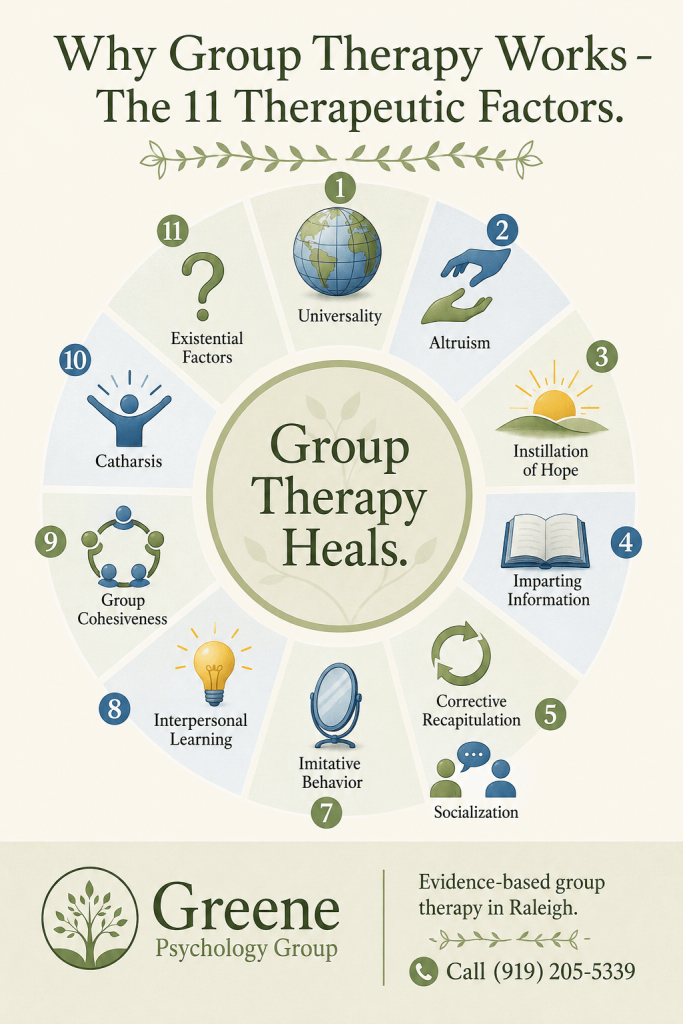
Psychologist Irvin Yalom identified 11 "therapeutic factors" that make group therapy effective:
| Factor | What It Means |
|---|---|
| Universality | "I am not alone. Others feel this way too." |
| Altruism | Helping others in the group boosts your own self‑worth. |
| Instillation of Hope | Seeing others improve gives you hope for yourself. |
| Imparting Information | Learning from the therapist and other members. |
| Corrective Recapitulation | Healing past relational wounds through new experiences in the group. |
| Socialization | Learning new ways of relating to others. |
| Imitative Behavior | Learning from watching others. |
| Interpersonal Learning | Receiving honest feedback from others. |
| Group Cohesiveness | Feeling accepted and valued by the group. |
| Catharsis | Releasing pent‑up emotions in a safe space. |
| Existential Factors | Facing life's realities together. |
The bottom line: Group therapy works because it addresses not just symptoms, but the isolation and shame that often accompany mental health struggles.
At Greene Psychology Group, we offer group therapy as part of our evidence‑based treatment menu.
Part 3: Types of Group Therapy – Which One Is Right for You?
Not all group therapy is the same. Here are the most common types.
1. Psychoeducational Groups
Focus: Education about a specific condition (e.g., anxiety, depression, bipolar disorder) and skills training.
Format: Structured, often with handouts, worksheets, and homework. Less focus on interpersonal process, more on learning.
Best for: People who want to understand their condition and learn practical coping skills.
Examples: CBT skills groups, DBT skills groups, stress management groups.
2. Process‑Oriented / Interpersonal Groups
Focus: Exploring relationships, communication patterns, and emotional expression within the group.
Format: Less structured. The group itself becomes the "laboratory" for understanding how you relate to others. Members give and receive honest feedback.
Best for: People with relationship difficulties, social anxiety, or a history of interpersonal trauma.
Examples: Interpersonal therapy groups, psychodynamic groups.
3. Cognitive Behavioral Therapy (CBT) Groups
Focus: Identifying and changing unhelpful thoughts and behaviors.
Format: Structured, with specific skills taught each session. Homework between sessions.
Best for: Anxiety, depression, OCD, anger management.
Examples: Group CBT for anxiety, group CBT for depression.
4. Supportive / Therapy Groups
Focus: Emotional support, validation, and coping with shared experiences.
Format: Less structured, more sharing and mutual support.
Best for: Grief, chronic illness, caregiving, life transitions.
Examples: Grief support groups, cancer support groups, caregiver groups.
5. Specialized Groups
Focus: Specific populations or conditions.
Examples:
Trauma‑focused groups (PTSD, childhood abuse)
Substance use groups
Adolescent groups
LGBTQ+ affirming groups
Perinatal mental health groups
Part 4: What a Group Therapy Session Looks Like
If you are new to group therapy, you might be nervous. Will you have to share your deepest secrets? Will you be forced to talk? Will others judge you?
Typical Session Structure (60–90 minutes)
| Time | Activity |
|---|---|
| 0–10 min | Check‑in: "How has your week been? Any highs or lows?" |
| 10–30 min | Structured activity: Skills practice, discussion topic, or psychoeducation |
| 30–50 min | Group discussion: Members share, give feedback, and process together |
| 50–60 min | Wrap‑up: Summarize insights, set intentions for the week |
What You Will NOT Experience
Forced sharing: You decide how much to share. Many groups have a "pass" option – you can say "I'd like to pass today."
Criticism: The therapist ensures a safe, respectful environment. Feedback is given constructively.
Chaos: The therapist guides the process and intervenes if needed.
Judgment: Everyone in the group is there for the same reason – to heal. You are not alone.
Group Agreements
Most groups start with a set of agreements to ensure safety:
Confidentiality: What is shared in the group stays in the group.
Respect: No interrupting, no criticizing, no giving unsolicited advice.
Attendance: Regular attendance is expected – consistency matters.
Pass option: You can choose not to share.
No cross‑talk: Support each other, but let the therapist guide.
Part 5: The Benefits of Group Therapy – What You Gain
Group therapy offers benefits that individual therapy alone cannot provide.
1. Universality – "I Am Not Alone"
One of the most powerful experiences in group therapy is realizing that others share your struggles. The shame of mental illness often thrives in isolation. Group therapy breaks that isolation.
2. Social Connection and Practice
For people with social anxiety, depression, or relationship difficulties, the group itself becomes a safe space to practice new ways of relating. You can try out new behaviors – speaking up, setting boundaries, asking for help – in a supportive environment.
3. Feedback from Others
In individual therapy, you only get feedback from your therapist. In group therapy, you get feedback from multiple people – each with a different perspective. This can be incredibly illuminating.
4. Learning from Others
You learn not just from your own work, but from watching others work through their challenges. You see what works, what does not, and you gain new perspectives.
5. Cost‑Effectiveness
Group therapy is typically less expensive than individual therapy, making it more accessible.
6. Accountability
Having a group of people who expect to see you each week can be a powerful motivator to stay engaged in your recovery.
7. Hope
Seeing others improve – people who started where you are now – gives you hope that you can improve too.
Research from Harvard Medical School has shown that group therapy can be an effective component of treatment for a range of conditions, offering unique benefits beyond individual therap
Part 6: Group Therapy vs. Individual Therapy – How to Choose
| Factor | Group Therapy | Individual Therapy |
|---|---|---|
| Focus | Interpersonal dynamics, shared experience, social skills | Your unique history, deeper exploration |
| Feedback | From multiple people | From one therapist |
| Social connection | Built into the process | Limited to the therapeutic relationship |
| Cost | Typically lower | Typically higher |
| Structure | Varies (structured or process‑oriented) | Highly individualized |
| Best for | Social anxiety, relationship issues, feeling isolated, wanting community | Complex trauma, severe symptoms, need for privacy, specific phobias |
The bottom line: Many people benefit from both. Individual therapy allows deep, private exploration. Group therapy provides connection, feedback, and the healing power of shared experience.
At Greene Psychology Group, we offer both individual therapy and group therapy. We can help you decide which is right for you – or recommend combining both.
Part 7: Common Fears About Group Therapy – And Why They Are Misguided
| Fear | Reality |
|---|---|
| "I'll be too nervous to speak." | That is normal. You can start by just listening. Many people feel more comfortable after a few sessions. |
| "Everyone will judge me." | Group members are there for the same reason – to heal. They are more likely to relate to you than judge you. |
| "I don't want to hear other people's problems." | Hearing others' struggles often helps you feel less alone. And you learn from their experiences. |
| "What if someone I know is in the group?" | Therapists screen for this. If you know someone, they will be placed in a different group. |
| "I'm too different from everyone else." | Groups are formed around shared concerns (anxiety, depression, grief, etc.). You have more in common than you think. |
| "I'll be triggered by others' stories." | The therapist is trained to manage this. If you become overwhelmed, you can take a break or pass. |
Research from Stanford University's Department of Psychology shows that people who attend group therapy often report that their initial fears were unfounded – and that the experience was far more positive than they expected.
Part 8: Group Therapy in Raleigh – What Greene Psychology Group Offers
Greene Psychology Group offers evidence‑based group therapy for a variety of concerns.
Current and Planned Groups
Anxiety Management Group: CBT‑based skills for managing worry, panic, and social anxiety.
Depression Recovery Group: CBT and behavioral activation for depression.
Grief and Loss Group: Support and processing for those navigating loss.
DBT Skills Group: Dialectical Behavior Therapy skills for emotion regulation and interpersonal effectiveness.
Social Anxiety Group: Gradual exposure and skills practice in a supportive environment.
Trauma Recovery Group: Processing and support for trauma survivors (using trauma‑informed approaches).
Note: Group offerings change based on demand. Contact us to inquire about current groups and availability.
What to Expect in a Greene Psychology Group
Licensed therapists: All groups are led by licensed mental health professionals with specialized training.
Evidence‑based: Groups follow structured, research‑supported protocols.
Safe environment: Strict confidentiality and group agreements ensure safety.
Small groups: Typically 5–10 participants for optimal interaction.
Time‑limited or open: Some groups run for a set number of weeks; others are ongoing.
Part 9: Putting It All Together – Three Group Therapy Archetypes
Archetype A: The Socially Anxious Professional
Presentation: 32‑year‑old, experiences intense anxiety in social situations. Avoids work gatherings, networking events, and social outings. Feels isolated and lonely but terrified of being judged.
Bottleneck: Social anxiety with isolation.
Treatment map: Individual therapy (CBT) to learn skills → Social Anxiety Group for exposure and practice → Group provides a safe space to practice speaking, making eye contact, and engaging with others → At 12 weeks, reports "I still get nervous, but I can go to work events now."
Archetype B: The Depressed Overthinker
Presentation: 45‑year‑old, chronic depression with rumination. Has been in individual therapy but feels "stuck." Feels alone in her struggles.
Bottleneck: Isolation and rumination.
Treatment map: Depression Recovery Group (CBT‑based) → Group provides accountability, social connection, and the experience of universality ("Others feel this way too") → Learns new coping skills from both therapist and group members → At 12 weeks, PHQ‑9 drops from 18 to 10.
Archetype C: The Grieving Spouse
Presentation: 58‑year‑old, lost his wife 9 months ago. Has withdrawn from friends and family. Feels like no one understands.
Bottleneck: Grief with social isolation.
Treatment map: Grief and Loss Group → Group provides a space to share memories, process emotions, and connect with others who have experienced loss → At 12 weeks, reports "I still miss her, but I don't feel so alone anymore."
Add Your Heading Text Here
You do not have to struggle alone. Group therapy in Raleigh, NC, offers the healing power of shared experience – and the skills to move forward. Call Greene Psychology Group at (919) 205-5339 or schedule an appointment online to inquire about current groups. We offer evidence‑based group therapy for anxiety, depression, grief, trauma, and more.
Group therapy is a form of psychotherapy where a licensed therapist leads a small group of people (5–12) who share similar concerns. Sessions are structured and focus on specific therapeutic goals.
Yes. Research shows that group therapy is as effective as individual therapy for a wide range of conditions – and in some cases, it can be even more effective
Common types include psychoeducational groups, process‑oriented groups, CBT groups, supportive groups, and specialized groups for specific conditions (e.g., trauma, grief, substance use).
No. You decide how much to share. Most groups have a "pass" option – you can say "I'd like to pass today."
That is normal. You can start by just listening. Many people feel more comfortable after a few sessions.
Yes. Confidentiality is a core agreement. What is shared in the group stays in the group.
Yes. Many people benefit from combining both. Individual therapy allows deep exploration; group therapy provides connection and social practice.
Some groups are time‑limited (8–12 weeks). Others are open‑ended. Your therapist will discuss the format.
Greene Psychology Group offers evidence‑based group therapy. Call (919) 205-5339 or contact us online to inquire about current groups.
Therapists screen for this. If you know someone, they will be placed in a different group.
The therapist is trained to manage this. If you become overwhelmed, you can take a break or pass.
Yes, in most cases. Group therapy is typically covered by insurance plans. Greene Psychology Group accepts major insurance plans.