
Add Your Heading Text Here
If you are reading this, you are probably familiar with the feeling. Your mind races with worst‑case scenarios. Your shoulders are tight. You lie awake at night rehashing conversations from three years ago or worrying about a meeting next Tuesday. You have been told to "just relax" – but if you knew how, you would have done it already.
You are not alone. Anxiety disorders are the most common mental health condition in the United States, affecting over 40 million adults. Chronic stress is even more widespread – a 2022 survey from the American Psychological Association found that 76% of adults reported experiencing at least one symptom of stress in the previous month.
Here is what most people do not know: anxiety and stress are not problems of willpower. They are problems of attention regulation and habitual thought patterns. Your brain has learned to scan for threats, catastrophize, and ruminate. These patterns are automatic – but they are not permanent.
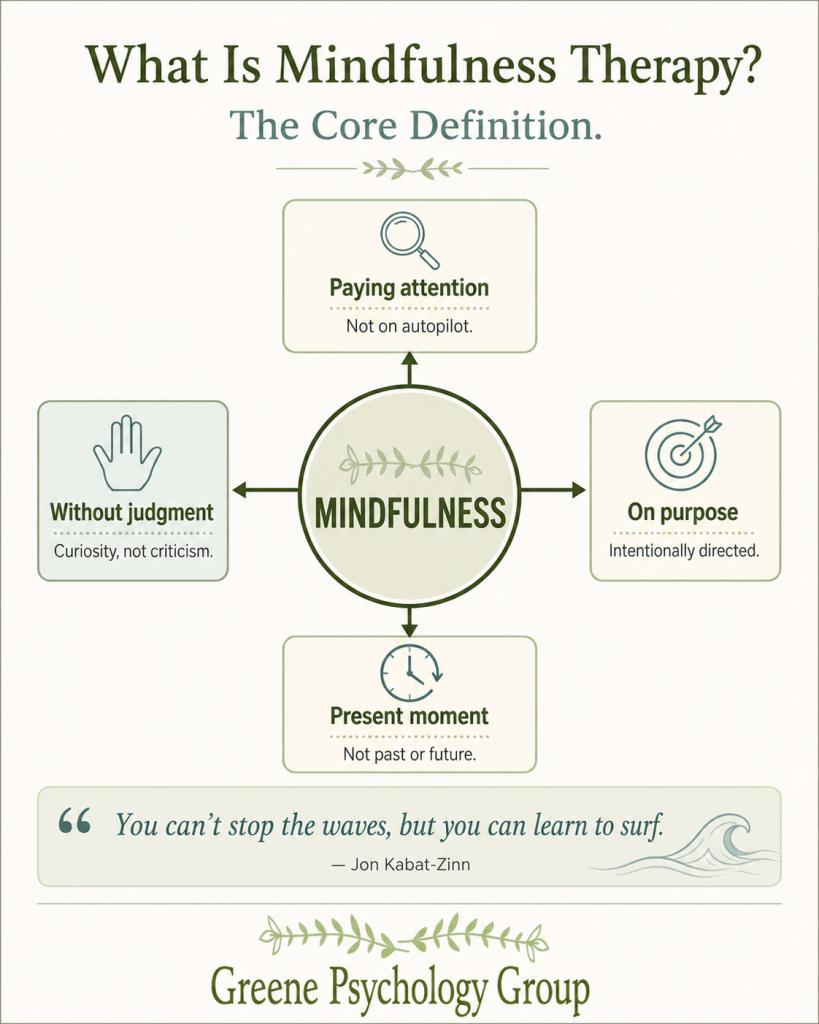
Mindfulness therapy is an evidence‑based approach that retrains your brain to relate differently to anxious thoughts and stressful sensations. Instead of fighting, avoiding, or being consumed by them, you learn to observe them with curiosity and compassion – and then let them go.
At Greene Psychology Group, we offer mindfulness therapy for stress and anxiety in Raleigh, NC, as part of our evidence‑based treatment menu. This guide is a complete, research‑backed overview: what mindfulness therapy is (and is not), the specific techniques used, the research supporting it, and how to know if it is right for you.
Part 1: What Is Mindfulness Therapy – A Clear Definition
Most people think depression is just intense sadness. It is not. Sadness is a normal human emotion that comes and goes. Depression is a persistent, pervasive change in mood, thinking, and physical functioning that lasts for weeks or months and interferes with daily life.
The Core Symptoms of Major Depressive Disorder (DSM‑5‑TR Criteria)
To receive a diagnosis of major depression, you must have at least five of the following symptoms nearly every day for at least two weeks, and one of the symptoms must be either (1) depressed mood or (2) loss of interest or pleasure:
| Symptom Category | Specific Symptoms |
|---|---|
| Emotional | Depressed mood most of the day (feeling sad, empty, hopeless, irritable) |
| Motivational | Markedly diminished interest or pleasure in almost all activities (anhedonia) |
| Physical (sleep) | Insomnia (trouble falling or staying asleep) OR hypersomnia (sleeping 10+ hours, still tired) |
| Physical (appetite) | Significant weight loss or gain (5%+ body weight in a month) or change in appetite |
| Physical (energy) | Fatigue or loss of energy nearly every day |
| Cognitive | Feelings of worthlessness or excessive/inappropriate guilt |
| Cognitive | Diminished ability to think, concentrate, or make decisions |
| Behavioral | Psychomotor agitation (restlessness, pacing) OR retardation (slowed speech, movements) |
| Suicidal | Recurrent thoughts of death, suicidal ideation with or without a plan, or suicide attempt |
Depression Often Does Not Look Like "Sad"
In many people – especially men, adolescents, and certain cultural groups – depression manifests as irritability, anger, or risk‑taking, not sadness. Signs include:
Unexplained rage or road rage
Increased alcohol or drug use
Risky behaviors (speeding, gambling, infidelity)
Withdrawal into work or hobbies to avoid feelings
Physical complaints (headaches, back pain, digestive issues) with no medical cause
Research from Duke University Department of Psychiatry found that up to 40% of men with depression do not report sadness as a primary symptom. They report fatigue, irritability, and loss of interest – which they often dismiss as "stress" or "aging."
Part 2: The Research – Why Mindfulness Therapy Works for Anxiety and Stress
Mindfulness therapy is not "woo‑woo." It is one of the most rigorously studied psychological interventions of the past 30 years.
Key Research Findings
For anxiety disorders: A 2018 meta‑analysis in JAMA Internal Medicine reviewed 47 randomized controlled trials with over 3,500 participants. Mindfulness‑based interventions produced moderate to large effects on anxiety (effect size Cohen's d = 0.6–0.8) – comparable to the effects of CBT.
For chronic stress: A 2019 meta‑analysis in Psychological Bulletin found that mindfulness‑based stress reduction (MBSR) significantly reduced perceived stress, burnout, and physiological markers (cortisol, blood pressure).
For relapse prevention in depression: Mindfulness‑Based Cognitive Therapy (MBCT) is recommended by the UK's National Institute for Health and Care Excellence (NICE) for preventing relapse in recurrent depression. It reduces relapse rates by approximately 40% compared to usual care.
What Happens in the Brain
Research from Harvard Medical School's Department of Psychiatry using functional MRI has shown that mindfulness practice:
Reduces activation in the amygdala (the brain's fear center) in response to threat
Increases activation in the prefrontal cortex (responsible for attention regulation and impulse control)
Increases gray matter density in the hippocampus (memory, learning) and insula (interoception, body awareness)
In other words, mindfulness literally rewires the brain to be less reactive and more resilient.
At Greene Psychology Group, we integrate mindfulness therapy into treatment for anxiety, stress, and depression, often alongside CBT.
Part 3: The Three Major Mindfulness Therapy Protocols
Not all mindfulness therapy is the same. There are three major evidence‑based protocols utilized by clinical psychologists today.
1. Mindfulness‑Based Stress Reduction (MBSR)
- Developed by: Jon Kabat‑Zinn at the University of Massachusetts Medical School.
- Format: 8‑week group program (2.5 hours per week) + one all‑day retreat + 45 minutes of daily home practice.
- Core practices: Body scan, mindful movement (gentle yoga), sitting meditation, and walking meditation.
- Best for: Chronic stress, generalized anxiety, chronic pain, and professional burnout.
- Evidence: Over 200 peer‑reviewed studies. Large effect sizes for stress reduction, moderate for anxiety.
2. Mindfulness‑Based Cognitive Therapy (MBCT)
- Developed by: Zindel Segal, Mark Williams, and John Teasdale (combining MBSR with CBT principles).
- Format: 8‑week group program (2 hours per week) + daily home practice.
- Core practices: Same as MBSR, plus Cognitive Behavioral Therapy concepts focused on relating to thoughts rather than challenging them.
- Best for: Recurrent major depression, residual depressive symptoms, and anxiety paired with heavy rumination.
- Evidence: Recommended by the National Institute for Health and Care Excellence (NICE). Reduces depressive relapse by 40% in patients with 3 or more prior episodes.
3. Acceptance and Commitment Therapy (ACT)
- Developed by: Steven Hayes.
- Format: Individual or group therapy, typically spanning 8–20 sessions.
- Core processes: Cognitive defusion (watching thoughts as passing events, not absolute facts), acceptance, present‑moment awareness, self‑as‑context (the observing self), values clarification, and committed action.
- Best for: Anxiety disorders, clinical depression, chronic pain, OCD, and substance use.
- Evidence: Over 300 randomized controlled trials. Clinical efficacy and effect sizes are comparable to traditional CBT.
Protocol Comparison Chart
| Protocol | Format | Home Practice | Best For |
|---|---|---|---|
| MBSR | 8 weeks (group) | 45 min/day | Stress, anxiety, chronic pain |
| MBCT | 8 weeks (group) | 45 min/day | Depression relapse, rumination |
| ACT | 8–20 sessions (individual or group) | Variable | Anxiety, OCD, values‑based change |
At Greene Psychology Group, we offer individual mindfulness therapy drawing from all three protocols. Contact us to discuss which approach fits your needs.
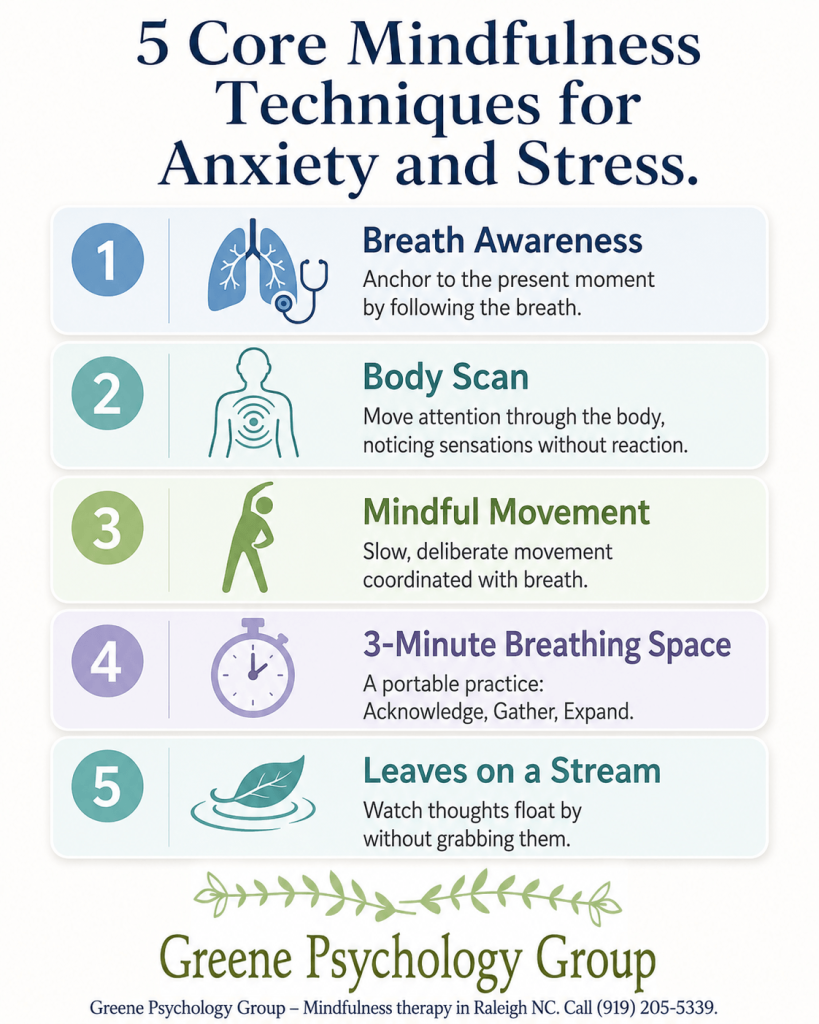
Part 4: Core Mindfulness Techniques You Will Learn
Whether in MBSR, MBCT, or ACT, these are the foundational practices.
1. Breath Awareness (Mindfulness of Breath)
What you do: Sit comfortably. Bring attention to the physical sensations of breathing – the rise and fall of the chest, the air moving through the nostrils. When your mind wanders (it will), gently return attention to the breath.
What you learn: Attention regulation. Noticing when you are distracted. Returning to the present without self‑criticism.
How it helps anxiety: The breath is always in the present moment. By anchoring to the breath, you stop rehearsing the future or replaying the past.
2. Body Scan
What you do: Lie down or sit. Systematically move attention through your body – toes, feet, ankles, knees, etc. – noticing sensations without trying to change them.
What you learn: Interoception (awareness of internal body states). Distinguishing between physical sensations and emotional reactions.
How it helps anxiety: Anxiety often lives in the body (tight chest, knotted stomach). The body scan helps you be with those sensations without fighting them – which paradoxically reduces their intensity.
3. Mindful Movement (Gentle Yoga or Stretching)
What you do: Slow, deliberate movements coordinated with breath. Notice body sensations as you move.
What you learn: Mindfulness in action. Moving with awareness rather than on autopilot.
How it helps anxiety: Exercise reduces anxiety; mindful movement adds an attention‑training component that generalizes to daily life.
4. The 3‑Minute Breathing Space (MBCT)
What you do:
Minute 1: Acknowledge – "What is happening right now? Thoughts, feelings, body sensations?"
Minute 2: Gather – Bring attention to the breath in the belly.
Minute 3: Expand – Expand awareness to the whole body, riding the breath.
What you learn: A portable, brief practice for moments of stress.
How it helps anxiety: Interrupts the automatic escalation of worry before it spirals.
5. Leaves on a Stream (Cognitive Defusion)
What you do: Visualize sitting by a stream. Place each thought on a leaf and watch it float away. You are not the thoughts; you are the one watching the leaves.
What you learn: Defusion – seeing thoughts as mental events, not facts. "I am having the thought that I will fail" feels different than "I will fail."
How it helps anxiety: Anxiety is fueled by believing catastrophic thoughts. Defusion creates distance and choice.
Part 5: What a Mindfulness Therapy Session Looks Like
If you are new to mindfulness, you might feel a bit nervous. Will you have to sit perfectly still for an hour? Will you be asked to completely clear your mind? (Spoiler: you cannot clear your mind. No one can.)
What a Typical Individual Session Looks Like (50 Minutes)
Mindfulness therapy is structured and collaborative. Here is how we typically spend our time together:
| Time | Activity |
|---|---|
| 0–10 min | Check‑in: "How was your week? What specific stressful moments or triggers came up?" |
| 10–30 min | Guided mindfulness practice: Active practice tailored to you (e.g., 10‑minute breath awareness, 10‑minute body scan, or a 5‑minute "leaves on a stream" exercise). You are fully guided, never left on your own. |
| 30–45 min | Inquiry & Processing: "What did you notice? Where did your mind wander? Did any judgments come up?" Your therapist helps you see your mental patterns without criticism. |
| 45–50 min | Practice assignment: "Between now and our next session, try this specific 5‑minute practice. Here is a custom recording to help you." |
What You Will NOT Experience in Mindfulness Therapy
There are many misconceptions about clinical mindfulness. In our sessions, you will never experience:
- Pressure to "clear your mind": This is biologically impossible. The goal is simply to notice when your mind wanders and gently bring it back, not to never wander at all.
- Uncomfortable or rigid positions: You do not need to sit cross-legged on the floor. You can sit comfortably in a traditional chair, lie down, or even stand. Whatever is physically accessible for you.
- Religious content: Clinical mindfulness is entirely secular. It focuses strictly on the neuroscience of attention, awareness, and emotional regulation, not on spirituality.
Group vs. Individual Mindfulness Therapy
Choosing the right format depends on your lifestyle, goals, and budget:
| Format | Pros | Cons |
|---|---|---|
| 8‑Week Group (MBSR/MBCT) | More cost-effective per hour, strong sense of community, highly structured, built-in accountability for home practice. | Less individualized attention, fixed weekly schedules, requires a rigid time commitment. |
| Individual Sessions | Completely tailored to your specific triggers and cognitive patterns, flexible scheduling, moves entirely at your own pace. | Higher cost per individual session. |
Greene Psychology Group offers individual mindfulness therapy, which we can adapt to your pace and preferences. We also offer online therapy for mindfulness.
Part 6: The Role of Home Practice – Why It Matters
Mindfulness is a skill, like learning an instrument or a sport. You would not expect to play piano after one lesson. Similarly, mindfulness therapy works best when you practice between sessions.
How Much Practice Is Needed?
Research from Harvard Medical School found that:
- No practice → minimal benefit
10–15 minutes daily → moderate benefit (significant reduction in anxiety)
20–30 minutes daily → large benefit (comparable to 8‑week MBSR graduates)
45+ minutes daily → largest benefit (but not necessary for most)
Common Barriers – And Solutions
| Barrier | Solution |
|---|---|
| "I don't have time" | Start with 3 minutes (the 3‑minute breathing space). Add 1 minute each week. |
| "I can't stop thinking" | That is the practice. Noticing that you are thinking IS the practice. |
| "It feels silly" | Try guided recordings (apps like Insight Timer, Calm, or your therapist's recordings). Many people find guided easier. |
| "I fall asleep" | Practice with eyes open, or stand, or do a walking meditation. |
The Most Important Attitude: Self‑Compassion
Many people quit mindfulness because they judge themselves for "doing it wrong." There is no wrong. If your mind wandered for the entire 10 minutes and you noticed it once – that is a successful practice. You built the muscle of noticing.
Research from Stanford University's Department of Psychology shows that self‑compassion (being kind to yourself when you struggle) is a stronger predictor of mindfulness practice adherence than initial skill level.
Part 7: Mindfulness vs. Other Anxiety Treatments – How to Choose
| Factor | Mindfulness Therapy | CBT | Medication (SSRI) |
|---|---|---|---|
| Primary mechanism | Changing relationship to thoughts | Changing content of thoughts | Biological (serotonin) |
| Time to benefit | 4–8 weeks (with practice) | 4–6 weeks | 4–8 weeks |
| Effect size (anxiety) | Moderate‑large (d=0.6–0.8) | Large (d=0.8–1.0) | Moderate (d=0.5–0.6) |
| Requires daily homework | Yes (mindfulness practice) | Yes (exposures, thought records) | No |
| Side effects | None | None | Nausea, sexual dysfunction, weight gain |
| Relapse prevention | Strong (skills persist) | Strong | Weak (symptoms return when stopped) |
| Best for | Rumination, worry, stress, depression relapse | Panic, OCD, specific phobias, all anxiety | Moderate‑severe, when therapy alone insufficient |
The bottom line: Mindfulness therapy is an excellent first‑line treatment for generalized anxiety, worry, and stress. For panic disorder or OCD, CBT (with exposure) is often more directly effective. Many patients benefit from combining mindfulness with CBT – using mindfulness to manage distress during exposure work.
At Greene Psychology Group, we offer CBT, mindfulness therapy, and anxiety therapy – and we can help you decide.
Part 8: Putting It All Together – Three Patient Archetypes
Archetype A: The Chronic Worrier (GAD)
Presentation: 38‑year‑old, worries about everything – health, finances, children, work. Difficulty sleeping. Constant muscle tension. Feels exhausted but cannot stop.
Bottleneck: Generalized anxiety with rumination.
Treatment map: 8‑week MBCT group (or individual adaptation) → Daily practice starts at 10 minutes → By week 6, reports "I still have worries, but they don't hijack me as often" → At 12 weeks, no longer meets criteria for GAD → Maintenance: 3‑minute breathing space as needed, 10‑minute daily practice 4x/week.
Archetype B: The Burned‑Out Professional
Presentation: 45‑year‑old executive, chronic stress, irritability at home, brain fog, feeling "on edge" constantly. No specific panic attacks, but never relaxed.
Bottleneck: Chronic stress, low stress resilience.
Treatment map: 8‑week MBSR (group or individual) → Home practice 15 minutes daily → Midway, reports sleeping better, less reactive to triggers → At 8 weeks, stress scores reduced by 50% → Maintenance: weekly practice, annual MBSR booster.
Archetype C: The Depressed Overthinker (With Anxiety)
Presentation: 32‑year‑old, history of recurrent depression, currently in remission but terrified of relapse. Ruminates about past failures. Low‑grade anxiety.
Bottleneck: Depressive rumination, fear of relapse.
Treatment map: 8‑week MBCT group → Learns to recognize early warning signs (withdrawal, rumination) and use 3‑minute breathing space → At 6 months, no relapse → Maintenance: daily practice, annual MBCT refresher.
Part 9: Raleigh‑Specific Resources for Mindfulness and Stress Reduction
At Greene Psychology Group
Online therapy for mindfulness (guided practices via video)
Community Resources in Raleigh
Duke Integrative Medicine – Offers MBSR groups (8 weeks) in Durham (nearby).
UNC Wellness Center – Mindfulness classes.
Kadampa Meditation Center Raleigh – Drop‑in meditation classes (secular friendly).
NC State University – Mindfulness for Students – Free resources, open to community.
Insight Timer / Calm / Headspace – Apps for home practice.
You do not have to be a prisoner of your anxious thoughts or chronic stress. Mindfulness therapy in Raleigh, NC, can teach you to relate differently to worry, rumination, and fear – so you can stop fighting and start living. Call Greene Psychology Group at (919) 205-5339 or schedule an appointment online. We offer individual mindfulness therapy with guided practices and home recordings. Same‑week availability for new clients.
FAQs
Mindfulness therapy teaches you to pay attention to the present moment without judgment. It reduces anxiety by breaking the automatic cycle of worry, rumination, and reactivity.
Yes. Hundreds of randomized controlled trials show mindfulness therapy significantly reduces anxiety, stress, and depression relapse. Major health organizations recommend it.
MBSR focuses on stress reduction, MBCT on preventing depression relapse, and ACT on psychological flexibility. All use mindfulness as a core skill.
No. Research shows 10–15 minutes of daily practice produces significant benefits. Start where you are.
No one can. The goal is not to stop thoughts but to notice them and return to the present. Wandering is not failure; it is the practice.
Yes, but panic disorder is often best treated with CBT (exposure) first, then mindfulness to manage residual anxiety.
Secular mindfulness (as used in MBSR, MBCT, ACT) has no religious content. It is a psychological skill.
Yes. Guided mindfulness practices work well via telehealth. Greene Psychology Group offers online therapy with guided recordings.
Most people notice reduced stress within 4 weeks of consistent practice. Significant anxiety reduction typically takes 8 weeks.
Yes, if delivered by a licensed mental health professional for a diagnosed condition (anxiety disorder, adjustment disorder, etc.). Greene Psychology Group accepts most major insurance.
Yes. Many patients use mindfulness alongside SSRIs. Mindfulness can also help manage medication side effects (e.g., emotional blunting).
Call Greene Psychology Group at (919) 205-5339 or schedule online. Your therapist will teach you the first practice in your first session.
Sources
UNC Chapel Hill School of Social Work – Mindfulness for depression relapse
Johns Hopkins Bloomberg School of Public Health – Mindfulness meta‑analysis
Stanford University Department of Psychology – Self‑compassion and mindfulness adherence
University of Massachusetts Medical School – MBSR founder research
National Institute of Mental Health (NIMH) – Mindfulness for anxiety