

If you are reading this, you may already know the exhausting reality of obsessive-compulsive disorder. Maybe you spend hours each day washing your hands until they crack and bleed. Maybe you are trapped in a loop of checking the stove, the doors, the windows – over and over, unable to leave the house. Maybe intrusive thoughts flood your mind: violent, sexual, or blasphemous images that horrify you and make you feel like a monster. Maybe you perform rituals in secret, terrified that someone will find out.
Here is the truth that OCD tries to hide from you: your intrusive thoughts are not your fault, and they do not define who you are. OCD is a medical condition – a brain disorder with well‑understood neurobiological mechanisms. It is not a character flaw. It is not a sign of weakness. And it is highly treatable.
Yet the average person with OCD suffers for 10–17 years before receiving appropriate treatment. Why? Because OCD is profoundly misunderstood – even by many mental health professionals. The wrong treatment (talk therapy, reassurance, general counseling) can actually make OCD worse.
Greene Psychology Group offers evidence‑based OCD treatment in Raleigh, NC, using Exposure and Response Prevention (ERP) – the gold‑standard treatment recognized by the American Psychiatric Association, the World Health Organization, and the National Institute of Mental Health. This guide is a complete, research‑backed overview: what OCD actually is (beyond the stereotypes), how ERP works, what a session looks like, and how to find the right help.
Part 1: What OCD Actually Is – Beyond the Stereotypes
Most people think OCD is about being neat, organized, or perfectionistic. "I'm so OCD about my desk" is a common phrase. This trivializes a condition that can be utterly debilitating.
The Clinical Definition
According to the National Institute of Mental Health (NIMH), OCD is a long‑lasting disorder in which a person experiences uncontrollable and recurring thoughts (obsessions) , engages in repetitive behaviors (compulsions) , or both. These symptoms are time‑consuming (typically more than one hour per day) and cause significant distress or interfere with daily life.
Obsessions: The Unwanted Thoughts
Obsessions are intrusive, unwanted thoughts, urges, or images that cause intense anxiety or distress. Common themes include:
| Theme | Examples |
|---|---|
| Contamination | Fear of germs, bodily fluids, chemicals, or environmental contaminants |
| Harm | Fear of hurting oneself or others (e.g., "What if I stab my partner?") |
| Doubting | Fear of having made a catastrophic mistake (e.g., "Did I lock the door? Did I run someone over?") |
| Order/Symmetry | Need for things to be "just right," symmetrical, or in a specific order |
| Forbidden Thoughts | Intrusive sexual, violent, or blasphemous thoughts that feel unacceptable |
| Health | Fear of having a serious illness despite medical reassurance |
Critical distinction: People with OCD do not want these thoughts. They are deeply disturbed by them. The thoughts are ego‑dystonic – they conflict with the person's values and self‑concept. A person with violent obsessions is not violent; they are terrified of being violent.
Compulsions: The Rituals
Compulsions are repetitive behaviors or mental acts that the person feels driven to perform in response to an obsession. The goal is to reduce anxiety or prevent a feared outcome. Common compulsions include:
| Compulsion | Examples |
|---|---|
| Washing/Cleaning | Excessive handwashing, showering, cleaning surfaces |
| Checking | Repeatedly checking locks, appliances, doors, or health status |
| Repeating | Repeating words, phrases, or actions a specific number of times |
| Ordering | Arranging items symmetrically or in a "perfect" way |
| Mental Rituals | Counting, praying, repeating "safe" phrases silently |
| Reassurance Seeking | Repeatedly asking others for confirmation ("Are you sure I didn't hurt anyone?") |
The trap: Compulsions provide temporary relief – but the relief does not last. The anxiety returns, often stronger. And each time you perform a compulsion, you reinforce the OCD cycle.
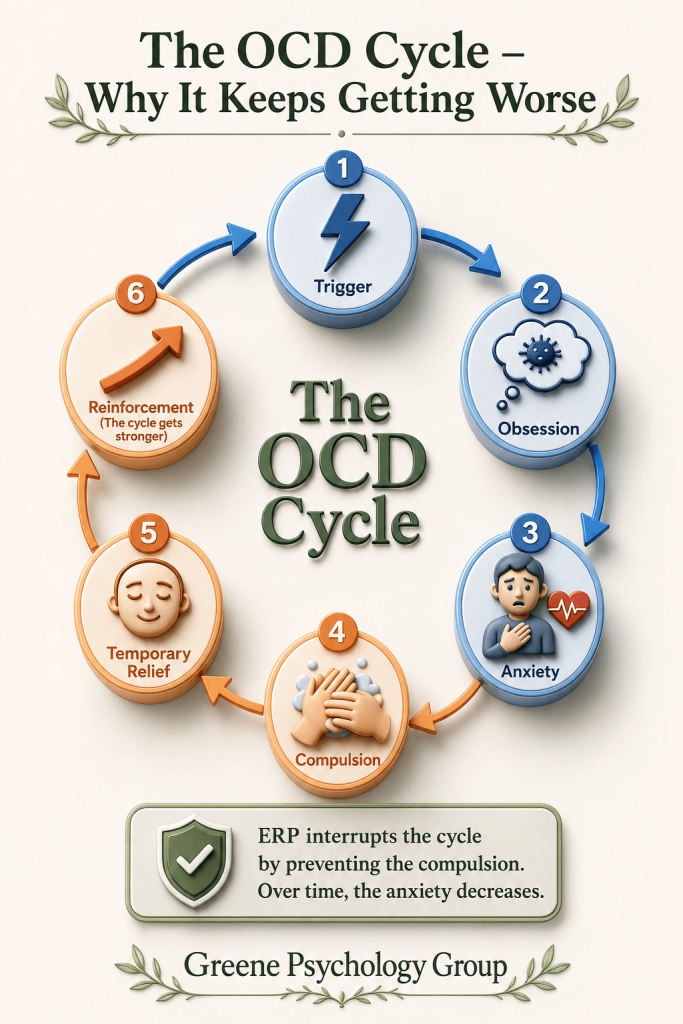
Part 2: The OCD Cycle – Why It Keeps Getting Worse
OCD operates on a predictable cycle. Understanding this cycle is the first step to breaking free.
The Cycle
Trigger: Something activates an obsession (e.g., touching a doorknob triggers contamination fears).
Obsession: An intrusive thought or image floods your mind ("I have germs on my hands. I could make someone sick.").
Anxiety: Intense distress, fear, or disgust follows.
Compulsion: You perform a ritual to reduce the anxiety (washing your hands for 5 minutes).
Temporary Relief: The anxiety decreases – but only briefly.
Reinforcement: The next time you touch a doorknob, the obsession is stronger. The compulsion is more urgent.
Why it gets worse: Each time you perform a compulsion, your brain learns that the obsession was truly dangerous – because you had to do something to neutralize it. You are teaching your brain that the threat is real.
The Role of Avoidance
Avoidance is a form of compulsion. If you avoid doorknobs entirely, you never learn that touching them is safe. Your fear grows. Your world shrinks.
Part 3: Exposure and Response Prevention (ERP) – The Gold Standard
Exposure and Response Prevention (ERP) is the most effective, evidence‑based treatment for OCD. It is the psychological treatment of choice, recognized by the American Psychiatric Association (APA), the World Health Organization (WHO), and the National Institute of Mental Health (NIMH).
How ERP Works
ERP has two components:
1. Exposure: You gradually and repeatedly face the thoughts, images, situations, or objects that trigger your obsessions – without performing the compulsion. You start with something that causes mild anxiety and work your way up to the scariest triggers.
2. Response Prevention: You deliberately refrain from performing the compulsion. You sit with the anxiety until it naturally decreases – which it always does. This is called habituation.
The Mechanism
Exposure works through two processes:
Habituation: Your brain learns that the feared outcome does not occur. The anxiety decreases naturally over time.
Inhibitory Learning: You form new, non‑fearful memories that compete with the old fearful memories. You learn that you can tolerate uncertainty, discomfort, and anxiety without performing rituals.
Is ERP Effective?
Yes. A meta‑analysis of randomized controlled trials found that ERP produces significant symptom reduction in 60–80% of patients. ERP, delivered in‑person or via telehealth, is effective. ERP alone or in combination with an SSRI is probably more effective than SSRI alone. For pediatric OCD, ERP seems to be more effective than SSRIs.
Research from Harvard Medical School has shown that ERP produces specific changes in brain network connectivity in patients with OCD. The treatment literally rewires the brain.
ERP vs. Other Treatments
| Treatment | Effectiveness for OCD | Notes |
|---|---|---|
| ERP | 60–80% response rate | Gold standard; no side effects |
| Medication (SSRI) | 50–60% response rate | Effective but often requires high doses; side effects common |
| ERP + SSRI | 70–85% response rate | Best for moderate‑severe OCD |
| General Counseling | Low | Can worsen OCD if therapist provides reassurance or does not understand ERP |
| Talk Therapy | Low | Does not target the OCD cycle; may reinforce compulsions |
At Greene Psychology Group, we offer CBT with ERP for OCD, often combined with anxiety therapy.
Part 4: What an ERP Session Looks Like – Realistic Expectations
If you are new to ERP, you might be nervous. Will you be forced to touch something disgusting? Will you have to describe your worst intrusive thoughts out loud?
The Hierarchy
Your therapist will work with you to create a fear hierarchy – a list of situations, thoughts, or objects that trigger your OCD, ranked from least anxiety‑provoking to most. For example:
| Rank | Exposure | SUDS (0–100) |
|---|---|---|
| 1 | Looking at a photo of a doorknob | 20 |
| 2 | Touching a doorknob with one finger | 35 |
| 3 | Touching a doorknob with your whole hand | 50 |
| 4 | Touching a doorknob and not washing for 5 minutes | 65 |
| 5 | Touching a doorknob and not washing for 30 minutes | 80 |
| 6 | Touching a doorknob and then eating a snack without washing | 95 |
A Typical ERP Session (50 minutes)
| Time | Activity |
|---|---|
| 0–10 min | Check‑in: "How was your week? Any exposures you practiced?" |
| 10–40 min | Active exposure: You and your therapist practice exposures from your hierarchy. You start with a manageable item and work your way up. Your therapist guides you, but you do the exposure. |
| 40–45 min | Processing: "What did you notice? How did the anxiety change over time? What did you learn?" |
| 45–50 min | Homework assignment: "Between now and next session, practice this exposure 3–5 times on your own." |
What You Will NOT Experience
Forced exposure: You always have control. You can stop at any time. You decide the pace.
Surprise exposure: Your therapist will never expose you to something without your knowledge and consent.
Judgment: Your therapist will not judge your obsessions. They have heard it all. Nothing shocks them.
The Role of Homework
ERP is a skill, not a passive treatment. Between‑session practice is essential. Research shows that patients who complete homework have significantly better outcomes. Your therapist will give you specific, graded assignments.
Part 5: Common Fears About ERP – And Why They Are Misguided
| Fear | Reality |
|---|---|
| "What if I can't handle the anxiety?" | You can. Anxiety always peaks and then decreases. Your therapist will help you stay in the exposure until the anxiety drops. |
| "What if my worst fear comes true?" | That is the point. You learn that your feared outcome is either unlikely or survivable. |
| "What if the therapist thinks I'm a bad person?" | Your therapist has worked with hundreds of people with OCD. They understand that intrusive thoughts are not desires. |
| "What if I get worse?" | Temporarily, yes. Anxiety often increases when you start exposure. But it decreases with repeated practice. The long‑term trend is improvement. |
| "Can't I just do talk therapy?" | Talk therapy (without ERP) often makes OCD worse because it provides reassurance or reinforces avoidance. ERP is the evidence‑based treatment. |
Research from Duke University Department of Psychiatry shows that patients who complete ERP have a 60–80% reduction in symptoms – and those gains are maintained at 1‑year follow‑up.
Part 6: OCD in Specific Populations
OCD in Children and Adolescents
OCD often begins in childhood or adolescence. The average age of onset is 10–12 for males and 20–22 for females. Children may not recognize their thoughts as "weird"; they may just feel overwhelmed and confused.
Signs in children:
Excessive handwashing or showering
Repetitive checking (homework, doors, belongings)
Asking the same question repeatedly (reassurance seeking)
Meltdowns if routines are disrupted
Difficulty concentrating in school
Treatment: ERP is effective for children, adapted with simpler language, visual aids, and parent involvement. A meta‑analysis found that ERP, delivered in‑person or via telehealth, is effective for pediatric OCD. ERP alone or in combination with an SSRI is more effective than SSRI alone.
OCD in Older Adults
OCD in older adults is often underdiagnosed. Symptoms may be mistaken for dementia, anxiety, or "just being set in their ways." Treatment: ERP is effective, though the pace may be slower.
OCD with Comorbid Conditions
OCD rarely travels alone. Common comorbidities include:
Depression (affects ~50% of people with OCD)
Anxiety disorders (social anxiety, panic disorder, GAD)
Tic disorders (especially in childhood‑onset OCD)
Eating disorders
Substance use disorders (often self‑medication)
Treatment: Treat the most impairing condition first. ERP can be adapted for comorbid conditions. Medication (SSRI) often helps both OCD and depression.
At Greene Psychology Group, we offer CBT for OCD and anxiety therapy, as well as family therapy when OCD affects loved ones.
Part 7: Medication for OCD – What You Need to Know
SSRIs (selective serotonin reuptake inhibitors) are the first‑line medications for OCD. They are effective, but often require higher doses than for depression.
Common SSRIs for OCD
| Medication | Typical Dose for OCD | Notes |
|---|---|---|
| Sertraline (Zoloft) | 200–250 mg | Well‑tolerated |
| Fluoxetine (Prozac) | 60–80 mg | Long half‑life |
| Fluvoxamine (Luvox) | 200–300 mg | Can be sedating |
| Paroxetine (Paxil) | 40–60 mg | Higher side effect profile |
| Escitalopram (Lexapro) | 20–30 mg | Well‑tolerated |
Response rate: 50–60% for a single SSRI. Up to 70% with augmentation (adding a second medication).
Side effects: Similar to other SSRIs – nausea, sexual dysfunction, weight gain, emotional blunting.
Duration: Many patients benefit from long‑term medication (2+ years). Relapse is common if medication is stopped abruptly.
ERP vs. Medication – What the Research Says
| Factor | ERP | Medication (SSRI) |
|---|---|---|
| Effectiveness | 60–80% response | 50–60% response |
| Side effects | None | Nausea, sexual dysfunction, weight gain |
| Durability | Skills persist after treatment ends | Symptoms return when stopped |
| Time to benefit | 4–8 weeks | 4–8 weeks |
| Best for | All OCD | Moderate‑severe, when ERP alone insufficient |
The bottom line: ERP is the psychological treatment of choice. For moderate‑severe OCD, combination treatment (ERP + SSRI) is often best.
Note: Greene Psychology Group does not prescribe medication. We can refer you to trusted psychiatrists in Raleigh.
Part 8: How to Find an OCD Therapist in Raleigh – What to Look For
Not all therapists understand OCD. Finding the right therapist is essential.
What to Look For
Specialized training in ERP: Ask: "What training do you have in ERP? How many OCD clients have you treated?"
Experience: Treating OCD requires specific skills. Look for therapists who list OCD as a specialty.
No reassurance: A good ERP therapist will NOT reassure you ("It's fine, you're safe"). They will help you sit with uncertainty.
Homework: ERP requires between‑session practice. If a therapist does not assign homework, they are probably not doing ERP.
Questions to Ask Before Booking
Do you use Exposure and Response Prevention (ERP)?
What is your training in ERP? How many hours of supervision/consultation?
Do you create a fear hierarchy? Do you assign between‑session exposures?
What is your success rate with OCD clients?
Do you work with children/adolescents (if applicable)?
Red Flags
"I don't do exposure – it's too upsetting" (exposure is the active ingredient)
"We'll just talk about your childhood" (talk therapy alone is not effective for OCD)
"I can cure your OCD in 6 sessions" (unrealistic)
No license or using a coaching credential only
At Greene Psychology Group, our therapists are licensed and trained in evidence‑based approaches including ERP. Contact us for a consultation.
Part 9: Putting It All Together – Three OCD Archetypes
Archetype A: The Contamination Fear
Presentation: 28‑year‑old, terrified of germs. Washes hands 20+ times daily, avoids public restrooms, will not shake hands. Spends 2+ hours cleaning her apartment. Has not eaten in a restaurant in 3 years.
Bottleneck: Contamination obsessions with extensive avoidance.
Treatment map: 16 sessions of ERP → Fear hierarchy: touching a doorknob, then a public railing, then a bathroom door, then eating without washing → At session 10, can eat in a restaurant (with some anxiety) → At session 16, reports "I still don't love germs, but they don't control my life" → Maintenance: monthly boosters.
Archetype B: The Harm Obsession
Presentation: 34‑year‑old, intrusive thoughts of stabbing his partner. Avoids knives. Sleeps in a separate room. Has been to the ER twice for suicidal thoughts – not because he wants to die, but because he is terrified he might lose control.
Bottleneck: Harm obsessions with catastrophic misinterpretation.
Treatment map: 20 sessions of ERP → Imaginal exposure: writing a script about the worst‑case scenario and reading it repeatedly → In vivo exposure: holding a knife while sitting with the anxiety → Cognitive restructuring: "Thoughts are not actions. Having a thought does not mean I want to act on it." → At session 16, returns to the same bed → At session 20, reports "I still have the thoughts, but they don't scare me anymore."
Archetype C: The Doubter/Checker
Presentation: 45‑year‑old, spends 2 hours every morning checking the stove, the doors, the windows. Leaves work multiple times to check. Has been late to work 15 times in the past year. Terrified of causing a fire.
Bottleneck: Doubt and checking compulsions.
Treatment map: 12 sessions of ERP → Hierarchy: checking the stove once, then leaving without checking, then leaving without checking and driving away → Response prevention: sitting with the uncertainty ("Maybe I did leave the stove on. I will not go back to check.") → At session 10, can leave the house in 5 minutes → Maintenance: occasional boosters.
OCD does not have to control your life. Evidence‑based OCD treatment in Raleigh, NC, using Exposure and Response Prevention (ERP), can help you break free from the cycle of obsessions and compulsions. Call Greene Psychology Group at (919) 205-5339 or schedule an appointment online. We offer ERP for OCD, evening appointments, and free insurance verification. Same‑week availability for new clients.
FAQs
OCD involves uncontrollable, recurring thoughts (obsessions) and repetitive behaviors (compulsions) that cause significant distress and interfere with daily life. Perfectionism is a personality trait; OCD is a disorder.
Exposure and Response Prevention (ERP) is the gold‑standard treatment for OCD, recognized by the APA, WHO, and NIMH
ERP involves gradually facing triggers (exposure) and then refraining from performing compulsions (response prevention). Over time, the anxiety decreases.
Most patients need 12–20 sessions. Severe or complex cases may need more. Gains are maintained with practice.
Accordion Content
Yes. ERP, delivered in‑person or via telehealth, is effective for pediatric OCD. It is adapted with simpler language and parent involvement.
Yes. Research shows that ERP delivered via telehealth is effective. Greene Psychology Group offers online therapy for OCD.
Yes. SSRIs are effective for OCD, but ERP is generally more effective and has no side effects. Combination treatment (ERP + SSRI) is often best for moderate‑severe OCD.
You will need to discuss them to create a fear hierarchy. Your therapist has heard it all. Nothing will shock them.
OCD is chronic, but it is highly treatable. With ERP, most people achieve significant symptom reduction and can live fulfilling lives.
Talk therapy (without ERP) often makes OCD worse because it provides reassurance or reinforces avoidance. ERP is the evidence‑based treatment.
Treat the most impairing condition first. ERP can be adapted for comorbid conditions. Medication (SSRI) often helps both.
Look for a licensed therapist with specialized training in ERP. Ask about their experience with OCD. Greene Psychology Group offers ERP for OCD – call (919) 205-5339.
Sources
Duke University Department of Psychiatry – ERP outcomes research
UNC Chapel Hill School of Social Work – OCD in children and adolescents
Johns Hopkins Bloomberg School of Public Health – OCD treatment guidelines
Columbia University Department of Psychiatry – OCD and comorbidity
Stanford University Department of Psychology – Inhibitory learning in ERP
National Institute of Mental Health (NIMH) – OCD information