

If you are reading this, you may already know the terrifying reality of a panic attack. One moment you are fine – maybe driving, sitting in a meeting, or lying in bed. The next moment, your heart is pounding out of your chest. You cannot breathe. You are dizzy, sweating, and absolutely certain that you are dying, having a heart attack, or losing your mind. You might rush to the emergency room, convinced something is catastrophically wrong. And then, after tests and examinations, the doctor tells you: "Your heart is fine. It was a panic attack."
You feel relief – and then confusion. If nothing is physically wrong, why did it feel so real? Why am I so terrified it will happen again?
You are not alone. Panic disorder affects approximately 2–3% of the adult population in the United States – about 6 million people. Many more experience panic attacks without meeting the full criteria for panic disorder. And for those who develop the disorder, the fear of the next attack can become so consuming that it limits where you go, what you do, and how you live.
Here is the truth that panic disorder tries to hide from you: panic attacks are not dangerous, and they are highly treatable. Panic disorder is a medical condition with well‑understood mechanisms and evidence‑based treatments that work.
Greene Psychology Group offers evidence‑based panic disorder treatment in Raleigh, NC, using Cognitive Behavioral Therapy (CBT) with interoceptive exposure – the gold‑standard treatment recognized by the American Psychiatric Association, the National Institute of Mental Health, and the World Health Organization. This guide is a complete, research‑backed overview: what panic attacks actually are (beyond the terror), how panic disorder develops, how CBT works, and how to find the right help.
Part 1: What Is a Panic Attack – The Clinical Definition
Most people have heard of panic attacks, but few understand what they actually are – and what they are not.
The Clinical Definition
According to the Diagnostic and Statistical Manual of Mental Disorders (DSM‑5‑TR), a panic attack is a sudden surge of intense fear or intense discomfort that reaches a peak within minutes. During that time, you experience at least four of the following symptoms:
| Symptom | What It Feels Like |
|---|---|
| Palpitations, pounding heart, or accelerated heart rate | Your heart is racing, skipping beats, or pounding so hard you can feel it in your throat |
| Sweating | Profuse sweating, even in cool environments |
| Trembling or shaking | Your hands, legs, or whole body shake uncontrollably |
| Sensations of shortness of breath or smothering | You cannot get enough air, feel like you are suffocating |
| Feeling of choking | A lump in your throat, difficulty swallowing |
| Chest pain or discomfort | Tightness, pressure, or pain in the chest – often mistaken for a heart attack |
| Nausea or abdominal distress | Stomach churning, nausea, or the urge to vomit |
| Feeling dizzy, unsteady, lightheaded, or faint | The room spins, you feel like you might pass out |
| Chills or heat sensations | Waves of cold or heat washing over your body |
| Paresthesia (numbness or tingling sensations) | Tingling in your hands, feet, face, or lips |
| Derealization (feelings of unreality) or depersonalization (being detached from yourself) | The world feels unreal, dreamlike, or you feel like you are watching yourself from outside your body |
| Fear of losing control or "going crazy" | A terrifying sense that you are about to lose your mind or do something uncontrollable |
| Fear of dying | An overwhelming certainty that you are about to die |
What a Panic Attack Is NOT
Not a heart attack: Panic attacks share symptoms with heart attacks, but they are not cardiac events. However, if you have chest pain, always seek medical evaluation to rule out cardiac causes.
Not "just anxiety": Panic attacks are far more intense than typical anxiety. They are acute, overwhelming, and often come "out of the blue."
Not a sign of weakness: Panic attacks are a physiological response – your body's fight‑or‑flight system activating in the absence of real danger.
Research from Harvard Medical School has shown that panic attacks involve the amygdala (the brain's fear center) and the locus coeruleus (which regulates the fight‑or‑flight response). They are a biological event, not a character flaw.
Part 2: What Is Panic Disorder – Beyond the Panic Attack
Not everyone who has a panic attack has panic disorder. Panic disorder is diagnosed when:
You experience recurrent, unexpected panic attacks (at least two).
At least one of the attacks has been followed by one month or more of:
Persistent concern or worry about additional panic attacks or their consequences (e.g., "What if I have one at work? What if I die?")
Significant maladaptive change in behavior related to the attacks (e.g., avoiding exercise, avoiding driving, avoiding being alone)
The Three Components of Panic Disorder
1. Panic Attacks (Acute Symptoms)
The sudden surge of intense fear and physical symptoms described above.
2. Anticipatory Anxiety
The fear of the next panic attack. This can be just as debilitating as the attacks themselves. You might spend hours each day worrying about when the next attack will strike.
3. Avoidance / Agoraphobia
You begin to avoid situations where you fear a panic attack might occur – or where escape might be difficult or embarrassing. This can include:
- Driving on highways
- Being in crowds or enclosed spaces (e.g., movie theaters, airplanes, elevators)
- Being far from home or medical help
- Exercising (because it mimics panic symptoms – rapid heart rate, sweating, shortness of breath)
- Drinking caffeine or alcohol (which can trigger or worsen symptoms)
Agoraphobia is when avoidance becomes so severe that you are essentially confined to your home. Approximately one‑third to one‑half of people with panic disorder develop agoraphobia.
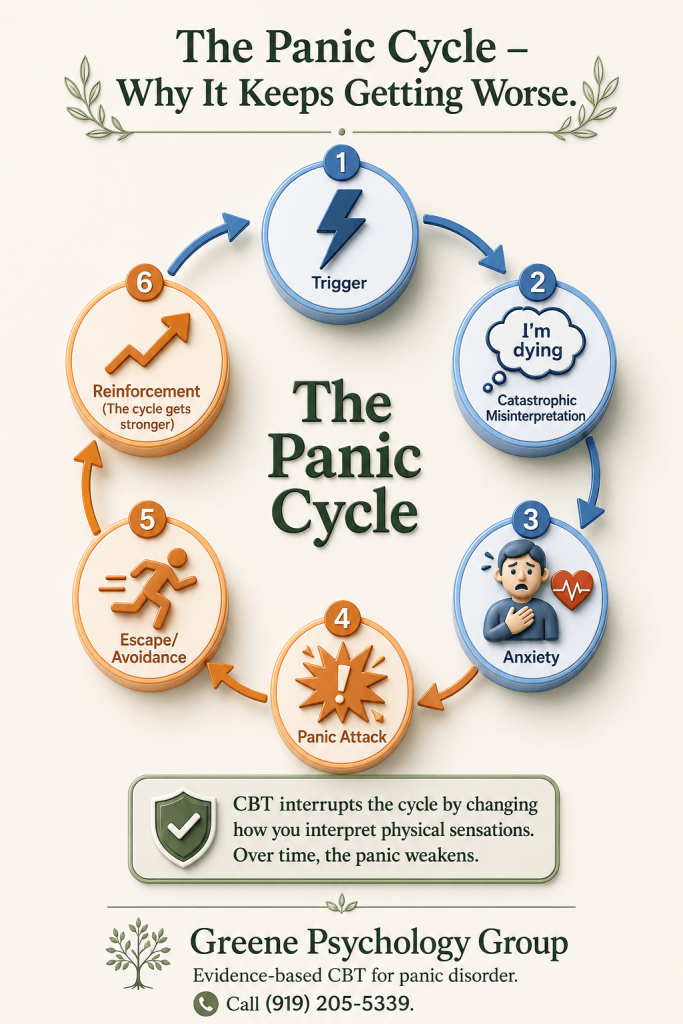
Part 3: The Panic Cycle – Why It Keeps Getting Worse
Panic disorder operates on a predictable cycle. Understanding this cycle is the first step to breaking free.
The Cycle
Trigger: Something activates your body's alarm system – maybe a physical sensation (racing heart after climbing stairs), a thought ("What if I have a panic attack right now?"), or an external trigger (a crowded room).
Catastrophic Misinterpretation: You misinterpret the physical sensation as a sign of imminent danger ("My heart is racing – I must be having a heart attack").
Anxiety: The misinterpretation fuels more anxiety, which fuels more physical symptoms – a vicious feedback loop.
Panic Attack: The feedback loop spirals into a full panic attack.
Escape/Avoidance: You escape the situation or avoid it in the future. This provides temporary relief – but it also reinforces the fear.
Reinforcement: The next time you encounter the trigger, your fear is even stronger. Your world shrinks.
The Role of Catastrophic Misinterpretation
This is the core of panic disorder. You do not just have physical symptoms – you misinterpret them as signs of catastrophe. Common catastrophic interpretations:
| Physical Symptom | Catastrophic Interpretation |
|---|---|
| Racing heart | "I'm having a heart attack" |
| Shortness of breath | "I'm suffocating" |
| Dizziness | "I'm going to faint" |
| Feeling unreal | "I'm going crazy" |
| Sweating | "Everyone can see I'm losing control" |
The treatment: You must learn to interpret these sensations differently – as uncomfortable but not dangerous.
Part 4: Cognitive Behavioral Therapy (CBT) for Panic Disorder – The Gold Standard
Cognitive Behavioral Therapy (CBT) is the most effective, evidence‑based treatment for panic disorder. It is the psychological treatment of choice, recognized by the American Psychiatric Association, the National Institute of Mental Health, and the World Health Organization.
How CBT Works for Panic Disorder
CBT for panic disorder has two main components:
1. Cognitive Restructuring
You learn to identify and challenge the catastrophic misinterpretations that fuel panic. For example:
Catastrophic thought: "My heart is racing – I'm having a heart attack."
Challenge: "I have had this feeling before. The doctor said my heart is fine. Racing heart is a normal response to adrenaline."
Alternative thought: "This is uncomfortable, but it is not dangerous. It will pass."
2. Interoceptive Exposure
This is the behavioral component – and the most powerful. You deliberately and repeatedly induce the physical sensations of panic in a safe, controlled environment, and then practice sitting with them without trying to escape or "fix" them. Over time, you learn that these sensations are uncomfortable – but not dangerous.
Common Interoceptive Exposures
| Exercise | What It Does |
|---|---|
| Spin in a chair | Induces dizziness |
| Breathe through a straw | Induces shortness of breath |
| Run in place | Induces rapid heart rate and sweating |
| Shake head side‑to‑side | Induces dizziness |
| Tense muscles | Induces muscle tension |
| Hyperventilate (rapid breathing) | Induces lightheadedness, tingling, and dizziness |
The process: You practice each exercise until you experience the sensation. Then you sit with the sensation – without escaping, without distracting yourself, without telling yourself "calm down." You notice: "This is uncomfortable. It is not dangerous. It will pass." Over repeated practice, your fear of these sensations decreases.
Evidence for CBT for Panic Disorder
A meta‑analysis of randomized controlled trials found that CBT for panic disorder produces significant symptom reduction in 70–85% of patients. CBT has higher efficacy and lower cost, dropout rates, and relapse rates than pharmacologic treatments. Research from Harvard Medical School has shown that CBT for panic disorder is effective, with many patients seeing improvement within 8 to 12 weeks.
At Greene Psychology Group, we offer CBT for panic disorder and anxiety therapy.
Part 5: What a CBT Session for Panic Disorder Looks Like
If you are new to CBT for panic disorder, you might be nervous. Will you be forced to have a panic attack in the therapist's office?
A Typical CBT Session (50 minutes)
| Time | Activity |
|---|---|
| 0–10 min | Check‑in: "How was your week? Any panic attacks? Any exposures you practiced?" |
| 10–30 min | Active work: Cognitive restructuring (identifying and challenging catastrophic thoughts) OR interoceptive exposure (practicing inducing and tolerating physical sensations) |
| 30–40 min | Processing: "What did you notice? How did the anxiety change over time? What did you learn?" |
| 40–45 min | Planning: "What exposures will you practice between now and next session?" |
| 45–50 min | Homework assignment: Specific, graded interoceptive and situational exposures to practice at home |
The Fear Hierarchy
Your therapist will work with you to create a fear hierarchy – a list of situations, sensations, or thoughts that trigger your panic, ranked from least anxiety‑provoking to most. For example:
| Rank | Exposure | SUDS (0–100) |
|---|---|---|
| 1 | Imagine having a panic attack | 20 |
| 2 | Spin in a chair for 10 seconds | 30 |
| 3 | Breathe through a straw for 30 seconds | 45 |
| 4 | Run in place for 1 minute | 55 |
| 5 | Drive on a highway for 5 minutes | 65 |
| 6 | Spin in a chair for 30 seconds | 70 |
| 7 | Breathe through a straw for 60 seconds | 75 |
| 8 | Run in place for 2 minutes + drive on highway | 85 |
| 9 | Hyperventilate for 60 seconds | 90 |
| 10 | Have a panic attack and sit with it without escaping | 95+ |
You start with the lower items and work your way up. Each exposure is repeated until the anxiety decreases significantly.
What You Will NOT Experience
Forced exposure: You always have control. You can stop at any time. You decide the pace.
Surprise exposure: Your therapist will never expose you to something without your knowledge and consent.
Judgment: Your therapist understands that panic is not a choice. They will not judge you.
The Role of Homework
CBT is a skill, not a passive treatment. Between‑session practice is essential. Research shows that patients who complete homework have significantly better outcomes. Your therapist will give you specific, graded assignments – both interoceptive exposures (inducing sensations) and situational exposures (going into feared situations).
Part 6: Panic Disorder Treatment – Comparison with Medication
Many patients with panic disorder benefit from medication, especially when symptoms are severe or CBT alone is not accessible.
SSRIs and SNRIs for Panic Disorder
First‑line medications for panic disorder are SSRIs (selective serotonin reuptake inhibitors) and SNRIs (serotonin‑norepinephrine reuptake inhibitors).
| Medication | Typical Dose for Panic Disorder | Notes |
|---|---|---|
| Sertraline (Zoloft) | 50–200 mg | Well‑tolerated, first‑line |
| Escitalopram (Lexapro) | 10–20 mg | Well‑tolerated, first‑line |
| Paroxetine (Paxil) | 20–60 mg | Higher side effect profile |
| Venlafaxine (Effexor XR) | 75–225 mg | SNRI, effective |
Response rate: 50–60% for a single SSRI.
Side effects: Nausea (first few weeks), sexual dysfunction, weight gain, emotional blunting, sleep disturbances.
Duration: Many patients benefit from 6–12 months of medication, with a gradual taper thereafter.
CBT vs. Medication – What the Research Says
| Factor | CBT | Medication (SSRI) |
|---|---|---|
| Effectiveness | 70–85% response | 50–60% response |
| Side effects | None | Nausea, sexual dysfunction, weight gain |
| Durability | Skills persist after treatment ends | Symptoms return when stopped |
| Relapse rate | Lower (~20–30%) | Higher (~50–60%) |
| Time to benefit | 4–8 weeks | 4–8 weeks |
| Best for | All panic disorder | Severe symptoms, when CBT alone insufficient |
The bottom line: CBT is the psychological treatment of choice for panic disorder. For moderate‑severe panic disorder, combination treatment (CBT + SSRI) is often best.
Note: Greene Psychology Group does not prescribe medication. We can refer you to trusted psychiatrists in Raleigh.
Part 7: Panic Disorder in Specific Populations
Panic Disorder in Children and Adolescents
Panic disorder often begins in adolescence, with a peak age of onset in the late teens and early 20s. Children may not recognize their symptoms as "panic attacks"; they may complain of stomachaches, headaches, or "feeling weird." They may avoid school, sleepovers, or extracurricular activities.
Treatment: CBT is effective for adolescents with panic disorder, adapted with simpler language and age‑appropriate exposures. Medication (SSRIs) is effective but requires monitoring.
Panic Disorder in Older Adults
Panic disorder in older adults is often underdiagnosed. Symptoms may be mistaken for cardiac problems, dementia, or "just aging." Treatment: CBT is effective, though the pace may be slower and medication requires lower starting doses.
Panic Disorder with Agoraphobia
Approximately one‑third to one‑half of people with panic disorder develop agoraphobia – fear of situations where escape might be difficult or embarrassing. This can lead to confinement to the home.
Treatment: CBT with exposure (both interoceptive and situational) is the treatment of choice. You gradually approach feared situations – starting with brief, supported exposures and working up to longer, independent ones.
Panic Disorder with Comorbid Conditions
Panic disorder rarely travels alone. Common comorbidities include:
Major Depressive Disorder (affects ~50% of people with panic disorder)
Generalized Anxiety Disorder (GAD)
Social Anxiety Disorder
Substance Use Disorders (especially alcohol and benzodiazepines, which are often used to self‑medicate)
Other medical conditions (asthma, hyperthyroidism, cardiac arrhythmias – which can mimic or trigger panic)
Treatment: Treat the most impairing condition first. CBT can be adapted for comorbid conditions. Medication (SSRI) often helps both panic and depression.
At Greene Psychology Group, we offer CBT for panic disorder, anxiety therapy, and mindfulness therapy.
Part 8: How to Find a Panic Disorder Therapist in Raleigh – What to Look For
Not all therapists understand panic disorder. Finding the right therapist is essential.
What to Look For
Specialized training in CBT for panic disorder: Ask: "Do you use interoceptive exposure? Do you create a fear hierarchy?"
Experience: Treating panic disorder requires specific skills. Look for therapists who list panic disorder or anxiety as a specialty.
No reassurance: A good panic therapist will NOT reassure you ("You're fine, it's not dangerous"). They will help you discover that it is not dangerous through exposure.
Homework: CBT for panic disorder requires between‑session practice. If a therapist does not assign homework, they are probably not doing CBT.
Questions to Ask Before Booking
Do you use Cognitive Behavioral Therapy (CBT) with interoceptive exposure for panic disorder?
What is your training in CBT for panic disorder? How many patients have you treated?
Do you create a fear hierarchy? Do you assign between‑session exposures?
What is your success rate with panic disorder clients?
Red Flags
"I don't do exposure – it's too distressing" (exposure is the active ingredient)
"We'll just talk about your childhood" (talk therapy alone is not effective for panic disorder)
"I can cure your panic disorder in 6 sessions" (unrealistic)
No license or using a coaching credential only
At Greene Psychology Group, our therapists are licensed and trained in evidence‑based approaches including CBT for panic disorder. Contact us for a consultation.
Part 9: Putting It All Together – Three Panic Disorder Archetypes
Archetype A: The Unexpected Attack
Presentation: 32‑year‑old, had a panic attack "out of the blue" while driving on I‑540. Now avoids highways. Has had 3 more attacks in the past 2 months – always unexpected, always terrifying. Now afraid to drive anywhere more than 5 minutes from home.
Bottleneck: Unexpected panic attacks with catastrophic misinterpretation and avoidance.
Treatment map: 12 sessions of CBT → Fear hierarchy: interoceptive exposures (spinning, breathing through straw) → Situational exposures (driving with therapist, then driving alone, then highways) → Cognitive restructuring ("Panic is uncomfortable, not dangerous") → At session 10, can drive on I‑540 with manageable anxiety → Discharge with relapse prevention plan.
Archetype B: The Panic with Agoraphobia
Presentation: 45‑year‑old, panic attacks began 3 years ago. Now avoids crowded places, airplanes, elevators, and being far from home. Has not been to a restaurant or movie theater in 2 years. Recently declined a promotion because it would require travel.
Bottleneck: Panic disorder with severe agoraphobia and avoidance.
Treatment map: 20 sessions of CBT → Begin with interoceptive exposures (inducing sensations) → Then situational exposures: start with brief, supported exposures (drive to a restaurant with therapist, sit in the parking lot) → Gradually increase duration and decrease support → At session 16, can eat in a restaurant with some anxiety → At session 20, reports "I still don't love crowds, but I can handle them" → Maintenance: monthly boosters.
Archetype C: The Panic with Depression
Presentation: 28‑year‑old, panic attacks started 6 months ago after a stressful life event. Now also experiencing low mood, loss of interest, and difficulty sleeping. Has had suicidal thoughts (no plan). PHQ‑9 = 24 (severe), panic frequency = 3x/week.
Bottleneck: Panic disorder with comorbid major depression and suicidal ideation.
Treatment map: Immediate safety assessment (no plan, agrees to safety contract) → Referral to psychiatrist for SSRI (treats both panic and depression) → 16 sessions CBT for panic + depression → Interoceptive exposures + behavioral activation → At session 12, panic frequency drops to 1x/week, PHQ‑9 drops to 12 → At session 16, reports "I still have panic attacks sometimes, but they don't scare me anymore, and my mood is much better" → Maintenance: monthly boosters.
Panic attacks are terrifying – but they are not dangerous, and they are highly treatable. Evidence‑based panic disorder treatment in Raleigh, NC, using CBT with interoceptive exposure, can help you break free from the cycle of fear and avoidance. Call Greene Psychology Group at (919) 205-5339 or schedule an appointment online. We offer CBT for panic disorder, evening appointments, and free insurance verification. Same‑week availability for new clients.
FAQs
A panic attack is a sudden surge of intense fear with physical symptoms like racing heart, shortness of breath, and dizziness. Panic disorder is when you have recurrent panic attacks and fear of having more, leading to avoidance of situations where attacks might occur.
Cognitive Behavioral Therapy (CBT) with interoceptive exposure is the gold‑standard treatment for panic disorder, with a 70–85% response rate.
Interoceptive exposure involves deliberately inducing physical sensations of panic (e.g., spinning, breathing through a straw) in a safe environment, and practicing sitting with them until the anxiety decreases.
Many need 12–16 sessions total.
Yes. CBT is highly effective for panic disorder without medication. Medication is sometimes added for severe cases.
Yes. SSRIs and SNRIs are effective for panic disorder, with a 50–60% response rate. Combination treatment (CBT + SSRI) is often best for moderate‑severe cases.
Yes. Research shows that CBT delivered via telehealth is effective for panic disorder. Greene Psychology Group offers online therapy.
Agoraphobia is fear of situations where escape might be difficult or embarrassing. It is treated with exposure therapy – gradually approaching feared situations.
No. You will be exposed to sensations that mimic panic – but in a controlled, graded way. You are always in control.
Many people have both. CBT can be adapted for both conditions. Medication (SSRI) often helps both.
Look for a licensed therapist with specialized training in CBT for panic disorder. Ask about interoceptive exposure and homework assignments.
Panic disorder is chronic, but it is highly treatable. With CBT, most people achieve significant symptom reduction and can live fulfilling lives.
Sources
Duke University Department of Psychiatry – Panic disorder treatment outcomes
UNC Chapel Hill School of Social Work – CBT for panic disorder
Johns Hopkins Bloomberg School of Public Health – Panic disorder guidelines
Columbia University Department of Psychiatry – Interoceptive exposure research
Stanford University Department of Psychology – Inhibitory learning in panic disorder
National Institute of Mental Health (NIMH) – Panic disorder information