

If you are reading this, you may already know the exhausting reality of living with post‑traumatic stress disorder. Maybe you have been avoiding anything that reminds you of what happened. Maybe you are constantly on edge, scanning for danger, unable to relax. Maybe the memories intrude without warning – in nightmares, in flashbacks, in sudden waves of terror that feel as real as the day it happened. Maybe you have tried to push it all down, to "move on," but the past keeps pulling you back.
Here is the truth that PTSD tries to hide from you: you are not broken. You are not weak. And you are not alone.
PTSD is not a character flaw or a sign of failure. It is a brain injury of sorts – a physiological response to overwhelming trauma that changes how your brain processes threat, memory, and emotion. And like any injury, it can heal – with the right treatment.
Yet many people with PTSD never receive treatment. Some do not recognize their symptoms. Some feel ashamed. Some believe they should be able to handle it on their own. Some tried one treatment that did not work and gave up. Some are terrified that therapy will force them to relive the trauma.
Greene Psychology Group offers evidence‑based PTSD treatment in Raleigh, NC, using therapies recognized by the American Psychological Association, the National Institute of Mental Health, and the Department of Veterans Affairs. This guide is a complete, research‑backed overview: what PTSD actually is, how it affects the brain, the most effective treatments, and how to find the right help.
Part 1: What PTSD Actually Is – Beyond the Stereotypes
Most people think PTSD only affects combat veterans. They picture a soldier diving for cover at the sound of a car backfiring. While military trauma is a common cause of PTSD, it is far from the only one.
The Clinical Definition
According to the National Institute of Mental Health (NIMH), PTSD is a disorder that develops in some people who have experienced a shocking, scary, or dangerous event.
To receive a diagnosis of PTSD (according to the DSM‑5‑TR), you must have experienced, witnessed, or learned about a traumatic event – such as actual or threatened death, serious injury, or sexual violence. Your symptoms must last for more than one month and cause significant distress or impairment.
The Four Symptom Clusters
PTSD symptoms fall into four categories:
| Symptom Cluster | What It Looks Like |
|---|---|
| Intrusion | Unwanted, distressing memories; nightmares; flashbacks; intense distress at reminders of the trauma; physical reactions (racing heart, sweating) when reminded |
| Avoidance | Avoiding thoughts, feelings, or conversations about the trauma; avoiding people, places, or activities that are reminders |
| Negative Alterations in Cognition and Mood | Inability to remember important parts of the trauma; negative beliefs about yourself, others, or the world ("I am bad," "No one can be trusted"); blaming yourself for the trauma; persistent sadness, fear, anger, guilt, or shame; feeling detached from others; inability to feel positive emotions |
| Alterations in Arousal and Reactivity | Irritability or angry outbursts; reckless or self‑destructive behavior; hypervigilance (always on guard); exaggerated startle response; difficulty concentrating; sleep disturbances |
What Causes PTSD?
PTSD can develop after any traumatic event, including:
Military combat
Sexual assault or abuse
Physical assault or abuse
Childhood abuse or neglect
Motor vehicle accidents
Natural disasters (hurricanes, tornadoes, floods)
Serious medical events or diagnoses
Traumatic childbirth
Witnessing violence or death
Sudden, unexpected death of a loved one
Community or gun violence
Research from Harvard Medical School has shown that PTSD involves changes in the amygdala (the brain's fear center), the hippocampus (which processes memory), and the prefrontal cortex (which regulates emotion). Trauma literally rewires the brain's threat‑detection system – but treatment can rewire it back.
Part 2: The PTSD Cycle – Why It Keeps Getting Worse
PTSD operates on a predictable cycle. Understanding this cycle is the first step to breaking free.
The Cycle
Trigger: Something reminds you of the trauma – a sound, a smell, a place, a sensation, a date on the calendar.
Intrusion: Memories, flashbacks, or nightmares flood your mind. You feel like you are back in the moment.
Distress: Intense fear, horror, anger, or helplessness overwhelms you.
Avoidance: You do everything you can to avoid triggers – and to avoid your own emotions. You push the memories away. You isolate. You numb out.
Temporary Relief: Avoidance provides short‑term relief – but the fear is reinforced.
Reinforcement: The next time you encounter the trigger, your fear is stronger. Your world shrinks. Your hypervigilance increases. The cycle continues.
The Role of Avoidance
Avoidance is the engine that keeps PTSD going. Every time you avoid a trigger, you teach your brain that the trigger is truly dangerous – because you had to avoid it. You never learn that you can face it and survive. Your fear grows. Your world shrinks.
Part 3: Evidence‑Based PTSD Treatments – What Works
PTSD is highly treatable. The most effective treatments are psychotherapies that directly address the trauma and its effects.
Research from Harvard Medical School found that the recommended treatment for PTSD, psychotherapy, is more effective than medication, has fewer adverse side effects, and is preferred by patients. A 2024 study also found that mindfulness‑based stress reduction can be an effective component of treatment.
The Gold‑Standard Psychotherapies for PTSD
The American Psychological Association strongly recommends four trauma‑focused psychotherapies for PTSD:
1. Cognitive Processing Therapy (CPT)
Developed by Dr. Patricia Resick at Duke University, CPT helps you identify and challenge the unhelpful beliefs that have developed as a result of trauma.
How it works: You learn to examine the thoughts and beliefs that keep you stuck – such as "It was my fault," "I should have done something," "The world is completely unsafe," "I cannot trust anyone." You write a trauma account and then work through stuck points systematically.
Format: Typically 12 sessions, weekly, 60‑90 minutes each. Homework is essential.
Evidence: CPT is one of the most effective therapies for PTSD. It is widely acknowledged as an effective treatment.
2. Prolonged Exposure (PE) Therapy
PE helps you gradually approach trauma‑related memories, situations, and emotions that you have been avoiding.
How it works: You repeatedly recount the traumatic memory in detail (imaginal exposure) and gradually approach feared situations that you have been avoiding (in vivo exposure). Over time, the fear decreases.
Format: Typically 8–15 sessions, weekly, 90 minutes each.
Evidence: A 2024 NIMH study using brain imaging identified a neural circuit on which PE acts to quell PTSD symptoms.
3. Eye Movement Desensitization and Reprocessing (EMDR)
EMDR uses bilateral stimulation (eye movements, taps, or tones) while you hold trauma‑related memories in mind. It helps the brain reprocess the memory so it no longer causes intense distress. (See Blog 8 for a detailed guide on EMDR.)
4. Trauma‑Focused Cognitive Behavioral Therapy (TF‑CBT)
A structured, evidence‑based therapy for children and adolescents with PTSD. It includes psychoeducation, parenting skills, relaxation techniques, cognitive processing, and gradual exposure.
Other Evidence‑Based Approaches
Acceptance and Commitment Therapy (ACT) for Trauma: Helps you develop psychological flexibility – the ability to be present with difficult experiences and move toward what matters to you. Used at the Stanford Adult PTSD Clinic.
Written Exposure Therapy (WET): A brief (5‑session) treatment where you write about the trauma in a structured way. Used at Stanford.
Cue‑Centered Therapy (CCT): An evidence‑based intervention for youth with chronic traumatic experiences, developed at Stanford.
Medication for PTSD
SSRIs (selective serotonin reuptake inhibitors) are the first‑line medications for PTSD. Sertraline (Zoloft) and paroxetine (Paxil) are FDA‑approved for PTSD.
Response rate: Approximately 50–60%.
Note on combination treatment: Many patients benefit from combining trauma‑focused psychotherapy with medication. Psychotherapy is more effective than medication, but medication can be helpful for severe symptoms or when therapy is not accessible.
Note: Greene Psychology Group does not prescribe medication. We can refer you to trusted psychiatrists in Raleigh.
Part 4: What a PTSD Therapy Session Looks Like
If you are new to trauma therapy, you might be terrified. Will you be forced to describe every detail of what happened? Will you have to relive the trauma? Will you lose control?
The Truth About Trauma Therapy
A skilled trauma therapist will never push you beyond your window of tolerance. The goal is not to retraumatize you. The goal is to help you process the memory so it loses its power.
A Typical CPT Session (50–60 minutes)
| Time | Activity |
|---|---|
| 0–10 min | Check‑in: "How has your week been? Any PTSD symptoms? Any homework completed?" |
| 10–35 min | Active work: Reviewing a stuck point, challenging a belief about the trauma, working on a written trauma account |
| 35–45 min | Processing: "What did you notice? How has this belief affected your life? What would you rather believe?" |
| 45–50 min | Homework assignment: Specific written exercises to complete before the next session |
A Typical PE Session (90 minutes)
| Time | Activity |
|---|---|
| 0–15 min | Check‑in, review homework (in vivo exposures practiced during the week) |
| 15–60 min | Imaginal exposure: You recount the traumatic memory in detail, out loud, while the therapist listens. The therapist asks you to repeat it, often multiple times, to reduce the emotional response. |
| 60–75 min | Processing: "What did you notice? How did your anxiety change during the recounting?" |
| 75–90 min | Planning in vivo exposures for the coming week |
What You Will NOT Experience
Forced disclosure: You decide what to share and how much. No one will force you to describe anything you are not ready to discuss.
Surprise exposure: Your therapist will never expose you to something without your knowledge and consent.
Losing control: Your therapist is trained to help you regulate. If distress becomes overwhelming, they will stop and help you return to the present.
Judgment: Your therapist has worked with trauma survivors. Nothing will shock them.
The Role of Homework
Trauma therapy requires between‑session practice. CPT has written assignments. PE has in vivo exposures. Research shows that patients who complete homework have significantly better outcomes.
Part 5: Common Fears About PTSD Therapy – And Why They Are Misguided
| Fear | Reality |
|---|---|
| "If I talk about it, I'll fall apart and never recover." | Processing the trauma under the guidance of a skilled therapist reduces symptoms – it does not make them worse. You will learn skills to cope before any processing begins. |
| "I don't want to relive the trauma." | In CPT, you do not have to recount the trauma in detail. You focus on the beliefs that developed as a result. In PE, you recount the memory – but in a controlled, gradual way, and the distress decreases over time. |
| "What if my therapist thinks I'm a bad person?" | Your therapist understands that trauma survivors often blame themselves. They will not judge you. |
| "I've tried therapy before and it didn't work." | Not all therapy is trauma‑focused. Different approaches, different therapists, and different timing can produce completely different outcomes. |
| "Can't I just take medication?" | Medication can help with symptoms, but it does not address the underlying trauma. Trauma‑focused psychotherapy is more effective and has no side effects. |
Research from Duke University shows that CPT helps PTSD sufferers systematically reexamine unhelpful thoughts about traumatic experiences, so the memories become less painful and overwhelming.
Part 6: PTSD in Specific Populations
PTSD in Veterans
PTSD is common among military veterans. The Department of Veterans Affairs strongly recommends CPT, PE, and EMDR as first‑line treatments. Many veterans benefit from group therapy with other veterans who understand the experience.
Raleigh resources: VA Durham Health Care System (serves Wake County) – offers specialized PTSD treatment. Greene Psychology Group can also help, though we are not a VA provider.
PTSD in Children and Adolescents
Children and adolescents can develop PTSD after trauma. Symptoms may look different: bedwetting, separation anxiety, difficulty concentrating, aggression, or re‑enacting the trauma through play.
Treatment: Trauma‑Focused CBT (TF‑CBT) is the most researched treatment for children with PTSD. Cue‑Centered Therapy (CCT) is another evidence‑based option.
PTSD in Survivors of Sexual Assault
Sexual assault is one of the most common causes of PTSD. Survivors often experience intense shame, guilt, and difficulty trusting others. CPT and PE are both effective for sexual assault‑related PTSD.
PTSD with Complex Trauma (C‑PTSD)
Complex PTSD develops after prolonged, repeated trauma – often in childhood – such as abuse, neglect, or domestic violence. Symptoms are more pervasive: difficulty regulating emotions, negative self‑concept, and relationship difficulties.
Treatment: Complex PTSD often requires longer treatment. A phased approach is often used: stabilization (coping skills), processing (trauma‑focused therapy), and integration (rebuilding life). EMDR and CPT can be adapted for complex trauma.
PTSD with Comorbid Conditions
PTSD rarely travels alone. Common comorbidities include:
Major Depressive Disorder
Substance Use Disorders (especially alcohol)
Other Anxiety Disorders
Chronic Pain
Sleep Disorders (insomnia, nightmares)
Treatment: Treat the most impairing condition first. Trauma‑focused psychotherapy often improves comorbid conditions as well.
At Greene Psychology Group, we offer CBT, EMDR, and mindfulness therapy. We can also refer to psychiatrists for medication.
Part 7: How to Find a PTSD Therapist in Raleigh – What to Look For
Not all therapists are trained in trauma‑focused therapy. Finding the right therapist is essential.
What to Look For
Specialized training in CPT, PE, or EMDR: Ask: "What trauma therapies do you use? How much training do you have?"
Experience: Treating PTSD requires specific skills. Look for therapists who list trauma or PTSD as a specialty.
No "just talking": Talk therapy alone is not effective for PTSD. You need a structured, evidence‑based approach.
Homework: Trauma therapy requires between‑session practice. If a therapist does not assign homework, they are probably not doing an evidence‑based trauma therapy.
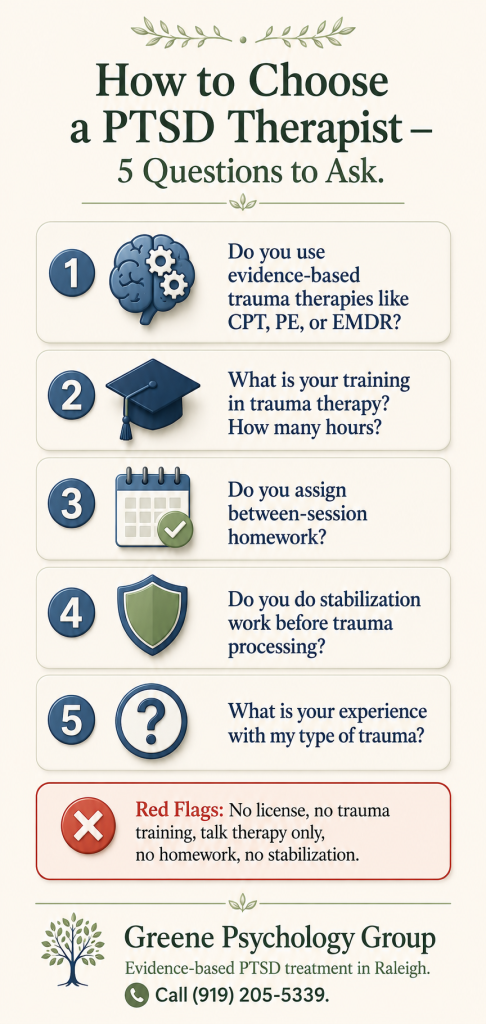
Questions to Ask Before Booking
Do you use trauma‑focused therapies like CPT, PE, or EMDR?
What is your training in trauma therapy? How many patients have you treated?
Do you assign between‑session homework?
What is your approach to stabilization before processing?
What is your experience with my type of trauma?
Red Flags
"I don't do exposure – it's too upsetting" (exposure is the active ingredient in PE)
"We'll just talk about it" (talk therapy alone is not effective for PTSD)
"I can cure your PTSD in 6 sessions" (unrealistic)
No license or using a coaching credential only
At Greene Psychology Group, our therapists are licensed and trained in evidence‑based approaches including CPT, EMDR, and CBT for trauma. Contact us for a consultation.
Part 8: Putting It All Together – Three PTSD Archetypes
Archetype A: The Combat Veteran
Presentation: 35‑year‑old, served two tours in Afghanistan. Has nightmares, hypervigilance, and avoids crowds. Has been drinking heavily to "numb out." His wife is worried. He has not been able to hold a job for more than 6 months.
Bottleneck: Military trauma with avoidance and substance use.
Treatment map: Safety assessment (substance use, suicidal thoughts) → Referral to VA for specialized care (or private practice) → 12 sessions of CPT → Addresses beliefs: "I should have saved my buddy," "The world is completely dangerous" → Begins to engage with community → At 12 weeks, PTSD symptoms reduced by 50% → Maintenance: monthly boosters, referral to VA for substance use support.
Archetype B: The Sexual Assault Survivor
Presentation: 28‑year‑old, assaulted 3 years ago by a former partner. Has avoided dating, sex, and intimacy. Has flashbacks during sex. Intense shame and self‑blame. Has not told anyone the full story.
Bottleneck: Sexual trauma with shame and avoidance.
Treatment map: Stabilization phase (grounding, coping skills) → 12 sessions of CPT or PE → Addresses beliefs: "It was my fault," "I am damaged" → Gradually approaches feared situations (dating, physical intimacy) → At 12 weeks, PTSD symptoms reduced by 60% → Maintenance: monthly boosters.
Archetype C: The Childhood Abuse Survivor (Complex PTSD)
Presentation: 42‑year‑old, history of emotional and physical abuse from age 5–16. Chronic shame, difficulty trusting others, frequent panic attacks, and feeling "numb" or disconnected. Has been in and out of therapy for years with limited improvement.
Bottleneck: Complex PTSD with chronic shame and dissociation.
Treatment map: Extended stabilization phase (8–10 sessions of coping skills, grounding, self‑compassion) → Processing of earliest memory (4–6 sessions of EMDR or CPT) → Then processing of subsequent memories in chronological order (12–20 sessions total) → Re‑evaluation every few sessions → Total treatment often 6–12 months → Maintenance: ongoing self‑care, occasional booster sessions.
PTSD is not a life sentence. Evidence‑based PTSD treatment in Raleigh, NC, using CPT, EMDR, or PE, can help you process traumatic memories so they no longer control your life. Call Greene Psychology Group at (919) 205-5339 or schedule an appointment online. We offer trauma‑focused therapy, evening appointments, and free insurance verification. Same‑week availability for new clients.
FAQs
PTSD is a disorder that develops after a traumatic event. It involves intrusive memories, avoidance, negative changes in mood and cognition, and hyperarousal. These symptoms last for more than one month and cause significant impairment. Normal stress resolves over time; PTSD does not without treatment.
Trauma‑focused psychotherapies – CPT, PE, and EMDR – are the most effective treatments. They are more effective than medication.
CPT is a 12‑session therapy that helps you identify and challenge unhelpful beliefs that have developed as a result of trauma.
PE is a therapy where you gradually approach trauma‑related memories and situations that you have been avoiding, reducing fear over time.
EMDR uses bilateral stimulation (eye movements, taps, tones) while you hold trauma memories in mind, helping the brain reprocess them.
Yes. Trauma‑focused psychotherapy is more effective than medication for PTSD.
In CPT, you focus on beliefs, not the full narrative. In PE, you recount the memory, but you are in control and can stop at any time.
CPT is typically 12 sessions. PE is 8–15 sessions. Complex PTSD may require 6–12 months of treatment.
Yes. Most insurance plans cover evidence‑based PTSD treatment. Greene Psychology Group accepts major insurance plans.
Yes. Research shows that CPT, PE, and EMDR can be effectively delivered via telehealth.
Treat the most impairing condition first. Many trauma therapists work with co‑occurring substance use. Referral to specialized treatment may be needed.
Look for a licensed therapist with specialized training in CPT, PE, or EMDR. Ask about their experience with trauma. Greene Psychology Group offers trauma‑focused therapy – call (919) 205-5339.
Sources
Duke University Department of Psychiatry – Cognitive Processing Therapy (CPT)
UNC Chapel Hill School of Social Work – Trauma‑informed care
Johns Hopkins Bloomberg School of Public Health – PTSD research
Stanford University Department of Psychiatry – Adult PTSD Clinic
National Institute of Mental Health (NIMH) – PTSD information
American Psychological Association – PTSD treatment guidelines